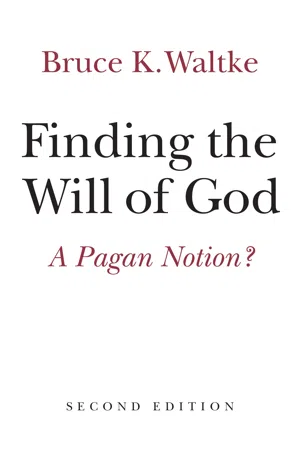
New edition of a popular, biblically based guidebook exploring God's will
Does the Bible teach Christians to "find" God's "special will" for their lives? No, it does not, says respected biblical scholar Bruce Waltke, contrary to much popular evangelical teaching. In this acclaimed book Waltke clearly distinguishes between pagan divination ("guessmancy") and solid, Bible-based guidance as he distills from Scripture a six-point program to help guide Jesus followers on their life journey.
This expanded and extensively rewritten second edition of Waltke's
Finding the Will of God incorporates the best insights from many other books on guidance that have appeared since the first edition came out (2002), and it includes an entirely new chapter on learning to protect one's heart. This edition also features thoughtful questions for reflection at the end of each chapter.
- 247 pages
- English
- ePUB (mobile friendly)
- Available on iOS & Android
eBook - ePub
About this book
Information
Topic
Teologia e religioneSubtopic
Studi bibliciPart One
God’s Will
Chapter One
Is Finding God’s Will a Biblical Idea?
He guides me along the right paths
for his name’s sake.
for his name’s sake.
Psalm 23:3
In his book The Mystery of God’s Will, Chuck Swindoll tells of a man who was driving through Washington, D.C., when his car stalled in front of the Philippine Embassy. He took this to be a sign that he should be a missionary to the Philippines.
Chuck also tells of a woman who wasn’t sure whether she should go on a tour of Israel. The brochure advertising the tour said they would fly on a Boeing 747. When she awoke in the morning her digital clock read 7:47. She saw it as a sign from God that she should go on the tour.
Dr. Chip MacGregor speaks of Dave, a surveyor for a land development firm, who wanted to go back to college. Dave had married young and started his family right away, so he never found the time to attend more than a course here and there. But quitting his job wasn’t very realistic. He had two kids in school, car payments, and he and his wife had been talking for a long time about getting together a down payment for a home of their own. Still, Dave wanted to get training to equip him for a better long-term career, and he also wanted to take a couple of Bible classes. At a men’s breakfast at his church he shared his thoughts with his good friend Tom, who was an older, more experienced Christian. “Have you prayed much about this,” his friend asked, “so that you can be given the mind of God?”
“Well, not as much as I’d like,” Dave admitted.
“Listen,” Tom replied, “We’re going to pray right now. I want you to make your mind blank. When we’re done praying, I want you to tell me the first thoughts the Lord puts into your mind. Okay?”
Dave agreed, and both men prayed earnestly. After Tom closed with the words, “Please tell my brother Dave what your will is,” they opened their eyes and looked at each other. “What’s He telling you?”
“I guess that I should be going back to school,” Dave replied, wondering if he had really heard the voice of God.
As you read through these illustrations, does it strike you that perhaps there is some silliness at play in the lives of God’s people? The Bible tells us God is our Father, our Provider, and our Redeemer. If this is true, does it make sense that we should have to resort to such tricks and techniques to find his will? In his book Finding God’s Will, M. Blaine Smith emphasizes, “God himself takes the initiative in guiding the person who is open to being directed by him.” The Bible also tells us Christ is our good Shepherd: he calls us by name and goes before us; we follow, for we know his voice, and “come in and go out [i.e., are secure and safe], and find pasture” (John 10:1-18, 25-28, quoting v. 9).
Yet many Christians talk about “the will of God” as though it were a version of the old con man’s ruse, the three-shell game. You remember the game: A pea is hidden under a walnut shell; two other walnut shells are placed on either side of the first, then all three are quickly moved around the table. The con man then asks you, the spectator or “mark,” to guess which shell the pea is under. No matter which shell you guess, you are always wrong. You can watch as carefully as possible, trying to unlock the secret of the manipulations, but you can never quite keep up with the manipulator.
When I hear Christians talking about the will of God, they often use phrases such as, “If only I could find God’s will,” or, “If only God would show me what he wants me to do,” as though God is keeping it hidden from them. Or they’ll say, “I’m praying that I’ll discover his will for my life,” as though in response to their prayer God will “tell” them, in some supernatural way, his will. And then the game is on to try and devise ways to find out God’s will. Unfortunately, the gimmicks that some pious Christians propose to unlock the will of God do not mesh with what we find in the balance of Scripture.
If we really believe in God as the perfectly loving Father, we can do away with our notion of him as an almighty manipulator and con man who never quite lets us discover his will. God is not a magician or a trickster. God loves us enough that he sent his Son to die on the cross to pay the penalty for our sins. So does it make sense that he would play games with his children, hiding his will? Is it logical that the God who “works everything in conformity with the purpose of his will” — and so, inferentially, has a plan for each of us — would conceal that will and plan so that his work cannot go forward through us? Is it logical that the God who leads us through dark valleys would keep us in the dark to hide the way from us? It is time for Christians to observe, analyze, and systematically determine what the Bible says about God’s will. And perhaps the place to start is for Christians to ask themselves if the phrase “finding God’s will” is even a biblical way to speak of making decisions.
Making decisions is at the heart of living. Dr. Eric Klinger, professor of psychology at the University of Minnesota, writes that all of us face between three hundred and seventeen thousand decisions every day! And Os Guinness notes: “In the modern world there are simply too many choices, too many people to relate to, too much to do, too much to see, too much to read, too much to catch up with and follow, too much to buy.” Hence the characterization of this age as the age of “over-choice,” as I noted in the preface to this book.
Faced with this bewildering and complex web of decision-making, what are believers to do? How will they know that they know they are making good and wise decisions that are in keeping with God’s purposes for them? This book hopes to ease that dilemma by disallowing disquieting false notions of guidance and by reflecting upon how our Shepherd leads us to make choices that will keep us on the blessed path of our pilgrimage to the Holy City. None of us will attain perfect decision-making in this life. Even with the best guidance we all fall at times into sloughs and tar pits. But even when we do so, our merciful Shepherd never gives up on us. Instead he lifts us up, shows us how our poor decision making led to our trouble, and calls us to renew the journey. He is the great Shepherd leading us, not the great Sheepdog snapping at our heels. We cannot stray beyond his love and care.
God’s Will: A Slippery Term
Let’s start by thinking about what we mean when we talk about “God’s will.” In fact, the term has several different meanings. It is often used in Scripture to refer to God’s eternal plan and the decrees by which he not only created the world, but is also moving everything in it to its divinely appointed destiny. Theologians call this God’s “decretive will.” Here is but a sampling of texts that teach God’s sovereign guidance of all things:
A person’s days are determined;
you have decreed the number of his months
and have set limits he cannot exceed. (Job 14:5)
The plans of the Lord stand firm forever,
the purposes of his heart through all generations.
(Psalm 33:11)
I say, “My purpose will stand,
and I will do all that I please.” (Isaiah 46:10)
He does as he pleases
with the powers of heaven
and the peoples of the earth.
No one can hold back his hand
or say to him: “What have you done?”
(Daniel 4:35)
As these texts show, the “will of God” here refers to his eternal, sovereign rulership over the world that, according to Habakkuk 2:3, “hastens toward the goal, and . . . will not fail” (NASB). In the New Testament this use of the “will of God” is sometimes spoken of with reference to his immutable, eternal purpose. Ephesians 1:9-11 reads,
[God] made known to us the mystery of his will according to his good pleasure, which he purposed in Christ, to be put into effect when the times reach their fulfillment. . . . In him we were also chosen, having been predestined according to the plan of him who works out everything in conformity with the purpose of his will. . . .
God has a plan in place, and as that plan is worked out we refer to it as “God’s will.” Some, like Leslie D. Weatherhead in his 1944 book The Will of God, reject this doctrine on the basis of human reason, but cannot shout down its basis in Scripture. Human reason finds it a hopeless contradiction that God’s will determines everything that happens in the world, while still holding us accountable for our decisions. But Scripture teaches both. Thus the Psalmist can say: “All the days ordained for me were written in your book before one of them came to be” (Psalm 139:16), while in the same canon of Scripture the apostle Paul warns us that “we must all appear before the judgment seat of Christ, so that each of us may receive what is due us for the things done while in the body, whether good or bad” (2 Corinthians 5:10). Similarly, Jesus tells his disciples: “The Son of Man will go as it has been decreed. But woe to that man who betrays him!” (Luke 22:22). Thus, despite what human reason would say, it is far wiser to let God be God, and trust that he alone understands the full connection between these seeming contradictions. What we do know is that God is perfect in both love and justice.
The “will of God” is also used to describe God’s desire or consent — what he wants and what is favorable to him. Some theologians call this his “preceptive will”; others call it his “moral will.” The three terms “desires,” “moral will,” and “perceptive will” are helpful ways of looking at ...
Table of contents
- Contents
- Preface
- Part One: God’s Will
- Part Two: God’s Program of Guidance
- Suggestions for Further Reading
Trusted by 375,005 students
Access to over 1.5 million titles for a fair monthly price.
Study more efficiently using our study tools.
Frequently asked questions
Yes, you can cancel anytime from the Subscription tab in your account settings on the Perlego website. Your subscription will stay active until the end of your current billing period. Learn how to cancel your subscription
No, books cannot be downloaded as external files, such as PDFs, for use outside of Perlego. However, you can download books within the Perlego app for offline reading on mobile or tablet. Learn how to download books offline
Perlego offers two plans: Essential and Complete
- Essential is ideal for learners and professionals who enjoy exploring a wide range of subjects. Access the Essential Library with 800,000+ trusted titles and best-sellers across business, personal growth, and the humanities. Includes unlimited reading time and Standard Read Aloud voice.
- Complete: Perfect for advanced learners and researchers needing full, unrestricted access. Unlock 1.5M+ books across hundreds of subjects, including academic and specialized titles. The Complete Plan also includes advanced features like Premium Read Aloud and Research Assistant.
We are an online textbook subscription service, where you can get access to an entire online library for less than the price of a single book per month. With over 1.5 million books across 990+ topics, we’ve got you covered! Learn about our mission
Look out for the read-aloud symbol on your next book to see if you can listen to it. The read-aloud tool reads text aloud for you, highlighting the text as it is being read. You can pause it, speed it up and slow it down. Learn more about Read Aloud
Yes! You can use the Perlego app on both iOS and Android devices to read anytime, anywhere — even offline. Perfect for commutes or when you’re on the go.
Please note we cannot support devices running on iOS 13 and Android 7 or earlier. Learn more about using the app
Please note we cannot support devices running on iOS 13 and Android 7 or earlier. Learn more about using the app
Yes, you can access Finding the Will of God by Bruce K. Waltke in PDF and/or ePUB format, as well as other popular books in Teologia e religione & Studi biblici. We have over 1.5 million books available in our catalogue for you to explore.