Accessible yet authoritative biography of the colorful character who instigated the Protestant Reformation
Martin Luther, the Augustinian friar who set the Protestant Reformation in motion with his famous Ninety-Five Theses, was a man of extremes on many fronts. He was both hated and honored, both reviled as a heretic and lauded as a kind of second Christ. He was both a quiet, solitary reader and interpreter of the Bible and the first media-star of history, using the printing press to reach many of his contemporaries and become the most-read theologian of the sixteenth century.
Thomas Kaufmann’s concise biography highlights the two conflicting “natures” of Martin Luther, depicting Luther’s earthiness as well as his soaring theological contributions, his flaws as well as his greatness. Exploring the close correlation between Luther’s Reformation theology and his historical context, A Short Life of Martin Luther serves as an ideal introduction to the life and thought of the most important figure in the Protestant Reformation.
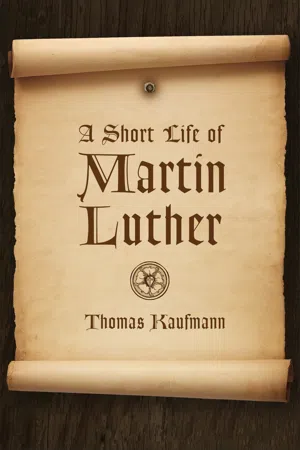
- 158 pages
- English
- ePUB (mobile friendly)
- Available on iOS & Android
eBook - ePub
A Short Life of Martin Luther
About this book
Information
Topic
Theology & ReligionSubtopic
Religious BiographiesCHAPTER ONE
The Search for Martin Luther
Because countless thinkers have interpreted Martin Luther and have painted wildly different portraits of him, the best place to begin to understand Luther is with his self-perception. Who did Martin Luther think he was?
Luther spoke and wrote about himself very often and in very different formats—in table talk and letters to intimate friends, but also in sermons and works addressed to the general public. It would be difficult to name a contemporary or predecessor, at least among theologians, who talked about himself as frequently as he. Moreover, Luther needed to talk about himself, both because of the intense and unparalleled scrutiny to which he was subjected, and because of the close relationship between his person and his theology.
In Luther we see an oscillation between the most extreme opposites imaginable: the highest self-certainty and the deepest sense of unworthiness, lighthearted confidence and dark self-accusation. Two cultural trends were clearly at work here: from the medieval monastic tradition he inherited a tendency toward scrupulous self-denial, and from recently risen humanism he passed along an affirmation of people and their possibilities. Luther combined these into a rich tension that corresponded to his understanding of what it means to be a Christian.
And that—the simple conviction that, at bottom, he was “a Christian”—constitutes the central theme that runs across all of Luther’s modes and moments of self-interpretation. He put it precisely in his 1525 polemic against Erasmus: “I have nothing and am nothing, except that I can almost boast to be a Christian” (Ego vero nihil habeo et sum, nisi quod Christianum esse me prope glorier).1 Long personal experience honed the central axiom of his theological anthropology to a sharp edge: strive as we might with all our strength of will, in the eyes of God we can accomplish nothing. And so his last written statement, composed on February 16, 1546, just two days before his death, aptly closed with these words: “We are beggars, hoc est verum [that is true].”2 That also held for human understanding, above all with regard to Scripture: we cannot understand it without the trials of experience and the sustaining support of the Holy Spirit, which we cannot control. In short, the central feature of Luther’s self-understanding was his complete dependence on faith alone for the assured grace of God.
On his public side, he staked his claim to credibility solely on the conviction that the knowledge of Christ and his gospel had been imparted to him and spread through him. His testament of 1542 put it this way: “I ask of every man . . . that he would allow me to be the person which in truth I am, namely, a public figure known both in heaven and on earth, as well as in hell, bearing respect or authority enough that one can trust or believe me more than any notary. For God, the father of all mercies, entrusted to me, a condemned, poor, unworthy, and miserable sinner, the gospel of his dear Son and made me faithful and truthful, and has up to now preserved and grounded me in it, so that many in the world have accepted it through me and hold me to be a teacher of the truth, without regard for the pope’s ban and the anger of emperor, kings, princes, clerics, yes, of all the devils.”3 Luther’s self-concept held steadfast simply because he applied to himself the basic insight of his faith, namely, that God’s provision of grace and freedom to the sinner is not based on the worthiness of the human being but on undeserved mercy alone. His confession of sin was inseparably interwoven with his certainty of justification; only God could overcome our distance from God, indeed, our enmity for God. This was the theological basis for his many tension-packed, dialectical self-descriptions.
We can see this already in the first act that spread his name beyond the narrow confines of the university, in his change of surname from Luder to Luther at the start of the indulgences controversy. The first time he clearly used his new name was in a letter of October 31, 1517, to Archbishop Albrecht of Mainz, the authority responsible for the sale of indulgences in that part of Germany. The letter demanded that the high-pressure sales campaign cease at once, and was accompanied by a copy of the Ninety-Five Theses. It was a bold action reflecting the self-confidence of a man who had been completely set free in the bond of Christ. In the Greek and Latin form of his new name, Eleutherius, “the free one,” Martin Luder saw an etymological verification of the secret that God had hidden in his family name. In a letter to his friend Johannes Lang, on November 11, 1517, he embellished his signature accordingly: “Brother Martinus Eleutherius, yes, all too much a servant and captive, Augustinian at Wittenberg.”4 From then on he pointedly reiterated this characteristic dialectic: from God’s point of view, Luther knew himself to be righteous and free; from his own perspective, he was a captive of sin and an unworthy servant.
His name change and all that it signified bore unmistakable parallels to self-references made by the apostle Paul, another name-changer. In Galatians 1:12, a verse Luther could well have claimed as his own, Paul declared that he had received the gospel “not from man, but from heaven alone through our Lord Jesus Christ.”5 Luther could identify his fight against the “papists” with the apostle’s fight against his Judaizing opponents. As Paul boasted of his “weakness” to the Corinthians6 (Luther detected some “holy pride”7 on the apostle’s part here), so Luther militantly asserted his authority as an “unworthy evangelist”8 who nonetheless was more “learned in scripture” than “all the Sophists and Papists.”9 Even if Luther did not claim personal inspiration in the sense of having received an immediate revelation (“I do not claim to be a prophet”),10 he most certainly did claim knowledge of the truth as mediated by the strength of the biblical word and a divine mandate to spread it, for “even if I am not a prophet, as far as I am concerned I am sure that the Word of God is with me and not with them [his ‘papist’ opponents], for I have the Scriptures on my side and they have only their own doctrine.”11 But this certainty was pierced by self-doubt whenever he pondered the question of how he could be right as a single person against the authority of the pope’s church and all the weight of interpretive tradition in understanding the Christian faith: “How often did my heart quail and reproach me with their [i.e., ‘the papists’] single strongest argument: ‘You alone are wise? Can it be that all the others are in error and have been for so long a time?’”12
At the heart of Luther’s dialectical self-understanding were the trials of faith that swelled up, his whole life long, in episodes of Anfechtungen, “torment.” From biblical examples he was convinced that God had sustained the church since creation through solitary witnesses to the truth: through patriarchs like Adam, Abraham, and perhaps Noah; through Old Testament prophets like Isaiah and Daniel; and finally through teachers of the church like Augustine, Ambrose, and Bernard of Clairvaux. And so also he sometimes seems to have understood himself as a kind of final witness before the apocalyptic last days, and to that extent as an “end-time prophet.”13 Bit by bit he heard of prophecies of a “hermit” who would attack the papacy of Leo X14 or, in 1516, of someone who would destroy monasticism.15 These prophecies could hardly have left him unaffected since they were all about him and were passed along by some of his busy epigones. The dynamic success of the “run of the gospel” in the Reformation of the early 1520s against all attempts to hinder it validated his sense of divine calling: “But God has opened my mouth and bidden me to speak, and he supports me mightily. The more they rage against me, the more he strengthens and extends my cause—without any help or advice from me—as if he were laughing and holding their rage in derision. . . . Therefore, I will speak (as Isaiah says) and not keep silent as long as I live.”16 Luther’s claims likely exceeded those of any ancient or medieval theologian. He declared himself to be a God-“ordained” preacher for the “German nation,”17 indeed, a “prophet of the Germans.”18 In deciding for or against him, people were determining their relationship with Christ;19 his cause was the cause of God;20 through him Christ would kill the papacy.21 He was presenting no “new” teaching, only the core of the “old” biblical proclamation, recovering it for the first time in centuries. Luther lived in the certainty that God would bear witness at the last judgment that he had taught well.22
Luther’s self-consciousness of being a teacher of the true church—one instructed in, and indeed, compelled to that role by Scripture—only grew after he was declared a heretic by the “pope’s church.” His doctorate in theology was particularly important for him at the start of his altercation with Scholastic theology and the system of penance and indulgences. The office of professor of theology bore with it—in good “medieval” fashion, and conveyed by full apostolic authority23—the church’s own mandate that he defend orthodoxy and fight against every teaching that was in error. Even more, via his university position under Augustinian auspices, the church had given him the right to exercise his own theological judgment in carrying out this duty.
Thus, Luther participated in the life of his community as the holder of an office; he “was not only a fool, but also a sworn doctor of Holy Scripture.”24 He was simply taking a stand for the truth of the gospel as required by his “conscience, oath, and duty, and as a poor teacher of the Holy Scripture.”25 After he had been “robbed of his title” by papal excommunication and the imperial ban,26 other self-descriptions moved into the foreground, especially “Ecclesiastes” (“Preacher”) and “Evangelist.” But Luther did not relinquish his doctoral title, which would have amounted to accepting his condemnation as a heretic. Indeed, in arguments with opponents both inside and outside of Reformation ranks,27 he used his degree to bolster his right to teach.
Even though (as he saw it in retrospect) he had first opposed accepting that title with all its attendant obligations, his acquiescence on this point proved to be the source and ground of the further theological development that eventually brought him to oppose the pope’s church: “However, I, Doctor Martinus, have been called to this work and was compelled to become a doctor, without any initiative of my own, but out of pure obedience. Then I had to accept the office of doctor and swear a vow to my most dearly beloved Holy Scriptures that I would preach and teach them faithfully and purely. While engaged in this kind of teaching, the papacy crossed my path and tried to hinder me in it.”28 Luther’s claim that ecclesiastical opposition prevented him from fulfilling his ecclesiastical obligation ran as a continuous theme through every stage of his life from the moment he graduated with his doctorate in October 1512. In calling himself “an ecclesiast by God’s grace” or “an evangelist by God’s grace,”29 Luther the heretic asserted in the most provocative way imaginable that everything he had to say proceeded simply “on the prompting . . . of the Spirit”30 and that Christ “is the master of my teaching and would be the witness on the last day that it is not mine but his pure gospel.”31
Luther’s conviction of the truth, like his self-understanding, rested theologically on the elementary fact that he was, “however unworthy, a baptized Christian.”32 From that core of personal identity, grounded not in himself but in God or Christ, he gained the flexibility to manage the historical individual Martin Luther. Thus he could imitate the apostle’s self-boasting (in 2 Cor. 11:2–3) in describing himself as “a doctor over all the doctors of the whole papacy,”33 yet call himself “the stinking bag of worms” whose “wretched name,” that is, “Lutheran,” the “children of Christ” should absolutely not adopt for themselves.34 That this Pauline dialectic of freedom and servanthood in Christ had no model in the standard value-system of medieval Christianity—though it may have had a parallel in cultural history to the figure of the fool35—accounts for much of the great interest taken in his person.
Luther’s self-concept also drew off...
Table of contents
- Title Page
- Copyright
- Table of Contents
- Foreword
- Timeline
- Map of Luther’s Germany
- Introduction
- 1. The Search for Martin Luther
- 2. Living in the Reformation of God
- 3. A Theological Life
- Epilogue
- Note on Citations
- Abbreviations
- Notes
- 95 Theses
- Further Reading
- Index
Trusted by 375,005 students
Access to over 1.5 million titles for a fair monthly price.
Study more efficiently using our study tools.
Frequently asked questions
Yes, you can cancel anytime from the Subscription tab in your account settings on the Perlego website. Your subscription will stay active until the end of your current billing period. Learn how to cancel your subscription
No, books cannot be downloaded as external files, such as PDFs, for use outside of Perlego. However, you can download books within the Perlego app for offline reading on mobile or tablet. Learn how to download books offline
Perlego offers two plans: Essential and Complete
- Essential is ideal for learners and professionals who enjoy exploring a wide range of subjects. Access the Essential Library with 800,000+ trusted titles and best-sellers across business, personal growth, and the humanities. Includes unlimited reading time and Standard Read Aloud voice.
- Complete: Perfect for advanced learners and researchers needing full, unrestricted access. Unlock 1.5M+ books across hundreds of subjects, including academic and specialized titles. The Complete Plan also includes advanced features like Premium Read Aloud and Research Assistant.
We are an online textbook subscription service, where you can get access to an entire online library for less than the price of a single book per month. With over 1.5 million books across 990+ topics, we’ve got you covered! Learn about our mission
Look out for the read-aloud symbol on your next book to see if you can listen to it. The read-aloud tool reads text aloud for you, highlighting the text as it is being read. You can pause it, speed it up and slow it down. Learn more about Read Aloud
Yes! You can use the Perlego app on both iOS and Android devices to read anytime, anywhere — even offline. Perfect for commutes or when you’re on the go.
Please note we cannot support devices running on iOS 13 and Android 7 or earlier. Learn more about using the app
Please note we cannot support devices running on iOS 13 and Android 7 or earlier. Learn more about using the app
Yes, you can access A Short Life of Martin Luther by Thomas Kaufmann, Peter D. S. Krey in PDF and/or ePUB format, as well as other popular books in Theology & Religion & Religious Biographies. We have over 1.5 million books available in our catalogue for you to explore.