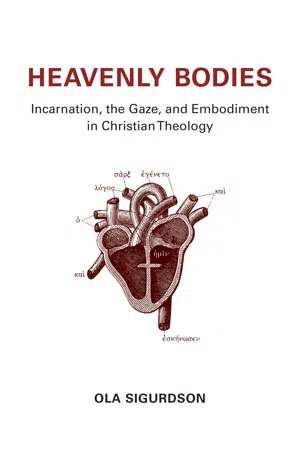
Deep and wide study of 2,000 years of Christian thought on the human body Does Christianity scorn our bodies? Friedrich Nietzsche thought so, and many others since him have thought the same. Ola Sigurdson contends, to the contrary, that Christianity — understood properly — in fact affirms human embodiment. Presenting his constructive contributions to theology in relation to both historical and contemporary conceptions of the body, Sigurdson begins by investigating the anthropological implications of the doctrine of the incarnation. He then delves into the concept of the gaze and discusses a specifically Christian "gaze of faith" that focuses on God embodied in Jesus. Finally, he weaves these strands into a contemporary Christian theology of embodiment. Sigurdson's profound engagement with the whole history of Christian life and thought not only elucidates the spectrum of Christian perspectives on the body but also models a way of thinking historically and systematically that other theologians will find stimulating and challenging.
eBook - ePub
Heavenly Bodies
Incarnation, the Gaze, and Embodiment in Christian Theology
- 683 pages
- English
- ePUB (mobile friendly)
- Available on iOS & Android
eBook - ePub
About this book
Information
Topic
Theology & ReligionSubtopic
Philosophical MetaphysicsPart I
Incarnation
2. Incarnation and Humanity
In this chapter I will examine the biblical and patristic conceptions of incarnation with respect to how they understand the humanity of Christ, as well as the sense in which they attempt to preserve the genuine humanity of Christ, i.e., the concrete, historical existence of humanity, inclusive of embodiment, as a constitutive feature of the human being. In other words, I will make use of a historical material that has been foundational for the traditional formulations of the doctrine of the incarnation. In both historical and contemporary Christological thought, Christology is about how one may understand the relationship between God and us humans in a way that neither makes it unfathomable how God can be present in the person Jesus, nor transforms Jesus into something other than a person. Even if the historical Christology that I will examine here emphasizes the divine pole of the relationship while modern Christology emphasizes the human pole, so long as the relationship itself does not disappear from sight it still falls within the same context of inquiry. I presume, therefore, that this more historically oriented chapter can be of constructive value for this study’s primary aim of examining the anthropological implications of the doctrine of the incarnation for the human mode of being-in-the-world.
A retrospective reflection might easily convince us that historical theology provides clear definitions, while all our own period has to offer is a fragmented diversity. It is therefore important to establish that early Christian history also offers a diversity of different christologies. In the New Testament’s twenty-seven different texts, which were, of course, compiled within the space of just over a hundred years, one finds no isolated, clearly defined Christology, or, for that matter, Christian theology.1 Even the patristic period, i.e., the early theological thought that was set in writing by the church fathers during the centuries that followed the writing of the biblical texts up until about the eighth century, proves to have a number of different context-dependent Christological formulations. At the same time, both of these periods have had a history of effect that broadly exceeds their contexts of origin. Here the Christological doctrines were developed in a way that has been normative for the Christian church up until our time, even if during the nineteenth century it was questioned whether these formulations can actually satisfy the needs of a theology relevant to the present day.
Apart from the fact that a basic knowledge of historical Christology is necessary in order to understand our contemporary christologies, including their critical repudiation of traditional Christology, one of the reasons that I choose to devote an entire chapter to the interpretation of the biblical and patristic christologies is that I want to avoid taking these as static and ahistorical formulations intended to offer rigid definitions of God’s nature. An uncritical complacency sometimes lurks behind overly simple contrasts between history and our time. I additionally believe, as will become clearer in the next chapter, that these historical Christological formulations can be made theologically fruitful even in our time—provided we avoid turning them into something more or something other than what they were intended to be. This means, among other things, that it becomes impossible to attribute an absolute distinction or contrast between “representations” and “doctrine” to the biblical vis-à-vis the patristic material. The biblical texts are written about concrete problems in the early Christian church, and the same goes for patristic theology—including, in the case of Christology, the historically normative councils in Nicea in 325 and Chalcedon in 451.2 The task in this chapter is thus to interpret the biblical and patristic conceptions of incarnation in order to see to what extent their formulations offer resources or create problems for a contemporary Christology, and I will proceed more or less chronologically: from the Old Testament to the New Testament, and from the council in Nicea in 325 to the council in Chalcedon in 451. I end with a short conclusion concerning the result of the investigation’s question thus far: What do the biblical and the patristic conceptions of incarnation tell us about the humanity of Christ?
God’s Personified Wisdom: The Old Testament
In a general sense, an incarnational theology deals with the active presence of God in human history, and a discussion of Christian conceptions of incarnation thus begins appropriately in that part of the Bible that Christians call the Old Testament. That the New Testament authors appropriated interpretive keys from the Hebrew Bible for their interpretation of the figure of Jesus is undeniable, but does this cover the representation of the incarnation as well?3 In general there are a number of ideas about how God is present with God’s own people Israel in the Hebrew Bible. Through the Spirit God is already present in creation in its infancy (Gen. 1:2), and God continues to renew creation through the Spirit as well (Ps. 104:30). God’s presence is not thematized here, however, via an abstract doctrine of the being of God, but is given form through more or less historical narratives, poetry, proverbs, prophecies—in other words, through texts written in reaction to concrete situations. This applies as well to other candidate concepts for incarnational theology, such as the conviction that God’s presence is linked to the name of God (yhwh; cf. Exod. 3:14), and is manifested in God’s active and compassionate presence in the affairs of the world.4
More personified Old Testament representations of the presence of God that later Christian incarnational christologists have been able to connect to are on the one hand the idea of Wisdom as the ultimate ground of Creation, on the other the idea of Messiah as the ultimate design for history.5 Regarding the representation of Wisdom as the ultimate ground of Creation, we must note that according to the Hebrew Bible’s understanding, it is only God who is “from everlasting” (Ps. 93:2). At the same time, there is a conception of a Wisdom that is beside God and that in some sense exists in addition to God. Such a conception comes forth most clearly in Proverbs 8:22–31 (I quote vv. 22–26):
The Lord possessed me [Wisdom] at the beginning of his work,
the first of his acts of old.
Ages ago I was set up,
at the first, before the beginning of the earth.
When there were no depths I was brought forth,
when there were no springs abounding with water.
Before the mountains had been shaped,
before the hills, I was brought forth,
before he had made the earth with its fields,
or the first of the dust of the world.
Here we find a representation of Wisdom as a personal, female figure who is separate from both God and the rest of Creation. There does not seem to be any doubt, however, that Wisdom is created by God, and thus not herself divine. We find a similar representation of a personified Wisdom in Job 28:24–28 as well, and a more far-reaching one in Sirach 24:1–22 (from the Apocrypha). The point of these representation...
Table of contents
- Contents
- Acknowledgments
- Part I. Incarnation
- Part II. The Gaze
- Part III. Embodiment
- Bibliography
- Name Index
- Subject Index
- Scripture Index
Trusted by 375,005 students
Access to over 1.5 million titles for a fair monthly price.
Study more efficiently using our study tools.
Frequently asked questions
Yes, you can cancel anytime from the Subscription tab in your account settings on the Perlego website. Your subscription will stay active until the end of your current billing period. Learn how to cancel your subscription
No, books cannot be downloaded as external files, such as PDFs, for use outside of Perlego. However, you can download books within the Perlego app for offline reading on mobile or tablet. Learn how to download books offline
Perlego offers two plans: Essential and Complete
- Essential is ideal for learners and professionals who enjoy exploring a wide range of subjects. Access the Essential Library with 800,000+ trusted titles and best-sellers across business, personal growth, and the humanities. Includes unlimited reading time and Standard Read Aloud voice.
- Complete: Perfect for advanced learners and researchers needing full, unrestricted access. Unlock 1.5M+ books across hundreds of subjects, including academic and specialized titles. The Complete Plan also includes advanced features like Premium Read Aloud and Research Assistant.
We are an online textbook subscription service, where you can get access to an entire online library for less than the price of a single book per month. With over 1.5 million books across 990+ topics, we’ve got you covered! Learn about our mission
Look out for the read-aloud symbol on your next book to see if you can listen to it. The read-aloud tool reads text aloud for you, highlighting the text as it is being read. You can pause it, speed it up and slow it down. Learn more about Read Aloud
Yes! You can use the Perlego app on both iOS and Android devices to read anytime, anywhere — even offline. Perfect for commutes or when you’re on the go.
Please note we cannot support devices running on iOS 13 and Android 7 or earlier. Learn more about using the app
Please note we cannot support devices running on iOS 13 and Android 7 or earlier. Learn more about using the app
Yes, you can access Heavenly Bodies by Ola Sigurdson in PDF and/or ePUB format, as well as other popular books in Theology & Religion & Philosophical Metaphysics. We have over 1.5 million books available in our catalogue for you to explore.