Elegant writings by a cutting-edge research scientist defending traditional theological and philosophical positions
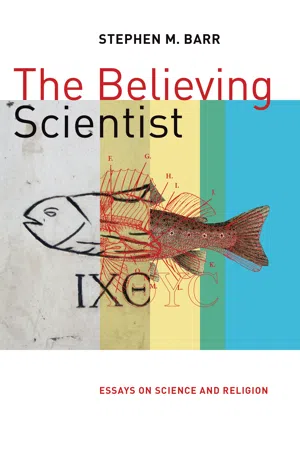
Both an accomplished theoretical physicist and a faithful Catholic, Stephen Barr in this book addresses a wide range of questions about the relationship between science and religion, providing a beautiful picture of how they can coexist in harmony.
In his first essay, "Retelling the Story of Science," Barr challenges the widely held idea that there is an inherent conflict between science and religion. He goes on to analyze such topics as the quantum creation of universes from nothing, the multiverse, the Intelligent Design movement, and the implications of neuroscience for the reality of the soul.
Including reviews of highly influential books by such figures as Edward O. Wilson, Richard Dawkins, Stephen Jay Gould, Francis S. Collins, Michael Behe, and Thomas Nagel,
The Believing Scientist helpfully engages pressing questions that often vex religious believers who wish to engage with the world of science.
- 232 pages
- English
- ePUB (mobile friendly)
- Available on iOS & Android
eBook - ePub
About this book
Information
Topic
Theology & ReligionSubtopic
Religion & Science02
EVOLUTION WITHOUT TEARS
The last twenty years have seen an intensifying of the evolution wars in the United States. The passion in these conflicts comes mainly from two groups, fundamentalist Christians and scientific atheists, who feed off each other even as they abominate each other. Although poles apart in their world views, they agree on one fundamental premise, namely that biological evolution is incompatible with biblical religion. Polls show that the fundamentalists have much popular support: 45% of Americans believe that God created plants and animals within the last 10,000 years in approximately their present form (a view called Creationism). The scientific atheists are much fewer in number, but are energetic propagandists. Caught in the middle are the rest of the American people, most of whom see no contradiction between God and evolution. It is often overlooked that a large number of American scientists are traditional religious believers. (A recent survey showed that nearly half believe in a personal God who answers prayers.) The great majority of these religious scientists regard evolution as a well-established fact and look upon the public battles over it as pointless and embarrassing.
One casualty of these battles is religious belief itself. The very fact that religious believers are still attacking evolution after so many decades lends credibility to the atheists’ claim that religion and science are irreconcilable. Science too is harmed. With so many people convinced that the scientific establishment is mistaken, or even lying, about an issue of fundamental importance, and with militant atheists claiming to speak for science and using science as a weapon against faith, public trust in the scientific community and its institutions is diminished. This is of no small concern to a profession that lives largely off the public purse. Equally worrisome are attempts by Creationists and others to re-draw the boundaries of science in order to justify the teaching of “alternatives” to “mainstream science” in schools. If that were done, there would be no principled grounds for objecting to the teaching of “alternative medicine,” astrology, and many other ideas that have a large popular following, or to the teaching of popular “alternatives” in other fields, such as “afro-centric history.” A scholarly discipline that is no longer trusted to police its own boundaries is like a body without an immune system.
A third and more subtle threat to the health of the scientific enterprise is intellectual rigidity. In closing ranks against Creationist pseudo-science, as it has been forced to do, the scientific community has grown increasingly intolerant toward even those who raise reasonable questions about evolution. As Creationists have exploited for propaganda purposes the normal debates within biology, the unresolved puzzles of theory, and the inevitable anomalies in data, some biologists have become afraid to admit any shortcomings or uncertainty in their theoretical framework.
Many religious leaders and theologians have attempted to defuse the conflict by pointing out that orthodox Christian faith is no bar to accepting the established facts of biological science. In 1996, Pope John Paul II made an important statement on the subject to the Pontifical Academy of Sciences, and in 2004, the Catholic Church’s International Theological Commission issued an impressive study of the theological issues, entitled Communion and Stewardship. Religious scientists have also begun to speak up. In 1999, Kenneth R. Miller, a biology professor at Brown University and co-author of a standard biology textbook, came out with Finding Darwin’s God. In 2006, The Language of God appeared, written by Francis S. Collins, a world-renowned geneticist and head of the Human Genome Project. Both books argue for the compatibility of standard neo-Darwinian evolution and traditional Christian faith. Miller is a Catholic and Collins an evangelical Christian.
Even many scientists who are not religious have tried to smooth things over, because they recognize that the conflict is fraught with dangers for science. One notes, for example, the following statement from the National Academy of Sciences: “[It is false] to think that the theory of evolution represents an irreconcilable conflict between religion and science. A great many religious believers accept evolution on scientific grounds without relinquishing their belief in religious principles.” The same point has been emphasized by several well-known scientists who are atheists, including the late Stephen Jay Gould. Unfortunately, these efforts have not brought peace.
When the Intelligent Design (or “ID”) movement came along in the late 1990s it looked like an attempt to find a middle ground. The movement did not deny1 that the earth is billions of years old or that the present species of plants and animals evolved from a common ancestor (the idea called “common descent”). They merely argued that natural mechanisms, including natural selection, are inadequate to explain evolution, a position that is not in itself unreasonable or a threat to science. Far from acting as a moderating force, however, the ID movement quickly ended up exacerbating the conflict. This is due to three strategic decisions they made from the very outset. First, they did not clearly dissociate themselves from Creationism, which they could have done by frankly admitting that the evidence for common descent is compelling. Instead, in some of their writings, such as those of Phillip E. Johnson, that evidence is called into question. It seems that the ID movement did not wish to alienate Creationists, whom they appeared to regard as allies against the common enemy of “Darwinism.”2 An obvious advantage to them in this informal alliance is that their potential audience and influence is enormously expanded. The drawback is that they have come to be seen, even by some people initially disposed to be sympathetic to them, as a stalking horse for Creationism. Second, the “ID theorists,” as they style themselves, did not merely argue that there were reasonable grounds to doubt the sufficiency of natural explanations; they sometimes argued that it was already provable that natural explanations will never be able account for certain biological facts.3 This is a highly provocative claim, since the scientific community sees as its business the search for such explanations. And third, the ID movement announced as one of its goals a redefinition of science to include types of explanation that most people see as religious or quasi-religious. As this kind of redefinition has always been one of the main practical threats to science posed by the Creationists, the backlash against the ID movement from the scientific community was predictably harsh.
At the same time as all this has been going on, some scientists have begun to argue for the importance of various non-Darwinian—but completely naturalistic—mechanisms of evolution. There is quite a grab-bag of such proposals, including “complexity theory” and a set of ideas that have come to be called “evo-devo” (short for “evolution-development”). The result is that there are now several evolution controversies going on at the same time instead of just the one we were all familiar with.
The Evolution Controversy, by Thomas B. Fowler and Daniel Kuebler, is an attempt to sort all this out for the general reader. It succeeds in this goal admirably. The authors begin by presenting the history of evolutionary thought from the forerunners of Darwin up to the present time, as well as the history of opposition to evolution. They note that much of the confusion surrounding the subject comes from the fact that the word evolution is used by different people to mean different things. Fowler and Kuebler therefore distinguish three “tiers” in the theory of evolution: The first tier is historical evolution, which is the idea that living things have undergone a process of development lasting hundreds of millions of years, the stages of which can be read in the fossil record. The second tier is common descent. The third tier is what they call strong Darwinian evolution, by which they mean the idea that natural selection is by itself sufficient to account for the facts of evolution. They then proceed to classify the main contending positions into four “schools.”
First is the Neo-Darwinian School. Neo-Darwinism is the standard term among scientists for the synthesis, achieved in the mid-twentieth century, of Darwin’s theory of evolution with modern genetics. The mutations that Darwin saw as fueling evolutionary change are now understood to be genetic mutations. Second is the Meta-Darwinian School. This actually comprises two groups: those who think that neo-Darwinism is basically correct, but accept that some non-Darwinian mechanisms may also be significant, and those who think that non-Darwinian mechanisms play the central and even dominant role in evolution.
Third is the Intelligent Design School. Like the Meta-Darwinians, they accept (or, at least, do not explicitly reject) the first two tiers of evolution. Finally there is the Creationist School. This school is far more radical than the others, for it rejects all three tiers of evolution. (There are some Creationists who accept that the universe is billions of years old, but most Creationists are of the so-called “Young Earth” type and believe that the universe is only a few thousand years old.)
Fowler and Kuebler succeed very well in explaining, without oversimplification, but in a way that will be understood by ordinary readers, the positions of each school, the principal arguments and counter-arguments, and the most important scientific evidence. Even fairly knowledgeable readers will come away having learned a great deal. For example, it came as a surprise to me that many Creationists not only believe that new species can evolve, but believe that such evolution can happen far faster than Darwinian evolution would allow. (They have to suppose this in order to explain how the relatively few types of animals that would have fit on Noah’s Ark could have led to the vast number of life forms we see today.)
Fowler and Kuebler’s purpose is not merely to explain the evolution controversies; it is to help ordinary people to “decide for themselves” where the scientific truth lies. This is a somewhat peculiar aim, as they themselves appear to recognize. We do not expect ordinary people to decide for themselves where the scientific truth lies with regard to disputed questions in subatomic physics or other highly technical fields. Common sense tells us that such matters are for trained specialists to debate and judge. What we face in the area of evolution, however, is precisely a crisis of trust. When 45% of the general public think that biologists, astrophysicists, cosmologists, and geologists, are all off by a factor of a million (!) in their calculations of the age of the universe, the age of the earth, and the duration of life on earth, we are no longer in a situation where the authority of experts can be invoked. Fowler and Kuebler therefore feel that there is no other way to proceed than to present the scientific evidence as clearly as possible and trust in ordinary people’s good sense.
There is reason to suspect that the authors are secretly hoping that open-minded Creationists who read their book will come to the realization that Creationism is scientifically untenable. Fowler and Kuebler cannot say this, however, because any appearance that they are not impartial would undermine their credibility with the very people they are most trying to reach. In consequence, they bend over backwards to emphasize their “neutrality” and to treat all four “schools” as scientifically respectable. This leads them very often to soften their language to an unjustified, and indeed absurd, degree when discussing Creationism. They speak of the “considerable” problems with fitting the history of the universe and the earth into 10,000 years. (The correct word is “insurmountable.”) They say that “there is no guarantee” that Creationist research will lead to viable explanations that can withstand rigorous scrutiny. (The correct statement is that there is an iron-clad guarantee that it will not produce such explanations, and that in fact Creationism is already unable to withstand even the mildest scrutiny.) They say that “a very good case” exists for common descent, when they must know full well that the evidence they presented for it earlier in their book is utterly conclusive. They say, “if they [the Creationists] can succeed in demonstrating a young age [of the earth and universe], of the order of 10,000 years or so . . .” That is like saying, “If they can succeed in showing that the moon is made of green cheese . . .” They several times explicitly deny that Young Earth Creationism should be treated as a “crackpot theory,” when in fact that is exactly what it is.
It is understandable that the authors want to be tactful, but there is a fine line between tact and lack of candor, and they clearly cross it. Some people might say that their attitude is right, since science should maintain an open mind about all possibilities. But that is nonsense; science can reach firm and reliable conclusions, and has on countless questions. The authors know this, and admit that some theories do belong in the crackpot category. Instead of patronizing the Creationists by pretending to take their theories seriously as science (which is not at all the same thing as taking Creationists seriously as people), Fowler and Kuebler might have explained what it is that distinguishes crackpot theories from serious ones. However, the epistemology of science that they develop in the early part of their book is inadequate to the task.
The misconception many people have about science is that experiments and observations provide one directly with statements about the world that can be lined up alongside the statements of theory in order to verify or falsify the latter. What they actually provide is facts—such as fragments of bone in a riverbed, readings on a dial, or tracks in a particle detector—whose significance cannot be grasped without the application of a large body of existing theory. In other words, every conclusion of science rests upon a large number of assumptions. Each of those assumptions can be questioned; and so it might seem that the uncertainty of scientific conclusions would actually increase as one probed the reasoning upon which they are based. The reason that this epistemological unraveling doesn’t occur is that while each conclusion rests upon many assumptions, each assumption also provides the basis for many conclusions. In other words, one does not have a fragile chain of logic that snaps if any link is broken, but a highly connected network of interlocking and mutually supporting facts and inferences. Every part of that network is held in place by many links to other known facts, both near and remote.
How then is it ever possible to revise any conclusion of science, let alone have a “scientific revolution” that revises many of them? The answer is that it is not as easy as some people imagine. In the early days of some branch of science, when few facts are known and their connections are not well understood, wholesale revisions of theory are not uncommon. But as a branch of science matures, it becomes more difficult to formulate a viable theory that departs in some fundamental way from the existing theory. Such radical revisions can still occur, but they are rare, and they generally require that the new theory give the same answers as the old one except in extreme and quite unusual conditions. For example, while Einstein’s theory of gravity involved major conceptual revisions, it gives the same answers as Newton’s theory to extremely high accuracy unless gravitational fields are enormously strong or the gravitating bodies are moving near the speed of light. Even finding a place where the existing theory can be modified in a minor way is not so simple. That is why coming up with a sensible new theory requires a great deal of technical knowledge and skill: the theorist must be able to spot the elements in the existing structure that are not really supporting much weight, and which can be modified or removed without bringing the whole building crashing down.
The same applies outside the natural sciences—for example in history. It is one thing to question some detail in the received account of, say, Julius Caesar’s life. It is quite another to propose a radical new account of history according to which the Roman Empire never existed. We simply know too many things, and the things we know are simply too interconnected for a revision of that sort to be possible. It is a revision of that sort that Creationism proposes, and that is why it is a crackpot idea.
G. K. Chesterton, in Orthodoxy, describes the futility of trying to debate on his own terms the ideas of a “maniac,” by which he meant someone who is trapped in a tiny circle of logic. It is not that the maniac’s logic is flawed, but that his world is too small. His system is self-consistent, but it leaves almost everything out. It is not enough to provide him with a few more facts and arguments to consider, he must be made to see the big picture and how much bigger it is than he supposed.
I do not wish to leave a wrong impression. This is in many ways an excellent book. Indeed, I know of no book that is better for someone wanting to understand the scientific aspects of the “Evolution Controversy.” It explains very well a great deal of material, including the strongest pieces of evidence against Creationism. If it tries too hard to be kind to Creationism, that is perhaps an excusable fault. Doubtless, Fowler and Kuebler are trying not to “crush the bruised reed.” I hope that in future editions they choose to be more frank. But even as it is, this is a book of considerable merits.
03
THE DEVIL’S CHAPLAIN CONFOUNDED
Richard Dawkins is the most truculent exponent of Darwinian theory writing today. It has been said that if T. H. Huxley was “Darwin’s bulldog,” Dawkins should be called “Darwin’s pit-bull.” “Red in tooth and claw” well describes his polemical style; and on the subject of religion, in particular, he is rabid. He has his calmer moments, of course. And when he confines himself to zoology, his field of expertise, he is capable of writing in a lucid manner. Unfortunately, he often prefers to play the philosopher, social critic, and moralist. Some of the results are exhibited in this book.
A Devil’s Chaplain is a collection of essays, book reviews, forewords, eulogies, and other short pieces that he has written over the last twenty-five years. They deal with a variety of topics, including postmodernism, ...
Table of contents
- Title Page
- Copyright
- Contents
- SCIENCE VERSUS RELIGION?
- EVOLUTION
- MIND AND SOUL
- THE BIG BANG AND CREATION
- REDUCTIONISM
- SCIENCE AS A SUBSTITUTE FOR RELIGION
- FINDING GOD THROUGH SCIENCE
- MISCHIEVOUS MYTHS ABOUT SCIENTIFIC REVOLUTIONARIES
- Notes and Sources
- Direct Quotations
Trusted by 375,005 students
Access to over 1.5 million titles for a fair monthly price.
Study more efficiently using our study tools.
Frequently asked questions
Yes, you can cancel anytime from the Subscription tab in your account settings on the Perlego website. Your subscription will stay active until the end of your current billing period. Learn how to cancel your subscription
No, books cannot be downloaded as external files, such as PDFs, for use outside of Perlego. However, you can download books within the Perlego app for offline reading on mobile or tablet. Learn how to download books offline
Perlego offers two plans: Essential and Complete
- Essential is ideal for learners and professionals who enjoy exploring a wide range of subjects. Access the Essential Library with 800,000+ trusted titles and best-sellers across business, personal growth, and the humanities. Includes unlimited reading time and Standard Read Aloud voice.
- Complete: Perfect for advanced learners and researchers needing full, unrestricted access. Unlock 1.5M+ books across hundreds of subjects, including academic and specialized titles. The Complete Plan also includes advanced features like Premium Read Aloud and Research Assistant.
We are an online textbook subscription service, where you can get access to an entire online library for less than the price of a single book per month. With over 1.5 million books across 990+ topics, we’ve got you covered! Learn about our mission
Look out for the read-aloud symbol on your next book to see if you can listen to it. The read-aloud tool reads text aloud for you, highlighting the text as it is being read. You can pause it, speed it up and slow it down. Learn more about Read Aloud
Yes! You can use the Perlego app on both iOS and Android devices to read anytime, anywhere — even offline. Perfect for commutes or when you’re on the go.
Please note we cannot support devices running on iOS 13 and Android 7 or earlier. Learn more about using the app
Please note we cannot support devices running on iOS 13 and Android 7 or earlier. Learn more about using the app
Yes, you can access The Believing Scientist by Stephen Barr in PDF and/or ePUB format, as well as other popular books in Theology & Religion & Religion & Science. We have over 1.5 million books available in our catalogue for you to explore.