Much has been written of late about what the apostle Paul really meant when he spoke of justification by faith, not the works of the law. This short study by Stephen Westerholm carefully examines proposals on the subject by Krister Stendahl, E. P. Sanders, Heikki Raisanen, N. T. Wright, James D. G. Dunn, and Douglas A. Campbell. In doing so, Westerholm notes weaknesses in traditional understandings that have provoked the more recent proposals, but he also points out areas in which the latter fail to do justice to the apostle.
Readers of this book will gain not only a better grasp of the ongoing theological debate about justification but also a more nuanced overall understanding of Paul.
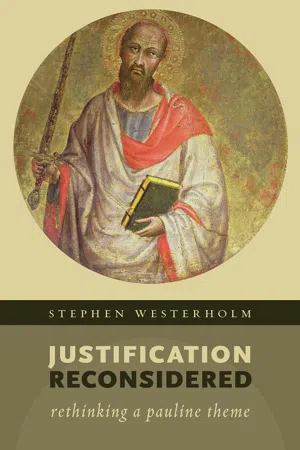
- 112 pages
- English
- ePUB (mobile friendly)
- Available on iOS & Android
eBook - ePub
About this book
Information
CHAPTER ONE
The Peril of Modernizing Paul

Sir Edmund Hillary climbed many mountains besides Everest. Neil Armstrong took many steps that did not land him on the moon. Krister Stendahl wrote a number of articles besides “The Apostle Paul and the Introspective Conscience of the West.” But no one cares. If Hillary, Armstrong, and Stendahl are remembered today, it is for one brief, shining moment.
The world of Stendahl’s fame is, to be sure, a good deal more confined than that of Hillary or Armstrong. But among New Testament scholars, his piece on the “introspective conscience”1 ranks with the best known, most influential single articles written in the twentieth century. It was meant to do (and is commonly believed to have done) for Paul what Henry Cadbury set out to achieve for the Gospels when he wrote The Peril of Modernizing Jesus.2 To lift Paul out of his first-century context is to distort him. And the ancients, among whom we must include the apostle Paul, were apparently not given to introspection. According to Stendahl, Augustine, not Paul, “express[ed] the dilemma of the introspective conscience,” and he “may well have been one of the first” to do so (83). “His Confessions is the first great document in the history of the introspective conscience. The Augustinian line leads into the Middle Ages and reaches its climax in the penitential struggle of an Augustinian monk, Martin Luther” (85). Self-examination, among “those who took this practice seriously,” brought on pangs of conscience; pangs of conscience led such people to ask in despair, “How am I to find a gracious God?” “It is in response to their question, ‘How can I find a gracious God?’ that Paul’s words about a justification in Christ by faith, and without the works of the Law, appears as the liberating and saving answer” (83).
But their question was not Paul’s question. Paul’s concern was “the place of the Gentiles in the Church and in the plan of God” (84). Hence (Stendahl claims) “the West for centuries has wrongly surmised that the biblical writers were grappling with problems which no doubt are ours, but which never entered their consciousness” (95). “Where Paul was concerned about the possibility for Gentiles to be included in the messianic community, his statements are now read as answers to the quest for assurance about man’s salvation out of a common human predicament” (86). Stendahl later summarized his differences from Ernst Käse-mann, his most noted and sharpest critic, along similar lines: “The first issue at hand is whether Paul intended his argument about justification to answer the question: How am I, Paul, to understand the place in the plan of God of my mission to the Gentiles, and how am I to defend the rights of the Gentiles to participation in God’s promises? or, if he intended it to answer the question, which I consider later and western: How am I to find a gracious God?” (131).
How we construe Paul’s claim that one is “justified by faith, not by works of the law” depends, at least in part, on the question we think it addresses. Both Stendahl’s posing of the issue and his response — not “How can a sinner find a gracious God?” but “On what terms can Gentiles gain entrance to the people of God?” — have become axiomatic for many.3 And, like a number of axioms dear to New Testament scholars, this one contains a grain of truth. The earliest followers of Jesus were Jews. Paul was “called” to be an “apostle to the Gentiles” (Rom 1:1; 11:13). The question how Gentile converts could be united with Jewish believers in a single community of faith brought different responses from different early church leaders. Some thought Gentile believers needed to become Jews through circumcision, and to live as Jews by keeping Jewish food laws, the Sabbath, and the like. To them and their views, Paul led the opposition. “Justification” became a central theme in his letters first in his response to this debate. So much any careful reader of the New Testament must grant.
The problem comes rather with what Stendahl denies; and, ironically, it was precisely by modernizing Paul that Stendahl made welcome his suggestion that others, not he, had modernized Paul. Our secularized age has undoubtedly thrust earlier concerns about human relationships with God into the background — if not rendered them completely unintelligible. Conversely, in our multicultural societies, acceptance of people from ethnic and cultural backgrounds other than our own is more crucial than ever to community peace. Both negatively and positively, then, Stendahl posits a Paul attuned to modern agendas. Is it possible that his portrait at the same time brings us closer to the first-century Paul?
The Burden of Paul’s Mission: Thessalonica and Corinth
Doubts begin as soon as we push beyond the issue that Stendahl rightly identifies as pivotal to Paul’s mission — the terms by which Gentiles could be admitted to the people of God — and ask an even more basic question: What moved Gentiles to enlist in a community of believers in the first place? We do not need Stendahl to tell us that Paul did not crisscross the Mediterranean world offering peace of mind to people plagued by a guilty conscience. But nor are we to imagine that he attracted Gentile converts with offers of membership in the people of (the Jewish) God, or that he advertised easy terms of admission to the Abrahamic covenant;4 with or without circumcision, few Gentiles can have felt a pressing urge to join a Jewish community or enter their “covenant.” Paul’s message can only have won acceptance among non-Jews by addressing a need they themselves perceived as important — if not before, at least after they met him. On the nature of that need, his letters are unambiguous.
Most scholars believe 1 Thessalonians was the first of Paul’s extant epistles to be written. Sent shortly after Paul established a community of believers in Thessalonica, the letter reflects from beginning to end the thrust of Paul’s message when he first arrived in the city. At any moment, Paul had warned his listeners, an outpouring of divine wrath would engulf an unsuspecting humanity and bring it sudden destruction (1:10; 5:3; cf. 2 Thess 1:5-10). Human sinfulness had all but reached its limit. Gentiles for their part had paid no heed to the true and living God while serving idols; their immorality was notorious and their conduct in general befitted darkness, not light (cf. 1 Thess 1:9; 4:4-5; 5:6-7). As for Jews, estrangement from God was signaled by their no less notorious history of rejecting his messengers: the prophets of old, the Lord Jesus but recently, and now his apostolic witnesses (2:14-16). Retribution for all would be swift and inescapable (5:3).
Many people today — for reasons we need not explore here — do not take such a message seriously. Evidently, however, Paul’s first-century readers in Thessalonica had done so; the notion that a deity might be angered by their actions was nothing new, and divine displeasure was a dangerous thing. Jews and non-Jews alike had always been concerned to keep on good terms with the supernatural powers that influenced, or even controlled, their destinies. With such concerns, Paul’s message found a natural resonance. We may well wonder whether Stendahl can be right in suggesting that the question “How am I to find a gracious God?” has occupied people in the modern West, but it is inconceivable that he is right in denying such a concern to the people of antiquity — particularly if we think of those who responded to Paul’s message of pending doom. Whether or not it induced a harbinger of the introspection characteristic of later times is, in this regard, a red herring. With or without an introspective conscience, anyone who takes seriously a warning of imminent divine judgment must deem it an urgent concern to find God merciful.
So much is clear. Conversely, nothing in the letter suggests that the relationship between Gentiles and Jews in the believing community was an issue in Thessalonica. If “the leading edge of Paul’s theological thinking was the conviction that God’s purpose embraced Gentile as well as Jew, not the question of how a guilty man might find a gracious God,”5 and if the latter question marks rather the concerns of the later West, then it must be said that Paul’s message to the Thessalonians left them in the dark about the core of his thinking while pointlessly answering a question that they were born in quite the wrong time and place to even dream of raising.
The answer Paul gave to the question he is no longer allowed to have raised was that God had provided, through his Son Jesus, deliverance from the coming wrath (1:10; 5:9). This message of “salvation” — appropriately labeled a “gospel” (= good news) — had been entrusted to Paul (2:4, 16). To be “saved,” people must “receive” the gospel he proclaimed (1:6), recognizing it to be, not the word of human beings, but that of God (2:13). Such a response to the word of God signified a “turning to” the true and living God (1:9) and faith in him (1:8). Those bound for salvation were thus distinguished from those doomed to wrath by their response of faith to the gospel. The former are repeatedly identified as “the believing ones” (1:7; 2:10, 13), the latter as those who do not believe (or obey) the truth of the gospel (cf. 2 Thess 1:8; 2:12; 3:2).
From time to time, it is suggested that there is something self-centered (or even uncouth) about being concerned with one’s own salvation. But surely only those who refused to take Paul’s message seriously could do otherwise, and “How can I find a gracious God?” is as good a way as any of expressing their inevitable concern. In addition to Augustine and his heirs, it was obviously felt by the first readers of 1 Thessalonians.
The significance of 1 Thessalonians for our argument would of course be diminished if it could be dismissed as “early Paul,” proclaiming a message quite different from that reflected in the epistles of his maturity. Yet the trip from Thessalonica to Athens to Corinth, at any rate, occasioned no such change. Paul’s stated goal in Corinth — and, he assures us, everywhere else — was to do whatever it took to “save” those who heard his message.
With Jews, I became like a Jew, so that I might win Jews. With those under the law, I became like one under the law (though I am not myself under the law) so that I might win those under the law. With those outside the law, I became like one outside the law (though I am not outside the law of God but under the law of Christ) so that I might win those outside the law. With the weak I became weak, so that I might win the weak. I have become all things to all people, so that by all means I might save some. (1 Cor 9:20-22; cf. 10:33)
“Salvation” in Thessalonians meant deliverance from God’s wrath and judgment; it means the same in Corinthians. The “world,” according to 1 Corinthians 11:32, faces condemnation; its people, according to several texts, are “the perishing” (1:18; 2 Cor 2:15; 4:3). And they are perishing because their deeds merit perdition: the “unrighteous will not inherit the kingdom of God” (1 Cor 6:9). To those otherwise perishing, Paul brought a gospel of salvation from sin and its condemnation for all who believed his message.
For the word of the cross is folly to those who are perishing, but to us who are being saved it is the power of God. . . . It pleased God through the folly of what we preach to save those who believe. (1 Cor 1:18, 21)
I remind you, brothers [and sisters], of the gospel I preached to you, which you also received, in which you also stand, and by which you are also being saved, if you adhere to the word I preached to you — unless you believed in vain. (1 Cor 15:1-2)
We are the aroma of Christ to God among those who are being saved and among those who are perishing; to the ones a scent from death to death, to the others a scent from life to life. Who is fit for such a role? (2 Cor 2:15-16; cf. 6:1-2)
There is no question, then, about the heart of Paul’s message when he arrived in Corinth. Significantly for our purposes, the language of “righteousness” and “justification,” absent from Thessalonians, is used in 1 and 2 Corinthians, though not prominently. The Greek verb we render “justify” (dikaioō) comes from the same stem as the words for “righteous” (dikaios) and “righteousness” (dikaiosynē); it is typically used in a legal setting, where it means “declare innocent,” “find righteous,” “acquit.” Paul writes in 1 Corinthians 4:4 that he himself is not aware of wrongdoing on his part,6 but since God, not he, is the judge, his own sense of innocence does not mean he is “justified.” In other words, God alone can pronounce on whether or not people are righteous. And to be “righteous,” in this (quite ordinary) sense of the word, is to have met one’s moral obligations, to have done what one ought to do. Conversely, the “unrighteous” are those who do not live as they ought, and Paul has lists at hand of the kinds of sinful deeds they practice (1 Cor 6:9-10). One way, then, of putting the dilemma addressed by Paul’s gospel is to say that the world is peopled by the “unrighteous” who, as such, cannot hope to survive divine judgment. The gospel responds to that dilemma by offering the unrighteous a means by which they may nonetheless be “declared righteous,” or “justified” (6:11).
Such language, to repeat, is not prominent in Corinthians; but it is there, and it has to do, not with whether Gentiles need to be circumcised and keep Jewish food laws (those questions are not an issue in Corinthians), nor with how Gentiles can be made equally acceptable before God as Jews (in fact, Jews, no less than Gentiles, need to be “saved” [1 Cor 9:20-23; cf. 1:18-25]). Paul invokes the language of righteousness and justification when he indicates how sinners can find the righteousness they need if they are to stand in God’s presence. That Christ is “our righteousness,” as 1 Corinthians 1:30 declares, makes the point in the most succinct way possible: Christ is the means by which people, themselves unrighteous (otherwise they would not need Christ to be their “righteousness”), can be found righteous by God. The same point is made in 2 Corinthians 5:21: “For our sakes,” Paul writes, “[God] made [Christ], who knew no sin, to be sin, so that in him we might become the righteousness of God.” The verb “to justify” is used in 1 Corinthians 6:11, in a context where those said to be “justified” (or “declared righteous”) are explicitly the “unrighteous.” Paul has just reminded the Corinthians that “the unrighteous will not inherit the kingdom of God” (6:9). After listing various categories of the “unrighteous,” he continues: “And such were some of you. But you were washed, but you were sanctified, but you were justified in the name of the Lord Jesus Christ and by the Spirit of our God” (6:11). Here “justification” is made possible by the removal of sins that otherwise exclude the “unrighteous” from God’s kingdom.
One other text from the Corinthian correspondence should be mentioned here. In 2 Corinthians 3, the covenant under which Paul serves is said to be one of “righteousness” (it brings “acquittal”) in contrast with the Mosaic covenant, which brings its subjects “condemnation” and “death” (2 Cor 3:7-9). Here Paul does not pause to explain why the Mosaic covenant condemns and does not acquit, but in light of what he writes elsewhere, his thinking on the matter is not in doubt. The Mosaic covenant promises life to those who obey its commandments (Rom 10:5; Gal 3:12) and curses those who do not (Gal 3:10). It thus becomes a covenant solely of “condemnation” and “death” (so 2 Cor 3:7, 9) only on the assumption that all its subjects transgress its prescriptions; and that, of course, was Paul’s conviction (cf. Rom 8:7-8). “In Adam all die” (1 Cor 15:22) — and the law of Moses, far from remedying that situation, only pronounces their condemnation (cf. 15:56). Conversely, Paul’s service under the new covenant involves bringing a message of righteousness (“justification,” “acquittal”) and life to those otherwise condemned (2 Cor 3:9).
In short, the Corinthian epistles link the language of “righteousness” (or “justification”) to the message that the Corinthian and Thessalonian epistles alike identify as the basic thrust of Paul’s mission: “saving” sinners from merited judgment. “Justification” through the gospel of Jesus Christ represents one way in which Paul can respond to the question inevitably provoked by a message of pending eschatological doom: “How can I find a gracious God?”
Before we go on, it is worth underlining that the language of “righteousness” (or “justification”) is only one way in which Paul can express God’s answer to the problem posed by human sin; indeed, it does not even occur in 1 Thessalonians. The broadest and perhaps most common terminology Paul uses is that of “saving” and “salvation”:
God has not appointed us for wrath, but for obtaining salvation through our Lord Jesus Christ. (1 Thess 5:9)
To us who are being saved, the message of the cross is the power of God. (1 Cor 1:18)
Such terminology ...
Table of contents
- Cover Page
- Title Page
- Copyright Page
- Contents
- Preface
- 1. The Peril of Modernizing Paul
- 2. A Jewish Doctrine?
- 3. Are “Sinners” All That Sinful?
- 4. Justified By Faith
- 5. Not By Works of the Law
- 6. Justification and “Justification Theory”
- 7. In a Nutshell
- Scripture Reference Index
Trusted by 375,005 students
Access to over 1.5 million titles for a fair monthly price.
Study more efficiently using our study tools.
Frequently asked questions
Yes, you can cancel anytime from the Subscription tab in your account settings on the Perlego website. Your subscription will stay active until the end of your current billing period. Learn how to cancel your subscription
No, books cannot be downloaded as external files, such as PDFs, for use outside of Perlego. However, you can download books within the Perlego app for offline reading on mobile or tablet. Learn how to download books offline
Perlego offers two plans: Essential and Complete
- Essential is ideal for learners and professionals who enjoy exploring a wide range of subjects. Access the Essential Library with 800,000+ trusted titles and best-sellers across business, personal growth, and the humanities. Includes unlimited reading time and Standard Read Aloud voice.
- Complete: Perfect for advanced learners and researchers needing full, unrestricted access. Unlock 1.5M+ books across hundreds of subjects, including academic and specialized titles. The Complete Plan also includes advanced features like Premium Read Aloud and Research Assistant.
We are an online textbook subscription service, where you can get access to an entire online library for less than the price of a single book per month. With over 1.5 million books across 990+ topics, we’ve got you covered! Learn about our mission
Look out for the read-aloud symbol on your next book to see if you can listen to it. The read-aloud tool reads text aloud for you, highlighting the text as it is being read. You can pause it, speed it up and slow it down. Learn more about Read Aloud
Yes! You can use the Perlego app on both iOS and Android devices to read anytime, anywhere — even offline. Perfect for commutes or when you’re on the go.
Please note we cannot support devices running on iOS 13 and Android 7 or earlier. Learn more about using the app
Please note we cannot support devices running on iOS 13 and Android 7 or earlier. Learn more about using the app
Yes, you can access Justification Reconsidered by Stephen Westerholm in PDF and/or ePUB format, as well as other popular books in Theology & Religion & Biblical Criticism & Interpretation. We have over 1.5 million books available in our catalogue for you to explore.