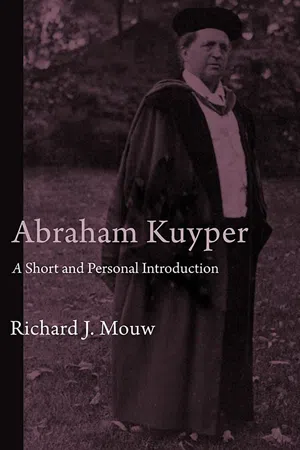
Richard Mouw was first drawn to Abraham Kuyper's writings about public life in the turbulent 1960s. As he struggled to find the right Christian stance toward big social issues such as the civil rights movement and the Vietnam War, Mouw discovered Kuyper's Lectures on Calvinism — and, with it, a robust vision of active Christian involvement in public life that has guided him ever since.
In this "short and personal introduction" Mouw sets forth Kuyper's main ideas on Christian cultural discipleship, including his views on sphere sovereignty, the antithesis, common grace, and more. Mouw looks at ways to update — and, in some places, even correct — Kuyper's thought as he applies it to such twenty-first-century issues as religious and cultural pluralism, technology, and the challenge of Islam.
- 148 pages
- English
- ePUB (mobile friendly)
- Available on iOS & Android
eBook - ePub
About this book
Information
Topic
Theology & ReligionSubtopic
Religious BiographiesSECTION ONE
Kuyper on Theology and Culture:
An Overview
An Overview

Kuyper’s Calvinism
Kuyper started off his career as a Dutch Reformed pastor who was deeply influenced by the liberal theology that he had been taught at the University of Leiden. But in the rural village where he served his first pastorate he encountered parishioners who exhibited a vibrant evangelical faith, and through his contacts with them he experienced a life-changing evangelical conversion. The person who initially influenced him in this regard was Pietje Baltus, the young daughter of a miller. Pietje was known in the community to be a person of deep spirituality, but she did not regularly attend the worship services, choosing instead to meet in private homes with others who shared her Calvinist faith.
When Kuyper found out that she was boycotting his services because of the content of his preaching, he paid her a pastoral visit. When he arrived at her home, she refused to shake his hand. This was a gesture of disrespect, and she was obviously signaling her rejection of his pastoral authority. Instead of being offended, though, Kuyper listened carefully to what she had to say, and he made a point of pursuing further conversations with Pietje and her friends. Later he wrote: “I did not set myself against them, and I still thank my God that I made the choice I did. Their unwavering persistence has been a blessing for my heart, the rise of the morning star in my life.”1
Creation’s “Square Inches”
Having embraced evangelical Calvinism, Kuyper ever thereafter placed a strong emphasis on personal piety. In the midst of his busy public career he wrote hundreds of meditations about the need for the individual believer to turn away from the demands of the active life and retreat into that very private sacred space where the soul is alone with her Maker.
But Kuyper was not content with a religion that was limited to the cultivation of a purely personal spirituality. In addition to his celebration of the experience of a Savior’s love, he also placed a strong emphasis on the supreme Lordship of Jesus Christ over all spheres of social, political, and economic life. Kuyper’s followers are fond of quoting the manifesto he issued at Free University’s inaugural convocation: “There is not a square inch in the whole domain of our human existence over which Christ, who is sovereign over all, does not cry ‘Mine!’ ”2
That manifesto is a good summary of his overall perspective. Calvinism is well known for its insistence that we are saved by grace alone, and that God “elects” those who are to be recipients of this saving grace. This perspective focuses on human sinfulness and divine sovereignty. Out of sheer mercy God does for human beings what they cannot do for themselves. He reaches into the depths of a human heart and irresistibly draws that person to himself.
Many think that’s all they need to know about Calvinism. But Kuyper was not content to leave it there. When God saves us, he insisted, he incorporates us into a community, the people of God. And this community, in turn, is called to serve God’s goals in the larger world. In the life of the church we worship a sovereign God, but that God then commands us to be active witnesses in our daily lives to God’s sovereign rule over all things.
For Kuyper, every Christian is called to be an agent of the Kingdom of Jesus Christ, wherever they are called by God to serve. The system of thought that Kuyper developed was an elaborate spelling out of how we are to understand this call to Kingdom service. How are we to understand God’s intentions in creating the world and—in response to the human rebellion that thwarted God’s creating purposes—in sending the divine Son to reclaim the world that had been so corrupted by sin? Given the continuing presence of sin in the world, how are Christians best to structure and pursue their Kingdom service “out there” in the near and far reaches of the creation? These are the questions that motivated much of Kuyper’s thinking about how Christians are to serve the Lord in the broad reaches of culture.

1. Quoted in Louis Praamsma, Let Christ Be King: Reflections on the Life and Times of Abraham Kuyper (Jordan Station, Ont.: Paideia Press, 1985), 49.
2. Abraham Kuyper, “Sphere Sovereignty,” in Abraham Kuyper: A Centennial Reader, ed. James D. Bratt (Grand Rapids: Eerdmans, 1998), 488.
“Filling the Earth”
Introductions to the study of culture often begin by observing that “culture” carries the meaning of “cultivation.” Thus, agriculture is the cultivation of the agros, Greek for “field”; horticulture is the cultivation of plants; and so on. When we use the word “culture” to apply to human realities, we are referring to the ways in which we human beings cultivate patterns and processes that give meaning to our collective interactions, as well as the things that we “grow” as a result of those interactions.
The Cultural Mandate
For Kuyper, God cares deeply about culture and its development—so deeply that the divine desire that human beings engage in cultural activity was a central motive for God’s creating the world. In the narrative of Genesis 1, immediately after creating human beings in God’s own image, God gives them instructions about how to behave in the garden.
In the three-part mandate of Genesis 1:28, the first thing God tells them is to “be fruitful and multiply.” That is about reproduction. He wants them to procreate, to have children. But when the Lord immediately goes on to tell them to “fill the earth,” that is a different assignment. This “filling” mandate, as viewed by Kuyper and others in the Reformed tradition, is a call to cultural activity—“the cultural mandate.” The first humans are placed in a garden—the raw nature of plants, animals, soil, and rocks—and they are instructed to introduce something new into that garden: the processes and products of human culture.
When the Creator goes on to stipulate that they are to “have dominion” over the garden, that means they must manage—rule over—these patterns and processes of culture in obedience to God’s will. In the well-known formulation of the Westminster Shorter Catechism, our “chief end” as created human beings “is to glorify God and to enjoy him forever”—and at the heart of this glorifying our Maker is our obedient service as God’s designated caretakers in the cultural aspects of created life. Our true “enjoyment” includes our flourishing in the kind of participation in created life that God intends for us.
Here is a simple way of illustrating how all that cultural “filling” activity was meant to go. Imagine a scenario of this sort for the first pair of humans. On their first day together, Adam and Eve decide that they should clear away one small area of the garden as their domestic space, and Adam begins brushing away leaves and twigs with his hands. “No, no! Try this,” Eve says to him, and she breaks a large branch off a nearby tree and strips it of some of its smaller branches. She then uses it to brush leaves and twigs away, in order to create a clear space on the ground. “See,” she says, “we can use this. Let’s call it a rake. And I’ll be the one who uses it today and then after that we’ll take turns every other day clearing away the leaves and twigs.”
In that brief transaction, several projects of cultural formation have already taken place. They have begun to “fill the earth.” Eve has created a piece of technology: out of raw nature she has fashioned a tool. She has transformed a mere stick into a cultural artifact. Then she has given it a name—“rake”—thus articulating a rudimentary labeling system. She has also outlined a pattern of social organization for distributing labor—“we’ll take turns”—as well as setting up a schedule. In all of this she has added several things to the primary garden environment that the Creator has designed, thus developing a new level of human-fashioned reality that is being superimposed upon the raw nature of the garden.
Human Rebellion
That was what God intended for the unfallen creation: that human beings would “fill the earth” by working with the stuff of nature to produce culture. Unfortunately, though, things did not go smoothly. Human beings rebelled against God and disrupted the original design for the creation and for their role in it. What is important for Kuyper’s account, though, is that the fact of our fallenness does not in any way diminish either the reality or the importance of cultural formation. What human rebellion against the will of God does introduce into the picture is that now we have two very different patterns of cultural formation in the world: cultural disobedience as well as cultural obedience.
The Fall occurred when human beings gave into the temptation presented to them by the Serpent. God has told them not to eat the fruit from one of the trees in the garden, and the Serpent challenges them to go ahead and eat it anyway. God is not to be trusted. God knows, says the Serpent, that “when you eat of it your eyes will be opened, and you will be like God” (Genesis 3:5).
This understanding of the nature of sin is crucial for grasping Kuyper’s overall system of thought. He is following the traditional theological idea—featured prominently in the thinking of theologians like St. Augustine and John Calvin—that sin is essentially a state of “ethical rebellion.” Sin does not consist simply in the awareness of our finitude, or a basic anxiety that emerges out of that awareness. The Fall was not about finitude as such, since human beings were at one time both finite and unfallen. What introduced sin into the created order was an act of will, a rebellion against the command of God.
Rejecting the Enlightenment
There is an element in Kuyper’s thinking on this subject that has an interesting link to the way present-day “postmodern” thinkers discuss the defects of “the Enlightenment project.” Enlightenment thought saw human reason—or more generally, an enlightened human consciousness—as the highest standard in the universe for deciding issues of truth and goodness. On that view, if there is anything worthwhile in religion, it conforms to or even reinforces what we “enlightened” human beings can come to know without the aid of any sort of revelation.
The postmodern thinkers who are asking us to reject that Enlightenment way of viewing things are not, of course, asking us to turn to God as the source of meaning and truth. Instead, they are insisting that we human beings are incapable of rising above our finitude; there is no “meta-narrative”—no above-it-all way of viewing things that allows us to critique our individual “social locations” from a perspective informed by “universal reason.”
Like the postmodern thinkers, Kuyper rejected the notion that an enlightened human consciousness can give us access to reliable answers to the big issues of life. Of course, he would disagree with them when they make the creative human will the supreme standard. It is God’s will that governs all things; our own wills need to be turned away from our sinful projects and brought into harmony with the divine will.
Corrupted Culture
When Eve and Adam succumbed to the Serpent’s challenge, then, they turned their wills away from God and placed their ultimate trust in something less than God. This had ramifications for their relationship not only with their Maker, but also with each other and with the rest of creation. They looked at each other in new ways, with suspicion and a propensity for conflict. And the larger creation now fell under a general curse.
To put it mildly, all of this has had very serious effects on cultural activity. Prior to the Fall, the processes and products of culture were directed toward glorifying God; the human pair were managing their cultural activity in obedience to God. After the Fall, the cultural mandate of “filling the earth” underwent a serious change.
Sin certainly does not put an end to cultural activity, but it does pervert it. Not long after the story of Adam and Eve being expelled from Eden, we learn that numbered among their immediate descendents was Jabal, “the ancestor of those who live in tents and have livestock”; Jubal, “the ancestor of all those who play the lyre and pipe”; and Tubal-cain, a craftsman, “who made all kinds of bronze and iron tools” (Genesis 4:20–22). But now all of this cultural activity is scarred by sinful rebellion. W...
Table of contents
- Title Page
- Copyright
- Contents
- Introduction
- Section One: Kuyper on Theology and Culture: An Overview
- Section Two: Kuyper for the Twenty-First Century
Trusted by 375,005 students
Access to over 1.5 million titles for a fair monthly price.
Study more efficiently using our study tools.
Frequently asked questions
Yes, you can cancel anytime from the Subscription tab in your account settings on the Perlego website. Your subscription will stay active until the end of your current billing period. Learn how to cancel your subscription
No, books cannot be downloaded as external files, such as PDFs, for use outside of Perlego. However, you can download books within the Perlego app for offline reading on mobile or tablet. Learn how to download books offline
Perlego offers two plans: Essential and Complete
- Essential is ideal for learners and professionals who enjoy exploring a wide range of subjects. Access the Essential Library with 800,000+ trusted titles and best-sellers across business, personal growth, and the humanities. Includes unlimited reading time and Standard Read Aloud voice.
- Complete: Perfect for advanced learners and researchers needing full, unrestricted access. Unlock 1.5M+ books across hundreds of subjects, including academic and specialized titles. The Complete Plan also includes advanced features like Premium Read Aloud and Research Assistant.
We are an online textbook subscription service, where you can get access to an entire online library for less than the price of a single book per month. With over 1.5 million books across 990+ topics, we’ve got you covered! Learn about our mission
Look out for the read-aloud symbol on your next book to see if you can listen to it. The read-aloud tool reads text aloud for you, highlighting the text as it is being read. You can pause it, speed it up and slow it down. Learn more about Read Aloud
Yes! You can use the Perlego app on both iOS and Android devices to read anytime, anywhere — even offline. Perfect for commutes or when you’re on the go.
Please note we cannot support devices running on iOS 13 and Android 7 or earlier. Learn more about using the app
Please note we cannot support devices running on iOS 13 and Android 7 or earlier. Learn more about using the app
Yes, you can access Abraham Kuyper by Richard J. Mouw in PDF and/or ePUB format, as well as other popular books in Theology & Religion & Religious Biographies. We have over 1.5 million books available in our catalogue for you to explore.