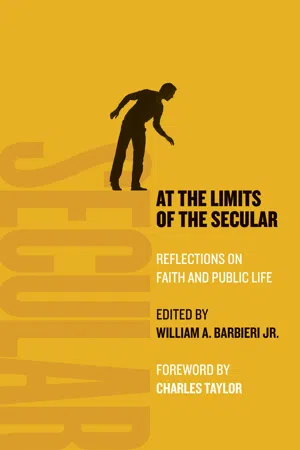
This volume presents an integrated collection of constructive essays by eminent Catholic scholars addressing the new challenges and opportunities facing religious believers under shifting conditions of secularity and "post-secularity."
Using an innovative "keywords" approach,
At the Limits of the Secular is an interdisciplinary effort to think through the implications of secular consciousness for the role of religion in public affairs. The book responds in some ways to Charles Taylor's magnum opus,
A Secular Age, although it also stands on its own. It features an original essay by David Tracy -- the most prominent American Catholic theologian writing today -- and groundbreaking contributions by influential younger theologians such as Peter Casarella, William Cavanaugh, and Vincent Miller.
CONTRIBUTORS
William A. Barbieri Jr.
Peter Casarella
William T. Cavanaugh
Michele Dillon
Mary Doak
Anthony J. Godzieba
Slavica Jakelic
J. Paul Martin
Vincent J. Miller
Philip J. Rossi
Robert J. Schreiter
David Tracy
- 384 pages
- English
- ePUB (mobile friendly)
- Available on iOS & Android
eBook - ePub
About this book
Information
Topic
Theology & ReligionSubtopic
Philosophy of ReligionPart I
Religion and the Public
Public
1. Religion in the Public Realm:
Three Forms of Publicness
Three Forms of Publicness
David Tracy
A defining characteristic of a public realm in modern pluralistic, democratic, secular societies is that the notion of publicness is defined by some understanding of reason. It may be useful, I suggest, to reopen the discussion on religion in the public realm by focusing on three distinct notions of public reason, that is, publicness, from the ancient Greeks until today: hence, Publicness One, Two, and Three.
1. Publicness One as Rational Inquiry: Dialectic and Argument
A truly public discussion must be free inquiry not simply because freedom is a basic value, indeed a human right, but because inquiry precisely as inquiry demands such freedom. For example, any model of theology — whether the classical model fides quaerens intellectum or any contemporary model — demands inquiry and therefore freedom for that inquiry to function.
The central question that this first reflection will address, therefore, is what is inquiry?
On the simplest level, to engage in inquiry is to provide reasons for one’s assertions. To provide reasons is to render one’s claims shareable, public. To provide reasons is to be willing to engage in argument. Argument is the most obvious but not the sole form of all disciplined inquiry. To engage in argument is to make claims and to give the evidence, warrants, and backings for those claims. Argument is not exhausted by the purely deductive procedures of the traditional syllogism or by too narrow understandings of either logic or evidence. The classical scholastic theologians knew this well; the later neo-scholastics, far more concerned with certainty than with understanding and inquiry, did not. To be reasonable does include the need to be logical. To be logical is not to contradict oneself and to be consistent. To argue is also to be as coherent as the subject matter allows. Sometimes — especially on issues of religion — the coherence will be a “rough coherence” or what William James in The Varieties of Religious Experience nicely called “on the whole” coherence. Indeed, James, both facetiously and seriously, named his position on religious issues “on the wholism.” Less imaginatively than James, I have regarded both the evidence for and the desired coherence of strictly religious (as well as aesthetic and ethical) claims of publicness as claims to “relative adequacy” in harmony with Bernard Lonergan’s excellent description of true judgment as a virtual, not absolute, unconditioned. In judgments of coherence, the relevant questions and evidence have been addressed to the relevant community of inquiry. Then one has reached a virtually, never absolute, judgment (usually in religious questions a judgment of relative adequacy). Further, more sophisticated questions and further relevant evidence may occur later. Then one should rationally change one’s earlier judgment. For the present, however, one has the rational right to claim to have reached a reasonable, that is, public judgment (either as knowledge or as reasonable belief).
To argue is also to be satisfied, as Aristotle and Thomas Aquinas insist, with the kind of evidence appropriate to the subject matter under discussion. To argue is to engage — to defend and correct one’s assertions to the larger community of inquiry — by providing the appropriate evidence, warrants, or backings relevant to the concrete subject matter under discussion. Entailed by this commitment to public argument is the willingness to render explicit the criteria appropriate to the particular subject matter under discussion. Those criteria will prove to be — in any case where the question is other than one of pure coherence — criteria of relative adequacy, relative to the appropriate subject matter and relative to the evidence presently available on this subject matter. Such judgmental relative adequacy is in no way equivalent to modern relativism — a desperate position largely determined by a double bind: too narrow a notion of rationality (for example, idealism, positivism, scientism) curiously joined to too weak a notion of the self-correcting power of reason itself. Reason when allowed to function normally can be trusted to reach judgments that are virtually unconditioned, that is, judgments of relative adequacy. As Aristotle, “the master of argument,” rightly insisted, arguments must always be proper to the subject matter under discussion (for example, poetics, rhetoric, metaphysics, logic, ethics, politics, and so on).
For example, to attempt to make a political judgment as an adequate argument on metaphysics or theology (or vice versa) is to commit a category mistake. Political (more accurately with Aristotle ethical-political) arguments are always valid once one has established a metaphysical or theological claim — not in place of that claim.
If there is a community of inquiry, there is a public realm where argument is not merely allowed but demanded of all participants. This means, as well, that truth is likely to lead to some consensus — a reasonable consensus of the community of inquiry cognizant of and guided by the criteria and evidence of the particular subject matter under discussion. In that sense, a community of inquiry must be democratic, even radically egalitarian, that is, public, in the most fundamental sense: the sense that no one is accorded privileged status in an argument, all are equal, all are bound to produce and yield to evidence, warrants, backings. The emerging consensus must be a consensus responsible to the best evidence. That remains the epistemological-ethical heart of any serious notion of inquiry and the first notion of publicness.
Inevitably, as in all inquiry, errors will be made. The self-correcting process of inquiry, however, can and should be trusted to spot and correct those errors as arguments are articulated. All serious inquiry yields its results to the appropriate community of inquiry. Any secular silencing of argued religious public claims — as when religious concerns are, in principle, silenced and ruled inappropriate to the public realm — is a position clearly unreasonable in principle. When that happens, the societal public realm properly instituted by a communally endorsed secularity (democratic, pluralistic, and egalitarian) yields to an ideology of secularism (for example, laïcité in 1905 France).
Many religiously originated positions, even before secular modernity, were argued in the wider public realm, for example, Marsilius of Padua. This became even clearer in modernity where the Catholic social justice traditions since Pope Leo XIII employed a Thomist notion of reason to argue for such ideas as “the common good,” “solidarity,” a “just wage,” human “rights” and “goods,” “religious tolerance,” and “pluralism” for modern secular democratic societies. It is not difficult to find many Catholic ethical and political philosophers and theologians (for example, John Courtney Murray and Jacques Maritain) defending their positions with purely philosophical arguments. To be sure, their philosophies usually originate in some cognitive implications of Catholic theology, for example, analogical theological understandings of the relationship of grace and nature; charity and justice for society; the relational notion of the person (a first theological, then philosophically relational concept distinct from the modern liberal individual); and other social relationships to both church and state. Personalism did not originate, as frequently claimed in histories of modern philosophy, in a modern historical and sociological “personalism.” The notion of the individual person as intrinsically related reality (pros-opon; per-sona) originated among the Cappadocians as a new philosophical category needed to help understand inner Trinitarian relations and was then applied analogously to humans as imago Dei, as grounded in the relational Trinity and thereby relational themselves — hence personalism as distinct from liberal individualism.
In most modern secular democracies the “separation” of church and state, as Charles Taylor has persuasively argued, should welcome this first form of publicness for considering religion in the public realm: reasoned, argued, evidential arguments on social justice. Except possibly in the historically complex case of France (the law of 1905), modern secular church-state separation (as the Second Vatican Council argued) aids all publicly reasoned positions on public issues on justice by religious bodies and religious thinkers. To refuse to endorse such religiously reasoned public contributions to the public realm is, ironically, to betray reason and publicness.
2. Publicness Two: Dialogue with Classics
The first responsibility of inquiry and publicness, therefore, is the responsibility to give reasons, to provide arguments. Argument has traditionally been and remains a primary candidate for inquiry. And yet there is an often unacknowledged (by many liberal theorists) second candidate for publicness as well — one related to, yet distinct from, argument. That candidate is the phenomenon of dialogue or conversation with all classic expressions (whether text, event, symbol, story, image, music; whether in art, ethics, or religion). More exactly, conversation or dialogue is a phenomenon that in a general epistemological sense is scarcely distinguishable from argument. This is so insofar as there is no genuine conversation unless the general criteria for inquiry are also observed: criteria of intelligibility (coherence), truth (warrants/evidence), right (mean what you say you mean), and equality of every person and every other — for example, a text (reading is also a dialogue) — in a conversation-dialogue. These general reasonable criteria are roughly identical to those Jürgen Habermas developed for communication, although Habermas himself is too narrowly focused on argument alone unlike, say, Hans-Georg Gadamer, who defends, correctly in my judgment, dialogue-conversation over argument as the primary form of rational inquiry. Gadamer is to Habermas as Plato is to Aristotle. The public realm is a realm of civilized conversation before it is a realm of argument.
The difficulties of a genuinely public realm in our contemporary secular, democratic societies precede the difficulties of religion in the public realm. Without a more expansive notion of reason than the modern scientistic and merely technical rationality in the public open space of the political realm, the encroaching techno-economic realm, so powerful in societies and globally, will confine argument to efficient means and reject the traditional political arguments over ends or goals as either impossible (because of the pluralism of goods in modern society) or irrelevant (since only technical arguments on efficient means are, on that reading, rational arguments). All else is merely personal preference. Hence, the exclusion of any public discussion of justice for the marginal and poor in a late capitalist increasingly global society with massive global suffering of whole peoples and regions. It is not merely that religion has been excluded from the public realm; increasingly so has a notion of reason more encompassing than either scientistic or techno-economic (solely technical) arguments on means, not ends. The religions, which along with the arts provide powerful visions of the Good for society, are denied entry to the public realm unless they argue in Publicness One terms (as they rightly do on social justice issues) or on purely technical reason terms. Even Habermas — who persuasively analyzes the danger that the techno-economic realm (and therefore solely technical reason) is gradually conquering and colonizing the political realm where we all meet — restricts argument to Publicness One terms. But even Habermas believes that only rights, not goods, can be rationally argued. The question recurs: is there a second form of publicness that can allow reasonable discussion of goods? The American founders assumed that a genuinely public discussion of political ends and values would endure (as occurred in the extraordinary public political discussions of The Federalist Papers). The founders did not foresee a situation where the public realm of political debate and dialogue might be swamped by the techno-economic realm.
The serious intellectual difficulties of the often allied positions of a scientistic (not scientific) model of rationality and a techno-economic realm smothering all public, reasoned, political-ethical discussion of shared values in a pluralistic, democratic secular society like our own endangers any public realm at all. Sometimes it seems that Max Weber’s pessimistic metaphor of the “iron cage” is even more accurate than Habermas’s “colonization” metaphor or Charles Taylor’s far more optimistic reading of secularity (as distinct, of course, from secularism). There is enough social evidence to suggest that we had best pay attention to Taylor’s brilliant new narrative of strong affirmation of the ordinary in a secular world as well as to the more pessimistic readings of Weber and Foucault. At times it does seem that religion has been so privatized that it is merely another consumer-item for personal preference. The public realm is in danger of becoming commercialized (or colonized?) by the juggernaut of the techno-economic and technological powers of late capitalism crushing every alternative reality — religion, art, ethics, and eventually reason itself.
Religion, as a public contribution to the public realm, has been admirably defended by some religious thinkers but abandoned by others whose lives of Christian witness seem relatively unconcerned with the need to think through how the religions can play both a role of witness (a surely admirable role — we always need such witnesses as Amish or cloistered orders) as well as a role of showing how religion can prove to be public-reasoned. That public-reasoned entry of religion into the public realm can happen either through argument (Publicness One) or through dialogue with the great classics, especially the religious classics for visions of the Good, including the good life of an individual and a society. The great religious classics (texts, events, persons, rituals, symbols) even if one is not a believer have much to suggest for reflection by any serious thinker in the public realm. No one has to become a Buddhist to learn from the Buddhist’s unique ability to think and feel equal partner to and even participant in “all sentient beings.” The Buddhist and Taoist traditions are as insightful on ecological issues as the prophetic traditions (Judaism, Christianity, Islam) are on social justice issues. On the former, Buddhist and Taoist traditions seem to me to provide even richer resources for rethinking our relationships with the Earth than the prophetic traditions. On the latter, George Orwell was right to say boldly to his fellow secular thinkers that our secular societies have lived ethically-politically on the interest of the Judeo-Christian traditions of justice and love. Now we are starting to spend not the interest but the capital. Without learning new skills to dialogue with all the classics of all the traditions (starting with our own Catholic Christian tradition) we may well see Weber’s nightmare vision becoming more and more plausible: religion will be privatized with no claim to public truth; art will be marginalized with no claim to disclosing some truth about our condition; science will be interpreted only scientistically; the techno-economic realm, with its global reach, will continue its brilliant successes via technical reason. Then all particular, age-old traditions and all their public resources for reflecting on the Good in their classics will be more and more leveled by contemporary global technology (for example, the new information technologies) and large-capitalist economies.
On that nightmare scenario (not a completely implausible one) any genuinely public realm will become a vague reminder of what once was an open space for any reasonable argument or dialogical account by thoughtful persons discussing the visions of the Good in the classics of religion and art. Reason itself would then become so technicized that it could join a privatized religion and a marginalized art. I...
Table of contents
- Cover
- Contents
- Foreword
- Acknowledgments
- Introduction
- Part I: Religion and the Public
- Public
- Culture
- Catholicity
- Part II: Post-Secularity? Critical Reflections
- Religion
- Post--Secularity
- Tradition
- Part III: In and Beyond a Secular Age:Theological Anthropology
- Imagination
- Agency
- Charity
- Part IV: Religion in a Post--Secular World
- Community
- Humanism
- Pluralism
- Contributors
- Index
Trusted by 375,005 students
Access to over 1.5 million titles for a fair monthly price.
Study more efficiently using our study tools.
Frequently asked questions
Yes, you can cancel anytime from the Subscription tab in your account settings on the Perlego website. Your subscription will stay active until the end of your current billing period. Learn how to cancel your subscription
No, books cannot be downloaded as external files, such as PDFs, for use outside of Perlego. However, you can download books within the Perlego app for offline reading on mobile or tablet. Learn how to download books offline
Perlego offers two plans: Essential and Complete
- Essential is ideal for learners and professionals who enjoy exploring a wide range of subjects. Access the Essential Library with 800,000+ trusted titles and best-sellers across business, personal growth, and the humanities. Includes unlimited reading time and Standard Read Aloud voice.
- Complete: Perfect for advanced learners and researchers needing full, unrestricted access. Unlock 1.5M+ books across hundreds of subjects, including academic and specialized titles. The Complete Plan also includes advanced features like Premium Read Aloud and Research Assistant.
We are an online textbook subscription service, where you can get access to an entire online library for less than the price of a single book per month. With over 1.5 million books across 990+ topics, we’ve got you covered! Learn about our mission
Look out for the read-aloud symbol on your next book to see if you can listen to it. The read-aloud tool reads text aloud for you, highlighting the text as it is being read. You can pause it, speed it up and slow it down. Learn more about Read Aloud
Yes! You can use the Perlego app on both iOS and Android devices to read anytime, anywhere — even offline. Perfect for commutes or when you’re on the go.
Please note we cannot support devices running on iOS 13 and Android 7 or earlier. Learn more about using the app
Please note we cannot support devices running on iOS 13 and Android 7 or earlier. Learn more about using the app
Yes, you can access At the Limits of the Secular by William A. Barbieri in PDF and/or ePUB format, as well as other popular books in Theology & Religion & Philosophy of Religion. We have over 1.5 million books available in our catalogue for you to explore.