A thought-provoking comparative take on two seminal thinkers in Christian history
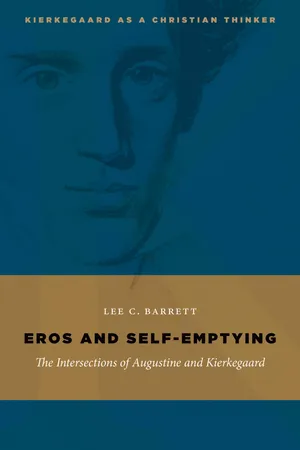
In this book -- the first volume in the Kierkegaard as a Christian Thinker series -- Lee Barrett offers a novel comparative interpretation of early church father Augustine and nineteenth-century philosopher-theologian Soren Kierkegaard.
Though these two intellectual giants have been paired by historians of Western culture, the exact nature of their similarities and differences has never before been probed in detail. Barrett demonstrates that on many essential theological levels Augustine and Kierkegaard were more convergent than divergent. Most significantly, their parallels point to a distinctive understanding of the Christian life as a passion for self-giving love.
Approaching Kierkegaard through the lens of Augustine, Barrett argues, enables the theme of desire for fulfillment in God to be seen as much more central to Kierkegaard's thought than previously imagined.
- 432 pages
- English
- ePUB (mobile friendly)
- Available on iOS & Android
eBook - ePub
About this book
Information
Topic
Theology & ReligionSubtopic
Christian TheologyPart One
Setting the Stage:
Two Pilgrims on the Way Home
Two Pilgrims on the Way Home
Chapter 1
Kierkegaard’s Tensive Picture of Augustine
Many Kierkegaard scholars have noted, usually with considerable surprise, that Kierkegaard seldom comments on Augustine’s work in any sustained way. Neither his journals nor his published writings abound with detailed analyses or critiques of Augustine. In Kierkegaard’s pages, Augustine gets much less attention, for example, than does Socrates or even Luther. Moreover, even cursory references to Augustine are not particularly numerous in Kierkegaard’s writings. What is most shocking, however, is that Kierkegaard does not explicitly mention the Confessions, the book that is usually considered to be most like his own writings — both in style and in substance. Many of the allusions to Augustine that appear in his work seem to be based on lectures about Augustine that Kierkegaard heard or discussions of Augustine in theological and historical textbooks that Kierkegaard read. When Kierkegaard does treat Augustine overtly, he does so unsystematically, often appropriating or attacking themes that are incidental to Augustine’s main purpose. This is certainly odd, given the prevalent (but opposed) perceptions that Kierkegaard either revivified the Augustinian heritage or devoted his career to dismantling it.
However, some scholars have suggested that, in spite of the dearth of direct references, a more indirect and unacknowledged presence of Augustine does indeed pervade Kierkegaard’s writings, and that the latter may not even have been aware of the true nature and extent of his indebtedness. As early as the 1940s, Ernst Moritz Manasse claimed to detect such a deep parallelism between the two thinkers on the importance of self-consciousness in the life of faith that some kind of mediated influence must be posited.1 A few years later, Carl Weltzer attempted to demonstrate that both Søren and his brother Peter were inspired by a renaissance of interest in Augustine that had occurred in Denmark in the early nineteenth century.2 In 1981, Jørgen Pedersen forcefully argued that the structure of Kierkegaard’s thought was implicitly based on the presuppositions of the Augustinian tradition.3 While admitting that Kierkegaard did not engage in any profound study of Augustine, George Pattison, David Gouwens, and many other scholars have suggested that the influence of Augustine was transmitted to Kierkegaard indirectly through the impact that Augustine had exerted on the Lutheran heritage and Western Christendom in general.4 Robert Puchniak has pointed out that, though Kierkegaard’s published works reveal only a few explicit traces of Augustine, his journals do show a more intensive engagement, some of which is appreciative and some of which is critical.5 Given these considerations, Augustine’s influence on Kierkegaard may have been stronger than the relative absence of Augustine in Kierkegaard’s published writings would indicate.
To assess the nature of Augustine’s impact on Kierkegaard, we must first try to reconstruct as best we can Kierkegaard’s acquaintance with Augustine’s writings and the picture of Augustine that he inherited from his intellectual environment. In every era, the popular portrayals of Augustine have been highly selective and have reflected the unique concerns of that particular culture, and nineteenth-century northern Europe was no different in this regard. It was not some alleged Augustine-in-himself that influenced Kierkegaard, but rather Augustine as constructed by a set of nineteenth-century Germans and Danes. This cultural mediation of Augustine is particularly important in Kierkegaard’s case, given the fact that he relied heavily on secondary sources. It is also crucial to take this mediation into account because Kierkegaard always appropriated other authors with an eye to their potential use in his own polemical exchanges with his culture.
The reconstruction of Kierkegaard’s nineteenth-century picture of Augustine is all the more necessary because Augustine’s tentative, rhetorical, and highly contextual writings have uniquely lent themselves to widely divergent appropriations in different eras and different cultural milieus. Although Augustine’s work ranged over almost all the topics dear to subsequent theologians, it was not neatly systematic. Nor were his reflections on these theological topics static. In fact, he freely admitted that he had changed his mind about many matters, sometimes drastically, and confessed that much truth remained hidden from him. For example, in recalling his struggle to understand the origin of the soul, Augustine admits: “I did not know then and I still do not know.”6 The influential Augustine scholar J. J. O’Meara has concluded: “In spite of the picture of him [Augustine] as the great definer of doctrines in the West, he was also profoundly questioning, profoundly aporetic.”7 Augustine was so unsystematic that he often exhibited countervailing tendencies. For example, he harbored a deep countercultural streak, including suspicions of the hubris of empire and the incapacity of philosophy to transform the soul. Nevertheless, he was also willing to appropriate the thought forms of the intellectual elite, to court alliances with the imperial authorities, and even to welcome the use of governmental coercion. Exhibiting another tension, Augustine emphasized human responsibility against the Manicheans, but emphasized the power of divine grace against the Pelagians. He critiqued the Donatist hunger for purity in the church, but continued to conceive of human life as a way toward sanctity. Sensitive to these discordant motifs in Augustine’s texts, James J. O’Donnell has denied that Augustine’s work can be reduced to “a linear, reductionistic narrative of the consecutive transformations of that single personality-entity.”8 According to O’Donnell, Augustine’s thought does not exhibit coherence, control, or integration, for it was a complex composite of seemingly contradictory impulses. Augustine’s works cannot be arranged into a neat system of mutually entailing propositions, and the discrepancies among his writings cannot be dismissed as being merely due to the evolution of his thought.
The piecemeal, rhetorical, and context-specific nature of Augustine’s work has guaranteed that it would be interpreted in a variety of very different ways through the centuries. The proliferation of discrepant interpretations has been exacerbated by the extraordinary authority that has been ascribed to Augustine’s corpus by a host of divergent theological parties. Theologian Mark Ellingsen observes: “Indeed, the entire theology of the post fifth-century Western church might be construed as a commentary on Augustine’s thought.”9 Ellingsen adds that Augustine (or different theologically constructed Augustines) have served as the basic springboards for Catholic, Lutheran, Reformed, and even Wesleyan thought. The Roman Catholic heritage has appealed to an Augustine who claimed that God’s grace enables growth in love so that the soul can be formed for fellowship with God. The Lutheran tradition has claimed the support of an Augustine who exposed the bondage of the will and realized that even the saints can never satisfy God’s law. Reformed Christians have cited the authority of an Augustine who regarded sanctification as an essential component of the Christian life and ascribed all aspects of salvation to the power of God’s sovereign grace. John Wesley invoked a pietist Augustine who proclaimed that sincere faith and an intentional life of discipleship are organically intertwined. Theologians as diverse as Thomas Aquinas and Paul Tillich have discerned an Augustine who based his thought on an assumed correlation of reason and revelation. Emil Brunner discovered a very different Augustine, who — at least at his best — explicated the narrative patterns in the biblical texts and used them as a lens to interpret human experience. Paul Ricoeur found an Augustine who delighted in the multiplicity of potentially edifying meanings that are generated when biblical text and contemporary experience interact. Even the heterodox theosophical traditions, from Paracelsus through Jacob Böhme to Franz Baader, found inspiration and support in Augustine. From the fifth century on, different pictures of Augustine have emerged, depending on which of his works have been highlighted and which issues have been taken to be most central. Because of this plurality of construals of Augustine, it will be necessary to determine exactly what pictures of Augustine were common in Kierkegaard’s intellectual environment.
The effort to reconstruct the specifics of Kierkegaard’s culturally derived picture of Augustine will involve a few different strategies. First, we must attempt to determine which of Augustine’s own writings — or at least which passages in them — Kierkegaard did actually read (insofar as that is possible). Next we will investigate what Kierkegaard probably learned about Augustine through his formal studies and through his own, often desultory, reading. Finally, we will examine Kierkegaard’s sporadic evaluative remarks about various aspects of Augustine’s thought. Having a rough idea of the distinctive characteristics of the German and Danish portraits of Augustine, we can then gauge which of the Augustinian motifs circulating in his culture made an impression on Kierkegaard, and which ones did not. On the basis of these different kinds of evidence we can begin to limn a tentative outline of Kierkegaard’s picture of Augustine.
Kierkegaard’s Firsthand Familiarity with Augustine’s Writings
Although Kierkegaard did not devote the amount of attention to Augustine that he did to such theological giants as Luther, or even the Pietist hymnodist Hans Adolph Brorson, he was by no means ignorant of the Bishop of Hippo and his work. Kierkegaard would have been familiar with at least some of the basic contours of Augustine’s life and writings. However, the way Augustine was presented to Kierkegaard led the latter to be more cognizant of certain aspects of Augustine’s theology than others — and to interpret them in particular ways. The picture of Augustine that Kierkegaard inherited was shaped by the concerns of early-nineteenth-century northern Europeans and was informed ...
Table of contents
- Cover
- Contents
- Foreword
- Explanation of the References
- Sigla
- Introduction: Augustine and Kierkegaard: Rivals or Allies?
- Part One: Setting the Stage: Two Pilgrims on the Way Home
- 1. Kierkegaard’s Tensive Picture of Augustine
- 2. Augustine’s Restless Heart and Kierkegaard’s Desirefor an Eternal Happiness
- 3. Augustine and Kierkegaard on the Road:Life as a Journey
- Part Two: Signposts on the Journey: Specific Theological Intersectionsof Augustine and Kierkegaard
- 4. God: The Attraction and Repulsionof Boundless Love
- 5. Sin: Culpable Action and Corrupt State
- 6. God’s Gracious Response to Sin: The Enigma of Divine Sovereignty and Human Responsibility
- 7. Christology: The Allure of Lowliness
- 8. Salvation: Faithful Love and Loving Faith
- 9. The Church: A Parting of the Ways?
- 10. Conclusion: Two Edifying Theologies of Self--Giving
- Bibliography
- Index
Trusted by 375,005 students
Access to over 1.5 million titles for a fair monthly price.
Study more efficiently using our study tools.
Frequently asked questions
Yes, you can cancel anytime from the Subscription tab in your account settings on the Perlego website. Your subscription will stay active until the end of your current billing period. Learn how to cancel your subscription
No, books cannot be downloaded as external files, such as PDFs, for use outside of Perlego. However, you can download books within the Perlego app for offline reading on mobile or tablet. Learn how to download books offline
We are an online textbook subscription service, where you can get access to an entire online library for less than the price of a single book per month. With over 1.5 million books across 990+ topics, we’ve got you covered! Learn about our mission
Look out for the read-aloud symbol on your next book to see if you can listen to it. The read-aloud tool reads text aloud for you, highlighting the text as it is being read. You can pause it, speed it up and slow it down. Learn more about Read Aloud
Yes! You can use the Perlego app on both iOS and Android devices to read anytime, anywhere — even offline. Perfect for commutes or when you’re on the go.
Please note we cannot support devices running on iOS 13 and Android 7 or earlier. Learn more about using the app
Please note we cannot support devices running on iOS 13 and Android 7 or earlier. Learn more about using the app
Yes, you can access Eros and Self-Emptying by Lee C. Barrett in PDF and/or ePUB format, as well as other popular books in Theology & Religion & Christian Theology. We have over 1.5 million books available in our catalogue for you to explore.