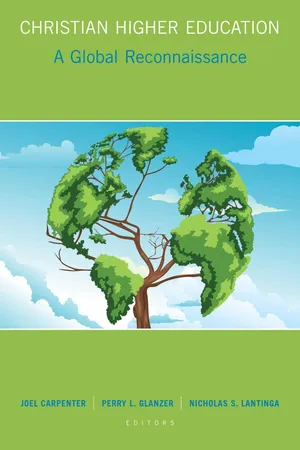
This book offers a fresh report and interpretation of what is happening at the intersection of two great contemporary movements: the rapid growth of higher education worldwide and the rise of world Christianity. It features on-site, evaluative studies by scholars from Africa, Asia, North America, and South America.
Christian Higher Education: A Global Reconnaissance visits some of the hotspots of Christian university development, such as South Korea, Kenya, and Nigeria, and compares what is happening there to places in Canada, the United States, and Europe, where Christian higher education has a longer history. Very little research until now has examined the scope and direction of Christian higher education throughout the world, so this volume fills a real gap.
eBook - ePub
Christian Higher Education
A Global Reconnaissance
- 360 pages
- English
- ePUB (mobile friendly)
- Available on iOS & Android
eBook - ePub
Christian Higher Education
A Global Reconnaissance
About this book
Information
Topic
Teología y religiónSubtopic
Educación superiorChapter 1
Revolution in Higher Education in Nigeria:
The Emergence of Private Universities
The Emergence of Private Universities
Musa A. B. Gaiya
The year 1999 not only ushered in a new democratic regime in Nigeria but also a liberalization of university education. In that year, the government began to charter private-owned universities. From 1948 to 1999, university education in Nigeria was the sole responsibility of the federal and state governments of Nigeria. State governments began to open universities in 1979 with the founding of River State University of Science and Technology, Port-Harcourt; the last, at the time of writing, was Kwara State University. It is expected that more state governments will open their own universities. This is not only a response to the growing need for university education but it is also, as Joel Carpenter rightly argues, a growing desire, mainly in the non-Western world, to respond to the impact of globalization and change society through higher education.1 An innovative move, however, was the establishment of privately owned universities, which has burgeoned since the first four were approved in 1999. At the time of writing, there were forty-one of them, while government universities numbered fifty-one, twenty-seven federal-owned and twenty-four owned by state governments. It has been suggested that Nigeria might need 500 private universities to cope with the demand for higher education.2
The rapid development of private universities raises a number of pertinent questions: Why were private universities, especially Christian ones, established? What are these Christian universities in their nature and objectives? How different are the objectives of private Christian universities from those of secular private universities or public universities? What impact have Christian universities made on students and society? What challenges do Christian universities in Nigeria face? Before attempting to answer these questions, it might be helpful to sketch a history of university education in Nigeria.
University Education in Nigeria
University education started in Nigeria in 1948, when the Yaba Higher College was transformed into University College, Ibadan, and affiliated with the University of London for the award of degrees. This was meant to meet the growing need for high-level manpower. University College, Ibadan, was one of, as Henk J. van Rinsum puts it, “the first so-called Asquith colleges (i.e. colonial colleges meant to serve colonial purposes, especially preparing students to serve in colonial civil service)”;3 the others also established in Africa were Khartoum University College founded in 1947, the University College at Achimota (Gold Coast, now Ghana) established in 1948, and Makerere University College founded in 1949. At independence in 1960, the University College became autonomous and known as the University of Ibadan; in the same year another university was founded in Nsukka modeled after the American system. Other universities established two years later were those in Lagos, Ile-Ife, and Zaria, and the University of Benin that began in 1970. These are called “first-generation universities.”
The “second-generation universities” were established between 1974 and 1977, including those located in Jos, Maiduguri, Kano, Sokoto, Ilorin, Calabar, and Port-Harcourt, and the Nigerian Defence Academy in Kaduna. These universities were to meet the demand for higher education through the Free and Compulsory Education project, a project embarked upon by the federal government of Nigeria at the height of the oil boom. Consequently, payment of fees in universities was abolished and higher education became a right for every Nigerian. There was, therefore, an increase in student enrollment that overstretched available facilities and infrastructure. To cope with high demand for higher education, the federal government of Nigeria created several universities of technology between 1980 and 1992 in Bauchi, Makurdi, Owerri, Abeokuta, Yola, Minna, Akure, and three additional conventional ones at Uyo, Awka, and Abuja, which constituted what is known as the “third-generation universities.”
Some state governments took advantage of the provision in the 1979 constitution, which placed the establishment of universities under the concurrent list of powers to establish their own universities. The first was Rivers State University of Science and Technology, Port-Harcourt, which began in 1979. As we have shown above other states followed suit. But still the absorption capacity of public universities was inadequate. In the 2007-2008 academic year, three million candidates sat for the Joint Admission and Matriculation Board (JAMB) examinations — a necessary requirement for admission into public and private universities in Nigeria. Only about 200,000 — fewer than 7 percent — were given places in various universities in Nigeria.4
These universities have had enormous problems. One of the major problems is funding. The collapse in the revenue accrued from oil in the 1980s affected university education greatly. And between 1999 and 2007, the percentage of budgetary allocation to education as a whole fluctuated wildly, ranging between 6 and 12 percent.5
Even so, these allocations were slight improvements on the allocations to this sector during the military regimes in Nigeria. None of the military leaders had attended university, and one of them, General Sani Abacha, considered university education a luxury. At his time, between 1993 and 1998, universities were shut for six months. Thus the 210 billion naira allocation to education in 2008 was at 13 percent the highest allocation to this sector since independence in 1960.6 Perhaps this improvement came because both the president of Nigeria, Umaru Yar’adua, and his deputy had university degrees and were lecturers in higher institutions of learning in Nigeria. The attention given to education by the present regime was in recognition of the role of education in transforming the nation’s economy into one of the twenty best economies of the world by the year 2020. It should be noted, however, that a 13 percent allocation is half of the 26 percent UNESCO minimum. Difficulties in funding higher education will continue to be a problem in the provision of higher education in Africa. Dantew Teferra and Philip Altbach enumerate some of the ongoing problems on the continent:
- • The pressures of expansion and “massification” t...
Table of contents
- Cover
- Dedication
- Acknowledgements
- Introduction: Christian Universities and the Global Expansion of Higher Education
- 1. Revolution in Higher Education in Nigeria: The Emergence of Private Universities
- 2. Development of Christian Higher Education in Kenya: An Overview
- 3. Rise and Development of Christian Higher Education in China
- 4. Korean Christian Higher Education: History, Tasks, and Vision
- 5. Christian Higher Education in India: The Road We Tread
- 6. Will the Parent Abandon the Child? The Birth, Secularization, and Survival of Christian Higher Education in Western Europe
- 7. Resurrecting Universities with Soul: Christian Higher Education in Post-Communist Europe
- 8. Christian Higher Education in Mexico
- 9. Christian Higher Education in Brazil and Its Challenges
- 10. Quest for Identity and Place: Christian University Education in Canada
- 11. A Renaissance of Christian Higher Education in the United States
- Conclusion: Evaluating the Health of Christian Higher Education around the Globe
- Select Bibliography
- Contributors
- Index
Trusted by 375,005 students
Access to over 1.5 million titles for a fair monthly price.
Study more efficiently using our study tools.
Frequently asked questions
Yes, you can cancel anytime from the Subscription tab in your account settings on the Perlego website. Your subscription will stay active until the end of your current billing period. Learn how to cancel your subscription
No, books cannot be downloaded as external files, such as PDFs, for use outside of Perlego. However, you can download books within the Perlego app for offline reading on mobile or tablet. Learn how to download books offline
Perlego offers two plans: Essential and Complete
- Essential is ideal for learners and professionals who enjoy exploring a wide range of subjects. Access the Essential Library with 800,000+ trusted titles and best-sellers across business, personal growth, and the humanities. Includes unlimited reading time and Standard Read Aloud voice.
- Complete: Perfect for advanced learners and researchers needing full, unrestricted access. Unlock 1.5M+ books across hundreds of subjects, including academic and specialized titles. The Complete Plan also includes advanced features like Premium Read Aloud and Research Assistant.
We are an online textbook subscription service, where you can get access to an entire online library for less than the price of a single book per month. With over 1.5 million books across 990+ topics, we’ve got you covered! Learn about our mission
Look out for the read-aloud symbol on your next book to see if you can listen to it. The read-aloud tool reads text aloud for you, highlighting the text as it is being read. You can pause it, speed it up and slow it down. Learn more about Read Aloud
Yes! You can use the Perlego app on both iOS and Android devices to read anytime, anywhere — even offline. Perfect for commutes or when you’re on the go.
Please note we cannot support devices running on iOS 13 and Android 7 or earlier. Learn more about using the app
Please note we cannot support devices running on iOS 13 and Android 7 or earlier. Learn more about using the app
Yes, you can access Christian Higher Education by Joel Carpenter, Perry L. Glanzer, Nicholas S. Lantinga, Joel Carpenter,Perry L. Glanzer,Nicholas S. Lantinga in PDF and/or ePUB format, as well as other popular books in Teología y religión & Educación superior. We have over 1.5 million books available in our catalogue for you to explore.