For many, the historical-critical method has released a host of threats to Christian faith and confession. In
Pandora's Box Opened, however, Roy Harrisville argues that despite the evils brought upon biblical interpretation by the historical-critical method, there is still hope for it as a discipline.
Harrisville begins by describing the emergence and use of the historical-critical method. He then attends to the malaise that has come over the method, which he says still persists. Finally, Harrisville commends the historical-critical method, though shorn of its arrogance. He claims that the method and all its users comprise a "Pandora's Box" that, when opened, releases "a myriad other pains," but hope still remains.
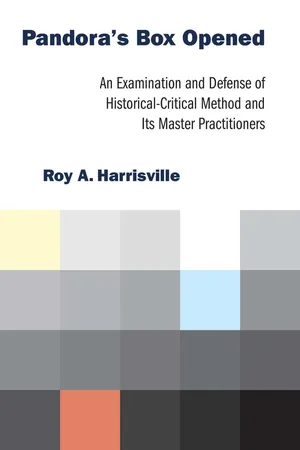
eBook - ePub
Pandora's Box Opened
An Examination and Defense of Historical-Critical Method and Its Master Practitioners
- 376 pages
- English
- ePUB (mobile friendly)
- Available on iOS & Android
eBook - ePub
Pandora's Box Opened
An Examination and Defense of Historical-Critical Method and Its Master Practitioners
About this book
Information
Chapter One
Ancient Thumbnail History
Hermes and Homer
Before the Old and New Testaments were written, text interpretation had enjoyed a long life. It may all have begun with the Greeks, who were repelled by the all-too human antics of the Olympian gods in Homer’s epics and ventured to rehabilitate them by way of allegory. The observation that by this method the Greeks were deliberately reading something into Homer is incorrect. For them the Iliad and Odyssey were a universally recognized authority that contained but one truth. Homer himself had given license to allegorizing when he transformed Hermes, god of life, symbolized by the phallus capping those old stone heaps (herma) that resisted the plow, into a glorious youth who carried messages to humans from the gods above. In this guise the god appears, for example, in Plato’s Symposium:
“And what is that, Diotima?” “A great spirit, Socrates: for the whole of the spiritual is between divine and mortal.” “Possessing what power?” I asked. “Interpreting and transporting human things to the gods and divine things to men; entreaties and sacrifices from below, and ordinances and requitals from above: being midway between, it makes each to supplement the other, so that the whole is combined in one. Through it are conveyed all divination and priest-craft concerning sacrifice and ritual and incantations, and all soothsaying and sorcery.”1
It was this Hermes, scrubbed and cleaned, who would give his name to the practice of interpretation (hermeneuein),2 and with whom the apostle Paul would be identified by the citizens of Lystra in Acts.
In Lystra there was a man sitting who could not use his feet and had never walked. . . . And Paul, looking at him intently and seeing that he had faith to be healed, said in a loud voice, “Stand upright on your feet.” And the man sprang up and began to walk. When the crowds saw what Paul had done, they shouted in the Lycaonian language, “The gods have come down to us in human form!” Barnabas they called Zeus, and Paul they called Hermes, because he was the chief speaker. (Acts 14:8-12)
Before Christ, when syncretism was in vogue, Hermes had been fused with the Egyptian Thoth, “scribe of the gods” or “lord of divine words,” celebrated for bringing humans their trustiest weapon or eruma,3 the logos, word of speech and understanding. In a hodgepodge of oriental and Greek religious literature called the Hermetica appears “Thrice-Greatest Hermes,” whose cult persisted into the post-Christian era and gave the nascent Christian community a considerable run for its money.
Although Plato nursed considerable distaste for Homer’s stories of the gods and their allegorical interpretation, for many Greeks the “reading” of Homer went beyond allegorization. For the philosophically minded, metaphysical insights lay beneath whatever allegory disclosed. Note, for example, Aristotle’s interpretation of the Iliad’s story of Zeus’s summons of the gods to a tug of war in support of his theory of the Unmoved Mover:
Must there, then, or must there not, be something immovable and at rest outside that which is moved and forming no part of it? And must this be true also of the universe? For it would perhaps seem strange if the origin of motion were inside. And so to those who hold this view Homer’s words would seem appropriate.
Nay, ye could never pull down to the earth from the summit of heaven
Zeus, the highest of all, no, not if ye toiled to the utmost.
Come, ye gods and ye goddesses all, set your hands to the hawsers.4
Halakhah and Haggadah
In Jesus’ time and forever after on every Sabbath in every Jewish synagogue one of fifty-four sections of the Tanakh (Torah, Prophets, and Writings) would be read, analogous to the present lectionary practice of the liturgical denominations. Present Jewish scholarship dates the Tanakh’s earliest portions to 500 b.c., and its first five books together with the prophets as constituting a “canon” in 200 b.c. Difficulty emerged when the Torah, regarded by the Jews as revealed by God to Moses on Sinai, thus as holy and unassailable, no longer corresponded to the altered conditions of Jewish life. At this point the Mishnah arose with its dual appeal to the God-given Torah and to oral tradition, likewise revealed at Sinai and given by Moses to the elders of Israel. The latter tradition gave rise to two embattled parties, Pharisees and Sadducees, the former accepting the oral tradition and the latter adhering to the Torah alone.
Since this dual tradition required application to contemporary Jewish life, a system of exposition and interpretation emerged called Midrash, from a Hebrew verb meaning “to investigate,” “to expound,” or “to interpret.” The first of this type to emerge was the Midrash Halakhah, originating in about 200 b.c. and ultimately (exclusively) taken up into the Mishnah. In it all the laws and regulations of the Torah were treated, forming the basis for Jewish religion. The second, later type comprised the Midrash Haggadah, an exposition of biblical narrative by means of stories and legends. The Old Testament pseudepigraphical book of Jubilees, authored ca. 150 b.c., contains halakhic material such as in its rules respecting Sabbath observance:
Let the man who does anything on it die. Every man who will profane this day, who will lie with his wife, and whoever will discuss a matter that he will do on it so that he might make on it a journey for any buying or selling, and whoever draws water on it, which was not prepared for him on the sixth day, and whoever lifts up anything that he will carry to take out of his tent or from his house, let him die. (Jubilees 50:6-9)5
Jubilees also contains haggadic material such as in its portrait of Abram as an amateur astrologer, able to heed God’s command to count the stars:
And in the sixth week, in [the] fifth year, Abram sat up during the night on the first of the seventh month, so that he might observe the stars from evening until daybreak so that he might see what the nature of the year would be with respect to rain. (Jubilees 12:16)6
In the so-called rabbinic period beginning with Jerusalem’s destruction, the rules of Torah interpretation were combined in a few catalogues that later came to be expanded. According to tradition, the earliest catalogue includes the seven rules of Rabbi Hillel (110 b.c.-a.d. 10), one of the two famous teachers in Judaism during the reign of Herod (37-4 b.c.), the other being his adversary Rabbi Shammai (50 b.c.-a.d. 30). The aim of Hillel’s seven rules was to regulate appeal from one biblical text to the other, and to ensure that nothing would be added or taken away from the requirements laid down in the Torah. In the Tannaitic period interpretation was practical and non-allegorical. Only in a later period, that of the Zohar (thirteenth century a.d.) was there an attempt to uncover the mysteries beneath the letter. One of the most well-known of Hillel’s rules is the qal-wachomer, or in its more familiar Latin form, the a minore ad maius, “from the easy to the hard.” The rule reads that a particular conclusion of lighter weight may be applied to a heavier one. A primer on Jewish religious literature furnishes the following illustration:
A man may not burden the ass of his enemy in such a way that he collapses under the load.
In application of the qal-wachomer this means that n...
Table of contents
- Contents
- Preface
- 1. Ancient Thumbnail History
- 2. The Reformation Era
- 3. Orthodoxy and Pietism
- 4. The Enlightenment
- 5. Contemporary in Dissent: Johann Georg Hamann
- 6. The Modern Period
- 7. The Twentieth Century
- 8. Summing Up
- 9. The Malaise
- 10. The Historical-Critical Method Down to Size
- 11. A Last Word
- Index of Names
- Index of Scripture References
Trusted by 375,005 students
Access to over 1.5 million titles for a fair monthly price.
Study more efficiently using our study tools.
Frequently asked questions
Yes, you can cancel anytime from the Subscription tab in your account settings on the Perlego website. Your subscription will stay active until the end of your current billing period. Learn how to cancel your subscription
No, books cannot be downloaded as external files, such as PDFs, for use outside of Perlego. However, you can download books within the Perlego app for offline reading on mobile or tablet. Learn how to download books offline
Perlego offers two plans: Essential and Complete
- Essential is ideal for learners and professionals who enjoy exploring a wide range of subjects. Access the Essential Library with 800,000+ trusted titles and best-sellers across business, personal growth, and the humanities. Includes unlimited reading time and Standard Read Aloud voice.
- Complete: Perfect for advanced learners and researchers needing full, unrestricted access. Unlock 1.5M+ books across hundreds of subjects, including academic and specialized titles. The Complete Plan also includes advanced features like Premium Read Aloud and Research Assistant.
We are an online textbook subscription service, where you can get access to an entire online library for less than the price of a single book per month. With over 1.5 million books across 990+ topics, we’ve got you covered! Learn about our mission
Look out for the read-aloud symbol on your next book to see if you can listen to it. The read-aloud tool reads text aloud for you, highlighting the text as it is being read. You can pause it, speed it up and slow it down. Learn more about Read Aloud
Yes! You can use the Perlego app on both iOS and Android devices to read anytime, anywhere — even offline. Perfect for commutes or when you’re on the go.
Please note we cannot support devices running on iOS 13 and Android 7 or earlier. Learn more about using the app
Please note we cannot support devices running on iOS 13 and Android 7 or earlier. Learn more about using the app
Yes, you can access Pandora's Box Opened by Roy A. Harrisville in PDF and/or ePUB format, as well as other popular books in Theology & Religion & Biblical Criticism & Interpretation. We have over 1.5 million books available in our catalogue for you to explore.