All historical work on Paul presupposes a story concerning the composition of his letters -- which ones he actually wrote, how many pieces they might originally have consisted of, when he wrote them, where from, and why. But the answers given to these questions are often derived in dubious ways.
In
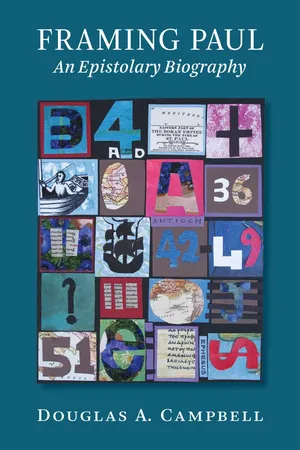
Framing Paul Douglas Campbell reappraises all these issues in rigorous fashion, appealing only to Paul's own epistolary data in order to derive a basic "frame" for the letters on which all subsequent interpretation can be built. Though figuring out the authorship and order of Paul's letters has been thought to be impossible, Campbell's
Framing Paul presents a cogent solution to the puzzle.
- 448 pages
- English
- ePUB (mobile friendly)
- Available on iOS & Android
eBook - ePub
About this book
Information
Chapter One
An Extended Methodological Introduction
1. A Starting Point
Victor Furnish gave voice in an excellent summary article in 1989 to a central challenge within Pauline interpretation: the extraordinary diversity of Paul’s writings, especially at first glance. Even allowing for the assignment of some or even most of the canonical letters written in Paul’s name to other authors — a move that will be scrutinized carefully in due course — the remaining letters are still characterized by a remarkable variation in argumentation, structure, and expression. Just Romans and 1 Corinthians, whose authenticity is usually uncontested, when placed side by side, seem to come not infrequently from overtly different places in conceptual terms. Meanwhile, adding only 2 Corinthians and Galatians to the comparison diversifies the overall situation further, creating a fundamental methodological challenge. How are interpreters to supply a unified account of various aspects of Paul himself as his texts strain in multiple directions?
An important response to this phenomenon was articulated by J. C. Beker (1984 [1980]) in a classic study that is now less read than it ought to be. It is Beker’s initial methodological proposal that concerns us here. He observed that any reconstruction of Paul’s thinking must navigate an interplay within his texts between “contingency” and “coherence.” This proposal seemed to capture much that Pauline scholars had been trying to do, justly passing into standard scholarly parlance, at least for his generation.
“Contingency” denotes the occasionality of Paul’s texts. The interpretative posture being identified here is, more expansively, the conviction that Paul’s letters were crafted and dispatched to deal with quite specific circumstances in the communities to which they were addressed, and hence were shaped significantly by Paul’s perceptions of those particular circumstances. All interpretation of Paul, at any level, must therefore take this dimension into account programmatically. Every statement is not merely a word of and from Paul but also, as Beker famously said, “a word on target” (1984 [1980], 12). (This axiom will be nuanced in due course.)
Beker’s hypothesis speaks immediately to the phenomenon of diversity with which we began. It could be that Paul crafted his letters to speak to specific communities so successfully that the very different communities to which he wrote thereby elicited very diverse communications. If Paul, something like a chameleon, changed his structures, arguments, and terms to reflect the very different situations of his auditors, then any collection of his letters would contain an initially bewildering array of colors and patterns. This is not ultimately surprising if we are explaining a rhetorical chameleon responding to diverse environments — or, in perhaps more positive terms, a good missionary contextualizing his message.
Having said this, however, Beker also insisted that Paul’s letters were nevertheless informed significantly by what he called Paul’s “coherence” — a term that can confuse as much as it clarifies, so it needs to be defined carefully. Coherence denotes for Beker certain important convictions on Paul’s part about God’s activity in Christ and its implications. Beker claimed that a constant coherence in basically this sense is discernible within all of Paul’s different letters — a “deep structure” underlying all the occasional argumentation.1 (He argued more specifically that it was “apocalyptic,” suitably defined, but we do not need to explore this particular proposal just yet.)
But Beker did not just name two important dynamics within Pauline explanation. He named them in relation to one another. By identifying the importance of both contingency and coherence, Beker insisted that Paul’s conceptuality could not simply be read out of Paul’s texts automatically or in any straightforward way; his texts are not simply coherent. Their basic texture is irreducibly contingent. Paul’s coherence can be recovered only through the patient interpretation of their occasional expression. Yet any occasional accounts of these texts must nevertheless be informed, he insisted in equal measure, by some account of Paul’s coherence at work within them. Paul’s contingent texts are infused in some way with an overarching coherence. A single chameleon, we might say, underlies the shifting colors and patterns.
Few if any scholars today accept the exact terms in which Beker set up his dialectical interpretative hypothesis; however, all do accept its basic claims and tend to proceed accordingly: with accounts within any explanation of a Pauline text of its contingency, its coherence, and the interplay between these two dynamics. Indeed, historical work on Paul, whether in toto or in part, is effectively impossible in any other terms. Given the brute fact of textual diversity, an utterly coherent account — the view that Paul is simply providing propositions exclusively drawn from his own theological system — is untenable. Clearly, Paul is overtly circumstantial in much that he writes. But the equally obvious facts of textual overlap coupled with, at the least, occasional moments of sustained argument within letters, not to mention terms and claims held in common across different texts, entail that some degree of coherence must be in play as well. Paul must hold certain propositions constant within and between sentences for much of the time, or his words would be simply random — meaningless — which they patently are not. All scholars in effect concede, then, that contingency and coherence are in play in some sense within all Pauline interpretation, and hence the question of their relationship is posed automatically. Beker’s formulation captures the complex ways in which Paul’s letters both overlap with and diverge from one another in terms that are essentially undeniable. And given its importance, we ought now to probe it a little more deeply.
2. A Conundrum
When we press on Beker’s account, we quickly discover that to name the problems of contingency, coherence, and their relationship within Pauline explanation more broadly is by no means to have resolved them. Beker himself tends to jump straightaway from this prescient articulation to a particular solution rather as a magician pulls a rabbit out of a hat (see, e.g., 1984 [1980], 16-19). He does try to justify his thesis in due course. But his frequent restatements and difficulties (see esp. xiv-xxi)2 indicate that further work on the account of the problem needs to be done before any proposed solution can be successful.
The difficulty begins to emerge when we realize that there are significant variations in the ways key interpreters have understood and correlated the basic dynamics of contingency and coherence. We can consider five important and rather different accounts of their relationship here first.
(i) A more traditional account of Paul tends to read him as a thinker who takes pains to articulate at any given moment only what accords with a carefully constructed prior theological orchestration. The circumstances surrounding each letter therefore catalyze the deployment of some of these resources but do not shape or elicit them in any stronger sense. It is possible simply to extract from the letters the data and arrange it topically without further ado, yielding a description of Paul’s conceptuality that holds together overtly and intelligibly as a theological account. As a result, Paul’s letters are viewed as largely coherent in propositional and even logical terms, merely mediated by their contingency or circumstances.
This is of course a maximal account of Paul’s coherence, although its nature is also being envisaged in certain terms. And most modern interpretation of Paul has been deeply unconvinced by it. But it represents one basic approach to the correlation of contingency and coherence in Paul, arguably lingering in the topical approach of many of the major current accounts of Paul’s theology.3 We can turn now to consider its polar opposite.
(ii) Some interpreters suggest a maximal account of Paul’s contingency that minimizes the role of any coherence — so, for example, the reading offered by Heikki Räisänen.4 Räisänen argues that Paul is a demonstrably ad hoc thinker, manufacturing statements and positions for temporary rhetorical and local advantage. We might say, then, that in each letter he basically tells his auditors whatever their itching ears want to hear, as long as this maintains his own objectives within their situation (and these can be viewed rather diversely, whether in terms of power, money, loyalty, and so on). It is therefore fruitless to search for any overarching coherence, because Paul is a conceptual opportunist. A slightly less cynical variation on this basic approach that also appears at times in Räisänen’s analyses suggests, rather, that he is deeply confused. Paul would deploy coherence if he could, but he cannot hold together the issues that he is debating in a coherent fashion, arguably because his different positions cannot be held together. He tends to paint himself into corners. Different letters — and even some letters within themselves, such as Romans — articulate incommensurate conceptualities, although the overall result is the same: an essentially contingent corpus informed by no basic coherence at all.
Most scholars feel, however, that Paul’s coherence cannot be dissolved completely into momentary rhetorical advantage or confusion, even if at times it can be. So they posit accounts of contingency and coherence that lie somewhere between these two options.
(iii) Beker clearly gestures toward an alternative account of contingency that takes Paul’s coherence more seriously than does Räisänen, without losing sight of the influence of circumstances on the texture of Paul’s texts, as a more traditional account tends to. We have already noted its main suggestions and so will only summarize them here. According to Beker, Paul contextualizes his material within the forms and situations of his auditors so that his letters take on a very different texture for each specific situation. This sensitive hermeneutical behavior on his part does not entail, however, that his coherence has been lost. Rather, it has merely been translated into local idioms, in response to specific local issues — a dynamic account of the presentation of the gospel that Beker rather admires. So a reversal of this process by the Pauline interpreter should be able to recover the coherence that is at work within the letters. We do not reduce Paul’s letters directly to coherence, as in option one, but neither do we abandon coherence altogether, as in option two.
But is this all we need to say? Other scholars have suggested that other key dynamics within this process need to be recognized.
(iv) E. P. Sanders can represent a fourth principal option (at least, in his famous early publications 1977 and 1983).5 Sanders articulates an account of the relationship between contingency and coherence in Paul that lies in effect between Räisänen’s and Beker’s. Like Beker, he is persuaded that coherence can be recovered from Paul’s texts in relation to certain pressing issues that his communities forced him to address. However, like Räisänen, he is not convinced that this coherence is always commensurate. According to Sanders, different issues raised by different situations in different communities can lead Paul to draw on different clusters of coherence as he responds. Within each cluster and in response to certain questions these communications are coherent, but the clusters are not especially coherent when placed side by side. (Although Sanders claims that his account of Paul is coherent in another sense from Beker, namely, that it explains coherently why Paul is often conceptually incoherent: Paul responds consistently to different questions with different systems. But this is of course a very different notion of coherence from Beker’s.)6 In short, Sanders sees Paul’s coherence as possessing areas of what we might call unresolved material. Not everything has been strictly correlated in systematic terms. But there are bunches or clusters of coherent material activated discernibly by different issues.7
Up to this point, our main options have basically assumed that the phenomenon (or not) of conceptual coherence in Paul can be explained in essentially synchronic terms that nevertheless hold firm diachronically: he makes perfect sense consistently at all times; he makes no consistent sense at any time; he translates consistently in every situation; or he draws intelligibly on particular clusters of coherence in relation to particular questions as they arise. But we need now to consider a rather different explanatory angle on our central problem that abandons this assumption.
(v) Some scholars have argued that Paul changes his mind about certain things,...
Table of contents
- Acknowledgments
- Abbreviations
- An Extended Preface
- 1. An Extended Methodological Introduction
- 2. The Epistolary Backbone:Romans and the Corinthian Correspondence
- 3. Augmenting the Backbone: Philippians and Galatians
- 4. Locating the Thessalonian Correspondence
- 5. Locating Philemon, Colossians, and “Ephesians”
- 6. Locating Titus and 1 and 2 Timothy
- Conclusion
- Appendix: The Pauline Letter Frame
- References
- Index of Authors
- Index of Subjects
- Index of Scripture and Other Ancient Literature
Trusted by 375,005 students
Access to over 1.5 million titles for a fair monthly price.
Study more efficiently using our study tools.
Frequently asked questions
Yes, you can cancel anytime from the Subscription tab in your account settings on the Perlego website. Your subscription will stay active until the end of your current billing period. Learn how to cancel your subscription
No, books cannot be downloaded as external files, such as PDFs, for use outside of Perlego. However, you can download books within the Perlego app for offline reading on mobile or tablet. Learn how to download books offline
Perlego offers two plans: Essential and Complete
- Essential is ideal for learners and professionals who enjoy exploring a wide range of subjects. Access the Essential Library with 800,000+ trusted titles and best-sellers across business, personal growth, and the humanities. Includes unlimited reading time and Standard Read Aloud voice.
- Complete: Perfect for advanced learners and researchers needing full, unrestricted access. Unlock 1.5M+ books across hundreds of subjects, including academic and specialized titles. The Complete Plan also includes advanced features like Premium Read Aloud and Research Assistant.
We are an online textbook subscription service, where you can get access to an entire online library for less than the price of a single book per month. With over 1.5 million books across 990+ topics, we’ve got you covered! Learn about our mission
Look out for the read-aloud symbol on your next book to see if you can listen to it. The read-aloud tool reads text aloud for you, highlighting the text as it is being read. You can pause it, speed it up and slow it down. Learn more about Read Aloud
Yes! You can use the Perlego app on both iOS and Android devices to read anytime, anywhere — even offline. Perfect for commutes or when you’re on the go.
Please note we cannot support devices running on iOS 13 and Android 7 or earlier. Learn more about using the app
Please note we cannot support devices running on iOS 13 and Android 7 or earlier. Learn more about using the app
Yes, you can access Framing Paul by Douglas A. Campbell in PDF and/or ePUB format, as well as other popular books in Theology & Religion & Biblical Criticism & Interpretation. We have over 1.5 million books available in our catalogue for you to explore.