A discerning study of a slice of modern Indian Christianity and Christian-Hindu encounter
This book revisits South Indian Christian communities that were studied in 1959 and written about in
Village Christians and Hindu Culture (1968). In 1959 the future of these village congregations was uncertain. Would they grow through conversions or slowly dissolve into the larger Hindu society around them?
John Carman and Chilkuri Vasantha Rao's carefully gathered research fifty years later reveals both the decline of many older congregations and the surprising emergence of new Pentecostal and Baptist churches that emphasize the healing power of Christ. Significantly, the new congregations largely cut across caste lines, including both high castes and outcastes (Dalits).
Carman and Vasantha Rao pay particular attention to the social, political, and religious environment of these Indian village Christians, including their adaptation of indigenous Hindu practices into their Christian faith and observances.
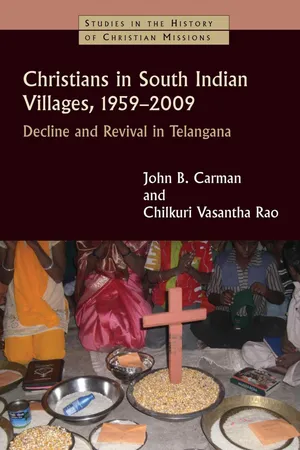
eBook - ePub
Christians in South Indian Villages, 1959-2009
Decline and Revival in Telangana
- 272 pages
- English
- ePUB (mobile friendly)
- Available on iOS & Android
eBook - ePub
Christians in South Indian Villages, 1959-2009
Decline and Revival in Telangana
About this book
Information
Topic
Theology & ReligionSubtopic
Indian & South Asian HistoryChapter 1
Studying and Restudying Village Christians
Review of the 1959 Study
This book began as a return to the churches that were the subject of a study more than fifty years ago. They are village Christian congregations in the Wadiaram pastorate, which belongs to the Medak Diocese of the Church of South India (CSI), a diocese containing churches in and around the city of Hyderabad and stretching northward for more than one hundred miles. The original study, made in 1959 by the Rev. P. Y. Luke, a presbyter in the Medak Diocese, and his wife, Devapala, resulted in the publication of Village Christians and Hindu Culture (1968).1
This was one of several studies (fifteen were eventually published) commissioned by the International Missionary Council, which became part of the World Council of Churches. Supervision of the studies in South India was assigned to the newly founded Christian Institute for the Study of Religion and Society in Bangalore. Its director, Dr. Paul Devanandan, gave John Carman, then a research fellow of the Institute, the task of working with Mr. Luke on this study and writing up the results.
The Institute was concerned about the isolation of urban Christians in India. In cities such as Bangalore and Hyderabad, the friendships and social contacts of educated Christians were largely with other Christians: Christian families arranged for their children to marry other Christians. Some church leaders bemoaned the isolation of Christians from the rest of Indian society. The Institute sought to encourage Christians to learn more about their Hindu neighbors and to work with them in various projects to improve and reform Indian society.
The situation in the village congregations that Luke and his wife studied could hardly have been more different from that of urban Christians. More than half the Christians had married non-Christians, and most Christians had a pattern of life that was both Christian and Hindu. Here is how it was summarized in Village Christians:
At the pastorate headquarters in Wadiaram is a little shrine of the local goddess, Mankali; it stands inside the compound behind the church hall. At this shrine the villagers offer sacrifices to the goddess on a few special occasions, and they call the entire church compound the “Mankali Compound.” This churchyard with two names is symbolic of the spiritual condition of village Christians in the pastorate; both Christian and traditional beliefs and practices exist side by side.
Most Christians have a Hindu or Muslim name as well as a Christian name. Some tie a cross round their necks, and on the same thread put a Hindu charm or talisman. Once when the author (P.Y.L.) was invited into a home to pray with a woman in acute pain, he found the sacred ashes of Kamudu (kept from the bonfire at Holi) smeared over her body in order to ward off the evil spirits. Christians give thank-offerings to Christ, and also pay considerable sums to the wandering religious mendicants of their own caste. They meet regularly to worship Christ, but also on occasion sacrifice a chicken to Poshamma, the goddess of smallpox. They respect their presbyter and sometimes bring him through the village to the evangelist’s house in great procession, yet they consult a Brahmin about auspicious days and hours and ask him to draw up horoscopes for various purposes. They keep a picture of Jesus Christ on the wall of their house, but in a niche in the same wall they have a little image of their household goddess, Balamma or Ellamma. They want the blessings of “Lord Jesus” without incurring the displeasure of any of the village goddesses. Each year many of them celebrate twelve or thirteen Hindu festivals and one Muslim festival (Muharram) as well as the two Christian festivals of Christmas and Easter. In Kondapuram, the washerman who came back from Sadhu Joseph’s healing services and started attending Christian worship said that he could not possibly be baptized because of the religious duties he had to perform for the whole village. To this an elder of the congregation replied, “It does not matter. You can do both. We are doing both and yet we are Christians. We carry out our traditional duties at the village sacrifices, except that we do not eat the meat offered to idols.”2
This earlier study was received with much consternation and some skepticism by Mr. Luke’s colleagues in the diocese. It was embarrassing that the Lukes’ findings differed so sharply from the enthusiastic reports of progress that had been sent to Methodist churches in Great Britain that were supporting the work of the diocese. The embarrassment may have been greater because the situation so resembled that of which Protestants in India had often accused Roman Catholics: a mixture of Christian and Hindu customs and a compromise of Christian principles.
This was not the only striking discovery that the Lukes made, however. From the perspective of Christians in the big cities, the level of village Christian belief and practice was minimal, and in recent years there had been very little Christian preaching to Hindus. Yet in several villages there were some Hindus attending Christian worship, and a few of them were seeking baptism. Some of these people had attended the healing services of a lay Christian, Sadhu Joseph, who said that Jesus had prevented him from committing suicide and had healed him of leprosy. A few Hindus had had their own encounter with Jesus in a dream, who restored them to health. While the earliest members of these congregations had all come from one or both of the two Dalit castes,3 Malas and Madigas, some of the new converts came from so-called higher castes that had previously shown no interest in becoming Christians.
The directive for the World Council studies asked the investigators to look for “signs of life and growth” in the churches studied: these were expected to be found in “the Church’s encounter with its environment.” The 1959 study therefore looked for such signs, seeking for them in responses both to the village Hindu society and to the specific Christian inheritance of church members. These might “be indicated by points of tension and costly personal decision, but also be present in those less conscious” attitudes that help to mold their lives.4
Returning to Achampet in 2008
This present study had already begun when investigators came more than six miles in an auto-rickshaw over a dirt road prior to arriving at the Dalit section of the village of Achampet. The congregation there was one of those where Mr. and Mrs. Luke had lived for three weeks during their study of the Jangarai section of the Wadiaram pastorate, forty-nine years before. At the time, this congregation, while not the largest in the section, seemed to have gone the furthest in developing a distinctive Christian style of life appropriate to its village setting.
Near the village, people on the road signaled for the auto-rickshaw to stop. Garlanded in traditional style, the authors rode the last two hundred yards very slowly. This procession was accompanied by the drums that members of this Dalit caste (the Madigas) had for centuries been obligated to beat on all local ceremonial occasions, including sacrifices to the village goddesses, funeral processions, and weddings within their own Madiga community. The warmth of the welcome and the enthusiasm of the drummers were no less than a half century before.
Turning a corner, however, it was clear that something important had changed. Instead of the old parsonage, whose veranda served as a worship hall, there were now two sheds housing cattle and a third shed storing wood. No “evangelist” (lay pastor and teacher) had been stationed in this congregation for the past thirty years, and it had been three years since the presbyter in charge of the pastorate had paid a visit. Without regular repair, the walls of the parsonage-church had crumbled, after which the land had been occupied by three families of the village’s other Dalit caste, the Malas, none of whom had become Christians. These families claimed that they had originally given the land on which the parsonage had stood. Since the land was no longer being used to provide a home for an evangelist and his family, they were simply reclaiming it. They took the stones from the parsonage and its well for their own houses, filled the well with debris, and up to that time had successfully thwarted all the Christians’ attempts to reconstruct their church building.
The congregation’s sense of its identity, however, had not disappeared. In part this was because its membership had included all within the Madiga caste community. Many of them gathered for a worship service led by the CSI pastors who were with us. This visit was not the first since our 2008 study began. One of our student assistants had already learned a good deal about this nonfunctioning congregation. Unlike many CSI congregations nearby, it had maintained a church roll with information about each family. That inquiry quickly made clear that there had been another major change, for the Madiga families were no longer the only Christians in Achampet.
About twenty years ago, two men from Achampet (one from the potter caste) had made the trip every Sunday to attend worship at a Pentecostal church in the market town of Chegunta.5 They had appealed to the pastor for someone to be sent to Achampet to start an independent church. Pastor Devadass, formerly a member of the CSI congregation in Chinna Shivnur, started a church that he later turned over to Pastor Satyanandam, who is there now. This had included some members of the already long-neglected CSI congregation. One of its leaders had donated a piece of his land on which to build a church. Some other CSI members had contributed their labor for a church building that could hold fifty people, as well as a separate two-room parsonage. While construction was underway, three young men from the landholding Reddy caste tried to prevent the church’s completion, verbally abusing the pastor’s wife and threatening to blow up the building if the pastor and his wife did not leave the village. Six members of the CSI congregation had defended the independent pastor and helped him complete the building.
At first, many of the CSI Christians had attended services and supported the new independent church, which included members of both Dalit castes and seven other castes.6 After some time, however, many of the CSI Christians had stopped attending these services, explaining that the pastor “did not love little children” and “did not tolerate elderly people.” During visits in 2008, they had again pleaded with visiting CSI pastors to help them reclaim the church land and build a new church and parsonage. More recently, an energetic student minister helped them to get the land back and build a worship shed. During the year that he was responsible for this congregation, he tried to come every Sunday to conduct worship.
The situation in Achampet illustrates several developments in the pastorate. During the thirty years prior to 2008, what was once the most active of CSI congregations had not been provided with pastoral care. Its members had then helped to start a new ind...
Table of contents
- Preface
- 1. Studying and Restudying Village Christians
- 2. A Brief History of Developments in Telangana
- 3. Christianity in India and Telangana
- 4. The Village Religion Surrounding Christians
- 5. The Older Congregations in the Jangarai Section
- 6. The Independent Churches
- 7. New CSI Congregations of Different Kinds
- 8. Christian Adaptations of Hindu Practices
- 9. Distinctive Beliefs of CSI Christians
- 10. Healing and Conversion
- 11. Challenges Facing the CSI Congregations
- 12. Challenges Facing a Divided Church
- Appendix
- Glossary
- Bibliography
- Index
Trusted by 375,005 students
Access to over 1.5 million titles for a fair monthly price.
Study more efficiently using our study tools.
Frequently asked questions
Yes, you can cancel anytime from the Subscription tab in your account settings on the Perlego website. Your subscription will stay active until the end of your current billing period. Learn how to cancel your subscription
No, books cannot be downloaded as external files, such as PDFs, for use outside of Perlego. However, you can download books within the Perlego app for offline reading on mobile or tablet. Learn how to download books offline
Perlego offers two plans: Essential and Complete
- Essential is ideal for learners and professionals who enjoy exploring a wide range of subjects. Access the Essential Library with 800,000+ trusted titles and best-sellers across business, personal growth, and the humanities. Includes unlimited reading time and Standard Read Aloud voice.
- Complete: Perfect for advanced learners and researchers needing full, unrestricted access. Unlock 1.5M+ books across hundreds of subjects, including academic and specialized titles. The Complete Plan also includes advanced features like Premium Read Aloud and Research Assistant.
We are an online textbook subscription service, where you can get access to an entire online library for less than the price of a single book per month. With over 1.5 million books across 990+ topics, we’ve got you covered! Learn about our mission
Look out for the read-aloud symbol on your next book to see if you can listen to it. The read-aloud tool reads text aloud for you, highlighting the text as it is being read. You can pause it, speed it up and slow it down. Learn more about Read Aloud
Yes! You can use the Perlego app on both iOS and Android devices to read anytime, anywhere — even offline. Perfect for commutes or when you’re on the go.
Please note we cannot support devices running on iOS 13 and Android 7 or earlier. Learn more about using the app
Please note we cannot support devices running on iOS 13 and Android 7 or earlier. Learn more about using the app
Yes, you can access Christians in South Indian Villages, 1959-2009 by John B. Carman,Chilkuri Vasantha Rao in PDF and/or ePUB format, as well as other popular books in Theology & Religion & Indian & South Asian History. We have over 1.5 million books available in our catalogue for you to explore.