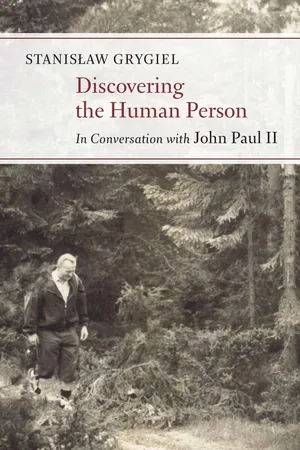
A longtime friend and student of the late Pope John Paul II, Stanislaw Grygiel in this book reflects on the life and thought of this extraordinary pope, giving new insight into his character and his vision of beauty as the path that leads us to God.
More than simply biographical information about John Paul II -- who was Bishop Karol Wojtyla before he became pope -- or a dry academic analysis of his teaching,
Discovering the Human Person derives from Grygiel's extensive firsthand interaction with Wojtyla. Grygiel reflects on the importance of Christian personalism, or communion, as the ground of John Paul II's life, particularly in response to the communist environment that surrounded him in Poland. Grygiel also addresses the pope's call for a new evangelization, his understanding of marriage and family, and the relationship of those to a genuine, healthy understanding of nation and state.
eBook - ePub
Discovering the Human Person
In Conversation with John Paul II
- 192 pages
- English
- ePUB (mobile friendly)
- Available on iOS & Android
eBook - ePub
About this book
Information
Topic
Theology & ReligionSubtopic
Christian DenominationsChapter 1
Vir fortis
Who was Blessed John Paul II? Only God, whose creative thought sustains every human being in existence, knows the answer to this question. None of us fully knows the being indicated by his own name. None of us knows the content of what we desire and choose about our being persons. A person’s name is not a concept. It has no meaning and points to nothing except to indicate the direction in which the person exists, guided by his desire for greater goodness and beauty. According to St. Thomas Aquinas, the person’s name points to the love that takes place in the space opened up within the “great question” (St. Augustine’s magna questio), that is, the question about the mystery of the Origin and the End. We always look at the person from behind, as it were. We see his footprints on the path he has taken, leading in the direction of the Future. We see the actions with which the person enters into the laborious love of others, in order to build with them a home that belongs to all.
The human person receives his name from those who love him laboriously and to whose call he must respond just as laboriously. He receives it from those on whom he fixes his gaze. I would dare to say that this name has its origin in one person’s enraptured listening to another (ex auditu), or when one person fixes his gaze on the gift of love that comes to him in and through the other person.1 When we gaze at another person, something primordial is revealed to us. Everything in our life leads back to this; everything, even the past, continues to exist in it.
In the tradition of the “home” that human persons are for one another, moral obligations arise in them that are not at all to be conflated with the habits that govern present-day society. Such obligations are, rather, identical with the call with which love calls to love. Love is love insofar as it obliges us to love and, as we respond to its call, becomes ever more truly love. Moral obligations sustain in us the hope of finding in Love the salvation promised to man — the salvation we await expectantly.
The person dwells in the other person to the extent that they build a common home together. The very essence of human work consists in this being together. For this reason, to the question, “Who was John Paul II?,” I would respond without hesitation: he was a person who revealed himself in the acts with which he built a “home” together with others. It is precisely in this shared building of a “home” that we must seek the answer to our question. According to Karol Wojtyła, a person reveals himself in his acts.2 These acts show with what message the person approaches other persons — for to be a person means to be sent (missio).
It is the beautiful — the “form of love”3 — that calls man to work. The beautiful reawakens amazement and wonder in us. It fills us with eagerness for life in this world according to a logic that is not of this world. It prompts us to transform our own life into a great poetical work (poiein). In doing this, the human person penetrates the meaning of his existence on this earth and understands everything with heart and mind. He becomes a friend of wisdom, a filosofos. The light of the beautiful allows him to look on the world and himself in a rational way. It frees his eyes, which were “hindered” (cf. Luke 24:16) because in this world, reason, closed in on itself, moves as if groping in the dark. It makes use of the cane that is its own calculation, and thus is a calculating reason (ratio means “calculation” and is derived from the verb reor, reri, to calculate).
In 1977, at the Catholic University of Milan, Cardinal Karol Wojtyła gave a conference that dealt with the sources of his vision of human life and culture. One of these sources emerges in a poem of the Polish poet Cyprian Kamil Norwid (1821-1883), “Promethidion.” I think I can say that in this work, Karol Wojtyła found a confirmation of his adequate anthropology.4 Norwid writes,
Beauty is the form of love . . .
beauty is to make you eager to work —
and work is for a man to gain his resurrection.5
Norwid’s words form a keystone under which the story of man’s life is composed in a harmonious ensemble. This story ends in the resurrection of the person in the other person for whom he works. The struggle with death not for the sake of honor, but for the resurrection, creates a culture of faith, hope, and love. In this struggle, the culture of the truth of man is being born.6
“Tell me who your friends are and I will tell you who you are,” says the proverb. With whom did John Paul II build a “home”? What tradition of “work” did he help to increase as he transmitted it to others? The answers to these questions point to some extent to who he was.
John Paul II shared his life above all with laypeople. From the years of his youth to the end of his life, it was with them that he built a common home. Together with laypeople, he entered into the work of the great figures of Polish history, who have always had to struggle for freedom and learned to suffer for it. At the same time, as a priest and a bishop, he entered into the tradition of three great pastors of the Church of Krakow. On Polish soil, the history of Poland coincides with the history of the Church in the struggle for freedom — and in suffering for it.
* * *
Once, in the first years of Pope John Paul II’s pontificate, I had the courage to tell him that he was very alone in the Church: “You’re criticized not only by theologians, but by priests and even bishops. Holy Father, they don’t understand you!” After reflecting for a while, he answered, “I am not alone. The laity are with me.” In John Paul II’s consciousness, a priestly life shared with laypeople confirmed the evangelical truth of Norwid’s words: “Man? . . . he is a high priest unaware,/And unformed.”7
From his high school years in Wadowice to the years of the Petrine ministry, John Paul II asked the question about man in a poetical-philosophical and poetical-priestly way. He asked this question in dialogue with others and again in the Eucharistic offering (in his priestly life there was not a single day that lacked this introibo to the altar of the Lord). Kneeling before the God-man, John Paul II knelt together with him before the human person to wash his tired feet. He knelt before God, who burns with love for man; and before man, who burns for God. He never knelt before circumstances.
On March 8, 1964, as he was installed as Archbishop of Krakow in Wawel Cathedral, he said, “I think that to be a pastor means to know how to receive everything that others contribute and the burdens that others carry.” To know how to receive means, to a large extent, to know how to give. It is to know how to coordinate, to put together, so that out of all this, the good that is common to all can grow — so that each of us has his or her place in the work of salvation, in the divine plan. Each of us is a great treasure.8
As he matured in his humanity and in his priesthood, Karol Wojtyła saw ever more clearly that he was sent to all. His priestly experience of man gave him the words that we find in the 1986 Letter to Priests: “The priest . . . is ordained . . . to bring people into the new life made accessible by Christ . . . to gather them into his body. . . . In a word, our identity as priests is manifested in the ‘creative’ exercise of the love for souls communicated by Christ Jesus.”9 At the funeral of another priest, he said that priests fight “for the same cause for which Christ fought, and for which the Church fights . . . for the most basic right of man: to know God.”10
As Archbishop of Krakow, Karol Wojtyła continued to open the doors of his house to all people at all times — even at night, if necessary. One could enter directly from the street. He was awake. He was not afraid to receive people even when meeting them could pose a great risk to himself. In the 1970s, I twice accompanied a Russian professor of the Soviet Academy of Sciences to the Archbishop’s residence. The man’s father had been a general and hero of the Soviet Union, who had worked closely with the notorious Lavrentiy Beria, Marshal of the Soviet Union and chief of the Ministry of State Security (NKVD), or the secret police. These dangerous nighttime conversations bore much fruit for the universal Church. They ended with a blessing imparted by Cardinal Wojtyła to the kneeling Russian, whose baptism had been kept secret even from his mother (his...
Table of contents
- Cover
- Foreword
- Introduction
- 1. Vir fortis
- 2. Via pulchritudinis — via crucis
- 3. The New Evangelization
- 4. Marriage and the Family
- 5. Nation and State
Trusted by 375,005 students
Access to over 1.5 million titles for a fair monthly price.
Study more efficiently using our study tools.
Frequently asked questions
Yes, you can cancel anytime from the Subscription tab in your account settings on the Perlego website. Your subscription will stay active until the end of your current billing period. Learn how to cancel your subscription
No, books cannot be downloaded as external files, such as PDFs, for use outside of Perlego. However, you can download books within the Perlego app for offline reading on mobile or tablet. Learn how to download books offline
Perlego offers two plans: Essential and Complete
- Essential is ideal for learners and professionals who enjoy exploring a wide range of subjects. Access the Essential Library with 800,000+ trusted titles and best-sellers across business, personal growth, and the humanities. Includes unlimited reading time and Standard Read Aloud voice.
- Complete: Perfect for advanced learners and researchers needing full, unrestricted access. Unlock 1.5M+ books across hundreds of subjects, including academic and specialized titles. The Complete Plan also includes advanced features like Premium Read Aloud and Research Assistant.
We are an online textbook subscription service, where you can get access to an entire online library for less than the price of a single book per month. With over 1.5 million books across 990+ topics, we’ve got you covered! Learn about our mission
Look out for the read-aloud symbol on your next book to see if you can listen to it. The read-aloud tool reads text aloud for you, highlighting the text as it is being read. You can pause it, speed it up and slow it down. Learn more about Read Aloud
Yes! You can use the Perlego app on both iOS and Android devices to read anytime, anywhere — even offline. Perfect for commutes or when you’re on the go.
Please note we cannot support devices running on iOS 13 and Android 7 or earlier. Learn more about using the app
Please note we cannot support devices running on iOS 13 and Android 7 or earlier. Learn more about using the app
Yes, you can access Discovering the Human Person by Stanislaw Grygiel, Michelle K. Borras in PDF and/or ePUB format, as well as other popular books in Theology & Religion & Christian Denominations. We have over 1.5 million books available in our catalogue for you to explore.