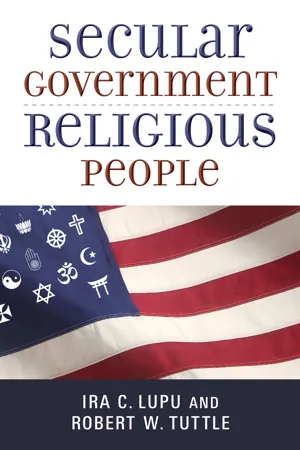
In this book Ira Lupu and Robert Tuttle break through the unproductive American debate over competing religious rights. They present an original theory that makes the secular character of the American government, rather than a set of individual rights, the centerpiece of religious liberty in the United States.
Through a comprehensive treatment of relevant constitutional themes and through their attention to both historical concerns and contemporary controversies — including issues often in the news — Lupu and Tuttle define and defend the secular character of U.S. government.
- 279 pages
- English
- ePUB (mobile friendly)
- Available on iOS & Android
eBook - ePub
Secular Government, Religious People
About this book
Information
Topic
Theology & ReligionSubtopic
American GovernmentChapter 1
A Secular Government for a Religious People
Justice William O. Douglas famously said that “We are a religious people whose institutions presuppose a Supreme Being.”1 The justice was half-right. We are a religious people. Although studies show increasing rates of those who identify as atheist or agnostic, we still have rates of religious belief and observance that consistently rank the United States among the most religious countries in the developed world.2 Religious movements have played central roles throughout American history, from the first European settlements through abolitionism to the contemporary debates over abortion and same-sex marriage. Indeed, many people believe deeply that the nation itself, including its government, has special religious significance.
But Justice Douglas was also half-wrong. Our political institutions do not “presuppose” a Supreme Being. The Constitution does not mention a deity,3 and the institutions described in that founding document are not logically dependent on the idea or existence of a deity. The authority of law does not rest on revealed truth or even the idea of a Supreme Being. Moreover, the Constitution specifically bars any religious test for federal office,4 so government service may not be conditioned on belief in a deity. Although many see a Supreme Being actively at work in the nation, the government may not make that claim. We are a religious people, but we have a secular government.
This book explores the idea of secular government for a religious people. The idea rests on a foundational claim that is often overlooked or rejected — the distinction between the government and the people. The government, in Abraham Lincoln’s words, is “of the people, by the people, and for the people,”5 but the two are distinct. The people have diverse and robust views about religion, and display an impressive range of religious beliefs and practices. The government respects and recognizes those commitments by acknowledging that they exist, by accommodating many of the religious needs of communities and individuals, by providing various forms of assistance to religious entities, and by guaranteeing rights related to religious exercise. But the government does not have a religious identity of its own. Whatever the current religious demography of America, we do not have a Christian state — or a Jewish, Islamic, theist, or atheist state, for that matter.
Some people argue, however, that the idea of secular government is hostile to religion, and effectively establishes an official “religion” of secularism.6 Those concerns are misplaced. Properly understood, the idea of secular government is not hostile or even indifferent to religion. Instead, it simply reflects the limited authority of civil government. The genius of our political system is the distribution of power and responsibilities — some matters lie within the jurisdiction of federal authorities, others belong to the states, and still others belong only to the people. Within the federal government, the executive, legislative, and judicial branches occupy distinct spheres of competence. At their best, these structures and relationships reflect mutual respect among the various institutions, and an awareness that usurpation of another institution’s authority undermines the welfare of the whole.
We believe that the relationship between civil government and religion is similar in important, though certainly not all, respects to the Constitution’s allocation of powers among various political institutions. In the late eighteenth century, most European states — and several states of the United States — assigned the government responsibility to care for the religious welfare of the people. Through various kinds of religious establishments, governments declared and enforced orthodox beliefs, imposed taxes to support ministers and churches, and compelled attendance at worship. The nonestablishment principle withdraws that responsibility from civil government. Under the nonestablishment principle, the government does not promote religious worship, oversee religious indoctrination, or exercise religious authority. Instead, that responsibility belongs solely to the people and their voluntary religious communities.
It may seem unusual to think of nonestablishment in terms of the character and structure of civil government, because most Americans tend to view the relationship between government and religion through the language of rights. In conflicts over that relationship, some emphasize the right to be free from unwanted religious experience, while others assert the right to freely exercise their faith in all dimensions of life, including public institutions. Although their differences are sharp, these rival claims both focus on religious liberty — the right of individuals and communities in religious matters.
In this book, however, we ask how the interaction between religion and government shapes the character of civil authority. By examining the relationship in terms of the character of civil government, we reach a quite different understanding of the nonestablishment principle. As we explain, the nonestablishment principle defines a government that receives its authority from the people, not from revealed or transcendent sources, and that recognizes the limited scope of its authority over the people.
This chapter, which sketches the broad outlines of this approach, begins by looking at why current conflicts over the relationship between government and religion are typically expressed in the language of rights. Then it briefly discusses structural approaches in other legal contexts, most notably federalism and the separation of powers, but also in relations between government and nongovernmental entities such as families. The chapter then moves to the core of our approach, which turns on the idea that religion constitutes a jurisdictional limit on civil government. That limit, we argue, arises from the distinctive relationship between religion and the quality of government authority. Under the nonestablishment principle, the state may not invoke religion as a source of civil authority; must disclaim the comprehensive sweep of religion as a subject within the scope of civil authority; and may not invoke the concept of worship as the character of citizens’ response to civil authority.
As we elaborate later in the book, our understanding of nonestablishment also has striking implications for the government’s role in preserving the religious liberties of the people. Those liberties are protected by a variety of constitutional provisions, including the Free Exercise Clause, as well as through discretionary decisions by government to accommodate religious objections to general laws. Through these mechanisms, the government protects the right of individuals and religious communities to believe, gather for worship, express their faith both within and without their own religious communities, and pursue religiously motivated social practices. Facilitating this collection of rights to religious freedom, however, is not the primary objective of nonestablishment. Nor does the language of rights offer the proper vocabulary or conceptual apparatus within which to frame or analyze nonestablishment.
Indeed, as later chapters emphasize, the principle of nonestablishment carries two important limits on a robust approach to religious liberty. First, the principle limits the state’s power to privilege religion over analogous nonreligious beliefs and practices. Second, the principle constrains government decisions to exempt religious adherents from general laws that burden their exercise of religion, where the exemptions require government officials to make substantive judgments about the religious meaning or importance of the burdened activity.
In the remainder of this introductory chapter we ask whether our approach is consistent with the history of the religion clauses, and whether it finds any support in recent doctrine. The chapter concludes with an overview of the rest of the book, where we explore the jurisdictional understanding of secular government by giving close attention to a number of the most challenging and complex interactions between government and religion.
Nonestablishment and Rights Talk
In this era of the “culture wars,” each day seems to bring another conflict over religion’s place in the political community. The news is thick with stories: about a fight over official prayer at a city council meeting, the expansion of a synagogue, the presence of an evangelical club in a public school’s extracurricular program, and the public funding of an Islamic charter school, to name only a few.7 Although the settings of conflict vary, the basic arguments in the dispute remain essentially the same. One side asserts a right to be free of government-backed religion. This side argues that government endorsement or support of religion violates the rights of those who don’t share the favored beliefs. The other side asserts a countervailing right to full involvement of religious individuals in public life, including the opportunity to express religious views in public spaces, equal access to public funding of religious education and causes, and an equal entitlement to government promotion of religious messages. The conflicts thus involve mutually incompatible claims of rights.
By asserting these rival and incompatible rights, each side ignores half of the Constitution’s distinctive way of connecting secular government and religious people. One group exalts the secularity of the state but dismisses the religious character of the people, and the government’s legitimate responsiveness to that character. The other group denies the distinction between the government and the people, and expects the government to mirror and celebrate the community’s (usually the majority’s) religious identity.
The rhetoric and results of Supreme Court decisions in Establishment Clause cases have tended to reinforce the two sides’ understandings of the conflict. As a vivid and important example, the Supreme Court decided a pair of legal challenges to government-sponsored displays of the Ten Commandments.8 Plaintiffs in the two cases argued that the displays violated the Establishment Clause. Although the texts of the displays were nearly identical, the Court — by 5-4 votes — upheld one and invalidated the other. The diffe...
Table of contents
- Contents
- Acknowledgments
- Introduction
- 1. A Secular Government for a Religious People
- Part I: Civil Government and Religious Institutions
- 2. Civil Authority and the Self--Government of Religious Communities
- 3. Government Funding of Religion
- Part II: Religion Inside Government
- 4. Religious Expression in Public Schools
- 5. Religious Expression in the Public Square
- Part III: Government and the People’s Religious Liberty
- 6. The Core of Religious Liberty
- 7. Government Responsiveness to a Religious People — Forms and Limits
- Conclusion
- 8. The Military Chaplaincy — a Concluding Case Study
- Appendix: Authors’ Note on Town of Greece v. Galloway
- Index
Trusted by 375,005 students
Access to over 1.5 million titles for a fair monthly price.
Study more efficiently using our study tools.
Frequently asked questions
Yes, you can cancel anytime from the Subscription tab in your account settings on the Perlego website. Your subscription will stay active until the end of your current billing period. Learn how to cancel your subscription
No, books cannot be downloaded as external files, such as PDFs, for use outside of Perlego. However, you can download books within the Perlego app for offline reading on mobile or tablet. Learn how to download books offline
Perlego offers two plans: Essential and Complete
- Essential is ideal for learners and professionals who enjoy exploring a wide range of subjects. Access the Essential Library with 800,000+ trusted titles and best-sellers across business, personal growth, and the humanities. Includes unlimited reading time and Standard Read Aloud voice.
- Complete: Perfect for advanced learners and researchers needing full, unrestricted access. Unlock 1.5M+ books across hundreds of subjects, including academic and specialized titles. The Complete Plan also includes advanced features like Premium Read Aloud and Research Assistant.
We are an online textbook subscription service, where you can get access to an entire online library for less than the price of a single book per month. With over 1.5 million books across 990+ topics, we’ve got you covered! Learn about our mission
Look out for the read-aloud symbol on your next book to see if you can listen to it. The read-aloud tool reads text aloud for you, highlighting the text as it is being read. You can pause it, speed it up and slow it down. Learn more about Read Aloud
Yes! You can use the Perlego app on both iOS and Android devices to read anytime, anywhere — even offline. Perfect for commutes or when you’re on the go.
Please note we cannot support devices running on iOS 13 and Android 7 or earlier. Learn more about using the app
Please note we cannot support devices running on iOS 13 and Android 7 or earlier. Learn more about using the app
Yes, you can access Secular Government, Religious People by Ira C. Lupu,Robert W. Tuttle in PDF and/or ePUB format, as well as other popular books in Theology & Religion & American Government. We have over 1.5 million books available in our catalogue for you to explore.