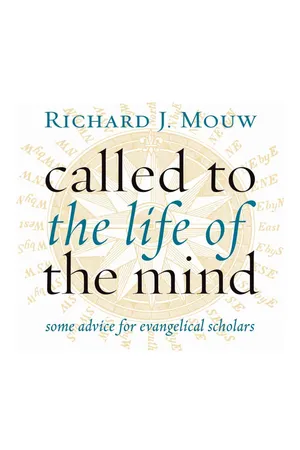
"I wasn't supposed to spend my life in the world of scholarship," Richard Mouw acknowledges at the beginning of
Called to the Life of the Mind. Yet he has indeed spent his career in the academy -- and has become one of the most widely respected evangelical Christian scholars of our time.
In this wise little book Mouw defends Christian scholarship as an important and legitimate endeavor, responding in particular to those traditions that continue to be suspicious of intellectual pursuits. Writing in an inviting, conversational style, Mouw reflects candidly on the faithful Christian cultivation of the life of the mind and offers gentle advice on how Christians, especially evangelicals, might fruitfully navigate the world of the academy as followers of Jesus.
- 80 pages
- English
- ePUB (mobile friendly)
- Available on iOS & Android
eBook - ePub
About this book
Information
Topic
Theology & ReligionSubtopic
Higher Educationone
The Price
I wasn’t supposed to spend my life in the world of scholarship. At least that was not what my family had in mind. I was an evangelical preacher’s son, and the pressure to follow in my father’s footsteps was strong. In my early spiritual environs, higher education was something you suffered through in order to be able to get on with the Lord’s real work: the urgent business of proclaiming the Gospel in all of its simplicity and power.
This “simple-Gospel” emphasis was reinforced by considerable anti-intellectual rhetoric from the pulpits. I remember clearly the loud “amens” that one traveling revival preacher evoked when he told us that, in contrast to what he had learned in the few seminary courses he had taken, “you don’t need exegesis, you just need Jesus!” All that the worldly intellectuals have to offer, another pulpiteer warned us, is a bunch of “fool-osophies.” And there was much more: “Education is a good thing only if you get the victory over it.” “The only school any Christian needs to attend is the Holy Ghost’s school of the Bible.” And so on.
As a student at a large public high school in New Jersey, I belonged to a teenage Bible club composed of students at that school who got together regularly to encourage each other in our Christian walk. One day an alumna of our little group came back to visit us. She had graduated from our high school the year before and was now a student at a large public university. She was home on her spring break and she visited our group to tell us what it was like to be a Christian on a secular university campus. I will never forget her testimony. She told us about a philosophy course she had been taking. It was a very weird subject, she said. The professor tried to get them to ask questions like, What is truth? What is goodness? What is reality? At one point in the course, she reported, he even asked them to think about whether the desks in their rooms continued to exist when no one was perceiving them.
We agreed with her: that was pretty weird stuff. Indeed we shook our heads in disbelief that sensible people could waste their time with such strange thoughts. And then she said something that made a deep impression on me. “I’m glad that I am a Christian,” she said, “because that means that I don’t have to worry about such things. When you know that Christ is the answer, then you don’t have to worry about the questions!”
I remember my reaction well. I was inspired by her straightforward and unadorned faith. And I silently prayed that I too would always have the kind of simple confidence that would keep me from being carried away by philosophical speculation.
But, alas, it was not to be. By the time I got to my sophomore year of college, I realized I was in big trouble. I was actually enjoying my liberal arts education — including philosophy courses in which we asked whether the desks in our rooms continued to exist when we did not perceive them! I had even started thinking that maybe I wanted to spend the rest of my life studying and teaching that kind of thing.
Here I was, then, a student at Christian liberal arts college who was finding my studies an exciting intellectual adventure. What was happening to me? I worried much that not only was I disappointing my family’s hopes for me, but I was also rebelling against the plans that the Lord himself had for my life.
Then one day a guest speaker came to speak in our chapel. Frank Gaebelein, the son of the editor of the Scofield Bible, was a well-known evangelical leader in his own right. He wrote learned articles in Christian magazines and was the headmaster of the Stony Brook School, a prestigious Christian prep school on Long Island.
In contrast to the secularist outlook, said Gaebelein, Christians must insist that “our intellectual life is infused with faith.” But that does not mean that Christian intellectual activity is an easy thing. We must pay a price if we are to use our minds to glorify God. “And the price will not come down. It is nothing less than the discipline of self-restraint and plain hard work.”
I can quote Gaebelein accurately because his talk that day, titled “The Christian’s Intellectual Life,” was later published in a book of his collected writings.1 But even if I did not have the exact words before me, I would not, more than five decades later, have forgotten the thrust of what he had to say. Hearing him was special experience — I see it as a gift from God — that set me on the course of a lifelong commitment to Christian scholarship.
two
Accusing Voices
Making a commitment to the life of the mind, though, did not end my struggle with anti-intellectualism.
On an autumn day in 1970, I traveled from my Michigan home to the Philosophy Department at the University of Chicago for the final oral defense of my Ph. D. dissertation. I gave myself plenty of time, and I arrived at the university with several hours to spare.
Wandering around the campus, I realized that I was quite apprehensive, even though I had no real worries about navigating this final exercise in my graduate program. As I sat in a campus coffee shop, reflecting on my mood, I realized that my inner turmoil had to do with a feeling of guilt in response to some accusing voices inside of me. They were Christian voices from my past, and they spoke the familiar language of that long line of preachers, Bible teachers, and family members. You have compromised with the world, this voice said. You have followed ways of thinking that are not fitting for a child of God. When you clear this final hurdle, it is Satan who will claim the real victory.
I did my best to silence those voices for the next few hours, but later that day, making the long drive back home to Grand Rapids after my successful dissertation defense, I argued back. I told the voices that their accusations were misguided. I was deeply grateful for my years of graduate study and for what I saw — and still see — as a genuine divine call to pursue a career of intellectual exploration, scholarship, and teaching.
Still, I also thanked the voices. And this is important for me to report now. I was grateful to those voices for making me aware of the dangers associated with the intellectual life. You overstate your case, I told the voices, but you are not completely wrong in your basic concerns.
I find it important to continue to stay in dialogue with those voices. They express the concerns of classic Christian pietism — which has often viewed the intellectual life against the background of a cosmic spiritual battle in which the human intellect, especially as it aligns itself with the cause of the academy, is inevitably on the wrong side of the struggle.
And in that continuing dialogue I find it necessary to concede two important points to the accusing voices. One is that there is indeed a spiritual struggle going on in the cosmos. The other is that the intellect does indeed often promote the wrong side of this struggle.
This means that as a Christian I need to be careful not simply to argue for the life of the mind as such — or for the intrinsic value of teaching and scholarship, which are the typical preoccupations of those committed to the life of the mind. Rather, I have an obligation to think carefully about the faithful cultivation of the life of the mind and its primary preoccupations.
I have found it helpful to listen carefully to some Christians’ expressions of anti-intellectualism. Here, for example, is a comment from the opening page of the great devotional classic The Imitation of Christ, where Thomas à Kempis urges us to forsake the pseudo-wisdom of “the world” in order to render our lives wholly “conformable to Christ”:
What use is it to you to argue loftily about the Trinity, if by your lack of humility you are displeasing to the Trinity? For lofty words make no man holy or just; but a lif...
Table of contents
- Contents
- 1. The Price
- 2. Accusing Voices
- 3. The Value Question
- 4. The Need for Calisthenics
- 5. Not Too Much Haste
- 6. The Disillusionment
- 7. Humility and Hope
- 8. Navigating the “Square Inches”
- 9. A Communal Task
- 10. Mutual Encouragement
- 11. Safe Spaces for “Playing Around”
- 12. Academic “Body Life”
- 13. Academic “Hopes and Fears”
- 14. Critique as a “Moment”
- 15. Reality Lovers
- 16. Honoring Creation
- 17. Beholders
- 18. Being Like Jesus in the Academy
- 19. A Loom for Weaving
- Endnotes
Trusted by 375,005 students
Access to over 1.5 million titles for a fair monthly price.
Study more efficiently using our study tools.
Frequently asked questions
Yes, you can cancel anytime from the Subscription tab in your account settings on the Perlego website. Your subscription will stay active until the end of your current billing period. Learn how to cancel your subscription
No, books cannot be downloaded as external files, such as PDFs, for use outside of Perlego. However, you can download books within the Perlego app for offline reading on mobile or tablet. Learn how to download books offline
Perlego offers two plans: Essential and Complete
- Essential is ideal for learners and professionals who enjoy exploring a wide range of subjects. Access the Essential Library with 800,000+ trusted titles and best-sellers across business, personal growth, and the humanities. Includes unlimited reading time and Standard Read Aloud voice.
- Complete: Perfect for advanced learners and researchers needing full, unrestricted access. Unlock 1.5M+ books across hundreds of subjects, including academic and specialized titles. The Complete Plan also includes advanced features like Premium Read Aloud and Research Assistant.
We are an online textbook subscription service, where you can get access to an entire online library for less than the price of a single book per month. With over 1.5 million books across 990+ topics, we’ve got you covered! Learn about our mission
Look out for the read-aloud symbol on your next book to see if you can listen to it. The read-aloud tool reads text aloud for you, highlighting the text as it is being read. You can pause it, speed it up and slow it down. Learn more about Read Aloud
Yes! You can use the Perlego app on both iOS and Android devices to read anytime, anywhere — even offline. Perfect for commutes or when you’re on the go.
Please note we cannot support devices running on iOS 13 and Android 7 or earlier. Learn more about using the app
Please note we cannot support devices running on iOS 13 and Android 7 or earlier. Learn more about using the app
Yes, you can access Called to the Life of the Mind by Richard J. Mouw in PDF and/or ePUB format, as well as other popular books in Theology & Religion & Higher Education. We have over 1.5 million books available in our catalogue for you to explore.