Informed theological guide to the Jewish foundations of the Christian faith
In this very readable sequel to his popular book
Our Father Abraham — which has sold more than 70,000 copies — Marvin Wilson illuminates theological, spiritual, and ethical themes of the Hebrew scriptures that directly affect Christian understanding and experience.
Exploring Our Hebraic Heritage draws from both Christian and Jewish commentary in discussing such topics as thinking theologically about Abraham, understanding the God of Israel and his reputation in the world, and what it means for humans to be created in God's image. Wilson calls for the church to restore, renew, and protect its foundations by studying and appreciating its origins in Judaism.
Designed to serve as an academic classroom text or for use in personal or group study, the book includes hundreds of questions for review and discussion.
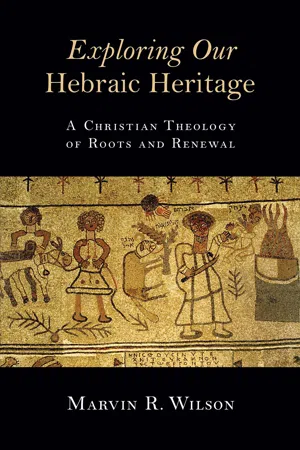
eBook - ePub
Exploring Our Hebraic Heritage
A Christian Theology of Roots and Renewal
- 332 pages
- English
- ePUB (mobile friendly)
- Available on iOS & Android
eBook - ePub
About this book
Information
Topic
Theologie & ReligionSubtopic
Vergleichende ReligionPart IV
On Approaching God
Chapter 10
A Life of Worship
In today’s church, misinformation about worship abounds. The biblical basis of worship is theological, not anthropological. Worship was never designed to make people feel better. In Scripture, worship is directed to the God of Israel. It is in his honor. There is a trend in certain churches today to equate worship with an entertainment type of mentality. People come with a view to “enjoying” the service. To worship is for the audience to feel good or feel happy or feel “blessed.” A main question of concern of some who come to “worship” is, “What am I going to get out of it?”
Yet others approach worship much like spectators at a public event. Their primary intention is to watch some paid religious professional perform certain rituals on their behalf. There is an expectation of decorum and the proper comportment and set formula of a robed functionary to ensure a genuine worship experience. Biblical worship, however, is focused upon neither the worshiper nor the one leading in worship. Praise is directed to the God of Israel. He is the object of worship. True worship focuses on him. Worship involves paying awesome devotion and reverent service from the human heart to the King of the universe. His pattern for Israel is the same as it is for us. We serve him; he does not serve us.
People of Praise
The worship that Christians render must be shaped by an appreciation of how the Jewish community has understood and practiced worship through the centuries. First, at the heart of worship is praise. The word “Jew” (yehudi) is traced back to Jacob and Leah’s son, Judah (yehudah).1 The name Judah is derived from the Hebrew root yadah, to “praise,” to “give thanks.” According to Genesis 29:35, Leah says on the occasion of Judah’s birth, “ ‘This time I will praise [Heb. ʿodeh] the Lord.’ So she named him Judah (yehudah).” In Jacob’s blessing of Judah in Genesis 49:8, a memorable play is made on the word “praise.” Jacob says, “Judah (yehudah), your brothers will praise you (yodukha); your hand (yadekhah) will be on the neck of your enemies.”
After the conquest of Canaan, the name Judah referred to the members of his tribe living in the territory assigned to Judah, the large hilly region running directly west of the Dead Sea (Josh. 15:1-12). From the time of the United Kingdom, the tribal area of Judah must have had a particular appreciation for praise and worship through music. David, a musician from Bethlehem, composed many songs of praise in the Judean hills. In addition, songs of praise by Levitical choirs flowed from the courts of the Temple in Jerusalem built by David’s son Solomon. King Hezekiah, for example, “ordered the Levites to praise the Lord with the words of David and of Asaph the seer. So they sang praises with gladness and bowed their heads and worshipped” (2 Chron. 29:30).
After the kingdom split North and South, the term “Judah” was used for all residents of the Southern Kingdom, which also included the tribe of Benjamin (see 1 Kgs. 12:16-21). Once the Northern Kingdom was destroyed (721 b.c.), the term “Jews” (yehudim) gradually became applied to all the descendants of Jacob, whatever their tribal origin.2
The rabbis, with etymological interest, built upon the above meaning of Judah’s name. Indeed, they taught that to be a Jew is to be a person of praise, one who thanks God for everything. Jews were to do more than to sing songs of praise to the Almighty. Rather, as one Orthodox rabbi once described his calling to me, “I am to be and my life is to be a song of praise to the living God.” Accordingly, one of the greatest sins is that of ingratitude. Traditional Jews, in a given day, praise or bless the Almighty upwards of a hundred times. Praise starts upon awakening. The first prayer a Jew prays is the Modeh Ani, literally, the “I give thanks” prayer. The great nineteenth-century Talmudic scholar Yitzchak Meir pointed out that Jews came to be called Yehudim, after Jacob’s son Judah, because one of the hallmarks of being Jewish is to be continually grateful to God in that God has given Jews more than their rightful share.3 Prayer and praise go together. In the Jewish tradition, “The primary purpose [of prayer] is to praise, sing, to chant.”4
Psalms is the largest book in the Bible. The Hebrew title for this collection of poetry is Tehillim, “praises.” The Hebrew root hll means “to praise.” The Book of Psalms is a work containing dozens of songs of praise. Throughout the history of the Jewish people, one of the keys to their survival has been the ability to sing in the dark experiences of life, particularly in those times of adversity when faith seeks understanding. The singers of Israel were able to proclaim the goodness of God irrespective of life’s circumstances. One of the great praise psalms in Jewish liturgy is Psalm 136. Verses 1-3 read,
Give thanks (hodu) to the Lord, for he is good.
His love endures for ever.
Give thanks (hodu) to the God of gods.
His love endures for ever.
Give thanks (hodu) to the Lord of lords:
His love endures for ever.
Psalm 150 serves as the “Grand Finale” of the collection; it is the “praise psalm” par excellence. It concludes, kol ha-neshamah tehallel yah hallelu-yah, “Let everything that has breath praise the Lord. Praise the Lord” (v. 6). In the beginning, God breathed the “breath of life” (nishmat ḥayyim) into man and he became a living being (Gen. 2:7). From man’s first breath till his last, his calling in life, according to the psalmist, is to give praise to his Creator (see Job 1:20).
Paul’s View of Who Is a Jew
In Romans 2:28-29, Paul defines who is a Jew. His answer is different from most contemporary definitions. As “apostle to the Gentiles” (see Acts 9:15; Gal. 1:16), Paul takes his argument beyond the “outward and physical” (Rom. 2:28) and focuses upon the inward and spiritual (v. 29). A real Jew, in Paul’s view, is one vitalized by the renewing gift of the Spirit within the heart, one whose “praise is not from men, but from God” (v. 29). By employing this spiritual metaphor from the Hebrew Bible, Paul emphasizes the need for one to have a circumcised heart, for this is what God especially cites as exemplary. Such a person is the object of God’s praise in that this “circumcising” work focuses on inward transformation through the Spirit of God. Inwardly, through a sincere faith, one spiritually consecrates oneself to God and thereby rolls away any impediment or obstacle that may block God’s genuine and deep work in the human heart (see Deut. 30:6; Jer. 4:4; Ezek. 36:26-27; also Josh. 5:9). For Paul, the ritual cutting of flesh is not enough. All outward ceremonial acts are intended to point beyond themselves to a deeper spiritual meaning. As the Scriptures of Israel teach, “Man looks at the outward appearance, but the Lord looks at the heart” (1 Sam. 16:7; also Ps. 51:10, 17).
In the above verses from Romans that emphasize inward spiritual identity rather than the purely physical, Paul is apparently playing on the Hebrew word for “Jew,” Yehudi. According to Joseph Fitzmyer, “In popular etymology [Yehudah] was often explained as the passive of hodah, ‘(someone) praised.’ Thus the person with the circumcised heart is the one ‘praised’ in God’s sight, the real Jew. Cf. Gen. 29:35; 49:8.”5 So, for Paul, praise cuts both ways as a kind of spiritual reciprocity: those who are recipients of God’s praise are those who have come to know God inwardly through the Spirit (Rom. 2:29). Their response, in return, is a life of active praise. Energized by God’s Spirit within, such believers are exhorted to “pray in the Spirit on all occasions” (Eph. 6:18). Paul also instructs, “Sing and make music in your heart to the Lord, always giving thanks to God the Father for everything” (Eph. 5:19-20).
Praise is a thematic pillar of Hebraic heritage; it is a key to spiritual self-definition. As the psalmist declares, “I will extol the Lord at all times; his praise will always be on my lips” (Ps. 34:1). Christians, like Jews, are to be people of praise. In Christian hymnology, a fitting reminder of this task is the song “The God of Abraham Praise,” a hymn of the church whose tune, sung in a minor key, is derived from a synagogue melody. Furthermore, the words of the Book of Common Prayer leading into the Eucharist are instructive for all Christians. They call believers to enter Israel’s vocation as people of praise: “It is indeed right; it is our duty and our joy at all times and in all places to give you thanks and praise.”
Paul’s emphasis above in defining who is a Jew not only as a matter of physical descent or ethnicity but of spiritual circumcision of the heart was an important teaching for the apostle to the Gentiles to communicate to Rome and other young churches of the Mediterranean world. However, the language must have been difficult — if not threatening or subversive — to the larger Jewish community around him; it meant some serious rethinking about the oldest rite in Judaism, God’s everlasting covenant in the fles...
Table of contents
- Pronunciation Key for Transliterated Hebrew Words
- Preface
- I. Theological Sources and Methods
- II. People of God: An Abrahamic Family
- III. God and His Ways
- IV. On Approaching God
- V. Moving into the Future
- A Selective Bibliography
- Index of Biblical Texts
- Index of Rabbinic Literature
- Index of Authors
- Index of Subjects
Trusted by 375,005 students
Access to over 1.5 million titles for a fair monthly price.
Study more efficiently using our study tools.
Frequently asked questions
Yes, you can cancel anytime from the Subscription tab in your account settings on the Perlego website. Your subscription will stay active until the end of your current billing period. Learn how to cancel your subscription
No, books cannot be downloaded as external files, such as PDFs, for use outside of Perlego. However, you can download books within the Perlego app for offline reading on mobile or tablet. Learn how to download books offline
Perlego offers two plans: Essential and Complete
- Essential is ideal for learners and professionals who enjoy exploring a wide range of subjects. Access the Essential Library with 800,000+ trusted titles and best-sellers across business, personal growth, and the humanities. Includes unlimited reading time and Standard Read Aloud voice.
- Complete: Perfect for advanced learners and researchers needing full, unrestricted access. Unlock 1.5M+ books across hundreds of subjects, including academic and specialized titles. The Complete Plan also includes advanced features like Premium Read Aloud and Research Assistant.
We are an online textbook subscription service, where you can get access to an entire online library for less than the price of a single book per month. With over 1.5 million books across 990+ topics, we’ve got you covered! Learn about our mission
Look out for the read-aloud symbol on your next book to see if you can listen to it. The read-aloud tool reads text aloud for you, highlighting the text as it is being read. You can pause it, speed it up and slow it down. Learn more about Read Aloud
Yes! You can use the Perlego app on both iOS and Android devices to read anytime, anywhere — even offline. Perfect for commutes or when you’re on the go.
Please note we cannot support devices running on iOS 13 and Android 7 or earlier. Learn more about using the app
Please note we cannot support devices running on iOS 13 and Android 7 or earlier. Learn more about using the app
Yes, you can access Exploring Our Hebraic Heritage by Marvin R. Wilson in PDF and/or ePUB format, as well as other popular books in Theologie & Religion & Vergleichende Religion. We have over 1.5 million books available in our catalogue for you to explore.