In this invitingly written, deeply joyful book, Joyce Ann Zimmerman makes Scripture her foundation as she explores the meaning and purpose of authentic Christian worship today. Intended for Christian communities across the denominational spectrum,
Worship with Gladness will appeal to a wide audience of pastors, worship leaders, college students, and lay readers.
Zimmerman discusses such subjects as the common elements of worship that transcend denominational boundaries, what Scripture tells us about participating in worship, and how authentic worship expresses itself in daily living. Each section concludes with thoughtful prompts that will encourage readers to reflect on and apply what Zimmerman discusses. Throughout the book she encourages readers not only to better understand worship but to better understand -- and rejoice in -- the One we worship.
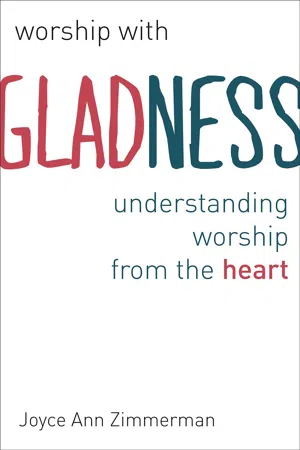
- 192 pages
- English
- ePUB (mobile friendly)
- Available on iOS & Android
eBook - ePub
About this book
Information
Topic
Theology & ReligionSubtopic
Christian Rituals & Practicechapter 1
Worship: Withering or Greening?
All people that on earth do dwell,
Sing to the Lord with cheerful voice;
Him serve with mirth, his praise forth tell;
Come ye before him and rejoice.
Sing to the Lord with cheerful voice;
Him serve with mirth, his praise forth tell;
Come ye before him and rejoice.
William Kethe, “All People That on Earth Do Dwell,” verse 1
The Issue: What, Really, Is Worship?
Worship is much easier to celebrate than to describe! Worship is much easier to describe than to define! Once we move beyond the “givens,” we often do not have a whole lot to say about worship. And yet, deep down, we all know when worship satisfies us or when worship leaves us feeling empty, when we hunger for more in worship or when we know we need to change how we worship.
One reason why worship in itself is so difficult to grasp is because there are so many variations on what worship is. When we visit other churches and participate in their services, we are comfortable with what is familiar to us from our own tradition, but we tend to be a bit uncomfortable with the unfamiliar. We may be fascinated by what is creative, new, or different, but fidelity to regular worship requires that we participate enough in a worship style or element that it is internalized, becomes comfortable and familiar. The reason for this need for “ownership” of worship is that without it worship can easily become focused on itself: on what we are doing, on how the elements are structured, on what is missing, on the relative importance or novelty of this or that element.
Another reason why worship is a knotty issue is because the Triune God we worship is not like us. Even Jesus, who became incarnate and dwelled among us (John 1:14) and was like us in all things except sin (2 Cor. 5:21), still was God. He had the power in the Spirit to heal, forgive, command nature, multiply bread and fishes, change water into wine, expel demons, raise the dead. If our understanding of God is as the divine One who is far away, judgmental, or demanding, our worship will reflect this. It will be difficult to find solace and satisfaction in worship. Worship will tend to be directed to placating such an exacting God or bargaining for what we need, but all with a sense of our own diminishment. Worship will be more duty than delight. On the other hand, if we experience God as the divine One who is compassionate and caring, loving and patient, kind and merciful, our worship will reflect this kind of relationship. We will approach worship with expectations and enthusiasm, assurance of forgiveness and help, and confidence that God hears us and answers our prayers. This worship is nothing less than a mutual exchange of love. This worship is pure joy, grace-filled, freeing.
A third reason that worship can be so hard to grasp is that so much of our society around us seems to hold devout people hostage. Sunday as a day of rest spent with family and friends seems to be all but lost for too many people. Shopping is a big culprit here, and we enable it by choosing to be in the “big box” stores and malls. Because of such activities, those who must work on Sunday and be away from family are not limited to emergency and helping professions (firefighters, police, doctors, nurses, social workers, etc.); now store managers and salesclerks are required to be on duty. Family prayer often took place at family mealtime, but packed schedules pulling us in many directions in so many cases force us to grab fast food on the run to the next activity. When both parents work long hours, it leaves them little quality time at home with each other, let alone with their children. The elderly are forgotten, and the values that naturally get passed on with the younger generations rubbing shoulders often with the older generations are too frequently lost.
Much has been said about our present “entitlement” generation, and this, too, can militate against a good worship ethic. If I expect everything about my life to revolve around me, and I expect to receive without any cost or consequences whatever I wish to have at the moment, then it is difficult to switch gears and surrender myself to Someone larger than myself outside of myself. Worship always involves giving myself — and my pleasures, needs, desires — over to something and Someone bigger than myself. If the universe revolves around my whims and wants, then it will be very difficult for me to adjust to any call to worship.
Yet another reason for our confusion about worship is that, subconsciously, we have so many other gods demanding our time, attention, and affection. Sports certainly would rank high on this list. Ball games (local, collegiate, and professional) now are sometimes scheduled on Sunday mornings, a traditional church time for Christians. Even Christmas and Easter are not exempt from the ubiquitous sporting events. Not too many years ago, Cincinnati, Ohio, was faced with an interesting dilemma. Traditionally the home of the first major league game of the baseball season (because that is where the first professional team was formed), first-game day in that city is always celebrated with a large parade and great festivities. One year, first-game day fell on Good Friday, and this coincidence precipitated a huge debate in the media. How could the tradition of first-game day be broken? Thankfully, this sacred day for Christians won the day! It was decided that the game would be played on Friday as scheduled, but the parade and festivities would be moved to Thursday. The very fact that such a debate arose (schedules are made out months ahead of time, and “Good Friday” probably escaped the schedulers) and lasted for as long as it did indicated something good. The people of Cincinnati somehow sensed that it was not quite right to have revelry on the very day we commemorate Jesus’ suffering and death on the cross. The sports-god temptation includes such a diversity of pulls as golf tee times, Sunday-morning football analysis programs, and practice times scheduled in overbooked facilities. Part of the difficulty here is that sports can be wholesome activities involving exercise, learning team effort, travel, gleeful release, and so on. In themselves, sports are certainly not bad. But when sports become the center of our lives, and especially when sports get in the way of quality worship time, then something is amiss.
Another god militating against our deep internalization of worship, especially Sunday worship, is our own busy lives. By the time we get to Sunday, still a day when most of us do not have to get up to go to work, we are absolutely exhausted. We may party hard and late on Saturday night, and when we do finally fall into bed, our last thought is Good — I don’t have to get up to my alarm clock tomorrow; I can sleep in. The thought of setting an alarm, getting up before we are completely rested or ready, dressing up for an important occasion, and getting to church is just too much for us to bear. It certainly is much easier to sleep in than make the effort to get to worship.
Finally, worship is sometimes hard to understand because it is poorly done, is too much of a contrast to our noisy lives, or challenges us and our way of living so that we are faced with needing to change or remaining uncomfortable with ourselves. Once we get into lifestyle patterns, it is very difficult to change them. Worship itself can become a lifestyle — in terms of setting aside regular, quality time to be at church with others, as well as oftentimes during the day turning our hearts and thoughts toward God. But for this to happen, it takes work on our part, a good bit of the effort literally being a choice to be countercultural. Many of us seem to be on a freight train on a fast track to nowhere. Worship calls us to slow down, quiet down, and set our priorities straight. Unless we consciously choose to do this, worship will wither away, not only in our own lives but essentially in society as a whole. Change is always costly. We must give up something in order to gain something we believe is better. And good worship always challenges us to change, to be transformed. Worship leaves us different, or it is not doing what it is supposed to do. The “different” is that we are more closely aligned with God — our will to the divine will. We are more deeply into a loving relationship with God — offering our imperfect human love in response to the divine overtures of perfect, unfailing love.
In spite of all this seeming withering of worship, we must be careful that we do not get too negative about what people do or don’t do, how often they attend services, or what seem to be attitudes about worship among the majority. One of the temptations in evaluating worship and worship-like church activities is that we place a great deal of emphasis on numbers. And, of course, this is natural. Who wouldn’t be pleased when, having planned a church formation program to study the Gospel of St. Mark, several hundred people show up the first night? Who wouldn’t be pleased to have attendance at Sunday services equal attendance at the local high school’s state championship football game? Who wouldn’t be pleased to have the weekly Bible study group mushroom into a dozen energetic groups? Numbers are easily calculated. But they do not tell the whole story.
God obviously does not act on sheer numbers alone. Consider Abraham’s bargaining with God (Gen. 18:22-33). Sodom and Gomorrah had become cities filled with people with “very grave sin.” So Abraham begs God to spare the cities if there are fifty righteous people (that is, in right relationship with God and each other) living there. God agrees. Then Abraham bargains for the cities’ salvation if forty righteous people can be found. Then thirty. Then twenty. Then ten. In all cases, God agrees. How bold is Abraham! How relenting and yielding is God! The story in Genesis stops with ten righteous people, and Sodom and Gomorrah are destroyed. Hm. Supposing Abraham had kept bargaining? Could he have worn God down to relenting divine punishment for only one righteous person? Genesis does not give us the answer, but Jesus does. All of Chapter 15 in Luke’s Gospel is an answer, for there we find the three great parables of mercy: the shepherd who leaves ninety-nine sheep to go find the one lost (not a very good economic gamble, but a great loving risk); the woman who wastes lamp oil looking, energy sweeping, and time searching to find one coin out of ten she loses (not a very good return on personal expenditure, but a great joy in the finding); and the prodigal father who not only takes back his wayward son but runs out to meet him, kisses him, clothes him in a garment worthy of an heir, bestows jewelry on him, and throws a feast (not a very good way to keep proper hierarchy in the household, but a great fatherly relating). No, God is not very concerned with numbers alone. God desires only that in our worship we open our lips to declare divine praises (Ps. 51:15) and that we offer God our very selves in service of others:
“With what shall I come before the Lord,
and bow myself before God on high?
Shall I come before him with burnt offerings,
with calves a year old?
Will the Lord be pleased with thousands of rams,
with ten thousands of rivers of oil?
Shall I give my firstborn for my transgression,
the fruit of my body for the sin of my soul?”
He has told you, O mortal, what is good;
and what does the Lord require of you
but to do justice, and to love kindness,
and to walk humbly with your God? (Mic. 6:6-8)
and bow myself before God on high?
Shall I come before him with burnt offerings,
with calves a year old?
Will the Lord be pleased with thousands of rams,
with ten thousands of rivers of oil?
Shall I give my firstborn for my transgression,
the fruit of my body for the sin of my soul?”
He has told you, O mortal, what is good;
and what does the Lord require of you
but to do justice, and to love kindness,
and to walk humbly with your God? (Mic. 6:6-8)
This kind of worship — emulating God’s care and largesse toward us — has a common echo in the prophets. Amos says something very similar to what Micah does (Amos 5:21-24). Hosea says it quite succinctly: “For I desire steadfast love and not sacrifice, the knowledge of God rather than burnt offerings” (Hos. 6:6).
There are many positive signs in our society that worship is still quite healthy, that our worship is in a constant process of greening. Our country is a world leader in philanthropy — and not just the kind of aid given by the government (which often is motivated by politics and self-interest). Private foundations and individuals are most generous when needs arise. When a natural disaster strikes, for example, not only do we donate money, but countless people drop their own everyday lives and travel many ...
Table of contents
- Cover
- Contents
- Foreword
- Introduction
- 1. Worship: Withering or Greening?
- 2. God’s Word: A Primer on Worship?
- 3. Who We Are before God: “Do You Not Know . . . ?”
- 4. Being Together before God: Is Worship Making a Difference in How We Live?
- Conclusion
- Index of Subjects
- Index of Biblical References
Trusted by 375,005 students
Access to over 1.5 million titles for a fair monthly price.
Study more efficiently using our study tools.
Frequently asked questions
Yes, you can cancel anytime from the Subscription tab in your account settings on the Perlego website. Your subscription will stay active until the end of your current billing period. Learn how to cancel your subscription
No, books cannot be downloaded as external files, such as PDFs, for use outside of Perlego. However, you can download books within the Perlego app for offline reading on mobile or tablet. Learn how to download books offline
Perlego offers two plans: Essential and Complete
- Essential is ideal for learners and professionals who enjoy exploring a wide range of subjects. Access the Essential Library with 800,000+ trusted titles and best-sellers across business, personal growth, and the humanities. Includes unlimited reading time and Standard Read Aloud voice.
- Complete: Perfect for advanced learners and researchers needing full, unrestricted access. Unlock 1.5M+ books across hundreds of subjects, including academic and specialized titles. The Complete Plan also includes advanced features like Premium Read Aloud and Research Assistant.
We are an online textbook subscription service, where you can get access to an entire online library for less than the price of a single book per month. With over 1.5 million books across 990+ topics, we’ve got you covered! Learn about our mission
Look out for the read-aloud symbol on your next book to see if you can listen to it. The read-aloud tool reads text aloud for you, highlighting the text as it is being read. You can pause it, speed it up and slow it down. Learn more about Read Aloud
Yes! You can use the Perlego app on both iOS and Android devices to read anytime, anywhere — even offline. Perfect for commutes or when you’re on the go.
Please note we cannot support devices running on iOS 13 and Android 7 or earlier. Learn more about using the app
Please note we cannot support devices running on iOS 13 and Android 7 or earlier. Learn more about using the app
Yes, you can access Worship with Gladness by Joyce Ann Zimmerman in PDF and/or ePUB format, as well as other popular books in Theology & Religion & Christian Rituals & Practice. We have over 1.5 million books available in our catalogue for you to explore.