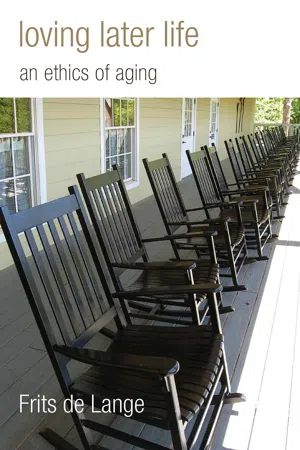
Is loving later life possible? In our youth-obsessed culture, nobody enjoys growing old. We normally fear our own aging and generally do not love old people -- they remind us that death is inescapable, the body frail, and social status transitory. In
Loving Later Life Frits de Lange shows how an ethics of love can acknowledge and overcome this fear of aging and change our attitude toward the elderly.
De Lange reframes the biblical love command this way: "We must care for the aging other as we care for our own aging selves." We can encourage positive self-love by embracing life as we age, taking good care of our own aging bodies, staying good friends with ourselves, and valuing the last season of life. When we cultivate this kind of self-love, we are released from our aversion to growing old and set free to care about others who are aging -- our parents, our relatives, and others in their final season of life.
- 169 pages
- English
- ePUB (mobile friendly)
- Available on iOS & Android
eBook - ePub
About this book
Information
Topic
Theology & ReligionSubtopic
Christian TheologyChapter One
Good Aging: Toward an Ethics of Aging
Old Age Is Here to Stay
There are several reasons why theological ethics should contribute to the subject and experience of aging. The first is demography. Today there are more old people in the world than ever before, and they are getting older than ever before. The “demographic transition” that the world population is facing is driven by two factors: increased life expectancy and declining fertility rates. Population aging is unprecedented: it has no parallel in the history of humanity, a United Nations report says. It is also pervasive and profound: it not only affects the lives of aging persons themselves but also has a direct bearing on the basic structures of society. Finally, population aging is enduring: the trend looks irreversible.1 In short, old age is here to stay.
It is an illusion that graying societies are a luxury issue caused by the postwar baby boom in affluent Western countries, an issue that will resolve itself as soon as that generation is gone.2 In developing countries with much higher birth rates and a higher number of younger people, the demographic transition is occurring more slowly. But they have fewer means to prepare themselves for it. Their development means increasing mobility of the population and rapidly changing family structures. Indeed, community networks that formerly provided support to the older generation have been weakened and often destroyed by rapid social and economic change.3 These changes in social structure have a greater impact on the lives of the elderly than the soaring numbers of those people above sixty or eighty: what counts is not the absolute numbers but the relative ratios of young versus old. The important question is how many people are effectively able and available in a given society to earn money and care for its elderly.
The old-age dependency ratio (the number of individuals over 64 divided by the number of individuals from 15 to 64, expressed as a percentage) indicates what happens in developed societies, whereas, for the time being, the destruction of traditional social structures in developing parts of the world as a result of urbanization will represent the most significant thread for the well-being of the elderly. In the European Union, the old-age dependency ratio is projected to more than double by 2060, from 25.4 percent to 53.5 percent. This means that the EU would move from having four persons of working age for every person over 65 to a ratio of only two to one. These population trends will have far-reaching effects on the labor market, social security and pensions, and the availability of health care.4
How are we to prepare for the graying of society, the tsunami of elderly that will flood the world in the next decades? Our societies are being challenged economically and ethically as well. Intergenerational justice, social security, health-care access and distribution, filial responsibilities, the quality of life, and the human dignity of the oldest elderly — all these issues are in need of normative orientation and ethical reflection.
“Successful Aging” and the Fourth Age
The second reason why ethics is needed in this area is — perhaps surprisingly — gerontology. Gerontologists usually avoid normative claims. Different old people have different ideas about how to live out their lives, they say. And why should we expect miracles from ethics at that age? “Old age isn’t so bad when you consider the alternative,” the entertainer Maurice Chevalier once said. A vast body of gerontological knowledge has become available since 1904, when Élie Metchnikoff, interested in the possibilities of prolonging human life, coined the term “gerontology” and laid the basis for a new scientific discipline.5 The hard data of empirical research have taken over the well-intended advice passed on by centuries of wisdom, self-help, and consolation literature, starting with Cicero’s De Senectute. But the positivism of much gerontology makes it easy prey for ethical naïveté. There is normativity in gerontology, but it is mostly implicit. Deliberately unaware of values and ideals, gerontology easily becomes an uncritical follower of prevailing “biopolitics.”6
Gerontological paradigms that are explicitly normative — such as “successful,” “healthy,” “active,” and “productive” aging — offer an optimistic and activist view of what old age can be. It tells people that, whoever they are, they can attain successful aging, which is defined almost exclusively in terms of physical and mental vigor, through individual choice and effort. Elder policies of governments and international health organizations, joined in a powerful political coalition, willingly adopt these paradigms, glad that their strategies have been scientifically legitimated by gerontological science. Emphasis is put on self-management, prevention, and empowerment. In the “risk society,” old age is considered to be a personal risk instead of a common fate.
Nonetheless, it is noteworthy that, however justified these political strategies may be in their aim to slow down the decay of old age, the models of successful, productive, healthy, and active aging have a strong anti-aging tendency.7 The oldest old are especially at risk of being neglected by policies that are focused on keeping the vital senior vital. “How can we respect age if we do everything in our power to deny it?” gerontologists Martha Holstein and Meredith Minkler ask critically. “What most assume as a matter of course in youth and middle age — that is, health and activity — cannot be the critical measure of success in old age,” they justifiably object.8 And Chris Gilleard writes:
Achieving at an advanced age the accomplishments of youth is little short of achieving the appearance of youth. The goals of government and gerontology are not to venerate old age because of its agedness, the way we might venerate an old wine or an old building, nor do they seek to make old age successful by the number of years lived. Successful old age is old age without old age.9
Positivist gerontology and health-care policy presently join together in trying to concentrate the majority of the physical and mental decline of old age into the shortest period (called “compression of morbidity”).10 They work on better aging (“How can we make you live healthily up to 100?”), but they refrain from asking what — if anything — makes a life marked by frail old age, dependence on others, and an accumulation of chronic diseases still worth living.
The distinction between a Third and a Fourth Age, introduced by the gerontologist Bernice L. Neugarten in 1974 and taken up by the historian Peter Laslett in his seminal book A Fresh Map of Life (1989), now in common parlance in gerontology, does more than just introduce a further chronological differentiation within the stages of an extending life, made necessary by life extension and the progressive reduction in late-life disability in affluent societies during the twentieth century.11 The Fourth Age is an embarrassing rest category of the Third Age, a shadowland of diminishment and the portal to death, the result of our inability to eliminate the impairments at the end of life and to push the vital and healthy Third Age until the very moment of death. In Laslett’s terms, the Fourth Age is an unwanted condition whose “onset, and hence . . . duration, should be put off for as long as possible by appropriate behavior during the Third Age.”12 Staying in good shape, for example, is rewarded with the extension of the Third Age and the postponement of the Fourth.13
As long as the compression of morbidity does not result in the rectangularization of the life curve, however, the Fourth Age attracts all the fears and anxieties of old age of former times. Paul P. Baltes and Jacqui Smith bring the optimistic message of the “happy gerontologists” into a more accurate balance with the bad news for the oldest old. There is positive news about aging, especially in the developed countries. Life expectancy has risen, and today’s seventy-year-olds are comparable to sixty-five-year-olds of thirty years ago. Today’s elderly have fewer physical disabilities, and are overall physically and mentally fitter than earlier cohorts of the same age range. More and more people are aging successfully. B...
Table of contents
- Contents
- Introduction
- 1. Good Aging: Toward an Ethics of Aging
- 2. The Ethics of Love
- 3. Why We Do Not Love the Elderly
- 4. Taking Care of Your Old Self
- 5. Love for Aging Neighbors
- Bibliography
- Index
Trusted by 375,005 students
Access to over 1.5 million titles for a fair monthly price.
Study more efficiently using our study tools.
Frequently asked questions
Yes, you can cancel anytime from the Subscription tab in your account settings on the Perlego website. Your subscription will stay active until the end of your current billing period. Learn how to cancel your subscription
No, books cannot be downloaded as external files, such as PDFs, for use outside of Perlego. However, you can download books within the Perlego app for offline reading on mobile or tablet. Learn how to download books offline
Perlego offers two plans: Essential and Complete
- Essential is ideal for learners and professionals who enjoy exploring a wide range of subjects. Access the Essential Library with 800,000+ trusted titles and best-sellers across business, personal growth, and the humanities. Includes unlimited reading time and Standard Read Aloud voice.
- Complete: Perfect for advanced learners and researchers needing full, unrestricted access. Unlock 1.5M+ books across hundreds of subjects, including academic and specialized titles. The Complete Plan also includes advanced features like Premium Read Aloud and Research Assistant.
We are an online textbook subscription service, where you can get access to an entire online library for less than the price of a single book per month. With over 1.5 million books across 990+ topics, we’ve got you covered! Learn about our mission
Look out for the read-aloud symbol on your next book to see if you can listen to it. The read-aloud tool reads text aloud for you, highlighting the text as it is being read. You can pause it, speed it up and slow it down. Learn more about Read Aloud
Yes! You can use the Perlego app on both iOS and Android devices to read anytime, anywhere — even offline. Perfect for commutes or when you’re on the go.
Please note we cannot support devices running on iOS 13 and Android 7 or earlier. Learn more about using the app
Please note we cannot support devices running on iOS 13 and Android 7 or earlier. Learn more about using the app
Yes, you can access Loving Later Life by Frits de Lange in PDF and/or ePUB format, as well as other popular books in Theology & Religion & Christian Theology. We have over 1.5 million books available in our catalogue for you to explore.