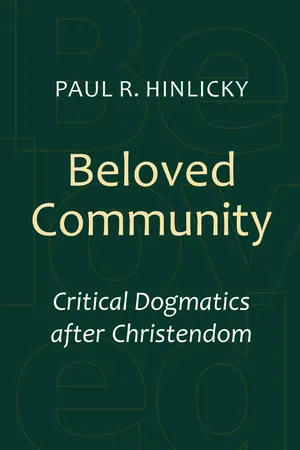
In this scholarly work Paul Hinlicky transcends the impasse between dogmatic and systematic theology as he presents an original, comprehensive system of theology especially apropos to the post-Christendom North American context.
Deploying an unusual Spirit-Son-Father trinitarian scheme, Hinlicky carefully develops his system of theology through expansive, wide-ranging argumentation. He engages with other theologians throughout the book and concludes each major section by discussing an alternate perspective on the subject.
- 960 pages
- English
- ePUB (mobile friendly)
- Available on iOS & Android
eBook - ePub
About this book
Information
Topic
Theology & ReligionSubtopic
Christian DenominationsPart One
Prolegomena
To know God is to enter by repentance and faith into the self-donation of the Son by the self-communication of the Spirit for new life before the self-surpassing Father of the Son on whom he breathes the Spirit.
Chapter One
The Knowledge of God
The Discipline of Theology as Critical Dogmatics
Ostensibly theology is about God and about all that is not God, taken as God’s creatures and “created,” as Martin Luther taught in the text that best represents his own “systematic” teaching,1 in order that God “might redeem us and make us holy . . . [by] his Son and Holy Spirit, through whom he brings us to himself.”2 Such a conception of theology is at once critical and dogmatic: critical because it must, and dogmatic because it can, discern the creative, redeeming, and fulfilling actions of God at work in the world. Yet such a conception of theology cannot be taken for granted today. Perhaps it could never have been taken for granted. While the term “theology” means knowledge of God, historically speaking theology is a contested discipline that like philosophy3 (or perhaps as part of philosophy!)4 is always arguing about its nature and task. And perhaps this is so because any substantive proposal in theology inevitably ventures a claim about the discipline itself, about its task and method — and vice versa, any claim about theological method betrays substantive dogmatic commitments.5 In such a contested, not to say conflicted situation, any theology that wants to be responsible to critical readers has to launch its presentation by locating its proposal in the whirl of controversy, old and new, that attends any who dare to speak before God in the world about God in relation to the world. That is the supposition and task of these initial chapters of Part One on preliminary considerations (prologoumena) in systematic theology, or, as I prefer to put it, critical dogmatics.
Judging from the literature, it can seem today that Christian theology is metaphysics or art. That is, theology is presented as putative knowledge of the protological conditions for the possibility of the visible world, as in metaphysics, discovering the divine arche (principle of origin).6 Or theology is presented as the construction of symbols giving expression to human experience of the ineffable ground or holy source, as in art. Certainly Christian theology shares a common world — or more primitively, what I will call in the following, a “common body” — with such metaphysical and aesthetic inquiries. Thus, theology as a discipline bears “family resemblances” to their claims and corresponding disciplines. For, like the metaphysical quest for the principle of origin of the cosmos or the religious need to figure the sacred grounding of human existence, Christian theology also speaks of the origin when it thinks of the eternal Father of the Son in the Spirit who becomes the Creator of all that is not God in the act of initiating and continuing our time-space as His creation.
According to the present proposal, however, ecumenical Christian theology in its substantive intention is not only, or even primarily, focused on origins and grounds, but rather pragmatically7 and hermeneutically8 on the identification of the God of the gospel for the purposes of public confession of and knowing collaboration in His approaching reign.9 “We do not in any unmediated way have the gospel that we are to speak; we have it only as we receive it. . . . Theology is an act of interpretation: it begins with a received word and issues in a new word essentially related to the old word. Theology’s question is always: In that we have heard and seen such-and-such discourse as gospel, what shall we now say and do that the gospel may again be spoken?”10 Jenson characteristically spoke of the identification of God in the maelstrom of experience. What follows next attempts to bring out not only the acknowledged hermeneutical method but also epistemically pragmatic features implied by it (in some critical distance from Jenson’s more idealistic proclivities).
Pragmatism here designates an epistemic approach that is rigorously located “in the middle of things,” barred from seeing (Greek: theoria) either origin or eschaton, but proceeding step by step from the unknown past into the unknown future with the best, i.e., most comprehensive and coherent, account of experience from across the broadest possible spectrum. Hermeneutics here means a style of argument that, while not despising but rather appropriating the logical rigor and precision afforded by more analytical modes of reasoning, holds that theological discourse as historically mediated by tradition from the inaugurating event in time and space can neither be appropriated, understood, critiqued, nor extended apart from probing inquiry into the history of the debate that the cognitive claim to truth has inaugurated. Since any contemporary understanding is itself historically situated, motivated by the concerns of the conscientious interpreter both for the truth-claim contained in the legacy and for its intelligible transmission and application in the present, tradition is just this debate, what MacIntyre once called an “embodied argument.”11 Only dead traditionalism presents its material as a fixed, finished deposit to be preserved from the erosion of time. Thus the form of argumentation in what follows will involve selective, but at times extended probes into the history of doctrinal topics as matters of contemporary theological import along the lines of David Friedrich Strauss’s observation that the history of doctrine is its own criticism.
The notion of “interpretation” calls for further initial comment here. Hegel demonstrated in the opening chapters of the Phenomenology of Spirit that any act of understanding that would go beyond reporting sheer sense certainty to say something to others involves the construction of an object by the aid of acts of memory organized in language that enable recognition of the phenomena in the sequence of time transcending the moment of sense certainty. In this way the object of sense is taken to persist through time despite the momentary evidences of its perceived movements and relations; thus its future can be projected. Such acts of memory presuppose, however, communities formed by language by which this construction is made; hence cognition has a tacit, often unnoticed but essentially social character. Interpretation is always interpretation by a subject of an object for an audience. Taking something as true in understanding is discovering an object that can be verbalized or mathematized to others who can so receive and understand, test and predict. It was Charles Sanders Peirce who teased out this social nature of interpretation in language, and it was Josiah Royce who explicitly formalized the process and named it hermeneutics. Any claim to truth, i.e., any cognitive construction of an object by a subject for others is thus a socially-linguistically embedded act of interpreting the common body’s sense experience in the here and now by binding past recollection with future expectation in and for communities of interpretation.
If Hegel was right at least about this, the hermeneutical procedure is not merely a method for the studia humanitatis (as we tend to think from Heidegger and Gadamer) but it holds in all forms of human understanding, from the natural sciences to theology. As Kuhn famously demonstrated,12 science too is the practice of a human interpretive community, with its own history, traditions, dogmas, paradigm shifts, even revolutions, which consists in the construction of a particular object, namely the “natural” world in some particular aspect or domain of inquiry. Theology and natural science will not be differentiated in this formal way of hermeneutical understanding. Theology too is the practice of a human community in just the same way, constituted by the construction of its particular object, namely (in respect to its overlap with science), the same natural world that science knows, taken now from faith for faith as “creature” of God. If this is so, contemporary knowledge of the natural world is not the victory of a triumphant advance of untrammeled rationality over traditional prejudices by pure attention to things in one’s own individual bedrock-certain sense experience (as Locke influentially imagined, especially for Anglo-American understandings of science). Rather, contemporary understandings are the ever-tested and often-contested product of a history of contending constructions of the meaning of things on many levels in various aspects in which science and faith overlap and intersect in both scientists and theologians, not infrequently one and the same person.
Christian theology, reflecting and expressing the gospel which elicits it, is an eschatological and missiological way of thinking about God and only as such also a doctrine about origins and symbolizations. Indeed its peculiar claims are subject finally to the triune God’s own — critical — verification or, as the case may be if this belief proves false, the disconfirmation of nonconfirmation. Theology never transcends this riskiness of faith in the putative Word of God that inaugurates its inquiry. Its knowledge is the knowledge of risky faith. But risky faith is not blind. It can know and critically discern the God of the gospel. In the interim theological claims to knowledge of God, and of His creatures in light of the knowledge of God in the gospel, are subject in pragmatic fashion to the tes...
Table of contents
- Author’s Preface and Acknowledgments
- Abbreviations
- Introduction
- Part One: Prolegomena
- Part Two: Pneumatology
- Part Three: Christology
- Part Four: Patrology
- Conclusion: Doxology
- Works Cited
- Index
Trusted by 375,005 students
Access to over 1.5 million titles for a fair monthly price.
Study more efficiently using our study tools.
Frequently asked questions
Yes, you can cancel anytime from the Subscription tab in your account settings on the Perlego website. Your subscription will stay active until the end of your current billing period. Learn how to cancel your subscription
No, books cannot be downloaded as external files, such as PDFs, for use outside of Perlego. However, you can download books within the Perlego app for offline reading on mobile or tablet. Learn how to download books offline
Perlego offers two plans: Essential and Complete
- Essential is ideal for learners and professionals who enjoy exploring a wide range of subjects. Access the Essential Library with 800,000+ trusted titles and best-sellers across business, personal growth, and the humanities. Includes unlimited reading time and Standard Read Aloud voice.
- Complete: Perfect for advanced learners and researchers needing full, unrestricted access. Unlock 1.5M+ books across hundreds of subjects, including academic and specialized titles. The Complete Plan also includes advanced features like Premium Read Aloud and Research Assistant.
We are an online textbook subscription service, where you can get access to an entire online library for less than the price of a single book per month. With over 1.5 million books across 990+ topics, we’ve got you covered! Learn about our mission
Look out for the read-aloud symbol on your next book to see if you can listen to it. The read-aloud tool reads text aloud for you, highlighting the text as it is being read. You can pause it, speed it up and slow it down. Learn more about Read Aloud
Yes! You can use the Perlego app on both iOS and Android devices to read anytime, anywhere — even offline. Perfect for commutes or when you’re on the go.
Please note we cannot support devices running on iOS 13 and Android 7 or earlier. Learn more about using the app
Please note we cannot support devices running on iOS 13 and Android 7 or earlier. Learn more about using the app
Yes, you can access Beloved Community by Paul R. Hinlicky in PDF and/or ePUB format, as well as other popular books in Theology & Religion & Christian Denominations. We have over 1.5 million books available in our catalogue for you to explore.