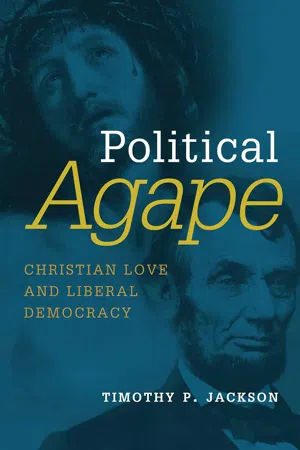
What is the place of Christian love in a pluralistic society dedicated to "liberty and justice for all"? What would it mean to take both Jesus Christ and Abraham Lincoln seriously and attempt to translate love of God and neighbor into every quarter of life, including law and politics?
Timothy Jackson here argues that agapic love of God and neighbor is the perilously neglected civil virtue of our time -- and that it must be considered even before justice and liberty in structuring political principles and policies. Jackson then explores what "political
agape" might look like when applied to such issues as the death penalty, same-sex marriage, and adoption.
- 441 pages
- English
- ePUB (mobile friendly)
- Available on iOS & Android
eBook - ePub
About this book
Information
Topic
Theology & ReligionSubtopic
DemocracyPart I
Liberalism and Agape
Chapter 1
Love and Mr. Lincoln
There is no longer Jew or Greek, there is no longer slave or free, there is no longer male and female; for all of you are one in Christ Jesus.
Galatians 3:28
Introduction: Beyond America’s Founding Documents
It is often argued that, as the American Civil War unfolded, Abraham Lincoln’s stated political priorities moved from national unity and the rule of positive law (as embodied in the U.S. Constitution) to the more distinctively moral goods of “liberty and equality for all” upheld in a version of natural law (as articulated in the Declaration of Independence). Jefferson’s Declaration was Lincoln’s political “Bible” throughout his life, but even that document could be read with emphasis on patriotic unity rather than human equality. So the struggle to preserve the Union was elevated to a higher plane, the argument runs, when Lincoln issued the Emancipation Proclamation (1863) and made freedom for the slaves an explicit ingredient in and justification for the war effort. Indeed, it was only with his Gettysburg Address (1863) that Lincoln found his full moral voice and enunciated a defense of natural rights and natural law that rejected the historicism and positivism advocated by the likes of Stephen A. Douglas and John C. Calhoun.1 With this defense, what Lincoln called “sober reason”2 carried the day over mob passion.
This common interpretive line has considerable plausibility,3 and I myself will be celebrating Lincoln’s refusal of purely procedural and traditionalist grounds for political association. But the common line tells only a part of the story of Lincoln’s evolving political faith. For it fails to appreciate that Lincoln eventually embraced the “charity for all” commanded in Hebrew-Christian Scripture, which charity inspires, governs, and finally transcends both of America’s founding documents and both positive law and natural law. The young Lincoln had held, in 1838, that “reason, cold, calculating, unimpassioned reason, must furnish all the materials for our future support and defense.”4 In a very different spirit, Alexander Stephens, the soon-to-be vice president of the Confederacy, declared in 1859 that “African slavery rests upon principles that can never be successfully assailed by reason or argument.”5 Stephens held hierarchy and subordination — the domination of the weak by the strong — to be part of “nature’s first law”6 and evident upon reflection; and, ironically, it was Stephens’s opinion that proved, in a sense, to carry the day for the mature Lincoln. It was biblical charity, rather than Enlightenment rationality, that actually triumphed in Lincoln’s war-hardened vision. In the brief Gettysburg Address, Lincoln refers to “liberty” and “equal[ity]” in his first sentence and to “God” once in his last, but he nowhere mentions “reason,” “rationality,” or “natural law.” In the Second Inaugural (1865), he again speaks not at all of “reason,” “rationality,” or “natural law,” but he invokes “God,” “the Almighty,” or “Him/His” ten times.
Stephens too had appealed to “the Almighty” and “Divine law,”7 but, unlike Lincoln, he simply conflated nature and grace — seeing what we today would call Darwinian survival of the fittest as expressive of God’s normative will. Lincoln never ceased to value reason and law, but he became increasingly sensitive to the slippage between positive law, natural law, and even divine law (the written “revelations” of the Bible). All these forms of law were mediated by human beings and thus fallible, and all were distinct from eternal law (the mind and heart of God as they are in themselves). Hence, across the war years, Lincoln shifted from analytical jurisprudence to a decidedly more theological (and tragic) idiom to explain himself and his nation. The Second Inaugural’s climactic words — “With malice toward none; with charity for all; with firmness in the right, as God gives us to see the right” — live on in history as Lincoln’s sublime transcendence of “unimpassioned reason.”8
Charity emerged as Lincoln’s means of holding in proper balance the Constitution’s political tenets and the Declaration’s ethical ideals, precisely because neither positive law nor natural law alone was enough. Neither the historical legal traditions ensconced in the Constitution, nor the liberty and equality guaranteed in the Declaration, could be relied on for sufficient practical guidance to meet the demands of the times. In fact, without a more fundamental principle, positive law, personal and political liberty, and human equality tended to conflict. (States’ rights and popular sovereignty meant slavery for some and inhuman misery for others, for instance.) Charity itself was not a panacea, removing all ambiguity and strife from the embattled American landscape. It did, however, prevent paralysis and allow for compassion in the president as well as many of the American people.
I. The Circling Camps
There is no unanimity, of course, on this reading of “Father Abraham.” Opinions on Lincoln’s precise motives and convictions, as well as on the meaning and ultimate consequences of his actions, divide roughly into three camps. Camp 1: Some maintain that “the Great Emancipator” was at heart no friend of the Negroes, was in fact a white supremacist and profound bigot who had to be compelled to act for the good of all races by a combination of radical abolitionists and military setbacks. Lincoln was incompetent in his running of the government and timid in his conduct of the war, on this view. More damningly, left to his own devices, he would have been perpetually content to leave slavery alone, so long as it did not expand into new territories, as he had promised in his presidential campaign and as he believed the Constitution required. As Lincoln stated in his famous public letter to Horace Greeley, “My paramount object in this struggle is to save the Union, and is not either to save or to destroy slavery.”9 Any “evolution” of his views was a matter of political and/or personal expediency. The Emancipation Proclamation, for instance, was defended by Lincoln himself as a military necessity rather than a moral mandate. The proclamation was considered constitutional because, as commander in chief, the president had war powers to confiscate property, including slaves;10 and Lincoln hinted at times that, once the war was over, the proclamation need no longer be effective. Call this the “Lincoln as forced into glory” school.11
Camp 2: Others hold a still more dour view in which not even the semblance of glory was achieved by Mr. Lincoln. Whatever his views on race, neither slavery’s abolition nor its limitation was a significant factor in Lincoln’s going to war against the Southern Confederacy. According to this second camp, Lincoln’s enduring and overriding goal was the centralization of governmental power and the economic and political hegemony this would ensure for the Northern Republican Party and himself as its leader. He could have ended slavery by other means — for example, compensated emancipation, as in Britain — but he chose to conduct “an unnecessary war” to further his agenda of protective tariffs, internal improvements, bureaucratic patronage, and other “mercantilist” and “socialist” measures to which the freedom-loving South objected. Rather than being politically incompetent and militarily timid, that is, Lincoln was a silver-tongued tyrant willing to wage “total war” on civilians to crush Southern resistance to the omnicompetent state and his own political ambitions. In standing against state sovereignty and the right of secession, in particular, Lincoln was an enemy of true democratic governance. He was not “forced into glory”; rather, he was a calculating and quite ignominious foe of liberty whose actions helped lead to the imperial presidency. His wartime institution of a draft, suspension of habeas corpus, denial of trial by jury, closing of opposition newspapers, and confiscation of private property simply confirmed his totalitarian proclivities. Indeed, the young Lincoln was uncannily (if unwittingly) describing himself when he wrote: “Towering genius disdains a beaten path. . . . It thirsts and burns for distinction; and, if possible, it will have it, whether at the expense of emancipating slaves, or enslaving freemen.”12 The picture, then, is of a Whiggish warmonger, whose inflated image of “Columbia” and himself left him little or no sensitivity to the suffering of others or to his own limits. Call this the “Lincoln as gory patriot” school.13
Camp 3: Still others maintain that the sweet sixteenth president was much more consistent ethically and much more liberal politically. On this account, Lincoln was always convinced of the injustice of slavery and forever inclined to liberate the shackled blacks by any practical means, but he was also committed to constitutional government and preservation of the consent of the governed. From early on in his career, Lincoln wanted to put slavery on the path to “ultimate extinction,”14 this camp insists, but he was constrained by politics as the art of the possible. He realized that preserving the Union was the sine qua non of both any legal effort to improve the lot of blacks nationwide and any practical hope of sustaining a democratic polity. If a state could nullify laws duly passed by Congress or interpose its own courts’ rulings contrary to the findings of the federal Supreme Court or ultimately secede at will from the Union itself, then the very idea of representative government would have collapsed into anarchy. Because the Constitution itself had protected slavery in the original colonies, Lincoln could not simultaneously claim to uphold constitutional order and to seek directly to abolish slavery. Yet, because secession and states’ rights threatened the rule of law, Lincoln could justify going to war, as well as suspending various civil liberties, as stemming from his obligation as chief executive to defend the general welfare. To be sure, he had to bide his time — on occasion, even to mix his signals — but eventually he found a way to work his inspired and farseeing will in recognizing the e...
Table of contents
- Contents
- Preface and Acknowledgments
- Liberal Introduction: Jesus and Abraham
- Part I: Liberalism and Agape
- Part II: Replies to Contemporary Liberals and Antiliberals
- Part III: Love, Law, and Modern Moral Issues
- Prophetic Conclusion: Martin Luther King Jr.
- Index of Names
- Index of Subjects
Trusted by 375,005 students
Access to over 1.5 million titles for a fair monthly price.
Study more efficiently using our study tools.
Frequently asked questions
Yes, you can cancel anytime from the Subscription tab in your account settings on the Perlego website. Your subscription will stay active until the end of your current billing period. Learn how to cancel your subscription
No, books cannot be downloaded as external files, such as PDFs, for use outside of Perlego. However, you can download books within the Perlego app for offline reading on mobile or tablet. Learn how to download books offline
Perlego offers two plans: Essential and Complete
- Essential is ideal for learners and professionals who enjoy exploring a wide range of subjects. Access the Essential Library with 800,000+ trusted titles and best-sellers across business, personal growth, and the humanities. Includes unlimited reading time and Standard Read Aloud voice.
- Complete: Perfect for advanced learners and researchers needing full, unrestricted access. Unlock 1.5M+ books across hundreds of subjects, including academic and specialized titles. The Complete Plan also includes advanced features like Premium Read Aloud and Research Assistant.
We are an online textbook subscription service, where you can get access to an entire online library for less than the price of a single book per month. With over 1.5 million books across 990+ topics, we’ve got you covered! Learn about our mission
Look out for the read-aloud symbol on your next book to see if you can listen to it. The read-aloud tool reads text aloud for you, highlighting the text as it is being read. You can pause it, speed it up and slow it down. Learn more about Read Aloud
Yes! You can use the Perlego app on both iOS and Android devices to read anytime, anywhere — even offline. Perfect for commutes or when you’re on the go.
Please note we cannot support devices running on iOS 13 and Android 7 or earlier. Learn more about using the app
Please note we cannot support devices running on iOS 13 and Android 7 or earlier. Learn more about using the app
Yes, you can access Political Agape by Timothy P. Jackson in PDF and/or ePUB format, as well as other popular books in Theology & Religion & Democracy. We have over 1.5 million books available in our catalogue for you to explore.