Misunderstandings about what it means for humans to be created in God's image have wreaked devastation throughout history -- for example, slavery in the U. S., genocide in Nazi Germany, and the demeaning of women everywhere.
In
Dignity and Destiny John Kilner explores what the Bible itself teaches about humanity being in God's image. He discusses in detail all of the biblical references to the image of God, interacts extensively with other work on the topic, and documents how misunderstandings of it have been so problematic.
People made according to God's image, Kilner says, have a special connection with God and are intended to be a meaningful reflection of him. Because of sin, they don't actually reflect him very well, but Kilner shows why the popular idea that sin has damaged the image of God is mistaken. He also clarifies the biblical difference between
being God's image (which Christ is) and being
in God's image (which humans are). He explains how humanity's creation and renewal in God's image are central, respectively, to human dignity and destiny.
Locating Christ at the center of what God's image means, Kilner charts a constructive way forward and reflects on the tremendously liberating impact that a sound understanding of the image of God can have in the world today.
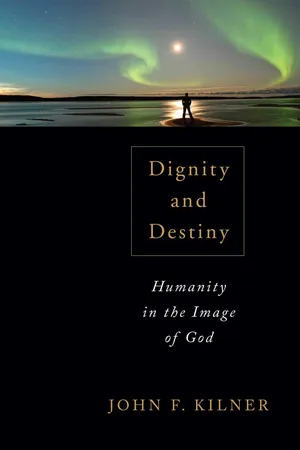
- 414 pages
- English
- ePUB (mobile friendly)
- Available on iOS & Android
eBook - ePub
About this book
Information
Topic
Theology & ReligionSubtopic
Christian TheologyPart I
The Human and Divine Context
Chapter One
Much Is at Stake:
The Liberation and Devastation of God’s Image
The Liberation and Devastation of God’s Image
How can something foster both liberation and devastation? The answer lies in the possibility of co-opting, for evil, a powerful idea that has the potential to inspire great good. Co-opting is much easier if the idea is inadequately formulated in a way that lends itself to misuse. Such has often been the case with the idea that humanity is in God’s image.
Viewing people in terms of the image of God has fostered magnificent efforts to protect and redeem people. It has also encouraged oppressing and even destroying people. All this has been possible simultaneously because of a common misconception that being in God’s image is about how people are (actually) “like God” and “unlike animals.” This view understands being in God’s image in terms of attributes that people have now, most commonly people’s ability to reason, rule over (manage) creation, be righteous, or be in relationship. In this view, sin can damage such attributes and thus damage God’s image. Accordingly, people vary in the extent to which they have these attributes — and are in God’s image. For many, that means how much people warrant respect and protection varies from person to person. The door to devastation is open as soon as people begin to define being in God’s image in terms of currently having attributes of God.
The problem here is not that a biblical idea has proven to be destructive, but that an unbiblical idea masquerading as a biblical idea has proven to be destructive. This unbiblical idea is at odds with what the Bible’s authors mean by being created in God’s image and how they employ this concept in life situations. So this book’s primary purpose will be to clarify what the Bible itself teaches about humanity being in God’s image, with no governing agenda other than that. The widely known concept of humanity’s creation in God’s image is indeed a concept that has reached the contemporary world largely via the Bible. Accordingly, clarity regarding biblical teaching on this idea is essential before further theological and cultural development of the idea is on sound footing.
Nevertheless, to appreciate the importance of doing this biblical study, it is helpful to note first how much is at stake. The idea of the image of God is quite influential in theology and in everyday life, and it is a huge loss to misunderstand it in a way that undermines its power to liberate. Moreover, misunderstandings of being in God’s image have contributed to some of the greatest atrocities in history, and it is a great gain to understand it in a way that is not conducive to such devastation. We will consider in this chapter both the potential of humanity’s creation in God’s image to inspire great good and how, if misunderstood, this idea can foster terrible evil. The chapter will conclude with a consideration of why such disagreement has surrounded this idea through the centuries.
Image-Inspired Liberation
Simply the amount of writing devoted to humanity’s creation and renewal in God’s image through the ages attests eloquently to the potential of these ideas to inspire great good. Biblical scholar Claus Westermann and theologian Stanley Grenz call this literature “limitless,” while a chronicler of that literature, Gunnlaugur Jónsson, describes it as “nearly infinite.”1 Few biblical ideas have stirred as much interest or prompted as much study.2
As Christian theologians have often acknowledged, the impact of the image-of-God idea has reached way beyond the bounds of their own field. Observes Emil Brunner (with later support from Hermann Häring and George Kelsey), “The history of this idea is the history of . . . Western understanding” when it comes to the meaning of being human.3 “It is doubtful if there is any one concept more basic for democracy and Western civilization in general,” concurs T. B. Maston.4 “Not only is theology involved,” echoes Charles Feinberg, “but reason, law, and civilization as a whole.”5 Human rights analyst Roger Ruston similarly underscores “the debt that secular thought owes to theology” for the illuminating idea of humanity in God’s image.6 In terms of religious thinking, members of the Muslim, Jewish, and Christian communities all consider the image of God concept to be particularly important.7
At the same time, Christian theologians are quick to acknowledge how influential the ideas of humanity’s creation and renewal in God’s image have been in Christian theology and ethics. According to Carl Henry, with a second from Charles Sherlock, the image-of-God concept is “determinative for the entire gamut of doctrinal affirmation.”8 That includes not just humanity’s creation but also humanity’s redemption and eternal destination.9 The image of God is a “starting point” (Michelle Gonzalez) with “orienting power . . . for Christian theology” (J. Wentzel van Huyssteen) — “the necessary bridging concept” (Ben Witherington III), which makes it part of “the essence of Christianity” (Vladimir Lossky).10 Many others concur that God’s image plays a pivotal role in a Christian understanding of God and all of life.11
Humanity’s existence in God’s image is particularly important for understanding who people are. Theologians Louis Berkhof and Philip Hughes see it as the “essence” of humanity.12 It is God’s “final vocabulary” (Mark Talbot) for what makes humans human (Millard Erickson) — a view shared by many in theological, biblical, and ministry fields alike.13 In fact, many see humanity’s creation in God’s image as “central,” “at the heart of” — in fact, “the most important matter in” — theological anthropology.14 From this perspective, humanity in God’s image is this discipline’s “foundation” and “controlling concept.”15
Many scholars, studying how Christians have viewed human beings through the centuries, have remarked over the “enduring” and “indestructible” influence of the idea of being created in God’s image.16 This “comprehensively normative” role is rather surprising to some, primarily because of the huge di...
Table of contents
- Introduction
- Part I: The Human and Divine Context
- Part II: Human Dignity
- Part III: Human Destiny
- Conclusion
- References Cited
- Index of Names and Subjects
- Index of Biblical Passages
Trusted by 375,005 students
Access to over 1.5 million titles for a fair monthly price.
Study more efficiently using our study tools.
Frequently asked questions
Yes, you can cancel anytime from the Subscription tab in your account settings on the Perlego website. Your subscription will stay active until the end of your current billing period. Learn how to cancel your subscription
No, books cannot be downloaded as external files, such as PDFs, for use outside of Perlego. However, you can download books within the Perlego app for offline reading on mobile or tablet. Learn how to download books offline
Perlego offers two plans: Essential and Complete
- Essential is ideal for learners and professionals who enjoy exploring a wide range of subjects. Access the Essential Library with 800,000+ trusted titles and best-sellers across business, personal growth, and the humanities. Includes unlimited reading time and Standard Read Aloud voice.
- Complete: Perfect for advanced learners and researchers needing full, unrestricted access. Unlock 1.5M+ books across hundreds of subjects, including academic and specialized titles. The Complete Plan also includes advanced features like Premium Read Aloud and Research Assistant.
We are an online textbook subscription service, where you can get access to an entire online library for less than the price of a single book per month. With over 1.5 million books across 990+ topics, we’ve got you covered! Learn about our mission
Look out for the read-aloud symbol on your next book to see if you can listen to it. The read-aloud tool reads text aloud for you, highlighting the text as it is being read. You can pause it, speed it up and slow it down. Learn more about Read Aloud
Yes! You can use the Perlego app on both iOS and Android devices to read anytime, anywhere — even offline. Perfect for commutes or when you’re on the go.
Please note we cannot support devices running on iOS 13 and Android 7 or earlier. Learn more about using the app
Please note we cannot support devices running on iOS 13 and Android 7 or earlier. Learn more about using the app
Yes, you can access Dignity and Destiny by John F. Kilner in PDF and/or ePUB format, as well as other popular books in Theology & Religion & Christian Theology. We have over 1.5 million books available in our catalogue for you to explore.