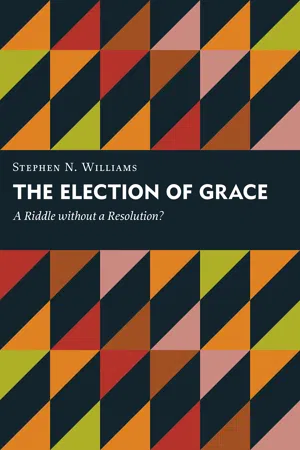
Few issues in Christian theology have sparked as much controversy over the centuries as the question of election. In this book -- the inaugural volume of the Kantzer Lectures in Revealed Theology series -- Stephen Williams offers a rich and nuanced account of the doctrine of election, arguing that we should diminish the role of "system" in Christian theology.
After expounding the Bible's teaching on election, Williams turns to questions of theological method and substance. He maintains that the subject of predestination must be considered in a wider biblical context than it often is and that we cannot expect to understand election within a comprehensive systematic framework. What matters is the relation of particular truths to the particulars of life, he says, not the systematic relation of truths to each other. Williams draws on and applies the insights of remarkable nineteenth-century Anglican leader Charles Simeon throughout his study, concluding the book with a cogent discussion of Karl Barth on election.
- 240 pages
- English
- ePUB (mobile friendly)
- Available on iOS & Android
eBook - ePub
About this book
Information
Topic
Theology & ReligionSubtopic
Christian TheologyChapter One
Election in the Old Testament
The Story
Walter Brueggemann has complained about Rudolf Bultmann’s “unfortunate articulation” of the history of Israel as a “history of failure.”1 If Brueggemann simply meant that the form of articulation was unfortunate, his complaint was in order, but it would be unfortunate if the phrase “history of failure” were regarded as exceptionable. It doubtless has the ring of political incorrectness about it, even if it correctly summarizes Israel’s political fortunes, and we may not be persuaded by Bultmann’s reasons for arriving at his judgment. Bultmann held that Israel had been seduced into identifying God’s eschatological activity with what happened in history.2 Nevertheless, he got his conclusion right, and others who differ theologically both from Bultmann and from each other — from H. H. Rowley to N. T. Wright — have come up with similar formulations.3 The most detailed study known to me of election in the Old Testament is that of Horst Dietrich Preuss, who, writing when it looked as though the sun were setting on the day of classic Continental “Old Testament theologies,” constructed his whole OT theology specifically on the base of election. Preuss approved of Gerstenberger’s observation that “the failure of the people of God is a theme of the OT to the same extent that their election is.”4
Failure is neither a judgment extrapolated from the Old in the light of a normative New Testament nor a judgment on Israel offered from outside Israel. The OT (or Hebrew Bible) is often castigated for its arrogant religious exclusiveness, menacing a world which would have been better off without it, even if not quite bathed in Elysian tranquillity and benign toleration if left to itself.5 Does any other scripture belonging to any other world religion tell a story so devastatingly against its own people as does the OT? Preuss’s words, apropos of Israel’s self-description as a slave in the land of Egypt, warrant extended application: “This manner of argumentation is seldom found in the history of religions and is relatively atypical for a nation’s perception of its own history, if not actually unique. A nation does not normally describe its early history in negative terms.”6
“You only have I chosen
of all the families of the earth;
therefore I will punish you
for all your sins,”
announces Amos, declaring the implications of election (3:2; obviously, my italics). Israel’s failure was chillingly sealed in 2 Kings 17:18 when the Lord “removed them [the people of Israel] from his presence” into exile. In diachronic coordination that is all too precise, Judah eventually follows, forcing the books of Kings to close with a scene that is none too hopeful or edifying, featuring King Jehoiachin reduced to listening for the dinner gong before getting stuck into his victuals at the table of Evil-Merodach in Babylon (2 Kings 25:30).
Yet, if we follow the order of the OT and not that of the Hebrew Bible and read the narrative on through the books of Chronicles, Ezra, and Nehemiah, we end on a different note. 2 Chronicles concludes as astonishingly as 2 Kings ends dismally. “This is what Cyrus king of Persia says: ‘The Lord, the God of heaven, has given me all the kingdoms of the earth and he has appointed me to build a temple for him at Jerusalem in Judah. Anyone of his people among you — may the Lord his God be with him, and let him go up’ ” (2 Chron. 36:23). Behind Cyrus was the Lord himself, who moved his heart to make this “proclamation throughout his realm and to put it in writing” (36:22). In Ezra and Nehemiah, there is a resettlement of a Jewish community centered on Jerusalem, one whose prospects, as we come to the end of the narrative, are by no means hopeless, though Ezra’s prayer reveals him to be the perfect realist (Ezra 9:6-15). The turn of events at the close of Chronicles in its own way keeps Bultmann’s judgment intact, for the manner of the exiles’ return and the consequent possibility of rebuilding the temple actually highlight more than mitigate Israel’s failure; after all, it is Cyrus who is particularly instrumental in God’s hand. In case we have not fully grasped this point, it is repeated and even expanded at the beginning of Ezra (1:2-3), and for the benefit of third-millennium punters whose main interest lies in how projects are funded, Ezra also reports Cyrus’s declaration that “the costs [of temple rebuilding] are to be paid by the royal treasury” (6:4). The bold thought might cross even the untutored reader’s mind that Cyrus has momentarily assumed the Davidic/Solomonic mantle, but a still bolder word is heard from the lips of Isaiah. Cyrus is God’s anointed, whose right hand God has taken hold of (Isa. 45:1), a veritable Gentile Messiah, it would seem.7 Salvation is apparently of the Gentiles.8
If we have followed the OT narrative(s) up to this point, what is most surprising in this turn of events is not that the Gentiles have some interest in the temple and the salvation of God’s people. Rather, it is their involvement in the deliverance and flowering of Israel to the point of temple reconstruction. Presumably, the tabernacle in the wilderness was built partly of materials provided by the Egyptians — willingly, but somewhat unwittingly — when Israel fled Egypt. However, the building itself was surely the work of Israelite hands. With Solomon’s temple, we have Solomon’s initiative, carried through to execution in collaboration with Hiram, so that the temple is built with Tyre on hire and with Sidonian labor as well. Transethnic collaboration on this scale is one thing, and its significance with regard to Gentile collaboration is somewhat muted by the forced labor conditions under which Hiram’s minions apparently worked. Yet, when the building campaign is relaunched later, the temple is rebuilt by kind permission of Cyrus — and that is another thing altogether. Of course, informed that Nebuchadnezzar had seized the articles of the house of God, Cyrus doubtless harbored a prudent and self-preserving anxiety, for which he can hardly be blamed, to see the items restored (Ezra 6:5). However, that does not matter. At this point, what matters is the work of God and not the motives of men, and, in that respect, Cyrus is part of a much bigger scene. When we scan it as far as the eye can reach, the nations are destined to be beneficiaries of Israel’s election.9
The call of Abraham is in the interest of the nations. Descended from Shem, Abraham was the idolatrous child of God’s covenant with Noah, a covenant of extreme breadth, taking in all the earth and restarting a story which had begun with the creation of Adam and ended its first phase in grief and flood, a restart that substituted, though not unreservedly, emphatic blessing for emphatic cursing (Gen. 8:12-17).10 It was a covenant announced to Noah and meant for Noah and family, but especially meant for the earth. Soon after his introduction into the narrative, Abraham builds an altar, as Noah had done (12:8; cf. 8:20), and calls upon the name of the Lord, as people had done around the time of Enosh, Adam’s grandson by Seth (13:4; cf. 4:26). In a further relaunch, Abraham will mediate a unique blessing to the nations (cf. 1:28; 8:17; 9:1-7; 17:6). God’s direct, unmediated blessing to his forefathers lay in the background: Canaan, son of Ham, is destined to be a slave of Japheth as well as of Shem, and Japheth is blessed not only with the extension of territory but also with habitation of the tents of Shem (9:27). The language of blessing here precedes its conspicuous use in the case of Abraham (12:2-3).
In his study of election from a Hebrew Bible perspective, Joel Kaminsky proposes that we speak of the elect, the anti-elect, and the nonelect, Japheth occupying the third category.11 This raises the question of whether we ...
Table of contents
- Series Foreword
- Preface
- 1. Election in the Old Testament
- 2. New Testament Election
- 3. Dogmatic Limits
- 4. Dogmatic Difficulties
- Appendix: Karl Barth on Election
- Index
Trusted by 375,005 students
Access to over 1.5 million titles for a fair monthly price.
Study more efficiently using our study tools.
Frequently asked questions
Yes, you can cancel anytime from the Subscription tab in your account settings on the Perlego website. Your subscription will stay active until the end of your current billing period. Learn how to cancel your subscription
No, books cannot be downloaded as external files, such as PDFs, for use outside of Perlego. However, you can download books within the Perlego app for offline reading on mobile or tablet. Learn how to download books offline
Perlego offers two plans: Essential and Complete
- Essential is ideal for learners and professionals who enjoy exploring a wide range of subjects. Access the Essential Library with 800,000+ trusted titles and best-sellers across business, personal growth, and the humanities. Includes unlimited reading time and Standard Read Aloud voice.
- Complete: Perfect for advanced learners and researchers needing full, unrestricted access. Unlock 1.5M+ books across hundreds of subjects, including academic and specialized titles. The Complete Plan also includes advanced features like Premium Read Aloud and Research Assistant.
We are an online textbook subscription service, where you can get access to an entire online library for less than the price of a single book per month. With over 1.5 million books across 990+ topics, we’ve got you covered! Learn about our mission
Look out for the read-aloud symbol on your next book to see if you can listen to it. The read-aloud tool reads text aloud for you, highlighting the text as it is being read. You can pause it, speed it up and slow it down. Learn more about Read Aloud
Yes! You can use the Perlego app on both iOS and Android devices to read anytime, anywhere — even offline. Perfect for commutes or when you’re on the go.
Please note we cannot support devices running on iOS 13 and Android 7 or earlier. Learn more about using the app
Please note we cannot support devices running on iOS 13 and Android 7 or earlier. Learn more about using the app
Yes, you can access The Election of Grace by Stephen N. Williams in PDF and/or ePUB format, as well as other popular books in Theology & Religion & Christian Theology. We have over 1.5 million books available in our catalogue for you to explore.