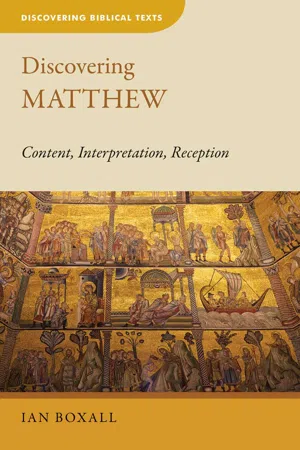
Student-friendly introduction to the Gospel of Matthew In this introduction to the story that Matthew tells, Ian Boxall deftly guides readers through the sources, origins, themes, and main characters of the first Gospel. The book’s short chapters enable coverage of a wide range of topics, presenting the issues and scholarly debates surrounding the Gospel of Matthew in an accessible yet nuanced manner. Like the first Discovering Biblical Texts volume, on the Gospel of John, Discovering Matthew offers a guide to key issues and questions raised by the text to enable readers to come to their own conclusions. Encouraging in-depth study of the text and genuine grappling with pertinent theological and historical questions, this book is an ideal introduction to the interpretation of Matthew.
- 216 pages
- English
- ePUB (mobile friendly)
- Available on iOS & Android
eBook - ePub
About this book
Information
1
Introduction
The First Gospel
The Gospel according to Matthew has had a profound impact on Christian history and on human culture more widely. In Christian worship, preference has been given to the Lord’s Prayer in Matthew’s version (‘Our Father, who art in heaven’, Matt. 6.9 –13; cf. Luke 11.2– 4: ‘Father . . .’). The Matthean wording of Jesus’ Beatitudes (‘Blessed are the poor in spirit’, 5.3) is far more familiar than Luke’s equivalent (‘Blessed are you poor’, Luke 6.20). Through centuries of use, phrases from Matthew’s Gospel have crept into common parlance: ‘salt of the earth’ (5.13); ‘the left hand doesn’t know what the right hand is doing’ (6.3); ‘wolves in sheep’s clothing’ (7.15). Even if modern scholarship now questions the traditional belief that Matthew was the first of the four canonical Gospels to be written, few will dispute its primacy of honour and usage. In its reception, if not its origins, it is the First Gospel.
A preference for Matthew over the other Gospels is manifest already
in Christian literature of the late first and early second centuries (Massaux 1990 –3). Early in the second century, Ignatius of Antioch quotes from or alludes to Matthew’s Gospel on a number of occasions. He refers to the star of Matthew 2.2 heralding Christ’s birth (Ignatius, Eph. 19.2). His description of Jesus’ baptism as ‘fulfilling all righteousness’ (Smyrn. 1.1) echoes Matthew 3.15. His letter to Polycarp of Smyrna recalls Jesus’ words to the Twelve about being ‘wise as serpents and innocent as doves’ (Polycarp 2.2 = Matt. 10.16; cf. Smyrn. 6.1 = Matt. 19.12; Trall. 11.1 = Matt. 15.13; Eph. 14.2 = Matt. 12.33). The Didache or ‘Teaching of the Twelve Apostles’ (possibly late first century) shares with Matthew the concern for the ‘two ways’ (Did. 1.1 = Matt. 7.13 –14), and the rite of baptism ‘in the name of the Father and
of the Son and of the Holy Spirit’ (Did. 7.1 = Matt. 28.19). It also cites Jesus’ teaching about turning the right cheek (Did. 1.4 –5 = Matt. 5.38 – 42) and avoiding the excesses of the ‘hypocrites’ when fasting (Did. 8.1 = Matt. 6.16 –18). Indeed, the author of the Didache seems to know Matthew
as the only Gospel: ‘And do not pray as the hypocrites, but as the Lord commanded in his Gospel, pray thus: “Our Father, who art in Heaven, hallowed be thy Name . . .”’ (Did. 8.2 = Matt. 6.7–13. Lake 1925: 1/321).
in Christian literature of the late first and early second centuries (Massaux 1990 –3). Early in the second century, Ignatius of Antioch quotes from or alludes to Matthew’s Gospel on a number of occasions. He refers to the star of Matthew 2.2 heralding Christ’s birth (Ignatius, Eph. 19.2). His description of Jesus’ baptism as ‘fulfilling all righteousness’ (Smyrn. 1.1) echoes Matthew 3.15. His letter to Polycarp of Smyrna recalls Jesus’ words to the Twelve about being ‘wise as serpents and innocent as doves’ (Polycarp 2.2 = Matt. 10.16; cf. Smyrn. 6.1 = Matt. 19.12; Trall. 11.1 = Matt. 15.13; Eph. 14.2 = Matt. 12.33). The Didache or ‘Teaching of the Twelve Apostles’ (possibly late first century) shares with Matthew the concern for the ‘two ways’ (Did. 1.1 = Matt. 7.13 –14), and the rite of baptism ‘in the name of the Father and
of the Son and of the Holy Spirit’ (Did. 7.1 = Matt. 28.19). It also cites Jesus’ teaching about turning the right cheek (Did. 1.4 –5 = Matt. 5.38 – 42) and avoiding the excesses of the ‘hypocrites’ when fasting (Did. 8.1 = Matt. 6.16 –18). Indeed, the author of the Didache seems to know Matthew
as the only Gospel: ‘And do not pray as the hypocrites, but as the Lord commanded in his Gospel, pray thus: “Our Father, who art in Heaven, hallowed be thy Name . . .”’ (Did. 8.2 = Matt. 6.7–13. Lake 1925: 1/321).
The evidence of surviving manuscripts of the Gospels in Greek and other languages points to a general preference for Matthew’s version in the tendency among scribes to harmonize disagreements between the Gospels. In later centuries, scenes unique to Matthew, such as the magi worshipping the infant Jesus (2.1–12), the giving of the keys of the kingdom to Simon Peter (16.18 –19) or the story of the soldiers guarding Jesus’ tomb (27.62– 66; 28.11–15), would inspire artists in their visual interpretations of the
biblical text. Famous examples include The Adoration of the Magi by Botticelli (c.1475 – 6; Uffizi, Florence) and Rembrandt (1632; Hermitage, St Petersburg), Pietro Perugino’s fresco The Delivery of the Keys (c.1481–2; Sistine Chapel, Rome) and The Resurrection by Piero della Francesca (c.1463 –5; Museo Civico, Sansepolcro). Artists have also been inspired by the figure of the evangelist himself and his part in the story he recounts. The Church of San Luigi dei Francesi in Rome contains three canvases
by Caravaggio, depicting The Calling of St Matthew, The Inspiration of
St Matthew and The Martyrdom of St Matthew. Musically, the most famous interpretation of Matthew’s account of Jesus’ suffering and death is probably Johann Sebastian Bach’s St Matthew Passion.
biblical text. Famous examples include The Adoration of the Magi by Botticelli (c.1475 – 6; Uffizi, Florence) and Rembrandt (1632; Hermitage, St Petersburg), Pietro Perugino’s fresco The Delivery of the Keys (c.1481–2; Sistine Chapel, Rome) and The Resurrection by Piero della Francesca (c.1463 –5; Museo Civico, Sansepolcro). Artists have also been inspired by the figure of the evangelist himself and his part in the story he recounts. The Church of San Luigi dei Francesi in Rome contains three canvases
by Caravaggio, depicting The Calling of St Matthew, The Inspiration of
St Matthew and The Martyrdom of St Matthew. Musically, the most famous interpretation of Matthew’s account of Jesus’ suffering and death is probably Johann Sebastian Bach’s St Matthew Passion.
Reasons for Matthew’s popularity, religiously and culturally, are at least threefold. First, the Gospel is superbly and memorably ordered, suggesting an author who is master of his material. This has led to specific proposals that the evangelist was a converted rabbi (von Dobschütz 1995: 31–2) or a scribe and ‘provincial schoolmaster’ (Goulder 1974: 5), as well as the more traditional identification of Matthew as a methodical tax-collector (9.9; 10.3). The Gospel’s juxtaposition of narrative and discourse, story and sermon, often regarded as a key to its structure, has been frequently commented upon. Matthew uses frequent repetitions: for example, his rounding off each of the major teaching blocks with ‘When Jesus had finished . . .’ (7.28; 11.1; 13.53; 19.1; 26.1) or his liking for the colourful phrase ‘weeping and gnashing of teeth’ (8.12; 13.42, 50; 22.13; 24.51; 25.30). He is fond of ‘triads’ or groups of three: for example, Jesus’ miracles are organized in groups of three in Matthew 8—9, and there are two triads of parables in Matthew 13 (for further examples, see Allison 2005: 202–5). He also uses doublets: examples of the latter are Matthew’s inclusion of two stories of the healing of two blind men (9.27–31; 20.29 –34) and his story of two Gadarene demoniacs (8.28 –34), his counterpart to Mark’s one Gerasene demoniac (Mark 5.1–20). Other numbers important to him include five (e.g. the five discourses or teaching blocks), seven (12.45; 15.34, 36, 37; 16.10; 18.22; 22.25, 26, 28; also seven ‘woes’ against the scribes and Pharisees, 23.13, 15, 16, 23, 25, 27, 29) and 14 (e.g. 1.17, repeated three times).
Matthew also makes use of chiastic (ABBA) and concentric (ABCBA) patterns (e.g. Matt. 5—7; 9.1b– 8; 13.13 –18; 18.10 –14). He uses brackets, known by the technical term inclusio, to mark out significant sections of his book. One example is the repetition of the same summary statement at 4.23 –25 and 9.35 –38 (referring to Jesus’ teaching, preaching and healing ministry in Galilee), which frames the Sermon on the Mount and the ensuing narrative of Matthew 8—9. Indeed, the book as a whole is located between a great inclusio (the statement at 1.23 that Jesus is Emmanuel, ‘God is with us’, is picked up at the very end by the risen Christ’s statement ‘I am with you always, to the end of the age’, 28.20). Finally, there is a certain poetic rhythm to many of Jesus’ sayings (e.g. 7.7– 8; 12.25 –26; 23.8 –10; 25.35 –39; Goulder 1974: 70 – 94).
Second, the widespread usage of Matthew in liturgy and catechesis
has ensured the importance of this Gospel within the churches. It is the preferred Gospel in church lectionaries, a fact frequently noted across
the centuries. ‘Lastly, we may note the great honour in which his Gospel is held in the Church’, declares a medieval lesson for the Feast of St Matthew (21 September), ‘for it is read more often than the other Gospels, just
as the Psalms of David and the Epistles of Saint Paul are recited more frequently than the other sacred writings’ (Jacobus de Voragine 1941: 565). Matthew’s catechetical value is due particularly to the prominence it gives to the teaching of Jesus. Indeed, for some scholars the careful ordering
of the Gospel is evidence that it was originally written for the purpose
of catechesis (teaching the faith). Paul Minear, for example, has offered a sustained reading of Matthew’s Gospel as written by a teacher for other early Christian teachers, with the five Matthean sermons or discourses understood as teaching ‘manuals’ (Minear 1984). Minear is in fact picking up on a very ancient hunch about the Gospel. The Prologue to the influential fifth-century Opus imperfectum or ‘Incomplete Work’ on Matthew describes how the Christians of first-century Palestine, threatened with dispersion due to persecution, urged Matthew to compose his account of Christ’s words and deeds, ‘so that even if by chance they had to be without any teachers of the faith, they would still not lack their teaching’ (Kellerman 2010: 1/1). It has very much the feel of a teacher’s guide, to those in need of sound catechesis.
has ensured the importance of this Gospel within the churches. It is the preferred Gospel in church lectionaries, a fact frequently noted across
the centuries. ‘Lastly, we may note the great honour in which his Gospel is held in the Church’, declares a medieval lesson for the Feast of St Matthew (21 September), ‘for it is read more often than the other Gospels, just
as the Psalms of David and the Epistles of Saint Paul are recited more frequently than the other sacred writings’ (Jacobus de Voragine 1941: 565). Matthew’s catechetical value is due particularly to the prominence it gives to the teaching of Jesus. Indeed, for some scholars the careful ordering
of the Gospel is evidence that it was originally written for the purpose
of catechesis (teaching the faith). Paul Minear, for example, has offered a sustained reading of Matthew’s Gospel as written by a teacher for other early Christian teachers, with the five Matthean sermons or discourses understood as teaching ‘manuals’ (Minear 1984). Minear is in fact picking up on a very ancient hunch about the Gospel. The Prologue to the influential fifth-century Opus imperfectum or ‘Incomplete Work’ on Matthew describes how the Christians of first-century Palestine, threatened with dispersion due to persecution, urged Matthew to compose his account of Christ’s words and deeds, ‘so that even if by chance they had to be without any teachers of the faith, they would still not lack their teaching’ (Kellerman 2010: 1/1). It has very much the feel of a teacher’s guide, to those in need of sound catechesis.
Others have seen a liturgical Sitz im Leben (or ‘setting in life’) for this Gospel. G. D. Kilpatrick proposed that it developed as a kind of running commentary and homiletic expansion of Mark’s Gospel, and Matthew’s other sources, as these were read in the context of community worship (Kilpatrick 1946: 59 –71). Michael Goulder has developed this liturgical explanation into an intricate thesis according to which the evangelist reworks Mark in the light of the cycle of Old Testament readings in the Jewish festival lectionary (Goulder 1974). Whether or not this can account for the Gospel as a whole, Matthew’s text certainly betrays some traits
of early Christian worship. Matthew’s version of the Lord’s Prayer, with its communal ‘Our Father’ and its similarities to the formal prayer of
the synagogue, the Eighteen Benedictions, may well reflect the liturgical practice of the Christian circles to which Matthew belonged. The triadic baptismal formula at 28.19 probably offers a window into how baptism was administered in those same circles (possibly in Syria, given a similar wording found in other Christian texts from that area: Did. 7.1; Ignatius, Magn. 13.2; Odes of Solomon 23.22).
of early Christian worship. Matthew’s version of the Lord’s Prayer, with its communal ‘Our Father’ and its similarities to the formal prayer of
the synagogue, the Eighteen Benedictions, may well reflect the liturgical practice of the Christian circles to which Matthew belonged. The triadic baptismal formula at 28.19 probably offers a window into how baptism was administered in those same circles (possibly in Syria, given a similar wording found in other Christian texts from that area: Did. 7.1; Ignatius, Magn. 13.2; Odes of Solomon 23.22).
A third reason for Matthew’s popularity is the centuries-old belief
that Matthew is the earliest of our four canonical Gospels, and one of only two (John being the other) attributed to an apostle and eyewitness of Jesus. The tradition linking this Gospel with someone called Matthew is reflected in the earliest Greek manuscripts, which include the title
Kata Matthaion (‘according to Matthew’). At an early stage, this Matthew was identified with Matthew the converted tax-collector and member of the Twelve (9.9 –13; 10.3). ‘I have learned by tradition’, writes the third-century exegete Origen of Alexandria, ‘that the first was written by Matthew, who was once a publican, but afterwards an apostle of Jesus Christ’ (quoted in Eusebius, H. E. 6.25: Eusebius 1995: 273). This virtually unanimous tradition meant that Matthew’s Gospel was viewed as closer to the source than Mark or Luke, both attributed to second-generation followers of apostles (Peter and Paul respectively). This seemed to be confirmed by
its Jewish character, apparently unaffected by the reinterpretation of the Christian message as it moved out of its original Palestinian context
into the wider Gentile world. Its greater length – covering almost all the content of Mark and much more besides – also made it a more complete and satisfying record than the other Synoptic Gospels.
that Matthew is the earliest of our four canonical Gospels, and one of only two (John being the other) attributed to an apostle and eyewitness of Jesus. The tradition linking this Gospel with someone called Matthew is reflected in the earliest Greek manuscripts, which include the title
Kata Matthaion (‘according to Matthew’). At an early stage, this Matthew was identified with Matthew the converted tax-collector and member of the Twelve (9.9 –13; 10.3). ‘I have learned by tradition’, writes the third-century exegete Origen of Alexandria, ‘that the first was written by Matthew, who was once a publican, but afterwards an apostle of Jesus Christ’ (quoted in Eusebius, H. E. 6.25: Eusebius 1995: 273). This virtually unanimous tradition meant that Matthew’s Gospel was viewed as closer to the source than Mark or Luke, both attributed to second-generation followers of apostles (Peter and Paul respectively). This seemed to be confirmed by
its Jewish character, apparently unaffected by the reinterpretation of the Christian message as it moved out of its original Palestinian context
into the wider Gentile world. Its greater length – covering almost all the content of Mark and much more besides – also made it a more complete and satisfying record than the other Synoptic Gospels.
The Breakdown of a Consensus
Since the nineteenth century, however, such a consensus has broken down, many scholars rejecting the age-old belief in authorship by an apostolic eyewitness. Rather, Matthew is now viewed as the second Gospel, composed by an anonymous author 50 to 60 years after Jesus’ death, and dependent upon the work of another (the Gospel according to Mark). That is not to say, as we shall see, that questions of authorship, chronological sequence and dating have been definitively settled. A minority of eminent scholars have continued to hold to a variation of apostolic authorship, Matthean priority or early dating (e.g. Farmer 1964 on the priority of Matthew; Gundry 1994 and France 2007 on authorship and dating). Nonetheless, the scholarly consensus on these questions is sharply at odds with the testimony of the early centuries.
This shift away from the ‘priority of Matthew’ has sometimes led modern commentators to a more negative assessment of its merits. In his comparative study of Matthew’s and Mark’s passion narratives, Leslie Houlden regards Matthew as the ‘villain of the piece, inferior and even reprehensible at almost every turn’ in his capacity to ‘spoil the purity of Mark’s teaching’ (Houlden 1987: 66). For Houlden, Matthew’s almost obsessive tidiness, his desire to tie up loose ends in Mark and his other sources, makes his a less sympathetic Gospel. Yet Houlden also recognizes that there is a realism about Matthew, particularly when it comes to Mark’s urgency about the imminence of the End. For good or for ill, he has had to come to terms with the longer term, which results in a toning down of Mark’s urgency.
Others regard the realism of this Gospel as its greatest asset. Matthew is in a true sense ‘the Gospel of the Church’, laying down patterns for structured Christian existence in this world. One of the greatest Matthean scholars of recent times, the Swiss exegete Ulrich Luz, speaks of the ‘transparency’ of Matthew’s Gospel (e.g. Luz 1995a). By this he means the way Matthew’s story of Jesus and his disciples offers a window on to the post-Easter situation of the Church. Luz, like many other recent scholars, means specifically the local first-century congregations for whom Matthew wrote (though he is also interested in the ongoing ‘transparency’ in the life of the Christian Church: e.g. Luz 2005b: 115 – 42). However, this way of reading the Gospels as ‘allegories’ of specific Christian communities is by no means undisputed (see Bauckham [ed.] 1998). For other reasons too, readers
of Matthew have found his a more compelling account than Mark’s. The Italian film director Pier Paolo Pasolini, for instance, thought that Matthew captured the revolutionary spirit of Jesus’ ministry more effectively than the rather crude Mark, the sentimental Luke or the overly mystical John. Thus it was the First Gospel that provided...
of Matthew have found his a more compelling account than Mark’s. The Italian film director Pier Paolo Pasolini, for instance, thought that Matthew captured the revolutionary spirit of Jesus’ ministry more effectively than the rather crude Mark, the sentimental Luke or the overly mystical John. Thus it was the First Gospel that provided...
Table of contents
- Contents
- Acknowledgements
- Abbreviations
- 1. Introduction
- 2. Interpreting Matthew: Strategies for Reading
- 3. The Text of Matthew:Puzzles and Possibilities
- 4. Characters and Places in Matthew’s Story
- 5. Matthew’s World: Locating the Text Historically and Socially
- 6. Beginnings: The Infancy Narratives
- 7. Jesus as Teacher: Ethics and Judgement
- 8. Jesus as Healer and Exorcist
- 9. Fulfilling the Law and the Prophets
- 10. ‘Built upon the Rock’:The Gospel of the Church
- 11. Endings: The Passion and Death of Jesus
- 12. Endings and New Beginnings: The Resurrection of Jesus
- 13. Conclusions: Interpreting Matthew Today
- Bibliography
- Index of Biblical References
- Index of Ancient Texts
- Index of Names and Subjects
Trusted by 375,005 students
Access to over 1.5 million titles for a fair monthly price.
Study more efficiently using our study tools.
Frequently asked questions
Yes, you can cancel anytime from the Subscription tab in your account settings on the Perlego website. Your subscription will stay active until the end of your current billing period. Learn how to cancel your subscription
No, books cannot be downloaded as external files, such as PDFs, for use outside of Perlego. However, you can download books within the Perlego app for offline reading on mobile or tablet. Learn how to download books offline
Perlego offers two plans: Essential and Complete
- Essential is ideal for learners and professionals who enjoy exploring a wide range of subjects. Access the Essential Library with 800,000+ trusted titles and best-sellers across business, personal growth, and the humanities. Includes unlimited reading time and Standard Read Aloud voice.
- Complete: Perfect for advanced learners and researchers needing full, unrestricted access. Unlock 1.5M+ books across hundreds of subjects, including academic and specialized titles. The Complete Plan also includes advanced features like Premium Read Aloud and Research Assistant.
We are an online textbook subscription service, where you can get access to an entire online library for less than the price of a single book per month. With over 1.5 million books across 990+ topics, we’ve got you covered! Learn about our mission
Look out for the read-aloud symbol on your next book to see if you can listen to it. The read-aloud tool reads text aloud for you, highlighting the text as it is being read. You can pause it, speed it up and slow it down. Learn more about Read Aloud
Yes! You can use the Perlego app on both iOS and Android devices to read anytime, anywhere — even offline. Perfect for commutes or when you’re on the go.
Please note we cannot support devices running on iOS 13 and Android 7 or earlier. Learn more about using the app
Please note we cannot support devices running on iOS 13 and Android 7 or earlier. Learn more about using the app
Yes, you can access Discovering Matthew by Ian Boxall in PDF and/or ePUB format, as well as other popular books in Theology & Religion & Biblical Criticism & Interpretation. We have over 1.5 million books available in our catalogue for you to explore.