Student-friendly introduction to the Gospel of John This up-to-date introduction to John's Gospel is the first volume in the Discovering Biblical Texts series, which encourages students to engage deeply with the biblical writings by alerting them to key issues and questions raised by the text. In Discovering John Ruth Edwards covers the structure, content, theological concerns, key interpretive debates, and historical reception of the Gospel of John. Does John still have meaning for the church and contemporary society? Does it need to be reinterpreted for today's world? Is it anti-Semitic? Edwards expertly guides readers through these questions and others, helping those interested in this provocative, sometimes enigmatic Gospel to discover the answers for themselves.
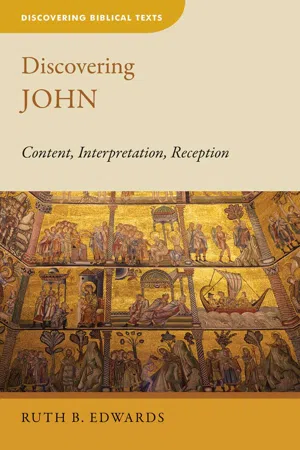
- 272 pages
- English
- ePUB (mobile friendly)
- Available on iOS & Android
eBook - ePub
About this book
Information
Topic
Theology & ReligionSubtopic
Biblical Studies1
Introduction
For many centuries John’s Gospel1 has been treated as the crown of the Gospels. Its author, identified with the seer of Revelation, the ‘elder’ and author of the Johannine Epistles, and the apostle John, was seen as the New Testament ‘theologian’ par excellence, Ioannēs ho theologos, St John the Divine. Evidence for his especially close relationship to Jesus was found in the allusions to ‘the disciple whom Jesus loved’, who lay on Jesus’ breast at the Last Supper, said to have written ‘these things’ (John 21.24). The ‘mystical’ theology of his Prologue was interpreted as revealing John’s closeness to God himself. John’s very name, derived from the Hebrew word for ‘grace’, was seen as disclosing his true character, as one who revealed in an unparalleled way the grace of God. It is no wonder that the Gospel has inspired artists and musicians, theologians, poets and thinkers, and countless ordinary Christians. It has sustained faith, aroused love and encouraged heroism, and profoundly shaped Christian doctrine. In patristic and medieval times John was symbolized as an eagle, ‘the spiritual
bird, fast-flying, God-seeing’ (Eriugena),2 an image still used in church art. He was so much revered that artists often depicted him as Christlike and enthroned; sometimes he was spoken of as ‘angelic’ or ‘deified’ (Hamburger, 2002, with illustrations).
bird, fast-flying, God-seeing’ (Eriugena),2 an image still used in church art. He was so much revered that artists often depicted him as Christlike and enthroned; sometimes he was spoken of as ‘angelic’ or ‘deified’ (Hamburger, 2002, with illustrations).
J. B. Lightfoot called John’s Gospel the ‘most divine of all divine
books’ (1893, p. 122). It has been seen as speaking tellingly to the simple believer, as well as soaring to the heights or plumbing the depths of
the Christian faith for the sophisticated (cf. Marsh, 1968, p. 81). Jean
Vanier (2004, p. 15) speaks of the ‘music’ he hears behind John’s words; Martin Hengel calls him ‘a towering theologian’, a ‘great teacher to
whom the church owes a good part of its foundation’ (1989, pp. ix, 135). But John has also been criticized as ‘world-denying’ and ‘sectarian’,
‘androcentric’, and ‘anti-Jewish’ – ‘a Gospel of Christian love and Jew hatred’ (Kohler, 1905, p. 251). While in the past it was seen as painting
‘a perfect portrait of Jesus’ (Temple, 1939, p. xvi), today some view it
as historically inaccurate, ‘a presentation of falsehood’, and responsible
for stimulating and supporting the vilest anti-Semitism (Casey, 1996, esp. pp. 198, 218 –29).
books’ (1893, p. 122). It has been seen as speaking tellingly to the simple believer, as well as soaring to the heights or plumbing the depths of
the Christian faith for the sophisticated (cf. Marsh, 1968, p. 81). Jean
Vanier (2004, p. 15) speaks of the ‘music’ he hears behind John’s words; Martin Hengel calls him ‘a towering theologian’, a ‘great teacher to
whom the church owes a good part of its foundation’ (1989, pp. ix, 135). But John has also been criticized as ‘world-denying’ and ‘sectarian’,
‘androcentric’, and ‘anti-Jewish’ – ‘a Gospel of Christian love and Jew hatred’ (Kohler, 1905, p. 251). While in the past it was seen as painting
‘a perfect portrait of Jesus’ (Temple, 1939, p. xvi), today some view it
as historically inaccurate, ‘a presentation of falsehood’, and responsible
for stimulating and supporting the vilest anti-Semitism (Casey, 1996, esp. pp. 198, 218 –29).
What is this writing that has provoked such diverse responses? Who wrote it, and why was it written? Can a study of its context and circumstances of composition help us understand it? It has been said that the questions asked of a text are as important as the answers given (Malbon, 2000, p. 1). Readers with a historical bent may be stimulated by the questions just posed; those with more literary interests may be intrigued by the Gospel as ‘story’. How does its ‘plot’ work? How does its author use characters, and what literary devices are employed? Their questions and motivation for study will be different from those of the first set of readers. Others will be more interested in John’s theology. How does John relate to the religious thought of its day? What is distinctive about its message? Christians (and others) study biblical texts to deepen their personal
faith, or find guidance for living. Many are inspired by John; for others, it raises problems. Does its message need to be reinterpreted for today’s world? How should Christians respond to recent criticisms of it? Does John still have meaning for the Church and contemporary society?
faith, or find guidance for living. Many are inspired by John; for others, it raises problems. Does its message need to be reinterpreted for today’s world? How should Christians respond to recent criticisms of it? Does John still have meaning for the Church and contemporary society?
This book is intended for those interested in any of these aspects of John. It will not answer all their questions, but it is hoped that it may help them to think out for themselves where they stand. Chapters 1–2 outline the shape of the Gospel and review its interpretation over the centuries and different ways it may be read. Chapters 3 –5 investigate authorship and composition, including the questions of John’s sources, historical accuracy, purpose in writing and intended audience. Chapters 6 – 9 focus more sharply on theology, especially John’s Christology (understanding of Christ). They explore the various methods by which he seeks to convey Jesus’ identity through miracles, faith confessions, and Jesus’ words and actions, death and Resurrection. Chapter 10 discusses John’s use of characters, both from a literary angle, and to see how they illuminate John’s understanding of faith in Jesus. Chapters 11–12 tackle different facets
of the question whether John’s Gospel is ‘anti-Jewish’ (or ‘anti-Semitic’),3 and how John’s belief in Jesus’ divinity relates to Jewish monotheism. Chapter 13 draws together the threads of this study, centring on whether John’s Gospel has any abiding value for today. Excursus 1 discusses John’s textual tradition, and Excursus 2 explores the question of eyewitness testimony in John.
of the question whether John’s Gospel is ‘anti-Jewish’ (or ‘anti-Semitic’),3 and how John’s belief in Jesus’ divinity relates to Jewish monotheism. Chapter 13 draws together the threads of this study, centring on whether John’s Gospel has any abiding value for today. Excursus 1 discusses John’s textual tradition, and Excursus 2 explores the question of eyewitness testimony in John.
Reading John’s Story
At this point you are invited to read John’s Gospel for yourself in the same way as you would read any book, following its storyline and enjoying its shape. As you read, you may like to refer to Table 1 (pp. 170f.), which summarizes the themes of the following discussion.
I. Proem: Prologue and Testimony
The Gospel opens with a proem (Greek prooimion, ‘opening’), consisting of an elevated ‘Prologue’ followed by a plain prose narrative, sometimes called the ‘Testimony’ (Dodd, 1953, p. 292). The Prologue (1.1–18) is mysterious, not readily grasped on a quick reading, or even on several readings, conveying its message through images of light, darkness, life, birth, grace, truth and glory. It meditates on Jesus as the divine, pre-existent Word, who became flesh to make God known to humankind. Apart from Jesus, only one historical personage is mentioned: John (the Baptist), sent by God as a witness (1.6, 15).
The Testimony (1.19 –51) takes us from eternity to time: different characters are shown who testify to Jesus through christological confessions. He is acknowledged in turn as God’s ‘lamb’, ‘son’, ‘messiah’ and ‘Israel’s king’. But although the Testimony seems to be historical narrative, being marked off by clear indications of time (e.g. 1.29), it too is preparatory for the main story. Its purpose, like that of the Prologue, is to herald themes which will be important for John – not just ‘titles’ for Jesus, but also motifs like ‘water’ (1.26), ‘Spirit’ (1.32) and ‘witness’ (1.7f., 34). It also anticipates future events, e.g. the recognition of Jesus as ‘messiah’ (1.41), placed much later by the other Gospels (cf. Mark 8.29 par.).
II. Jesus’ Self-revelation and Ministry
The main narrative is generally divided into two sections, with further subdivisions (cf. Table 1). John 2—12, sometimes called ‘the Book of Signs’,4 reflects on Jesus’ disclosure of himself and his ministry. Interest centres on his miracles and teaching, and controversies arising from them. Only a few miracles are related, but those chosen have a significant role. Beginning with that at Cana (2.1–11), they are called ‘signs’ (Greek sēmeia) and function as pointers to Jesus’ identity. Their climax is the raising of Lazarus (11.1– 44), demonstrating Jesus’ control over death and looking forward to his own Resurrection. These miracles are often associated
with dialogues bringing out their meaning. Jesus also discloses his
identity through his actions in the Temple (2.13 –22), in his dialogue
with Nicodemus (3.1–15) and in his meeting with the Samaritan
woman (4.4 – 42). Particularly intriguing are the references forward to Jesus’ Passion, e.g. ‘Destroy this Temple and in three days I will raise it
up’ (2.19), ‘As Moses lifted up the serpent in the desert, so must the Son of Man be lifted up’ (3.14). These grow in frequency and intensity as the narrative advances.
with dialogues bringing out their meaning. Jesus also discloses his
identity through his actions in the Temple (2.13 –22), in his dialogue
with Nicodemus (3.1–15) and in his meeting with the Samaritan
woman (4.4 – 42). Particularly intriguing are the references forward to Jesus’ Passion, e.g. ‘Destroy this Temple and in three days I will raise it
up’ (2.19), ‘As Moses lifted up the serpent in the desert, so must the Son of Man be lifted up’ (3.14). These grow in frequency and intensity as the narrative advances.
Another prominent theme of these chapters is Jesus’ relationship to Moses, flagged in 1.17 and 1.45. By his miracles and teaching, Jesus shows himself to be like Moses, and yet as greater than Moses (6.4 –59, esp. 41–51; cf. Boismard, 1993). Jesus is also presented as greater than Jacob (4.12) and greater than Abraham (8.53 –58). This interest in Moses and the patriarchs, together with numerous allusions to the Jewish Scriptures, raises questions about how John saw Christianity’s relation to Judaism. Some (e.g. Moloney, 1996; Brown, 1997, p. 334) have suggested that by giving prominence to Jewish religious feasts – Sabbath, Passover, Dedication, Tabernacles – John depicts Jesus as superseding (for Christians) many aspects of Judaism, including both Temple and festivals.
By his words and actions Jesus antagonizes ‘the Jews’, and their leaders ‘the Pharisees’ and ‘High Priests’. These are represented as misunderstanding Jesus, ‘persecuting’ him and seeking to kill him. Some scholars (e.g. Harvey, 1976) see John as presenting Jesus ‘on trial’, or as the
focus of a juridical controversy (Asiedu-Peprah, 2001). ‘The Jews’ make
charges, and Jesus defends himself and makes counter-accusations.
The Baptist, the disciples and the crowd all bear witness to him, as do
the Scriptures and, most importantly, the Father (8.18). Readers find
themselves drawn into the process and having to make up their own
minds about Jesus. There is also a deep irony about all this: although
Jesus appears to be ‘on trial’, he is in fact serving as judge over, and
witness against, those who accuse him (this element is brought out
very fully by Lincoln, 2000). This stylized presentation, though dramatic, presents problems: by using ‘the Jews’ to stand for opposition to Jesus, John lays himself open to ‘anti-Jewish’ readings of his text, with dire
consequences.
focus of a juridical controversy (Asiedu-Peprah, 2001). ‘The Jews’ make
charges, and Jesus defends himself and makes counter-accusations.
The Baptist, the disciples and the crowd all bear witness to him, as do
the Scriptures and, most importantly, the Father (8.18). Readers find
themselves drawn into the process and having to make up their own
minds about Jesus. There is also a deep irony about all this: although
Jesus appears to be ‘on trial’, he is in fact serving as judge over, and
witness against, those who accuse him (this element is brought out
very fully by Lincoln, 2000). This stylized presentation, though dramatic, presents problems: by using ‘the Jews’ to stand for opposition to Jesus, John lays himself open to ‘anti-Jewish’ readings of his text, with dire
consequences.
Another feature of this section is Jesus’ ‘elusiveness’ (Stibbe, 1991). The Pharisees send officers to arrest him (7.32), but they are so impressed by his words they fail to do so (7.45f.). After Jesus’ statement that he existed before Abraham, ‘the Jews’ try to stone him, but he hides himself (8.59). Again they attempt to stone him, or arrest him, but he escapes (10.31, 39). Jesus is also ‘elusive’ in the sense that he speaks enigmatically, and is often misunderstood (see further Hamid-Khani, 2000). This ‘elusiveness’ is also part of the pattern of John’s plot.
In John 2—12 Jesus appears as both life-giver (e.g. 4.13f., 50; 6.68; 11.25f.) and judge. By coming as a ‘light’ to the world, Jesus shows up the darkness (3.19 –21): by speaking the truth, he makes people come to a decision between truth and falsehood, ‘light’ and ‘darkness’, himself and ‘the world’. His coming separates people into those who accept him and those who reject him. This recurring dichotomy climaxes in John 11, where Jesus raises Lazarus after Martha has confessed him as the Christ. ‘The Jews’ are divided into those who put their faith in Jesus and those who inform on him to the Pharisees, leading to the plot to kill him (11.45f.). Chapter 12 acts as a transition between Jesus’ public ministry and his Passion.
Mary anoints his feet, and a crowd acclaims him ‘Israel’s king’. He speaks allusively of his death, agonizing over his ‘hour’ (12.23 –33), and tells of the casting out of ‘the ruler of this world’ (12.31). This section ends with a sombre quotation from Isaiah about God blinding eyes and hardening hearts, and an appeal from Jesus to believe, with both a warning of judgement and promise of eternal life (12.37–50).
Mary anoints his feet, and a crowd acclaims him ‘Israel’s king’. He speaks allusively of his death, agonizing over his ‘hour’ (12.23 –33), and tells of the casting out of ‘the ruler of this world’ (12.31). This section ends with a sombre quotation from Isaiah about God blinding eyes and hardening hearts, and an appeal from Jesus to believe, with both a warning of judgement and promise of eternal life (12.37–50).
III. Passion and Resurrection Narrative
This part is sometimes called ‘the Book of Glory’,5 because John sees
Jesus’ suffering and death not as his humiliation, but rather as his ‘lifting up’ or ‘glorification’. Jesus’ death, Resurrection and return to the Father are presented as part of a single movement. Thus the ‘hour’ of his death is also the ‘hour’ of his glory (13.31f.; 17.1, etc.). Chapter 13 both introduces the Passion and provides a key to its understanding. At his last meal, on the eve of the Passover, Jesus washes his disciples’ feet as an example of love and humble service; by this act he foreshadows his loving ‘to the end’ (cf. Edwards, 1994). The emotional tension grows as he gives Judas a morsel from the common dish, and Satan enters him. Judas leaves to betray Jesus, ‘and it was night’ (13.30).
Jesus’ suffering and death not as his humiliation, but rather as his ‘lifting up’ or ‘glorification’. Jesus’ death, Resurrection and return to the Father are presented as part of a single movement. Thus the ‘hour’ of his death is also the ‘hour’ of his glory (13.31f.; 17.1, etc.). Chapter 13 both introduces the Passion and provides a key to its understanding. At his last meal, on the eve of the Passover, Jesus washes his disciples’ feet as an example of love and humble service; by this act he foreshadows his loving ‘to the end’ (cf. Edwards, 1994). The emotional tension grows as he gives Judas a morsel from the common dish, and Satan enters him. Judas leaves to betray Jesus, ‘and it was night’ (13.30).
Jesus’ tender farewell to his disciples and his ‘High-Priestly Prayer’6 occupy John 14—17. The pace is slow and reflective, as the Evangelist mingles reassurances for the future, promises of the Paraclete (Holy
Spirit, seen as advocate and guide) and injunctions to love. He calls
the disciples his ‘friends’, warns them that ‘the world’ will hate them,
speaks of his ‘departure’, and promises to return. But there is also a note of triumph: Jesus’ farewell ends with the words, ‘Be encouraged; I have defeated the world’ (16.33). He has fulfilled his mission: he has made God known to those given him. He now consecrates himself and his disciples, praying that they may be one. His closeness to the Father is intensely expressed as he prays that the disciples may know the love with which God loves him.
Spirit, seen as advocate and guide) and injunctions to love. He calls
the disciples his ‘friends’, warns them that ‘the world’ will hate them,
speaks of his ‘departure’, and promises to return. But there is also a note of triumph: Jesus’ farewell ends with the words, ‘Be encouraged; I have defeated the world’ (16.33). He has fulfilled his mission: he has made God known to those given him. He now consecrates himself and his disciples, praying that they may be one. His closeness to the Father is intensely expressed as he prays that the disciples may know the love with which God loves him.
The pace quickens with the narrative of Jesus’ trial and death. Roman soldiers and Jewish officers arrest him. In a se...
Table of contents
- Contents
- Preface to the Second Edition
- Preface to the First Edition
- Abbreviations
- 1. Introduction
- 2. Interpreting John: Strategies for Reading
- 3. The Question of Authorship
- 4. Traditions, Sources and Relation to the ‘Historical Jesus’
- 5. Purpose, Audience, Place and Date of Composition
- 6. Jesus’ Miracles as Narrative Theology
- 7. Christological Confessions and Titles for Jesus
- 8. Jesus’ Passion and Resurrection
- 9. Jesus: Word Incarnate and Father’s Son
- 10. Characters in John’s Story
- 11. ‘Anti-Semitism’/‘Anti-Judaism’ in John’s Gospel?
- 12. ‘Replacement Theology’ and Jewish Monotheism
- 13. Conclusions: The Value of John’s Gospel Today
- Notes
- Bibliography
- Index of Ancient Authors and Texts
- Index of Names and Subjects
Trusted by 375,005 students
Access to over 1.5 million titles for a fair monthly price.
Study more efficiently using our study tools.
Frequently asked questions
Yes, you can cancel anytime from the Subscription tab in your account settings on the Perlego website. Your subscription will stay active until the end of your current billing period. Learn how to cancel your subscription
No, books cannot be downloaded as external files, such as PDFs, for use outside of Perlego. However, you can download books within the Perlego app for offline reading on mobile or tablet. Learn how to download books offline
Perlego offers two plans: Essential and Complete
- Essential is ideal for learners and professionals who enjoy exploring a wide range of subjects. Access the Essential Library with 800,000+ trusted titles and best-sellers across business, personal growth, and the humanities. Includes unlimited reading time and Standard Read Aloud voice.
- Complete: Perfect for advanced learners and researchers needing full, unrestricted access. Unlock 1.5M+ books across hundreds of subjects, including academic and specialized titles. The Complete Plan also includes advanced features like Premium Read Aloud and Research Assistant.
We are an online textbook subscription service, where you can get access to an entire online library for less than the price of a single book per month. With over 1.5 million books across 990+ topics, we’ve got you covered! Learn about our mission
Look out for the read-aloud symbol on your next book to see if you can listen to it. The read-aloud tool reads text aloud for you, highlighting the text as it is being read. You can pause it, speed it up and slow it down. Learn more about Read Aloud
Yes! You can use the Perlego app on both iOS and Android devices to read anytime, anywhere — even offline. Perfect for commutes or when you’re on the go.
Please note we cannot support devices running on iOS 13 and Android 7 or earlier. Learn more about using the app
Please note we cannot support devices running on iOS 13 and Android 7 or earlier. Learn more about using the app
Yes, you can access Discovering John by Ruth B. Edwards in PDF and/or ePUB format, as well as other popular books in Theology & Religion & Biblical Studies. We have over 1.5 million books available in our catalogue for you to explore.