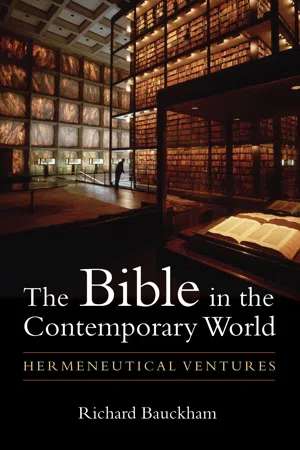
A crucial responsibility for Christian interpreters of Scripture, says Richard Bauckham, is to understand our contemporary context and to explore the Bible's relevance to it in ways that reflect serious critical engagement with that context. In this book Bauckham models how this task can be carried out.
Bauckham calls for our reading of Scripture to lead us to greater engagement with critical issues in today's world, including globalization, environmental degradation, and widespread poverty. He works to bring biblical texts to bear on these contemporary realities through the Bible's metanarrative of God and the world, according to which God's purpose takes effect in the blessing and salvation and fulfillment of the world as his cherished creation.
- 192 pages
- English
- ePUB (mobile friendly)
- Available on iOS & Android
eBook - ePub
About this book
Information
Topic
Theology & ReligionSubtopic
Biblical StudiesChapter 1
Reading Scripture as a Coherent Story
The church’s reading of Scripture has usually presupposed its narrative unity, that is, that the whole of the Bible — or the Bible read as a whole — tells a coherent story. Any part of Scripture contributes to or illuminates in some way this one story, which is the story of God’s purpose for the world. If Scripture does indeed tell the story of God’s purpose for the world, then we should certainly expect to find unity and coherence in it. But the idea of reading Scripture as a unified narrative seems problematic from at least two very different perspectives: that of biblical scholars for whom the great diversity of the biblical texts makes it inappropriate to the nature of the Bible and that of postmodern critics for whom a unified narrative would constitute Christianity the oppressive metanarrative that historically it has at least very often been.1 This essay begins with a section responding mainly to the first concern. The argument about the Bible is then interrupted by a critical consideration of the postmodern critique of metanarratives in order to resume, in the third section, a discussion of the biblical story with some conceptual tools provided by the postmodern approach.
1. The Biblical Story — Unity and Diversity
We should first be clear about the senses in which Scripture is clearly not a unified narrative. (1) Not all Scripture is narrative. Those books that are in narrative form sometimes contain nonnarrative material within the narrative context (e.g., law in Exodus-Deuteronomy), and it is not difficult to see how some nonnarrative books can be seen as implicitly, by their canonical relationship to the narrative works, given a narrative setting within the story told by the narrative books (e.g., Psalms, Lamentations). In a sense this is true of the largest category of nonnarrative works in each testament: prophecy and apostolic letters. (In the case of the former, the Hebrew Bible recognizes this in calling the historical books from Joshua to 2 Kings “ ‘the Former Prophets” and the prophetic books “the Latter Prophets.”) Prophecy and apostolic letters are intrinsically related to the biblical story, to which they constantly refer, even summarizing and retelling parts of it. The biblical narrative of God, his people, and the world structures their theology and is presupposed in the way they address the present and future. The apocalypses — Daniel and Revelation — like parts of the prophets, presuppose “the story so far” in envisioning its eschatological conclusion. Thus, while not all Scripture is generically narrative, it can reasonably be claimed that the story Scripture tells, from creation to new creation, is the unifying element that holds literature of other genres together with narrative in an intelligible whole. However, there are a few books of which this is more difficult to say: Song of Songs, Proverbs, Ecclesiastes. Association with Solomon links them externally to the story of Israel, but they seem to lack intrinsic connection with it.2 The presence of these books in the canon might suggest that Scripture finds its unity not in the story it tells but in the God about whom it speaks (though the problem of a book that does not speak of God at all — the Song of Songs — would still remain). But this is not a convincing distinction, since Scripture in general knows who God is from the story of God, his people, and the world that it tells. The solution surely lies in recognizing that, although this story focuses on the particularity of God’s activity in history, it also, especially in its beginning (Genesis 1–11), recognizes God’s general relationship as sovereign Creator to the whole creation and all people. In any case, it is important to note, with the trend of scholarship since the demise of the biblical theology movement, that the shape of the canon is distorted if biblical theology focuses on salvation history either at the expense of the wisdom literature of the Old Testament or at the expense of the significance of creation throughout the canon.
(2) The Bible does not tell a single story in the way that either a novel or a modern work of historiography by a single author may. Whatever unity it has is not the kind of coherence that a single author can give his or her work. The narrative books in fact adopt a wide variety of kinds of storytelling and historiography, while the future completion of the story can naturally only be indicated by quite different narrative means than those which tell, in whatever way, a story set in the past. Moreover, no one before the final editors or compilers of the New Testament canon ever planned the assembling of precisely this collection of works. Of course, Christians believe that God’s Spirit inspired these books and God’s providence guided their collection, but this does not warrant our supposing the Bible must have the kind of unity a human author can give to a work. God’s inspiration has evidently not suppressed the human diversity of the many human minds and circumstances that, at the human level, have constituted Scripture the collection of very varied materials that it is. Perhaps one could appeal to Mikhail Bakhtin’s notion of the polyphonic novel, in which the voices of the various characters and even the narrator are autonomous and equal.3 The unity of such a novel consists in the dialogue of conflicting voices. Perhaps the relation of the author to a polyphonic novel might constitute a kind of analogy for the relation of God to Scripture, but it would remain an analogy. Scripture has neither the kind of diversity nor the kind of unity a polyphonic novel does.
While the Bible does not have the kind of unity and coherence a single human author can give a literary work, there is nevertheless a remarkable extent to which the biblical texts themselves recognize and assert, in a necessarily cumulative manner, the unity of the story they tell. The books from Genesis to 2 Kings constitute a single edited history from creation to the exile, though the editors, especially of the Pentateuch, were evidently content to let a good deal of variety in the traditions they incorporated stand. In this they form something of a model for the compilers of the canon itself. 1-2 Chronicles spans the same period as Genesis–2 Kings, in its first eight chapters employing genealogy as a quite sophisticated means of representing the history from Adam to David. Although Ezra-Nehemiah is not placed after 1-2 Chronicles in the Hebrew canon, the editorial replication of the opening verses of Ezra at the end of 2 Chronicles does create a link, indicating the continuation of the same story. As well as these two parallel narratives, stretching from creation to, in one case, the exile, in the other, the reconstitution after the exile, the Old Testament contains the three short stories: Ruth, Esther, and Jonah.4 Each gives a perspective significantly different from those represented within the two major narrative sequences, but this is only possible because each is explicitly linked to the larger story of Israel (Ruth 1:1; 4:17-22; Esth. 2:5-6; Jon. 1:1 with 2 Kings 14:25).
The one biblical book that, in its way, matches the span of the whole canon is the Gospel of John, which begins with a deliberate echo of the opening words of Genesis (1:1: “In the beginning”) and concludes with a reference to the parousia (“until I come” [21:23], Jesus’ last words and the last words of the Gospel before the colophon [21:24-25]) that corresponds to the prayer with which Revelation concludes (22:20: “Come, Lord Jesus!”). Matthew’s opening genealogy resumes the whole Old Testament history from Abraham onward, at the same time evoking the messianic promises to Abraham and David, while the Gospel ends with reference to “the end of the age” (28:20). (It is worth noting that, whereas the biblical narratives in general leave a chronological gap between Old and New Testament stories [even if the deuterocanonical books of Maccabees are taken into account], the two genealogies of Matthew and Luke do create a kind of narrative link across this gap.) Throughout the New Testament, of course, the story of Jesus is treated as the continuation of the story of Israel and as initiating the fulfillment of the prophetic promises to Israel.
A sense of the unity of the biblical story is also given by a number of summaries to be found in both testaments, though there is no summary of the whole story from creation to new creation. Summaries of the story of Israel, of varying scope, include:
Deuteronomy 6:20-24 (exodus to occupation of the land);
Deuteronomy 26:5-9 (settlement in Egypt to occupation of the land);
Joshua 24:2-13 (Abraham to occupation of the land);
Nehemiah 9:6-37 (creation + Abraham to return from exile);
Psalm 78 (exodus to David);
Psalm 105 (Abraham to occupation of the land);
Psalm 106 = 1 Chronicles 16:8-16 (exodus to exile);
Psalm 135:8-12 (exodus to occupation of the land);
Psalm 136 (creation + exodus to occupation of the land);
Acts 7:2-50 (Abraham to Solomon).
Different as the focus and intent of these various summaries are, they tend to highlight the same major landmarks of the story. Just one of them virtually summarizes the whole Old Testament story: Nehemiah 9:6-37, placed at the chronological end of that story, resumes the whole story from creation to its own time. Rather surprisingly, the Bible contains only one summary of the Old and New Testament stories as one: Acts 13:17-41 begins with the patriarchs and ends with the resurrection of Jesus and the preaching of the apostolic message. The New Testament con...
Table of contents
- Acknowledgments
- Introduction
- 1. Reading Scripture as a Coherent Story
- 2. Are We Still Missing the Elephant? C. S. Lewis’s “Fernseed and Elephants” Half a Century On
- 3. Contemporary Western Culture — A Biblical--Christian Critique
- 4. The Bible and Globalization
- 5. Freedom and Belonging
- 6. Humans, Animals, and the Environment in Genesis 1–3
- 7. The Story of the Earth according to Paul
- 8. Ecological Hope in Crisis?
- 9. Creation — Divine and Human: An Old Testament Theological Perspective
- 10. God’s Embrace of Suffering
- 11. The Christian Way as Losing and Finding Self
- 12. The Fulfillment of Messianic Prophecy
- 13. Where Is Wisdom to Be Found? Christ and Wisdom in Colossians
- 14. What Is Truth?
- Index of Modern Authors
- Index of Scripture References
Trusted by 375,005 students
Access to over 1.5 million titles for a fair monthly price.
Study more efficiently using our study tools.
Frequently asked questions
Yes, you can cancel anytime from the Subscription tab in your account settings on the Perlego website. Your subscription will stay active until the end of your current billing period. Learn how to cancel your subscription
No, books cannot be downloaded as external files, such as PDFs, for use outside of Perlego. However, you can download books within the Perlego app for offline reading on mobile or tablet. Learn how to download books offline
Perlego offers two plans: Essential and Complete
- Essential is ideal for learners and professionals who enjoy exploring a wide range of subjects. Access the Essential Library with 800,000+ trusted titles and best-sellers across business, personal growth, and the humanities. Includes unlimited reading time and Standard Read Aloud voice.
- Complete: Perfect for advanced learners and researchers needing full, unrestricted access. Unlock 1.5M+ books across hundreds of subjects, including academic and specialized titles. The Complete Plan also includes advanced features like Premium Read Aloud and Research Assistant.
We are an online textbook subscription service, where you can get access to an entire online library for less than the price of a single book per month. With over 1.5 million books across 990+ topics, we’ve got you covered! Learn about our mission
Look out for the read-aloud symbol on your next book to see if you can listen to it. The read-aloud tool reads text aloud for you, highlighting the text as it is being read. You can pause it, speed it up and slow it down. Learn more about Read Aloud
Yes! You can use the Perlego app on both iOS and Android devices to read anytime, anywhere — even offline. Perfect for commutes or when you’re on the go.
Please note we cannot support devices running on iOS 13 and Android 7 or earlier. Learn more about using the app
Please note we cannot support devices running on iOS 13 and Android 7 or earlier. Learn more about using the app
Yes, you can access The Bible in the Contemporary World by Richard Bauckham in PDF and/or ePUB format, as well as other popular books in Theology & Religion & Biblical Studies. We have over 1.5 million books available in our catalogue for you to explore.