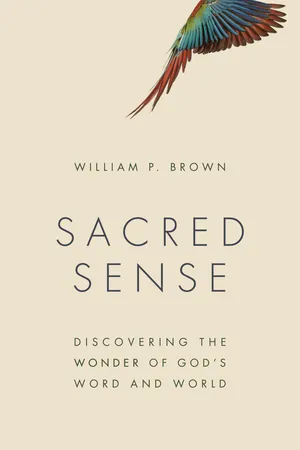
All too often Scripture is read only to find answers to life's perplexing questions, to prove a theological point, or to formulate doctrine. But William Brown argues that if read properly, what the Bible does most fundamentally is arouse a sacred sense of life-transforming wonder.
In this book Brown helps readers develop an orientation toward the biblical text that embraces wonder. He explores reading strategies and offers fresh readings of seventeen Old and New Testament passages, identifying what he finds most central and evocative in the unfolding biblical drama. The Bible invites its readers to linger in wide-eyed wonder, Brown says -- and his
Sacred Sense shows readers how to do just that.
- 184 pages
- English
- ePUB (mobile friendly)
- Available on iOS & Android
eBook - ePub
About this book
Information
1. Cosmic Wonder
Genesis 1:1–2:3
Then God said, “Let light be!”
Genesis 1:3
Given its pride of place, Genesis 1:1–2:3 (hereafter Genesis 1) serves as the official gateway to the Bible, a towering, majestic entrance into all of Scripture. Put to music, Genesis 1 would be something like a Bach organ fugue, full of contrapuntal variations filling every nook and cranny of a Gothic cathedral. But instead of resounding notes, we hear divinely spoken cadences reverberating throughout an intricately ordered universe.
One of the many but overlooked wonders of Genesis 1 is its mathematical intricacy. The account is crafted around seven days, eight acts, and ten commands. As the number ten matches the number of commandments in the Decalogue (Exod. 20:2-17; 34:28), so the number seven is no random counting. God “saw” and pronounced creation “good” seven times; “earth” or “land” (same word in Hebrew) appears twenty-one times; the word “God” is repeated thirty-five times. The number seven, and multiples thereof, is also attested in certain sections in Genesis 1. The first verse consists of seven words; the second contains fourteen. The final section, Genesis 2:1-3, yields a count of thirty-five. And the total word count of the account in Hebrew is 469 or 7 × 67. Genesis 1 is a numerologist’s wonderland. One could go on, but the most obvious example is no doubt the most important: the seventh day marks the climax of the account, the only day declared “holy.” The number seven connotes a sense of completion, of mission accomplished and order achieved. By numerical reckoning alone, Sabbath, one could say, is the solution to the equation of creation.
It is no coincidence that Genesis 1 is the most complex, intricately structured text of the entire Bible. It is, one could say, the brain of the Bible. Given its head position in the canon, Genesis 1 determines how the rest of Scripture is to be understood, subsuming everything that follows under the God who created “in the beginning.” Everything that follows Genesis 1 is infused with cosmic, creational significance, from the emancipation of Israelite slaves to the cry of dereliction on the cross, from a burning bush to broken bread. So also the Apocalypse.
Genesis 1 is also the Bible’s closest thing to a “natural” account of creation.1 Compared to the gripping (and gory) drama of the Babylonian creation myth (Enuma elish),2 Genesis 1 reads like a dry, dense treatise. Rigorously methodical in its presentation, the Bible’s opening chapter resembles more an itemized list than a flowing narrative. Genesis 1 is a highly disciplined text, reflecting a literary austerity that scrupulously avoids the wholly unnecessary drama of epic conflict. The text’s literary restraint is itself a mark of wonder.
Historical Context
There is, however, a great deal of drama lurking beneath the text’s intricate surface. Written most likely near the end of, or soon after, Israel’s exile in Babylon in the sixth century b.c.e., Genesis 1 offers a cosmic vision for a community intent on rebuilding itself from the ground up. The Babylonian exile of 587 b.c.e. had left the land of Judah decimated. From the perspective of those most affected, conquest and deportation rendered their land “formless and void” (Gen. 1:2). The survivors experienced this national trauma as nothing less than a cosmic upheaval that left the land emptied of life as they knew it, with the temple lying in ruins, much of Jerusalem razed to the ground, and the community thus stripped of its national and religious identity. Many came to think of their God as a loser, soundly defeated by Babylon’s imperial deity, Marduk, who according to Mesopotamian myth slew the gods of chaos and proclaimed himself lord of the universe. Marduk’s calling card was “creation by conquest.” Brutalized and humiliated, the survivors desperately needed hope and some semblance of dignity in the land of exile.
Enter Genesis 1. No clash of the Titans here. Only God, Israel’s unrivaled deity. This God in Genesis creates not through conquest but by command, by collaboration rather than through conflict. Lacking any hint of polemical nastiness, Genesis 1 served as a textual form of nonviolent resistance against imperial oppression and influence, whether Babylonian or Persian. Through its own account of cosmic creation, the exiled community sustained its identity amid the pressures of cultural assimilation, on the one hand, and national despair, on the other. With the edict of release issued in 538 b.c.e. by Babylon’s conqueror, the Persian king Cyrus II, the opportunity availed itself for the exiles to return and rebuild. In its historical context, Genesis 1 offers a cosmically hopeful vision for those ready to begin the great collaborative work of restoration, a monumental task of biblical proportions, a rebuilding program that does not require a native monarchy (forbidden under Persian rule) but instead affirms, as we shall see, the divinely endowed worth of every individual, made in “the image of God.” In this text, the God of the primordial beginning proves to be the God of ever new beginnings. Genesis 1, it turns out, constructs a cosmic edifice of hope.
Primordial Soup
But first, back to the beginning, or at least to the beginning described in the first two verses. The curtain rises to reveal a dark, cosmic mishmash:
When God began to create the heavens and the earth,3 the earth was void and vacuum, and darkness was upon the surface of the deep while the breath of God hovered over the water’s surface. (Gen. 1:1-2)
This initial state is described as tohu wabohu, a wonderfully poetic phrase translated here as “void and vacuum.”4 The Hebrew, however, is more vivid. The phrase is an alliterative meshing of two Hebrew words whose semantic sense transcends its individual components, as in “topsy-turvy,” “vice versa,” “mishmash,” “hodgepodge,” “mingle-mangle.” It designates, in other words, a farrago — a messy, confused mixture or conglomeration.5 Such was the “soupy” state of the universe in the beginning, according to the ancient cosmologist of Genesis. One could call it chaos, but not in any mythically threatening sense. This “chaos” is no enemy of God. Darkness, water, and emptiness together do not make a monster. But neither do they constitute mere nothingness (nihil). To find God creating something from nothing (creatio ex nihilo), one must look elsewhere in later tradition (e.g., 2 Macc. 7:28). Genesis 1, rather, depicts creatio ex chao, creation out of a soupy mishmash, a watery, roiling, empty waste of a state. Genesis 1:2 describes a state of dynamic disorder poised for the in-breaking of order. With God’s breath suspended over the dark, turbid waters, the stage is now set for a dramatically creative act, a cosmic blast of light.
The Legacy and Levity of Light
“Let light be!” As God’s first words (only two in Hebrew) shatter the cosmic silence, so God’s first act splits the primordial darkness. This command marks God’s exhalation of ruach, which can be translated “breath,” “wind,” or “spirit.” “Breath,” I’m convinced, is the best choice in 1:2, from the simple fact that, by analogy, exhaling is essential for speaking, and God does plenty of speaking in Genesis 1. (Try speaking while inhaling.) God’s breath “hovering”6 over the watery darkness, pregnant with potential, is God’s breath waiting to be released. And with breath released, so light is unleashed.7 God in Genesis 1 “exhales,” as it were, ten times in speech to bring about creation. God breathes out at every step in the process, initiating creation through uttered word, and the result is a cosmos replete with variety, structure, and the greatest wonder of all: life!
So why is light the first act of creation? The text does not say. Clearly, light is intimately associated with God. This primordial light bears the radiance of the divine. But there may be another side to light shining in the darkness, hinted at by a winsome paraphrase of the first three verses o...
Table of contents
- Preface and Acknowledgements
- Introduction: Wonder’s Wonder
- 1. Cosmic Wonder: Genesis 1:1–2:3
- 2. Grounded Wonder: Genesis 2:4b–3:24
- 3. Covenantal Wonder: Genesis 6–9
- 4. Woeful Wonder: Exodus 19–20
- 5. Playful Wonder: Proverbs 8:22-31
- 6. Manifold Wonder: Psalm 104
- 7. Wounded Wonder: Job 38–42
- 8. Mundane Wonder: Ecclesiastes
- 9. Erotic Wonder: Song of Songs
- 10. Prophetic Wonder: Isaiah 43:15-21 and Amos 5:21-24
- 11. Incarnational Wonder: John 1:1-18
- 12. Christ and Cosmic Wonder: Colossians 1:15-20
- 13. Terrifying Wonder: Mark 16:1-8
- 14. Resurrection Wonder: John 20:1-18
- 15. Communion Wonder: Luke 24:13-32
- 16. Consummated Wonder: Revelation 21–22
- Conclusion: Called to Wonder
- Works Cited
- Subject and Name Index
- Scripture Index
Trusted by 375,005 students
Access to over 1.5 million titles for a fair monthly price.
Study more efficiently using our study tools.
Frequently asked questions
Yes, you can cancel anytime from the Subscription tab in your account settings on the Perlego website. Your subscription will stay active until the end of your current billing period. Learn how to cancel your subscription
No, books cannot be downloaded as external files, such as PDFs, for use outside of Perlego. However, you can download books within the Perlego app for offline reading on mobile or tablet. Learn how to download books offline
Perlego offers two plans: Essential and Complete
- Essential is ideal for learners and professionals who enjoy exploring a wide range of subjects. Access the Essential Library with 800,000+ trusted titles and best-sellers across business, personal growth, and the humanities. Includes unlimited reading time and Standard Read Aloud voice.
- Complete: Perfect for advanced learners and researchers needing full, unrestricted access. Unlock 1.5M+ books across hundreds of subjects, including academic and specialized titles. The Complete Plan also includes advanced features like Premium Read Aloud and Research Assistant.
We are an online textbook subscription service, where you can get access to an entire online library for less than the price of a single book per month. With over 1.5 million books across 990+ topics, we’ve got you covered! Learn about our mission
Look out for the read-aloud symbol on your next book to see if you can listen to it. The read-aloud tool reads text aloud for you, highlighting the text as it is being read. You can pause it, speed it up and slow it down. Learn more about Read Aloud
Yes! You can use the Perlego app on both iOS and Android devices to read anytime, anywhere — even offline. Perfect for commutes or when you’re on the go.
Please note we cannot support devices running on iOS 13 and Android 7 or earlier. Learn more about using the app
Please note we cannot support devices running on iOS 13 and Android 7 or earlier. Learn more about using the app
Yes, you can access Sacred Sense by William P. Brown in PDF and/or ePUB format, as well as other popular books in Theology & Religion & Biblical Criticism & Interpretation. We have over 1.5 million books available in our catalogue for you to explore.