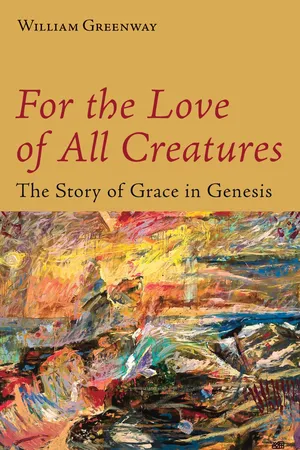
Fresh biblical take on a transcending, divine grace that embraces all of God's creatures
This broad-ranging, groundbreaking book by William Greenway unfolds a biblical spirituality centering on love for all creation and all creatures. Greenway rereads the creation and flood narratives in Genesis from an overtly creature-loving perspective that not only inspires care for creation but also reveals sophisticated understandings of faith, grace, and evil vital for twenty-first-century spirituality.
Comparing the ancient Israelite cosmology of Genesis both with the ancient Babylonian cosmology of the Enuma Elish and with the modern Darwinian cosmology of Thomas Hobbes's
Leviathan, Greenway shows how the Bible in Genesis extends far beyond those other cosmologies in its discernment of the transcending, gracious love of God. Standing at the intersection of animal rights, "green" biblical studies, and philosophical theology, Greenway's
For the Love of All Creatures will interest and inform a wide range of readers.
- 176 pages
- English
- ePUB (mobile friendly)
- Available on iOS & Android
eBook - ePub
About this book
Information
Topic
Theology & ReligionSubtopic
EcologyChapter One
Genesis 1–11
A Spiritual Classic
It should seem natural and wise, when seeking spiritual wisdom, to turn to classic spiritual writings. Unfortunately, “spiritual classic” and “spiritual wisdom” are not what most turn-of-the-millennium Westerners think of when they refer to the Genesis Flood and seven-days-of-Creation narratives. There are four major reasons a turn to these narratives may be surprising, especially in light of my claim to be committed to wholly reasonable investigation. First, because in the modern West the invocation of Scripture so often amounts to nothing more than an indefensible appeal to authority, and any such appeal would immediately vitiate any claim my argument may have to reasonableness.
Second, because the seven-days-of-Creation narrative is notorious for its “subdue the earth” and “have dominion” proclamations, which have been widely and justifiably blamed for promoting human exploitation of the earth and of nonhuman creatures.
Third, because the Flood narrative is on its face highly offensive, seemingly painting the picture of a reactionary god who viciously destroys almost all families of all kinds on the earth in a wildly disproportionate and wholly ungracious (to say the least) reaction to sin.
Fourth, because these narratives are Exhibit A in strident debates over creation science and the “flood geology” of young-earth creationists, and since the scientific approach to Scripture presumed by creation science is indefensible, it might seem that I should, by default, dismiss the Flood and Creation accounts as nothing more than the hopelessly outdated and obviously incorrect science of a primitive people.
All four reasons for surprise concerning a turn to the Flood and seven-days-of-Creation accounts are understandable. They involve reactions to influential modern readings of the Flood and seven-days-of-Creation narratives. However, these readings are distorted. The distortions are largely the result of modern Western tendencies to philosophical materialism (defined below) and anthropocentrism. Unfortunately, the distorted interpretations of these narratives, which are highly influential across the globe, both marginalize their stunning spiritual insight and elide all nonhuman creatures from our moral vision, facilitating their abuse in modern Western culture. I will argue that this moral elision and ethical abuse violates the heart of the testimony of these very narratives.
I will address issues of “subdue,” “have dominion,” and the violence of the Flood narrative in due course. But through the balance of this chapter I will work to address the issues of biblical authority and of the relationship of Scripture and science. First, I defend my appeal to these passages of Scripture as revelatory and distinguish my appeal from illegitimate appeals to authority. Second, I explain why many read the Flood and seven-days-of-Creation narratives as scientific accounts, and explain how these narratives themselves clearly tell us that they are not scientific. Third, I consider — as a contrasting case — a passage of Hebrew Scripture that is primarily scientific. Fourth, I clarify the general context within which the Flood and seven-days-of-Creation narratives reached their mature form, and thereby I clarify the signal spiritual questions these narratives originally addressed. I hope that, by the close of this brief analysis, I can disarm illegitimate appeals to authority, disarm the confusion of reading the Flood and Creation narratives as if they are primitive stabs at science, and characterize a legitimate way of hearing these spiritually profound narratives.
1. Legitimate Turn to Scripture
The Flood and seven-days-of-Creation narratives are at the heart of the so-called “primeval history” that stands at the very beginning of the Jewish and Christian scriptures in chapters one through eleven of the book of Genesis. Centuries before the time of Jesus, the primeval history had already earned its authoritative place at the very beginning of the ancient Israelites’ most revered writings. The primeval history, then, is an ancient narrative that had tremendous influence on Judaism and Christianity.
While it is an ancient narrative, the primeval history is itself the product of a rich, centuries-long history of redaction (“redaction” stands for the editing and reediting of oral and written texts by diverse authors and/or communities of religious leaders). For instance, the primeval history reached its present form in Israel’s late exilic or early postexilic period, around 500 bce, whereas the earliest written versions of Ancient Near Eastern flood narratives are dated to around 1700 bce.1 As will become clear, the primeval history makes no attempt to hide the fact that it integrates multiple strands of extant traditions, the roots of which stretch to the earliest reaches of Israelite spirituality.
By the time the primeval history was redacted into the form we now find in Genesis, the centuries-old oral and textual traditions that the redactors were combining and revising into the Genesis version had already garnered considerable religious and political authority within the community. Therefore, as a matter of sincere respect and perhaps also serious political expedience, those authoritative narratives had to be recontextualized with considerable care. Therefore, while the primeval history is an ancient and influential narrative, it is itself a relatively late writing; and though it retains intact strands of more ancient narratives, taken as a whole in its present form, it represents one of the more mature strands of ancient Israelite spirituality in the Hebrew scriptures of Judaism and Christianity.
It is reasonable to expect narratives with such a rich and fluid history of composition and maturation, narratives that over the centuries became established and were refined as spiritual classics, to be founts of spiritual wisdom. Insofar as similar histories of composition hold for narratives among all the world’s classic wisdom traditions, this conclusion holds for the spiritual classics of all the world’s religions. One certainly cannot conclude from this that spiritual classics are inerrant or infallible. Nor is any revelation or truth contained in such narratives, such that it could be extracted from them by the application of the right method. That is, I do not accept the pseudoscientific idea that revelation is some sort of propositional deposit that can be objectively mined out of a text if one applies the right methodological tools. Moreover, I never wish to be heard saying anything as self-alienating and spiritually stultifying as “Do or think this because the Bible says so.”
I will not be seeking any set of objective, propositional meanings in these texts. I will not be asking, “What did the authors mean?” I will be engaged in spiritual philosophy, in a reasonable awakening to spiritual truths that I do not demonstrate, prove, construct, or in any other way originate, in a reasonable awakening to spiritual truths by which I hope we find ourselves seized. I will be asking: What spiritual awakening inspired these authors to write these texts? Or, what is the character of the spirituality to which these texts testify? In other words, what I will be saying is this: Here is classic spiritual testimony, testimony that matured over the course of centuries, testimony that stood the test of time, testimony that the Jewish and Christian traditions came to affirm as most wise and true. Do you hear it? Are you moved and convicted? More specifically, are you seized by love for every creature? These are the key questions, for the Flood and seven-days-of-Creation narratives become legitimate, truth-bearing testimony only insofar as they awaken us spiritually.
The truth-bearing potential of spiritual narratives is ever and only contemporaneous with and realized in the event of a reader’s awakening. The authority of the narratives cannot be — and never should be — dogmatically asserted. And the authority of the narrative is not immanent within the text. It obtains only in the reader’s having been awakened to some transcending truth. Reasonable affirmation comes in the face of this wholly subjective dynamic insofar as the awakening is logically consistent and subject to broad intersubjective confirmation: the broader and more diverse the confirmation, the greater the degree of confirmation.
In any case, I turn to these narratives precisely because for multitudes of people across generations and cultures, and for me personally, in a fashion consistent with classic Jewish and Christian spirituality, they have indeed proven to be revelatory guides in the struggle to stand faithfully, and even joyfully, eyes wide open to the otherwise overwhelming injustice and suffering that suffuses reality. In particular, I will argue that the Flood and seven-days-of-Creation narratives testify profoundly to the reality and implications of our having been seized by love for every creature.
In summary, my argument will not depend on convincing readers to affirm a proposition; nor will it be confirmed objectively in accord with my explanation of the argument’s consistency with classic spiritual affirmations. The truth of the argument will obtain only insofar as it is logically consistent, coheres with historically deep and culturally diverse affirmation, and, most immediately, insofar as all readers find that it resonates with them and truly expresses and perhaps even helps them to more accurately understand and interpret within history the reality and implications of their own having been seized by love for every creature.
I am by nurture, profession, and conviction a Christian, so it is no accident that I turn to the Flood and seven-days-of-Creation narratives in Genesis. Nonetheless, it is not primarily or ultimately my Christian identity that dictates my turning to these texts; rather, it is the fact that I have indeed found them to be revelatory. Let me emphasize in this regard that insofar as we are dealing with divine reality, which is always interpreted within some culturally specific context but which is not primordially or ultimately culturally contingent, I would expect those from other faith traditions to find parallel revelatory resources among their own spiritual classics. But, quite naturally, it has been in contemplation of spiritual classics from my own tradition that I have found myself convicted and my understanding enhanced.
I have been awakened by the Flood and seven-days-of-Creation narratives. I have found that they testify to an overwhelming, humbling awe at the fragility and preciousness of each life. They gesture beyond all the distractions and superficialities of daily existence. They look at the harshest realities of existence. They bluntly name human selfishness, spite, and hatefulness. They stare, unblinking, at the suffering and injustice suffusing reality. And yet they still testify to and inspire wonder, love, and hope. So I turn to them for spiritual wisdom. This is a wholly reasonable tur...
Table of contents
- Acknowledgments
- Preface
- 1. Genesis 1–11: A Spiritual Classic
- 2. Enuma Elish: The Ancient Near Eastern Counterpoint
- 3. Leviathan: The Modern Western Counterpoint
- 4. The Genesis Flood: Shattering Violence
- 5. Aftermath: The Birth of the God of Grace
- 6. The Seven Days of Creation
- 7. Dominion versus Domination: Living Life and Living Death
- 8. A Knowing Idealism: The Decisive Asymmetry
- 9. The Primeval History: Spiritually Accurate, Realistic, and Profound
- Bibliography
- Index
Trusted by 375,005 students
Access to over 1.5 million titles for a fair monthly price.
Study more efficiently using our study tools.
Frequently asked questions
Yes, you can cancel anytime from the Subscription tab in your account settings on the Perlego website. Your subscription will stay active until the end of your current billing period. Learn how to cancel your subscription
No, books cannot be downloaded as external files, such as PDFs, for use outside of Perlego. However, you can download books within the Perlego app for offline reading on mobile or tablet. Learn how to download books offline
Perlego offers two plans: Essential and Complete
- Essential is ideal for learners and professionals who enjoy exploring a wide range of subjects. Access the Essential Library with 800,000+ trusted titles and best-sellers across business, personal growth, and the humanities. Includes unlimited reading time and Standard Read Aloud voice.
- Complete: Perfect for advanced learners and researchers needing full, unrestricted access. Unlock 1.5M+ books across hundreds of subjects, including academic and specialized titles. The Complete Plan also includes advanced features like Premium Read Aloud and Research Assistant.
We are an online textbook subscription service, where you can get access to an entire online library for less than the price of a single book per month. With over 1.5 million books across 990+ topics, we’ve got you covered! Learn about our mission
Look out for the read-aloud symbol on your next book to see if you can listen to it. The read-aloud tool reads text aloud for you, highlighting the text as it is being read. You can pause it, speed it up and slow it down. Learn more about Read Aloud
Yes! You can use the Perlego app on both iOS and Android devices to read anytime, anywhere — even offline. Perfect for commutes or when you’re on the go.
Please note we cannot support devices running on iOS 13 and Android 7 or earlier. Learn more about using the app
Please note we cannot support devices running on iOS 13 and Android 7 or earlier. Learn more about using the app
Yes, you can access For the Love of All Creatures by William Greenway in PDF and/or ePUB format, as well as other popular books in Theology & Religion & Ecology. We have over 1.5 million books available in our catalogue for you to explore.