Shows how economics functions as the dominant religion in America today
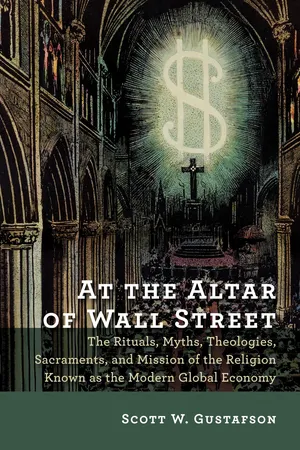
In this provocative book Scott Gustafson argues that economics functions in our current global culture as religions have functioned in other cultures. He describes and analyzes the rituals, pilgrimage sites, myths, prophets, sacraments, and mission of Economics to show how the Economy is our de facto God. Discussing such topics as debt, economic terrorism, globalization, and money as the Economy's sacrament, Gustafson's
At the Altar of Wall Street encompasses a broad sweep of history, philosophy, culture studies, economic ideas, and religion in its trenchant analysis.
eBook - ePub
At the Altar of Wall Street
The Rituals, Myths, Theologies, Sacraments, and Mission of the Religion Known as the Modern Global Economy
- 224 pages
- English
- ePUB (mobile friendly)
- Available on iOS & Android
eBook - ePub
At the Altar of Wall Street
The Rituals, Myths, Theologies, Sacraments, and Mission of the Religion Known as the Modern Global Economy
About this book
Information
Topic
Theology & ReligionSubtopic
Economic TheoryChapter 1
Economic Rituals
Each day on Wall Street begins with a simple liturgy. A presider . . . stands at a podium and rings a bell. For the next eight hours exchanges occur that determine the well-being of the market for that day that bring either hope or despair to the participants in the ritual. This experience of a bull-market “heaven” or a bear-market “hell” is indistinguishable in effect from revivalist experiences of being “saved” or “damned.” A simple economic exchange becomes something “more” than that within the ritual parameters of the Wall Street market. The day ends, of course, exactly as it began: with a ritual ringing of a bell. The stock market is the soul of capitalism, and capitalism is the soul of the nation.
Jon Pahl, Shopping Malls and Other Sacred Places1
The Power and Function of Ritual
Human life is replete with rituals. We don’t think about them much. We just participate. We uncritically believe our rituals are synonymous with reality itself. Our Economic rituals hold such power over us. We rarely think about them, we seldom see an alternative to them. As such they have a strong hold over our lives.
Confucius (551-479 bce) was the first person to understand the power of ritual (li).Over two thousand years before modern sociologists began to discuss ritual, Confucius described ritual (li) as objective prescriptions of human behavior that bind human beings together. Rituals are meaning-invested roles, activities, relationships, and institutions that foster communication and create a sense of community between diverse people. Rituals include all formal conduct from table manners to greeting employers or employees. Weddings and funerals are obviously rituals. Others, like public transactions between strangers, are less obvious but they are rituals nevertheless. Rituals are the social grammar that provides each person with a defined place and status within family, community, and public life. Rituals help transmit meaning from one generation to the next. They help the values of a culture persist through time.2
One of Confucius’ most important observations is that rituals modify human behavior in ways far more powerful than direct commands or written rules because commands and rules always bring to mind the possibility of doing otherwise. There is no obvious alternative to a ritual. A person either participates or refrains from participation. Participation creates harmony. But, for the individual, refusing to participate often has severe social consequences. For example, it is risky for a person to remain seated during the National Anthem when it is played at a sporting event. Threats and violence could be directed at such a person because such public refusal to engage in any ritual creates disharmony. But, once engaged in a ritual, doing is believing, and, quite often, we perform our rituals without conscious reflection.3
The power inherent in ritual is most obvious when we feel uncertain, anxious, or impotent. At such times rituals provide “patterns of predictability” that create an illusion of control over the uncontrollable powers that confront us.4 In his classic novel The Sleepwalkers, Hermann Broch artfully describes ritual’s power in his account of a funeral’s ability to transform the horror of death into the mundane.
. . . he went slowly over and touched the black-draped wall, felt under the gloomy hangings the picture-frames and the frame of the case where the Iron Cross hung, and this refound fragment of actuality transformed death in a novel and almost exciting way into a matter of drapery, accommodating almost cheerfully the fact that Helmuth in his coffin, decked with all his flowers, had been introduced into this room like a new piece of furniture, thus once more reducing the incomprehensible so radically to the comprehensible, the certain and the assured that the experience of these few minutes — or had they been seconds? — passed over into a soothing feeling of quiet confidence.5
Economic rituals provide this same transformative function. The Economy threatens us with uncertainty, disorder, abject poverty, and death. What will we do if the stock market collapses? How will we survive hyperinflation? Will our children be better off than we are? How can I put food on the table? Will I have a job tomorrow? In times of crisis as well as normalcy, our economic rituals transform the incomprehensible and uncertain into the comprehensible and certain.
When an Economic crisis ensues, the President appears before the American flag and other symbols of state in the ritual attire we call a business suit. If the crisis is great, he will also be surrounded by other appropriately clad men and (some) women we believe to be experts. These experts function as Priests of the Economy whose religious sanction is always needed by political rulers. These men and women stand behind the President to assure us that the President is not “shooting from the hip.” Experts are in control. Order will soon arise from the chaos of the moment. We are told that we need not be anxious. The crisis is under control. As a matter of fact, we are told that some of the people on the stage actually predicted and expected this disaster and are “ahead of the curve” in protecting us because, in their wisdom, they “saw it coming.” The ritual of words, postures, and symbols turns the uncertain into the certain, the unpredictable into the predictable, and the incomprehensible into the comprehensible.
The media also provides us ritualistic certainty during difficult times. The wild drop in the stock market is “explained” by Hungary’s skyrocketing interest rates or online shopping. Media experts tell us to remain calm. They say that this drop is a “necessary correction” to a market that “got ahead of itself.” The more intrepid tell us that we should use this as a “buying opportunity” because we will never see prices this low again! The closing bell rings (not the only liturgy in which a bell or a gong rings). The traders applaud. They go in peace to serve their God. The Market rituals have conveyed the certainty that this extraordinary and frightening event is actually normal and that everything is under control and explainable. It doesn’t really matter what the explanations are. It does not matter if the explanations are consistent with reality. It does not matter if they make sense. All that matters is that there is an explanation.
Explanation rituals operate even if there is nothing to be explained. Sometimes we hear of the Dow Jones Industrial Average dropping by .02 percent on a volume of 1 billion shares. Our experts (or are they really our priests?) even offer their explanations for this non-event by citing something like a lukewarm consumer report or a rise in Latvian interest rates. Such obviously ridiculous pronouncements are important rituals because they create the belief that someone understands even the minutest details behind the millions of decisions surrounding the stock market each day. Explanations of non-events are very important economic rituals. They are conducted so that when a crisis does occur, we will be primed to believe in and perhaps even be comforted by the explanations that once more transform the incomprehensible into the comprehensible, the certain, and the assured.
Rituals have the unique ability to convince us of the unbelievable.6 Their ordered and repetitive characteristics suggest that order and meaning triumph over disorder and meaninglessness. Since many believe that the Market stands between us and the unbridled forces of scarcity, disorder, poverty, and death, we have developed economic rituals to protect us from these threats. We do so by introducing the regularity of ritual into the irregularity of market transactions, and we strive to “save ourselves” by so doing. If one reflects on the unspoken assumptions behind our rituals, the unspoken claims our rituals make may appear quite dubious; however, we normally do not reflect on our rituals. We participate in them long before we reflect upon them. Such unreflecting participation is the source of ritual’s power.
Economic Rituals That Revive Our God, The Economy
The ancient Babylonians had an interesting creation myth. They believed that before the earth and Babylonia were created, there were many gods. There were male gods and female gods. There were older gods and younger gods. The older gods had a problem. The younger gods were rambunctious. They were making too much noise. Tiamat, the mother of all the gods, decided that the only way to achieve peace and quiet was to kill all the young gods. The young gods heard of the plan and were terrified, but Marduk saw this as an opportunity. He told his siblings that he would kill Tiamat, but, in exchange, the surviving gods had to recognize him as supreme. Marduk’s siblings agreed, and Marduk killed Tiamat. From her body he formed the earth, and he created the Babylonian people to serve Marduk and the rest of the gods.
The Babylonians understood that they owed their l...
Table of contents
- Cover
- Titel
- Dedication
- Contents
- Preface
- Introduction
- 1. Economic Rituals
- 2. Economic Myths, Metaphors, and Rhetoric
- 3. The Economy’s Theologians, Prophets, Reformers, Terrorists, and Priests
- 4. Corporations: The Religious Communities of the Economic Faithful
- 5. Money: The Sacrament of The Market Economy
- 6. The Economy’s Global Mission
- 7. Is Economics Civilization’s Primal Religion?
- 8. Beyond Our Current Religious Configurations
- Bibliography
- Index
Trusted by 375,005 students
Access to over 1.5 million titles for a fair monthly price.
Study more efficiently using our study tools.
Frequently asked questions
Yes, you can cancel anytime from the Subscription tab in your account settings on the Perlego website. Your subscription will stay active until the end of your current billing period. Learn how to cancel your subscription
No, books cannot be downloaded as external files, such as PDFs, for use outside of Perlego. However, you can download books within the Perlego app for offline reading on mobile or tablet. Learn how to download books offline
Perlego offers two plans: Essential and Complete
- Essential is ideal for learners and professionals who enjoy exploring a wide range of subjects. Access the Essential Library with 800,000+ trusted titles and best-sellers across business, personal growth, and the humanities. Includes unlimited reading time and Standard Read Aloud voice.
- Complete: Perfect for advanced learners and researchers needing full, unrestricted access. Unlock 1.5M+ books across hundreds of subjects, including academic and specialized titles. The Complete Plan also includes advanced features like Premium Read Aloud and Research Assistant.
We are an online textbook subscription service, where you can get access to an entire online library for less than the price of a single book per month. With over 1.5 million books across 990+ topics, we’ve got you covered! Learn about our mission
Look out for the read-aloud symbol on your next book to see if you can listen to it. The read-aloud tool reads text aloud for you, highlighting the text as it is being read. You can pause it, speed it up and slow it down. Learn more about Read Aloud
Yes! You can use the Perlego app on both iOS and Android devices to read anytime, anywhere — even offline. Perfect for commutes or when you’re on the go.
Please note we cannot support devices running on iOS 13 and Android 7 or earlier. Learn more about using the app
Please note we cannot support devices running on iOS 13 and Android 7 or earlier. Learn more about using the app
Yes, you can access At the Altar of Wall Street by Scott W. Gustafson in PDF and/or ePUB format, as well as other popular books in Theology & Religion & Economic Theory. We have over 1.5 million books available in our catalogue for you to explore.