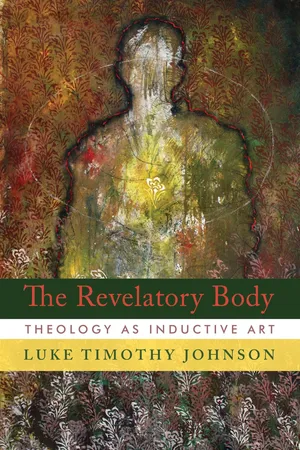
Argues that theology can respond faithfully to the living God only by paying due attention to human bodily experience
Scripture points to the human body and lived experience as the preeminent arena of God's continuing revelation in the world, says Luke Timothy Johnson. Attentively discerning the manifestations of God's Spirit in and through the body is essential for theology to recover its nature as an inductive art rather than — as traditionally conceived — a deductive science.
Willingness to risk engaging actual human situations — as opposed to abstract conceptualizations of those situations — is required of the theologian, Johnson argues. He celebrates the intimations of divine presence and power in such human experiences as play, pain, pleasure, work, and aging, showing how theology can respond faithfully to the living God only by paying due attention to human bodily experience.
- 256 pages
- English
- ePUB (mobile friendly)
- Available on iOS & Android
eBook - ePub
About this book
Information
Topic
Theology & ReligionSubtopic
Biblical StudiesChapter One
The Way Not Taken:
A Disembodied Theology of the Body
A Disembodied Theology of the Body
Among the many books available that in one way or another call themselves theologies of the body, perhaps the most notable is the collection of conferences delivered at papal audiences by the late (and now Saint) John Paul II, published as Theology of the Body: Human Love in the Divine Plan.1 Appearing with such a title, under the name of the (then) sitting leader of Christianity’s largest denomination, the book was bound to attract attention, and it did, especially among conservative Roman Catholics, who have greeted all papal teaching on sexuality with extravagant praise. Archbishop Charles J. Chaput, OFM Cap., for example, has declared that Pope Paul VI was a prophet because, in the encyclical Humanae Vitae, he was correct in forbidding artificial birth control. Janet Smith believes that Catholics who disagree with the papacy’s condemnation of contraceptives have not appreciated or understood the full richness of papal teaching on sexuality, above all in the work of John Paul II.2 Similarly, Jennifer Popiel declares that, “unlike many women, I find the church’s doctrinal statements on contraception and reproduction to be clear and compelling,” and she argues that natural family planning is fully compatible with feminism, since “only when we control our bodies will we truly control our lives.”3
In a lengthy blog response to an earlier version of this present chapter,4 Christopher West, another papal apologist, declares that “the theology of the body has already begun the sexual counter-revolution . . . . [I]t’s a revolution that Luke Timothy Johnson doesn’t understand, isn’t ready for, or doesn’t desire.”5 The implication of West’s crisp statement is that if I really understood the pope, I would be intellectually compelled to agree with him, and if I understood the pope’s position and still did not agree, my resistance would be due to moral rather than intellectual inadequacy.
The preeminent papal apologist, however, is George Weigel. In his biography of John Paul II,6 Weigel takes particular pains to trace the pope’s systematic response to what he terms the “pastoral and catechetical failure” of Paul VI’s encyclical Humanae Vitae (1968), infamous for its rejection of every form of artificial birth control.7 John Paul II’s 130 fifteen-minute conferences (delivered between 1979 and 1984) were gathered together under four headings: “The Original Unity of Man and Woman,” “Blessed Are the Pure of Heart,” “The Theology of Marriage and Celibacy,” and “Reflections on Humanae Vitae.” As Weigel himself observes, the arrangement of the collection reveals its intention as a theological rationalization for Paul VI’s encyclical on birth control.
Weigel is rhapsodic concerning what he considers John Paul II’s resounding success. The collection of sermons, he says, is a “theological time bomb” that may take a hundred years fully to appreciate. It “may prove to be the decisive moment in exorcizing the Manichaean demon and its depreciation of human sexuality from Catholic moral theology,” precisely because the pope takes “embodiedness” so seriously. The book has “ramifications for all of theology,” and is a “critical moment not only in Catholic theology, but in the history of modern thought.” High praise, indeed; no wonder Weigel is surprised that so few priests preach from the book, and only a “microscopic” portion of the Catholic people even seem aware of this great accomplishment. He attributes the neglect to the density of the Pope’s thought, the fascination of the media with incidentals, and the controversial character of the pontiff. Weigel concludes that it will take time to appreciate the pope and his magnificent achievement.
Weigel is certainly on target with regard to the polarizing character of the late pope and the media’s chronic inability to transcend the trivial. He is accurate as well (if perhaps overly charitable) in calling the 130 talks “dense.” They are, in fact, exceptionally difficult to read and almost mind-numbingly repetitious. What must they have been like to hear? But are they, nevertheless, as theologically important as Weigel proposes? Do they represent the future direction of thinking theologically about the body? I don’t think they do. Indeed, I regard the pope’s effort as exemplifying precisely the wrong kind of approach to the mystery of human embodiedness.
I do not challenge the proposition that in some respects John Paul II’s teaching on sexuality could be called “prophetic,” above all in his resistance to what he termed the “culture of death” (exemplified by millions of abortions) in contemporary society, and his critique of the pervasive sexualization of identity in the West. But his effort in this book falls far short of adequate theological thinking on the subject of the human body as the arena of God’s self-disclosure. The pope’s book is inadequate, not in the obvious way that all theology is inadequate to speak of God (and should therefore exhibit intellectual modesty), but in the sense that it simply does not engage what ought most to be engaged in a theology of the body. Because of its theological weakness, the pope’s teaching does not really respond to the anxieties of those who, seeking a Christian understanding of the body and of human sexuality, look for practical guidance for their lives as sexually active adults.
If John Paul II had made only passing remarks on his chosen subject in a single homily, then a full-fledged critical response would be unfair. But everything suggests that he intended these collected conferences to be read as a “theology of the body” in the fullest sense of the term “theology.” The pope uses academic terms such as “phenomenology” and “hermeneutics”; he refers to contemporary thinkers; he provides copious notes; and in the very commitment to the subject over a period of five years in 130 conferences, he indicates that he wants his thought to be given the most serious consideration. Weigel’s dismay at the lack of such attention certainly suggests that he has had the same expectation. It is appropriate, then, to treat John Paul II’s words as those of a theologian and to test them for their intellectual adequacy, especially since his approach is in some ways characteristic of others who are seeking a “theology” of the body.
The Problem of Focus
Perhaps the title of this collection of talks was not chosen by John Paul II himself, but it legitimately derives from his frequent reference to a “theology of the body” and his concentration on “human love in the divine plan.” Surely, though, adequate theological reflection on the body must encompass far more than human love, even if that were comprehensively treated. Sex is simply not the only mysterious aspect of the body, or the exclusive expression of human love! The pope cites Paul’s statement in 1 Corinthians 6:18 with approval: “Flee fornication. Every sin a person commits is apart from the body. But the one who fornicates sins in his own body.” But Paul’s rhetoric in this case cannot be taken as sober description of reality. Do not the sins of gluttony and drunkenness and sloth have as much to do with the body as fornication, and do not all forms of avarice also involve dispositions of the body?
To be sure, a responsible theological phenomenology of the body as primordial mystery or symbol of human freedom and bondage must include every aspect of sexuality. But it must also embrace all the other ways in which human embodiedness both enables and limits human freedom (and the freedom of the Spirit) through the body, as in the use of material possessions, engagement with the environment, artistic creativity, and suffering — both sinful and sanctifying. The pope’s title provides the first clue to the way in which a grander — or to use his word, “vast” — conceptual framework serves to camouflage a distressingly narrow view of his chosen topic.
As for “human love in the divine plan,” the conferences provide few glimpses of human love as actually experienced. The topic of human love in all its dimensions has been wonderfully explored by the world’s literature, but none of its grandeur or giddiness appears in these talks, which remain at a level of abstraction far removed from novels and newspapers that carry stories of love among people who look and act like us. John Paul II claims to be practicing “phenomenology,” but from the evidence of these homilies, he seems to have paid little attention to actual human experience. Instead, he dwells on the nuances of words in biblical narratives and propositions, while fantasizing an ethereal and all-encompassing mode of mutual self-donation between man and woman that lacks any of the messy, clumsy, awkward, charming, casual, and yes, silly aspects of love in the flesh. Carnality, it is good to remember, is at least as much a matter of humor as of solemnity. In the pope’s formulations, though, human sexuality is observed by telescope from a distant planet. Solemn pronouncements are made on the basis of scriptural exegesis rather than living experience. The effect is something like that of a sunset painted by the unsighted.
The Use of Scripture
An objection might be made like this: Isn’t it proper to base theology in Scripture, and isn’t John Paul II correct to devote himself so sedulously to the analysis of biblical texts rather than the slippery and shoddy stuff of experience? Much more must be said on this subject later, but for now it can be noted that the Catholic tradition takes seriously the continuing work of God’s Holy Spirit in the world. If we believe — and this is a crucial point — that revelation is not exclusively biblical but occurs in the continuing experience of God in the structures of human freedom, then at least an occasional glance at human experience as actually lived might be appropriate even for the magisterium.8
The pope’s way of reading Scripture, however, also falls below the level of serious theological engagement. John Paul II certainly shows care with the passages he considers, and he does not misrepresent in a major way the texts he discusses, though he leaves the clear impression that Matthew’s “Blessed are the pure of heart” (Matt. 5:8) refers to chastity, when he knows full well that the beatitude does not have so restricted a sense. More questionable is the way John Paul II selects and extrapolates from specific texts without sufficient grounding or explanation. An adequate theological engagement with Scripture concerning sexuality would require, I submit, both an assessment of everything said in the Old and New Testaments touching on the subject — both the good and the bad — and then a judicious inquiry into how these diverse testimonies might or might not be taken normatively. One simply cannot move from a flat and uncritical reading of the text to normative claim. But this is what John Paul II does.
Given that the pope has reduced “human love” to “human sexuality,” it is striking that his discourses center on only a handful of (admittedly) important passages, with a mere nod in the direction of other rich texts that might have rewarded much more attention, such as the Song of Songs (three conferences) and t...
Table of contents
- Preface
- Introduction: Toward an Inductive Theology
- 1. The Way Not Taken: A Disembodied Theology of the Body
- 2. Scripture and the Body
- 3. Spirit and Body
- 4. The Body at Play
- 5. The Body in Pain
- 6. The Passionate Body
- 7. The Body at Work
- 8. The Exceptional Body
- 9. The Aging Body
- Epilogue
- Index of Subjects
- Index of Scripture References
- Index of Other Ancient Sources
Trusted by 375,005 students
Access to over 1.5 million titles for a fair monthly price.
Study more efficiently using our study tools.
Frequently asked questions
Yes, you can cancel anytime from the Subscription tab in your account settings on the Perlego website. Your subscription will stay active until the end of your current billing period. Learn how to cancel your subscription
No, books cannot be downloaded as external files, such as PDFs, for use outside of Perlego. However, you can download books within the Perlego app for offline reading on mobile or tablet. Learn how to download books offline
Perlego offers two plans: Essential and Complete
- Essential is ideal for learners and professionals who enjoy exploring a wide range of subjects. Access the Essential Library with 800,000+ trusted titles and best-sellers across business, personal growth, and the humanities. Includes unlimited reading time and Standard Read Aloud voice.
- Complete: Perfect for advanced learners and researchers needing full, unrestricted access. Unlock 1.5M+ books across hundreds of subjects, including academic and specialized titles. The Complete Plan also includes advanced features like Premium Read Aloud and Research Assistant.
We are an online textbook subscription service, where you can get access to an entire online library for less than the price of a single book per month. With over 1.5 million books across 990+ topics, we’ve got you covered! Learn about our mission
Look out for the read-aloud symbol on your next book to see if you can listen to it. The read-aloud tool reads text aloud for you, highlighting the text as it is being read. You can pause it, speed it up and slow it down. Learn more about Read Aloud
Yes! You can use the Perlego app on both iOS and Android devices to read anytime, anywhere — even offline. Perfect for commutes or when you’re on the go.
Please note we cannot support devices running on iOS 13 and Android 7 or earlier. Learn more about using the app
Please note we cannot support devices running on iOS 13 and Android 7 or earlier. Learn more about using the app
Yes, you can access The Revelatory Body by Luke Timothy Johnson in PDF and/or ePUB format, as well as other popular books in Theology & Religion & Biblical Studies. We have over 1.5 million books available in our catalogue for you to explore.