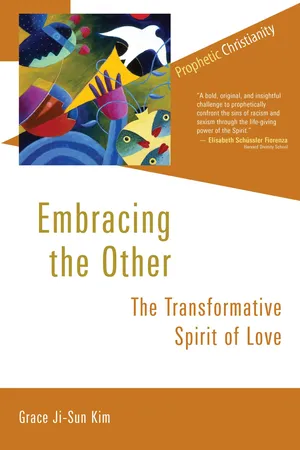
An innovative Asian feminist perspective on God's Spirit
We live in a time of great racial strife and global conflict. How do we work toward healing, reconciliation, and justice among all people, regardless of race or gender? In
Embracing the Other Grace Ji-Sun Kim demonstrates that it is possible only through God's Spirit.
Working from a feminist Asian perspective, Kim develops a new constructive global pneumatology that works toward gender and racial-ethnic justice. She draws on concepts from Asian and indigenous cultures to reimagine the divine as "Spirit God" who is restoring
shalom in the world. Through the power of Spirit God, Kim says, our brokenness is healed and we can truly love and embrace the Other.
- 192 pages
- English
- ePUB (mobile friendly)
- Available on iOS & Android
eBook - ePub
About this book
Information
Topic
Theology & ReligionSubtopic
Christian MinistryChapter 1
Foreign Women in the Hebrew Bible
Many of us are familiar with the story of Giacomo Puccini’s Madama Butterfly,1 not only as an opera but also as a reality for many people of color in America. The story of Madama Butterfly begins with a U.S. Navy officer named B. F. Pinkerton, who wishes to marry a fifteen-year-old Japanese girl, Cio-Cio San (Butterfly) for convenience until he finds a proper American wife. Shortly after they get married, Pinkerton leaves. Butterfly waits for him faithfully, and gives birth to their son without him. After three years, Butterfly receives news that Pinkerton is coming back to see her. Her heart swoons, but little does she know that he has married a white American woman.2
The tragedy is not only that Butterfly was used as a temporary wife in a marriage of convenience, without her knowing it, but also that as a result of marrying an American, she was alienated by her own family. The tragedy is also that Pinkerton and his new wife are coming back because the American wife has agreed to raise the Japanese-American child. Once Butterfly realizes that the real reason for Pinkerton’s visit is to take her child with him, she is devastated, agrees to the request, blindfolds the child, and commits suicide.
This is a tragic ending to a love story that Butterfly thought was hers, when in reality she was only used as a sexual partner while the naval officer was lonely and far from home. To him, Butterfly was a commodity, not a person in her own right. Pinkerton gave his young bride the name “Butterfly” because he did not even know her Japanese name! By relegating her to the world of nature, she became an object in the “background” of his own story and an object to be used and discarded. To use Rudolf Otto’s3 terminology, to him Butterfly was an “it” rather than a “thou.”
We are all too familiar with this narrative. It is not necessarily the story of a white man marrying an Asian woman out of convenience, but more broadly the story of how a white person treats, or rather mistreats, a person of color as the Other and does as he or she wishes to them. The white person can throw away the Asian person, can exile her from both American and Asian cultures. Asian American women are caught between two cultures and never feel at home in either. They are exiled between cultures.
There are many variations on this story, such as in the 1954 James Michener novel Sayonara, and the subsequent film starring Marlon Brando, Red Buttons, and Miyoshi Umeki.4 In this story, the American culture and Air Force refuses to recognize the union of a white American man (Kelly) with a Japanese woman (Katsumi). Kelly suffers further prejudice at the hands of a mean colonel. When he and many others who are married to Japanese are ordered back to the States, Kelly realizes he will not be able to take his wife, who is now pregnant. Finding no other way to be together, Kelly and Katsumi commit double suicide.
Still today, in all aspects of life Asian Americans encounter racism, prejudice, and stereotyping. That many consider them the “model minority” or “honorary whites” is no relief, but is only further evidence of that racism. This is discussed further in Chapter 2. Racism can take subtle forms. We tend to interpret the same actions by different people as being radically different. For example, when a person commits a mass murder, as Seung-Hui Cho did by murdering students at Virginia Tech on April 16, 2007, the person of color is often demonized, viewed as evil, and, as an immigrant, automatically put under suspicion. However, when James Holmes committed a similar crime by murdering twelve people and wounding another fifty-eight in an Aurora, Colorado, movie theater on July 20, 2012, rather than viewing him with suspicion we labeled him a “bad apple,” a unique case.5 We described his actions as a psychological breakdown or the consequences of a psychiatric problem for which he cannot be held responsible. We perceive him not really to be guilty of the crime. We see this again in the case of the Sandy Hook Elementary School killer, Adam Lanza, whom society labeled as “mentally ill” right after he was found responsible for the killings. Therefore the color of a person’s skin determines one’s character, one’s place, role, and expectations in society — even if objectively one is a mass murderer.
Scripture: Foreign Women
Women are mistreated and oppressed by men in patriarchal societies. In many societies such oppression is masked by a difference in nongender-based status, such as cases in offices where all the “talent” and management are men and all the secretaries and clerks are women. This is dramatically shown in the first season of the TV show Mad Men, where all the women are in roles serving men. This television show is about the 1950s patriarchal business culture, which subordinated women. It is social injustice when half the population has been and continues to be denied equal rights and privileges based on their gender. That same patriarchy fuels the alarmingly high rates of domestic violence toward women. One in four women today is likely to experience domestic violence during her lifetime. Women may also experience assaults and rape committed at the hands of their partners.6 And the darker one’s skin color, the worse one is treated. There is a hierarchy of skin tones, even within one’s own racial ethnic group; the lighter skin is more valued. In Asia, this perception is rooted in an agricultural context where the poor work outside all day long in the weather while the elite study and stay inside homes and buildings. Therefore the ones who work outside are darker and are often associated with the lower class and are more negatively treated. Racism is based on the color of one’s skin and it has become an ongoing struggle for our society to overcome this problem.
The phrase “foreign women” occurs ten times in the New Revised Standard translation of the Old Testament. There are many foreigners in the Bible. Moses’ Midianite wife’s story is about those who claimed that only golah (exiled) Jews and their offspring were part of Israel or the holy seed. All those who were not exiled were then viewed as foreign. In the book of Ezra, the writer argues that male golah Jews together with foreign women produced polluted offspring and therefore could be easily discarded from their community. However, the stories of Zipporah and other outsider wives or mothers such as Tamar, Asenath the Cushite, and Ruth indicate otherwise. These narratives show that foreign wives were important to the building of the people Israel and were intricately woven into Israel’s historical narratives. It is intriguing to notice that the “insider” women, the sister/cousin-wives, were always barren until the Lord opened their wombs. (This includes Leah, Laban’s older daughter, and her sister Rachel, the object of Jacob’s affection; both became Jacob’s wives.) The Lord intervened on Leah’s behalf when he saw that “she was unloved” (Gen. 29:31-35). However, barrenness was not a problem for the outsiders: Hagar, Tamar (the wife of Judah’s firstborn son), Asenath (the Egyptian given by Pharaoh to Joseph as a wife), and Zipporah (the daughter of a Midianite priest, given to Moses as a wife).7 God uses those who are different to play a primary goal in redemption, and this is what God did with the foreign women. They became the mothers of important sons in the history of Israel. Sometimes God uses the foreigner to shame those who are of the dominant group who think so highly of themselves. They are brought down to illustrate that we are all equal in God’s eyes. In this, as in so many instances throughout Israelite history, tradition itself constantly “subverts” attempts to ossify it.
The most common identification of the “foreign women” is as pagan, non-Jewish women from the nations surrounding Judah. The list of eight foreign nations in the context (Ezra 9:1) is usually the basis for this identification. Among those who agree that the foreign wives were pagan women, no agreement exists regarding why the marriages were a problem. One standard rationale is ...
Table of contents
- Acknowledgments
- Introduction
- 1. Foreign Women in the Hebrew Bible
- 2. The Lives of Asian American Immigrant Women
- 3. Women as the Other: A Postcolonial Perspective
- 4. Overcoming the Gendered Division of Humanity
- 5. Spirit God and Shalom Justice
- 6. The Transformative Spirit of Love
- Conclusion
- Postscript
- Index
Trusted by 375,005 students
Access to over 1.5 million titles for a fair monthly price.
Study more efficiently using our study tools.
Frequently asked questions
Yes, you can cancel anytime from the Subscription tab in your account settings on the Perlego website. Your subscription will stay active until the end of your current billing period. Learn how to cancel your subscription
No, books cannot be downloaded as external files, such as PDFs, for use outside of Perlego. However, you can download books within the Perlego app for offline reading on mobile or tablet. Learn how to download books offline
Perlego offers two plans: Essential and Complete
- Essential is ideal for learners and professionals who enjoy exploring a wide range of subjects. Access the Essential Library with 800,000+ trusted titles and best-sellers across business, personal growth, and the humanities. Includes unlimited reading time and Standard Read Aloud voice.
- Complete: Perfect for advanced learners and researchers needing full, unrestricted access. Unlock 1.5M+ books across hundreds of subjects, including academic and specialized titles. The Complete Plan also includes advanced features like Premium Read Aloud and Research Assistant.
We are an online textbook subscription service, where you can get access to an entire online library for less than the price of a single book per month. With over 1.5 million books across 990+ topics, we’ve got you covered! Learn about our mission
Look out for the read-aloud symbol on your next book to see if you can listen to it. The read-aloud tool reads text aloud for you, highlighting the text as it is being read. You can pause it, speed it up and slow it down. Learn more about Read Aloud
Yes! You can use the Perlego app on both iOS and Android devices to read anytime, anywhere — even offline. Perfect for commutes or when you’re on the go.
Please note we cannot support devices running on iOS 13 and Android 7 or earlier. Learn more about using the app
Please note we cannot support devices running on iOS 13 and Android 7 or earlier. Learn more about using the app
Yes, you can access Embracing the Other by Grace Ji-Sun Kim in PDF and/or ePUB format, as well as other popular books in Theology & Religion & Christian Ministry. We have over 1.5 million books available in our catalogue for you to explore.