- 272 pages
- English
- ePUB (mobile friendly)
- Available on iOS & Android
eBook - ePub
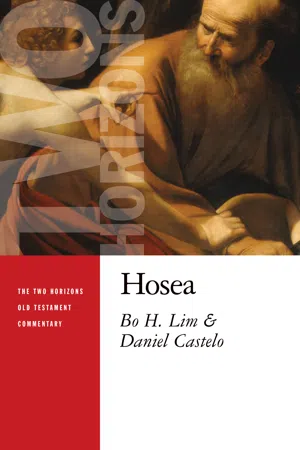
Hosea
About this book
In this commentary Old Testament scholar Bo Lim and theologian Daniel Castelo work together to help the church recover, read, and proclaim the prophetic book of Hosea in a way that is both faithful to its message and relevant to our contemporary context. Though the book of Hosea is rich with imagery and metaphor that can be difficult to interpret, Lim and Castelo show that, with its focus on corporate and structural sin, Hosea contains a critically important message for today's church.
Information
Print ISBN
9780802827005
1. Theological Interpretation and the Book of Hosea
Daniel Castelo
Many have welcomed the momentum associated with the theological interpretation of Scripture; others have not. On the one side, students of Scripture have found a disciplinary orientation that can account for the role the Bible plays in their piety and devotion; for others, this approach is the weakening of a resilience forged over centuries to give some legitimacy to biblical studies as a valid discipline in the academy. The conflict is largely an “in-house” affair, and as with all family disputes, this one can occasion mistrust and a fair degree of antipathy and pain. After all, the two camps are in a sense fighting over the same turf: the proper way to approach the reading of the Bible. Both sides are vying for the hermeneutical privilege of determining the way Scripture is fittingly read and understood.
This division — between those who are favorable to theological interpretation, and those who are not — is far from the only point of conflict within the discipline of biblical studies today, yet it is that division which the present volume, as a contribution to the Two Horizons Old Testament Commentary Series, seeks to address. As an endeavor within the field of theological interpretation, and given this strife-laden context of academic biblical interpretation, this commentary ought to demonstrate to some degree what it aims to accomplish and how it intends to do so. Part of this process involves taking inventory of the many ways this volume could be pursued, and giving a rationale for why it will proceed in the way that it does.
Theological Interpretation
Part of the difficulty with writing a commentary that aims to be an exercise in “theological interpretation” is getting a hold of what that phrase actually means. “Theological interpretation” could signify any number of possibilities, since the approach focuses more on exegetical goals than exegetical methods.1 Presumably, these goals could be achieved by any number of means, so the phrase retains some level of methodological ambiguity.
“Interpretation”
Take for instance the notion of “interpretation.” Interpretation is tied to the apprehension of meaning, yet how one goes about demarcating meaning in the hermeneutical process is a complicated affair. Stephen Fowl mentions the possibilities of determinate, anti-determinate, and underdeterminate strategies in biblical interpretation.2 The first negotiates a text’s meaning as requiring unsheathing and excavation, the second operates out of a sensibility of resisting predetermined meanings, and the third seeks to locate meaning in the motives behind the way texts are used, rather than attributing one meaning to the text itself. Within each of these approaches, the notion of “meaning” is up for grabs, and one could easily say that efforts that pursue a “theological interpretation” of the Bible could employ each of these possibilities and still be considered as properly meriting the designation. Nevertheless, as one can see, each possibility represents a very different hermeneutical strategy, and the results of such varied approaches would themselves be manifold.
The determinate approach is fascinating in that it enjoys wide appeal among self-identified “conservatives” and “liberals” alike. This view’s proponents find meaning to be rooted in a text, yet always contingent on its authorial, historical, and linguistic embeddedness. In short, this hermeneutical strategy is largely a contextualizing endeavor, one that emphasizes the historical “otherness” of a text. Such a method attempts to counteract the destabilization of interpretation owing to factors such as cultural and reader-related contingencies. Linguistics, anthropology, archaeology, and a host of other fields can be jointly employed to depict the historical situatedness of the text, allowing it in turn to speak for itself in what is hoped is an unobstructed and pure way. The field of biblical studies under this guise becomes methodologically subsumed under the pursuit of history. Within these concerns, meaning is understood to be something empirically available to all so that facts are understood to exist and bias, it is fideistically assumed, can be overcome.3
These tendencies associated with the historical task are largely constitutive of a modernist and foundationalist epistemological framework, particularly an Enlightenment one.4 From its own modernist commitments, the determinate approach purports to arrive at a stable meaning of a text via historical excavation and reconstruction stemming from “a peculiarly modern understanding of what historical reality is.”5 Essentially, this perspective understands meaning through a “container” approach;6 that is, the meaning is contained within the text itself in an empirically discernible, self-regulated form. Such are the epistemological commitments of historical-critical methodologies: They tend to assume that texts should be read as historical artifacts, and the hard work of immersing oneself as much as possible into conditions and contexts in which a text was written is the key to establishing the text’s meaning.7 This process, as Brian Daley notes, is conducted
as far as possible under the same standards of evidence and verifiability as those used in the laboratory; historical reality — like physical reality — is assumed to be in itself something objective, at least in the sense that it consists in events independent of interests and preconceptions of the scholar or narrator, accessible through the disciplined, methodologically rigorous analysis of present evidence such as texts, artifacts, and human remains. For this reason, the establishment and interpretation of texts from earlier ages, like the study of material archaeological evidence, is understood to be an inductive process governed by the rules of logic, the recognition of natural cause and effect, the assignment of probability based on common human experience. As a result, modern historical criticism — including the criticism of biblical texts — is methodologically atheistic.8
In this regard, the Bible should be read “like any other book.”9 It should be exposed to scrutiny of the highest standards, for it is a text that for far too long has been given a place of privilege. This in turn has perpetuated both ignorance and bias, both of which facilitate the employment of the Bible for self-interested, power-laden ends. In this sense, historical-critical methods aim to make the Bible a “strange” text, allowing for “interpretation” to have some relative independence outside of the aims and agendas of interpreters.
These commitments to the determinate meaning are held not only by those thinking that the Bible is primarily a collection of ancient texts and that interpretation is largely a historical affair, but also by those who seek to establish the Bible as God’s — and by implication, many would say, “universal” — truth. In order to safeguard authoritative legitimacy (usually through the language of “inspiration,” “infallibility,” or “inerrancy”), many scholars on this side of the debates 1) pursue historical verification of figures, 2) sustain word studies so as to find linguistic similarities and connections across ancient Near Eastern cultures, and 3) maintain a commitment to the original manuscripts or autographs. They see Scripture as an epistemic foundation from which doctrines and practices can be drawn.10 Despite affirming the authority of these texts as “the Word of God,” these scholars and believers assume this particular paradigm of meaning-generation so as to create theological space for their commitments regarding Scripture. Therefore, the appeals that are made by these more conservative scholars are similar to the ones made by those on the liberal side; in both cases, history and modernist approaches to knowledge suggest the way forward in establishing the Bible’s meaning and Scripture’s authority overall.
This privileging of the historical for the meaning of texts implicitly contributes to a “muddy ditch” between “what the text meant” and “what it can mean today.” This division has reigned supreme within the academy of biblical studies, and it is still very much detectable on the contemporary scene. Through this bifurcation, “what the text meant” is the proper domain of biblical scholars trained in historical-critical methodologies, and they in turn create the baseline that subsequent readers of the text have to observe in order for their reading to avoid randomness and bias and truly be intellectually respectable in nature. This presentation of the matter, however, naturally contributes to the text’s contemporary marginalization, given that the “application” or appropriation is considered artificial with respect to its true meaning because it involves an additional, subsequent step in relation to primordial historical investigation. Within such conditions, the text’s relevance is cast as idiosyncratic to the reader’s experience and purposes. The bias here is that Scripture meant something determinate in the past, and only in meaning something in the past can it mean something (if anything) today.
What is often missing from this commitment to the determinate meaning approach is a sense of how tentative was the Enlightenment project that brought about such a pursuit of meaning in the first place.11 Far too often, those who pursue a text’s contextual localization fail to question not only the degree to which one can know “what it meant” but, more pertinently, why that pursuit is legitimate in the first place as a way of securing meaning. In this shared neglect, historical-critical methodologies, as well as those pursuits that require complex and foundationalist accounts of Scripture’s inspiration or inerrancy, are simply mirror images of one another or nonidentical offspring of the modern spirit. The way these traditions of investigation and interpretation establish the legitimacy of their pursuits is through an assumed intellectual tradition that has its roots in the modern era.
Especially worrisome about the determinate approach generally is the neglect of a self-awareness that recognizes its own dependence on a particular intellectual formulation. Through such refusal, proponents often employ such modifiers as “scientific,”12 “scholarly,” and “academic” as suitable self-descriptors. In other words, the tendency by these academicians is to assume that their approach is a pedigreed one within the scholarly project. To take one prominent example, Michael Fox has repeatedly been quoted by theological interpreters for claiming that faith-based study has no “place” in academic scholarship because it is, at the end of the day, not scholarly at all.13 Historical-critical methodologies are still preferred within the academy14 as a way to secure the autonomy of biblical studies and so avoid the “bias” of theological readings. Scholars, in other words, often see this privileging as a way to secure their methodological independence as academics. The troublesome feature of such privileging, however, is precisely its presumption. Such accounts often assume that theirs is the only way to establish a non-biased reading of ancient texts. But the assumption of non-bias is not only unsustainable; it is itself one of the worst kinds of biases because of its resistance and denial of its own particularity and contingency.15
For this reason, the “critical turn” in biblical interpretation is to be welcomed, in that it allows for an ongoing assessment of the reader’s location and aims within the interpretive task. This critical awareness marks the other two approaches outlined by Fowl — the anti-determinate and underdeterminate perspectives — in varying degrees because both resist the totalizing closures associated with determinate readings. This kind of critical localization of the interpreter — not simply vis-à-vis his or her historical and cultural embeddedness, but also in terms of the reader’s aims, goals, and purposes — has in turn enabled the gesture toward theological interpretation of Scripture to have intellectual merit despite the prominence of historical-critical methodologies. Once the process of interpretation (and not simply the text to be interpreted) has been particularized, multiple readings can be permitted and deemed as significant in the hermeneutical process.
At this point, it is important to register a basic claim that many theological interpreters have made regarding the “whence” of theological interpretation. Essentially, reading the Bible theologically — that is to say, looking to it as Scripture — is a churchly exercise, practice, and art. This particular localization is simply nonnegotiable for theological interpreters: Confessing Christians look to the Bible as sacred text; as such, for them the Bible is Holy Writ or Holy Scripture. Robert Jenson has made the claim as strongly as one could: “The question, after all, is not whether churchly reading of Scripture is justified; the question is, what could possibly justify any other?”16 Serious attention to the way the church has used this book and its engagement from an ecclesial location can both be forms of sc...
Table of contents
- Cover
- Title Page
- Copyright Page
- Dedication
- Contents
- Abbreviations
- Preface
- 1. Theological Interpretation and the Book of Hosea (Daniel Castelo)
- 2. Introduction to the Theological Exegesis of the Book of Hosea (Bo H. Lim)
- 3. Hosea 1:1–2:1 [1:1–2:3] (Bo H. Lim)
- 4. Hosea 2:2-23 [2:4-25] (Bo H. Lim)
- 5. Hosea 3:1-5 (Bo H. Lim)
- 6. The Covenant Conditions for God-talk and God-knowledge (Daniel Castelo)
- 7. Hosea 4:1–5:7 (Bo H. Lim)
- 8. Hosea 5:8–7:2 (Bo H. Lim)
- 9. Hosea 7:3–8:14 (Bo H. Lim)
- 10. Hosea 9:1–10:15 (Bo H. Lim)
- 11. Hosea 11:1-11 (Bo H. Lim)
- 12. Marriage, Sexuality, and Covenant Faithfulness (Daniel Castelo)
- 13. Hosea 11:12–13:16 [12:1–14:1] (Bo H. Lim)
- 14. Hosea 14:1-9 [14:2-10] (Bo H. Lim)
- 15. Readers of Terror: Brief Reflections on a Wise Reading of Hosea (Daniel Castelo)
- Bibliography
- General Index
- Scripture Index
Trusted by 375,005 students
Access to over 1.5 million titles for a fair monthly price.
Study more efficiently using our study tools.
Frequently asked questions
Yes, you can cancel anytime from the Subscription tab in your account settings on the Perlego website. Your subscription will stay active until the end of your current billing period. Learn how to cancel your subscription
No, books cannot be downloaded as external files, such as PDFs, for use outside of Perlego. However, you can download books within the Perlego app for offline reading on mobile or tablet. Learn how to download books offline
Perlego offers two plans: Essential and Complete
- Essential is ideal for learners and professionals who enjoy exploring a wide range of subjects. Access the Essential Library with 800,000+ trusted titles and best-sellers across business, personal growth, and the humanities. Includes unlimited reading time and Standard Read Aloud voice.
- Complete: Perfect for advanced learners and researchers needing full, unrestricted access. Unlock 1.5M+ books across hundreds of subjects, including academic and specialized titles. The Complete Plan also includes advanced features like Premium Read Aloud and Research Assistant.
We are an online textbook subscription service, where you can get access to an entire online library for less than the price of a single book per month. With over 1.5 million books across 990+ topics, we’ve got you covered! Learn about our mission
Look out for the read-aloud symbol on your next book to see if you can listen to it. The read-aloud tool reads text aloud for you, highlighting the text as it is being read. You can pause it, speed it up and slow it down. Learn more about Read Aloud
Yes! You can use the Perlego app on both iOS and Android devices to read anytime, anywhere — even offline. Perfect for commutes or when you’re on the go.
Please note we cannot support devices running on iOS 13 and Android 7 or earlier. Learn more about using the app
Please note we cannot support devices running on iOS 13 and Android 7 or earlier. Learn more about using the app
Yes, you can access Hosea by Bo H Lim,Daniel Castelo in PDF and/or ePUB format. We have over 1.5 million books available in our catalogue for you to explore.