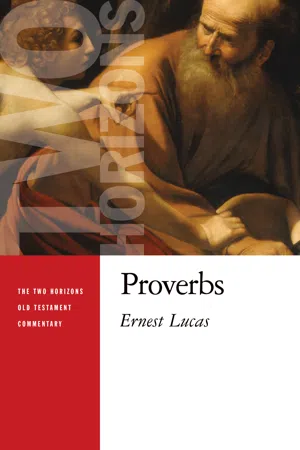
In this erudite yet accessible commentary Ernest Lucas elucidates the book of Proverbs both exegetically and thematically. Explicating the text in light of its ancient Near Eastern context, Lucas also shows the relevance of Proverbs for the twenty-first century, speaking as it does to such issues as character formation, gender relations, wealth and poverty, interpersonal communication, science and religion, and care for the environment.
Lucas uniquely identifies "proverbial clusters" in his critical exegesis of the biblical text and uses them as the basis for interpreting individual proverbs. Several substantial theological essays at the end of the book illuminate major ethical, pastoral, and spiritual themes in Proverbs. Ably unpacking the rich wisdom embedded in the book of Proverbs, Lucas's accessible theological commentary is perfect for pastors, teachers, and students.
There are calendars for sale which provide a proverb for each day. However, using Proverbs as a guide to Christian living has its problems. There is a pastoral problem. It seems to say that there is a straightforward relationship between acts and their consequences. Good deeds lead to success and prosperity, evil deeds result in calamity and ruin.
No trouble befalls the righteous,
but the wicked are filled with calamity. (12:21)
If only life were as simple as this tidy dogmatism asserts! Strict adherence to it can lead to pastoral problems.
What about that faithful, committed Christian who suddenly faces calamity: redundancy, loss of income and consequent repossession of their home, or serious, maybe terminal, illness, or some family tragedy? Does it prove that they were not righteous after all? I’ve known people who have been driven into spiritual, if not clinical, depression by such thoughts. How many Christian parents flagellate themselves with Prov. 22:6?
Train up a child in the way he should go;
even when he is old he will not depart from it.
They have done what they thought was their best but their adult children are not believers, or even church-goers. How does one handle such pastoral situation? Is Proverbs right, or does it claim too much? Or are we misusing it?
This pastoral problem obviously has a theological dimension. In some accounts of the history of Israelite religion it is asserted that the cut-and dried, optimistic worldview of Proverbs was commonplace among the Hebrew sages. However, it could not stand up to the realities of life and came under attack from dissident voices among the sages. The evidence of this is to be found in the books of Job and Qoheleth, or Ecclesiastes as it is known in the English Bible.1
However, it seems to be a bit of an anomaly that two out of the three ‘wisdom books’ in the Hebrew Bible have been considered ‘dissident’ voices or ‘protest literature’. After all, they form the majority of the extant Hebrew wisdom literature! Moreover, if they are so strongly at odds with the Book of Proverbs, why is it that the latter survived and found a place in the Hebrew canon of scripture? Maybe matters are not as cut-and-dried as has often been claimed.
The fact is that until the last half of the twentieth century the wisdom literature of the Hebrew Bible was largely neglected by OT scholars, especially the Book of Proverbs. The idea that it presented a rather simplistic worldview is one reason for this. Another reason was that the absence from the wisdom books of any significant references to Israel’s history, cult and covenant relationship to her God made them problematic because scholars could not readily integrate them into their accounts of Israelite religion or OT theology.2 Some went so far as to describe these books as ‘a foreign body’ within the Hebrew canon.
For various reasons the situation began to change a few decades ago, and scholars have begun to re-evaluate their understanding of these books. Here we will concentrate on the issue of the act-consequence relationship in the ‘sentence literature’ of the Book of Proverbs, which is basically Prov 10–29.
The Egyptian Connection
Before looking at the Book of Proverbs itself, we need to take account of its link with the wider ‘international wisdom’ of the ancient Near East. In 1923 E. W. Budge3 published the Egyptian ‘wisdom’ text which came to be known as The Instruction of Amenemope.4 There was immediate recognition that it had a close relationship to a section of the Book of Proverbs: 22:17–24:22. The nature of the relationship has been a matter of some debate ever since but need not concern us here.5 What is of relevance for our purpose is the assumption, which became widespread, that the Egyptian concept of Maʿat strongly influenced the Hebrew sages.6 Maʿat was a central concept in Egyptian ethics and religion. There is no single English (or Hebrew) word by which to translate it. It is the force which creates and sustains ‘justice and truth’ — a single notion in Egyptian, not two separate notions. Various scholars came to hold that the idea of an underlying cosmic order was central to ‘wisdom thought’ in the ancient Near East and that this was taken over by the Israelite sages. This concept, it was argued, underlies Prov. 10–29. In addition, the hypothesis was put forward that the figure of personified Wisdom in Prov. 8 is based on Maʿat, perceived as a goddess in Egypt.7
In 1995 M. V. Fox8 published an important paper which attacked this position. His attack was three-pronged.
1. He argued that while Maʿat can be seen as in some sense as a ‘world order’, it was not ‘an automaton maintaining justice/truth by impersonal processes’, which is how T scholars have sometimes presented it.
2. Secondly, the concept of Maʿat was so inextricably bound up with Egyptian religion and society that it could not be transferred into an Israelite context without becoming a ‘denatured concept’ very different from its origin.
3. Finally, the claimed parallels between the concept of Maʿat and wisdom in Proverbs are limited or non-existent.
There seems to be a growing recognition that Fox has made a good case, and that it requires a re-examination of what kind of worldview does underlie Prov. 10–29.
A different line of criticism has come from a change in the consensus among Egyptologists on the nature of Maʿat.9 They now argue that there was shift over time from a belief in the principle of Maʿat as the dominant factor to an emphasis on the will and power of the god. From the 18th Dynasty onward there is a shift in Egyptian wisdom literature from the conventional view of Maʿat towards an emphasis on human piety and the free will of the god. The Instruction of Amenemope is singled out as a prime example of the new emphasis. This is significant since it predates the rise of the monarchy in Israel, and therefore the development of any Israelite wisdom literature. Many OT scholars seem unaware of this change in the consensus among Egyptologists.
The Act-Consequence Nexus
In 1955 K. Koch10 published an influential paper in which he argued that there is in the Book of Proverbs, and elsewhere on the OT, the assumption of an act-consequence nexus. It is assumed that wicked actions will inevitably result in disastrous consequences and that good actions will result in blessing. In support of this he quoted a number of proverbs. The following are some of the more notable ones:
Whoever digs a pit will fall into it,
and whoever rolls a stone, it will come back on him. (26:27)
Whoever misleads the upright into an evil way will fall into his own pit,
but the blameless will inherit good. (28:10)
Whoever walks in integrity will be safe,
but he who is crooked in his ways will suddenly fall. (28:18)
The righteousness of the blameless keeps his way straight,
but the wicked falls by his wickedness. (11:5)
The righteousness of the upright delivers them,
but the treacherous are trapped by their desire. (11:6)
Koch argues strongly that what is being presented in such proverbs is the inevitable outcome of the actions themselves and not the result of God stepping in to administer punishments and rewards. His main reason for saying this is that, in his view, there is no hint of any ‘judicial process’ whereby God weighs up the actions according to an established norm and administers the appropriate punishment or reward.
To defend his case Koch has to deal with some proverbs which seem to speak of Yahweh administering rewards or punishments. For example:
If your enemy is hungry, give him food to eat,
and if he is thirsty, give him water to drink,
for you will heap burning coals on his head,
and the LORD will reward you. (25:21-22)
Here Koch questions the usual translation of the Hebrew word
(yĕšallem) as ‘reward’. He points out that, since it comes from a root
(šlm), meaning ‘undamaged, complete’, and is a piel form, a more natural translation would be ‘make complete’. So, he argues,11 what is being said is that Yahweh ‘completes’ the person’s action by ‘facilitating the completion of something which previous human action has already set in motion’.
Does not he who watches over your soul know it,
and will he not repay man according to his works? (24:12b)
Here the key word is the one translated ‘repay’,
(hēšîb). This is a hiphil form from the root
(šûb), meaning ‘to turn back’. Koch translates it as ‘turn (the effects of) the action back towards’ the person who does it:
The good obtain favour from the LORD,
but a man of evil devices he condemns. (12:2)
In this case the word translated ‘co...
Table of contents
Cover
Title Page
Copyright Page
Dedication
Contents
Acknowledgements
Abbreviations
Introduction
Commentary
Theological Horizons of Proverbs
Bibliography
Index of Authors
Index of Scripture and Other Ancient Literature
Trusted by 375,005 students
Access to over 1.5 million titles for a fair monthly price.
Study more efficiently using our study tools.
Frequently asked questions
Yes, you can cancel anytime from the Subscription tab in your account settings on the Perlego website. Your subscription will stay active until the end of your current billing period. Learn how to cancel your subscription
No, books cannot be downloaded as external files, such as PDFs, for use outside of Perlego. However, you can download books within the Perlego app for offline reading on mobile or tablet. Learn how to download books offline
Perlego offers two plans: Essential and Complete
Essential is ideal for learners and professionals who enjoy exploring a wide range of subjects. Access the Essential Library with 800,000+ trusted titles and best-sellers across business, personal growth, and the humanities. Includes unlimited reading time and Standard Read Aloud voice.
Complete: Perfect for advanced learners and researchers needing full, unrestricted access. Unlock 1.5M+ books across hundreds of subjects, including academic and specialized titles. The Complete Plan also includes advanced features like Premium Read Aloud and Research Assistant.
Both plans are available with monthly, semester, or annual billing cycles.
We are an online textbook subscription service, where you can get access to an entire online library for less than the price of a single book per month. With over 1.5 million books across 990+ topics, we’ve got you covered! Learn about our mission
Look out for the read-aloud symbol on your next book to see if you can listen to it. The read-aloud tool reads text aloud for you, highlighting the text as it is being read. You can pause it, speed it up and slow it down. Learn more about Read Aloud
Yes! You can use the Perlego app on both iOS and Android devices to read anytime, anywhere — even offline. Perfect for commutes or when you’re on the go. Please note we cannot support devices running on iOS 13 and Android 7 or earlier. Learn more about using the app
Yes, you can access Proverbs by Lucas C. Ernest,Ernest C. Lucas,Lucas c. Ernest in PDF and/or ePUB format. We have over 1.5 million books available in our catalogue for you to explore.