A clear, engaging introduction to the Catholic faith
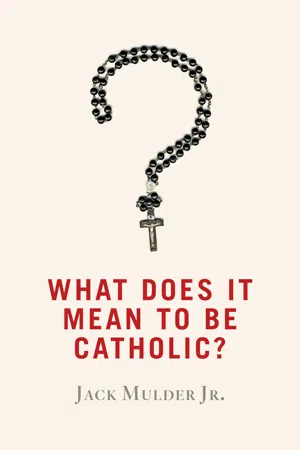
What
does it mean to be Catholic? Many people, both non-Catholics and even Catholics themselves, really don't know. This accessible book by Jack Mulder is ideal for all who are curious to know more about Catholicism.
Writing in a conversational style, Mulder clearly portrays the main contours of the Catholic faith. For readers who have ever wondered what exactly the Roman Catholic Church teaches about predestination, original sin, the Virgin Mary, abortion, same-sex marriage, and other issues, Mulder explains all that — and much more — in simple language.
Mulder, who was raised in the Protestant tradition and converted to Catholicism later in life, speaks from the perspective of having wrestled with his own beliefs over the years. With solid information — and without proselytizing — Mulder's
What Does It Mean to Be Catholic? presents a truly fresh perspective on the distinctive features of the Catholic faith.
- 248 pages
- English
- ePUB (mobile friendly)
- Available on iOS & Android
eBook - ePub
What Does It Mean to Be Catholic?
About this book
Information
Topic
Theology & ReligionSubtopic
Christian DenominationsChapter 1
Scripture and Tradition
The purpose of this book is to give an introduction to the way Catholics think about some important matters, and to do it in a spirit of open and honest dialogue with others and especially with other Christians. In my experience, the way to start such a dialogue is to begin by talking about the Catholic views of revelation and the Bible. Although the truth is that the Catholic tradition and other Christian traditions now agree on more with regard to the Bible than is commonly thought, vestiges of the popular view that they are deeply opposed remain. To be sure, there are differences among Christians on Scripture, the most obvious of which is that the Catholic Old Testament has more books in it than the Protestant Old Testament, and one fewer than the Orthodox Old Testament (3 Maccabees). Yet, the differences that still divide Christians on the Scriptures are not as fundamental as the conviction that the task of the Bible is to communicate the one revelation whose entire content is Jesus Christ.1 The purpose of this chapter is to discuss the way Scripture is understood in the Catholic Church, and to discuss the relationship it bears to tradition. Though I intend everything here to be faithful to the Catholic understanding of the topics I discuss, I will sometimes quote writers from other Christian traditions. Except where I note divergence from the Catholic tradition, I will be doing this to show where there are some significant points of agreement across Christian traditions.
What Is Scripture?
In my wallet I carry a little card with a picture of St. Thomas Aquinas (1225-1274) and a tiny piece of cloth laminated to it. Next to the cloth it reads: “This piece of cloth has been touched by his relics.” This is not something I would have been carrying years ago. At that time I would have either regarded it simply as idolatry or as one more strange “religious” practice that only serves to get in the way of a real relationship with Jesus. The shift in my thinking, however, did not come about because I began to turn my attention away from Scripture and Jesus, but because I began to reflect more deeply on Scripture and the Lord it reveals. Let me explain.
For a Catholic, the written record of Scripture attests to Christ and how to follow the Gospel. In the Catholic community there will never be another testament of Jesus such as the Latter-day Saints (or Mormon) community sees in The Book of Mormon.2 Holy Scripture is unrepeatable and definitive; its words attest to the saving work of God in Jesus Christ and they will never be surpassed. Not everything that is authentically Christian, however, can be read right off the face of the scriptural record. In some cases, a longstanding practice of the early church is referenced, or an insight is recorded, that is something like a seed sown in the Scriptures, and only later, through centuries of reflection, does it manifest itself as a practice or a doctrine. That doesn’t mean that it is not an authentic way to live the faith of Jesus. What it means is that we still discern that faith through time. Thus, in Acts 5:15-16, people sought to have those who were sick near Peter so that even his shadow might fall on them, as he was curing others. These people were making a good inference. People crowded in on Jesus and one woman was healed just by touching his cloak in faith (Mark 5:25-34), and Jesus himself said that “whoever believes in me will do the works that I do, and will do greater ones than these, because I am going to the Father” (John 14:12). If Peter has the power, from Christ, to heal in his name, then it’s reasonable to suppose that coming into contact with him, with faith in Christ’s power to heal through him, could actually heal you. But then why not others who follow in Christ’s footsteps? Why indeed wouldn’t we attach special significance to holy people and things associated with them? If done in the right spirit, this can serve to bring to mind their example as heroes of the faith and, if God should will, even be a source of encouragement and healing.
Christ is a Christian’s life, and we draw our understanding of how to live the Christian life from his example. Thomas Merton, a Catholic Trappist monk, once wrote that “[t]he whole truth of Christianity has been fully revealed: it has not yet been fully understood or fully lived.”3 As the Gospel of John has it, the “Word” of God is Christ himself (John 1:1), and it is this communication of God to us that is the fundamental revelation to which the church is always attending. This does not mean that Jesus, in his earthly life, had a kind of “to-do list” in seeing to it that the whole content of God’s message was revealed and that he just managed to accomplish everything at his death. No, Jesus’ very person just is God’s self-communication. Of course, there is general revelation in nature, and there is special revelation in Scripture, but God is one, and Jesus Christ the God-man is the whole content of God’s revelation to human beings. The apostles, as they wrote and taught, were communicating, in ways that we are still discerning, God’s fundamental revelation in Jesus Christ.4 Thus, while Christianity looks to the Bible as a permanent source of revelation, the Catholic Church does not see Christianity as a “religion of the book” but as a religion of the living word of God.5
This is why I will not be spending much time in this book on the scholarly questions concerning what Jesus “really” said or did not say. While I agree that when a claim by Jesus occurs in, say, all four Gospels (or even in Matthew, Mark, and Luke, the “Synoptic” Gospels), this should enhance our confidence that it was said by Jesus in much the way it is recorded, I am nervous about the opposite conclusion, namely, that my confidence that Jesus “really” said something should diminish just because only one Gospel reports a particular saying. As a believing Christian, the way in which I receive the apostolic testimony about Jesus reflects the way I receive Jesus himself. Even if Jesus did not utter exactly the words one Gospel reports, I must have faith that the Gospels accurately reflect his message and that I will do no better as a Christian than by following the earliest memories of the church and its apostolic communities, as they converge on the central message of Jesus. That message may need to be shepherded down through time and interpreted, but that claim itself reflects a very Catholic understanding of Scripture.
The claim of the Christian church is that the texts in which the apostles, prophets, and other inspired writers testified to God’s revelation in Jesus are inspired texts. Inspiration is a gift of the Holy Spirit to individuals who are then moved to give a written account of God’s revelation.6 While divine revelation is primarily God’s communication of himself and the way of salvation for human beings,7 “inspiration” can be taken to refer to the messages of the entire texts. Now if God inspires human beings to communicate his revelation through written accounts, we should expect that these authors are right when they definitively claim something about how human beings attain salvation. We should not, however, necessarily expect that the authors of the biblical texts would stand altogether outside of their cultural environment and the literary customs of their ages.
In contrast to an important current that has run through some modern American evangelical and fundamentalist communities, the contemporary Catholic Church has not generally concerned itself much with whether Scripture is “inerrant” in the way that word is often understood in those traditions.8 A good example is the Southern Baptist Convention, which, in its dialogue with the Catholic Church, claimed that in Scripture, “every inflection, . . . tense of the verb, . . . number of the noun and every little particle are regarded as coming from God,” and this meant for this group that every assertion is true in the text, down to “the attributed authors and the historical narratives.”9
Instead of claiming that each word of the Bible is individually inspired, it would be more accurate to characterize the approach taken by Catholics after the Second Vatican Council as saying that “[t]he Scriptures are verbally inspired but in the limited sense of the historical knowledge and cultural context of the biblical authors.”10 We needn’t trouble ourselves overmuch about whether Solomon is the author of Song of Songs, as the first verse of that book claims. Nor is there anything deeply troubling, from a Catholic point of view, about seemingly conflicting accounts of who killed Goliath (1 Sam. 17:50 and 2 Sam. 21:19) or how Judas Iscariot died (Matt. 27:5 a...
Table of contents
- Acknowledgments
- Abbreviations and Frequently Cited Works
- Introduction
- 1. Scripture and Tradition
- 2. The Church and Her Magisterium
- 3. God and Humanity
- 4. The Person and Work of Christ
- 5. Mary and the Communion of Saints
- 6. The Seven Sacraments
- 7. Heaven, Hell, and Purgatory
- 8. The Human Person
- Conclusion
- Index of Subjects and Names
- Index of Scripture References
Trusted by 375,005 students
Access to over 1.5 million titles for a fair monthly price.
Study more efficiently using our study tools.
Frequently asked questions
Yes, you can cancel anytime from the Subscription tab in your account settings on the Perlego website. Your subscription will stay active until the end of your current billing period. Learn how to cancel your subscription
No, books cannot be downloaded as external files, such as PDFs, for use outside of Perlego. However, you can download books within the Perlego app for offline reading on mobile or tablet. Learn how to download books offline
Perlego offers two plans: Essential and Complete
- Essential is ideal for learners and professionals who enjoy exploring a wide range of subjects. Access the Essential Library with 800,000+ trusted titles and best-sellers across business, personal growth, and the humanities. Includes unlimited reading time and Standard Read Aloud voice.
- Complete: Perfect for advanced learners and researchers needing full, unrestricted access. Unlock 1.5M+ books across hundreds of subjects, including academic and specialized titles. The Complete Plan also includes advanced features like Premium Read Aloud and Research Assistant.
We are an online textbook subscription service, where you can get access to an entire online library for less than the price of a single book per month. With over 1.5 million books across 990+ topics, we’ve got you covered! Learn about our mission
Look out for the read-aloud symbol on your next book to see if you can listen to it. The read-aloud tool reads text aloud for you, highlighting the text as it is being read. You can pause it, speed it up and slow it down. Learn more about Read Aloud
Yes! You can use the Perlego app on both iOS and Android devices to read anytime, anywhere — even offline. Perfect for commutes or when you’re on the go.
Please note we cannot support devices running on iOS 13 and Android 7 or earlier. Learn more about using the app
Please note we cannot support devices running on iOS 13 and Android 7 or earlier. Learn more about using the app
Yes, you can access What Does It Mean to Be Catholic? by Jack Mulder in PDF and/or ePUB format, as well as other popular books in Theology & Religion & Christian Denominations. We have over 1.5 million books available in our catalogue for you to explore.