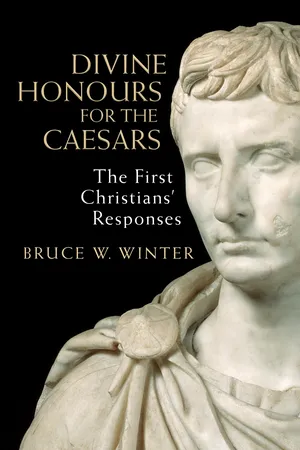
Though the first century a.d. saw the striking rise and expansion of Christianity throughout the vast Roman Empire, ancient historians have shown that an even stronger imperial cult spread far more rapidly at the same time. How did the early Jesus-followers cope with the all-pervasive culture of emperor worship?
This authoritative study by Bruce Winter explores the varied responses of first-century Christians to imperial requirements to render divine honours to the Caesars. Winter first examines the significant primary evidence of emperor worship, particularly analysing numerous inscriptions in public places and temples that attributed divine titles to the emperors, and he then looks at specific New Testament evidence in light of his findings.
- 348 pages
- English
- ePUB (mobile friendly)
- Available on iOS & Android
eBook - ePub
About this book
Information
Topic
Theology & ReligionSubtopic
Christian TheologyChapter 1
The All-Pervasive and Inescapable
Imperial Cultic Phenomena
Imperial Cultic Phenomena
There is a perception that the most striking feature of the first century a.d. was the speedy rise and expansion of Christianity. However, ancient historians have shown that in the same century an even stronger cultic movement spread far more rapidly both in the East and West of the vast Roman Empire.
In his two-volume work, Anatolia: Land, Men, and Gods in Asia Minor, Mitchell concluded, ‘The diffusion of the cult of Augustus and of other members of his family in Asia Minor and throughout the Greek East from the beginning of the empire was rapid, indeed almost instantaneous.’1 Wardle also observed, ‘To a Roman of the first century a.d. who chose to reflect on the changes the state had witnessed over the previous century perhaps one of the most striking would be the introduction of imperial cult.’2 Garnsey and Saller likewise commented, ‘Rome’s main export to the empire was the cult of the emperors . . . it appealed to Augustus, as it did to later emperors, as a way of focusing the loyalty of provincials on the imperial persona.’3 Emperors were known as ‘the god of the Romans’ (Romanorum deus) in the days of the second-century Christian apologist Tertullian.4
Mitchell further noted that in all three of the Roman cities in central Anatolia, namely Ancyra, Pessinus and Pisidian Antioch, ‘the central feature of these excavations has been a temple dedicated to the imperial cult built in the time of Augustus and Tiberius. Emperor worship was from the first an institution of great importance to provincial communities’.5 Other cities where Christians resided in the East were no different in terms of the central location of these temples.
How had it come about that the Greek East, ‘incorporated’ as it was by Rome into its vast empire, saw divine imperial veneration spread so spectacularly at both the local and provincial levels? There were intense social pressures brought to bear on all provincials and Roman citizens residing in the East to reciprocate with appropriate divine honours to and for emperors in their temples because of the enormous benefits and other blessings brought by the pax romana socially, economically and politically. Performing cultic acts before statues of living emperors, and at times members of their family, on the numerous official high and holy days in the city’s annual calendar was considered the only appropriate expression of loyalty. Rome’s great achievements were attributed to the divine imperial peace and prosperity, long anticipated but only now being enjoyed throughout its empire by its loyal subjects.6 All this is well attested in official and literary sources.
How then would the first Christians cope with the requirement to give divine honours to the Julio-Claudian Caesars? Would they remain steadfast, observing the clear parameters laid by the founder of their faith by obeying his command regardless of enormous societal pressures — ‘the things that are Caesar’s you must render to Caesar and the things of God to God’ (τὰ Καίσαρος ἀπόδοτε Καίσαρι καὶ τὰ τοῦ θεοῦ τῷ θεῷ) (Mark 12:17)? This book sets out to explore the first Christians’ different responses to requirements at both local and provincial levels to render divine honours to the Caesars as the conventional public expression of loyalty to Rome and its rulers.
In this opening chapter it is proposed (I) to record the reasons for the enigma felt by leading ancient historians as to why imperial cultic activities were not a problem for the first Christians; (II) to map recent, changing perceptions of such activities by the former whose predecessors had until recently underestimated the intrusive nature of the imperial cult in the lives of all citizens in the Roman empire, not least of all in the East; and (III) to explain the rationale for, and outline of, the chapters in Divine Honours for the Caesars: The First Christians’ Responses.
I. The Enigma for Ancient Historians
Concerning the First Christians
Concerning the First Christians
Over forty years ago in 1972 Millar posed this important question with its inescapable implication — ‘But when gentiles began to convert to Christianity, might we not expect that the pagan communities in which they lived would begin to use against them the accusation of not observing the Imperial cult?’7
A decade later in a landmark monograph for ancient historians on the imperial cult, Price noted of Asia Minor —
non-participation by Christians, whose communities were already very widespread in Asia Minor before Constantine, were deeply worrying to the rest of the population. Indeed the problem was already pressing to the assembly of the province of Asia under Hadrian [a.d. 117-38].8
Mitchell writing on cults in Anatolia in 1993 has perceptively and succinctly described the enormous societal pressures that existed for the early Christian converts to apostatize because of the requirement on everyone to give divine honours publicly to statues of the Caesars. He comments —
One cannot avoid the impression that the obstacle which stood in the way of the progress of Christianity, and the force which would have drawn new adherents back to conformity with the prevailing paganism, was the public worship of the emperors . . . where Christians could not (if they wanted to) conceal their beliefs and activities from their fellows, it was not a change of heart that might win a Christian convert back to paganism, but the overwhelming pressure to conform imposed by the institutions of his city and the activities of his neighbours.9
Certainly in the early years of the second century a.d. Pliny the Younger interrogated a later generation of those who were named ‘Christians’. Enormous pressure was put on them to perform cultic honours before the emperor’s statue. Among those he interrogated were lapsed Christians, some of whom had been apostate for ‘two or more years previously, and some up to twenty years ago’. Others compromised when this distinguished governor of Bithynia and Pontus pressured them to burn incense to the statue of the living emperor, Trajan. Those provincials ‘who refused three times to do this were led away to their execution’, while Roman citizens among them were put on ‘the list of persons to be sent to Rome for trial’.10 The important question is, if imperial veneration were alive and thriving in the era of the Julio-Claudian emperors of the first century, why would not the first Christians be likewise ‘dragooned’ into imperial veneration or even executed if they refused?
In 2000 Clifford Ando, in his work Imperial Ideology and Provincial Loyalty in the Roman Empire, went to the heart of the issue for Christians, concluding with this comparison.
In the end, Rome gave to the empire as a whole two very different gods, who shared one essential quality. So long as his power endured, the emperor’s immanence in his ubiquitous portraits made him ἐφανέστατος, ‘the most manifest’, of the numinous powers of this world. His chief rival, who became his chief patron [from the time of Constantine onwards when the empire became Christian], was likewise present everywhere in potentiality and promise. . . . ‘Wherever two or three of you are gathered in my name, there I am in their midst’ (Matt. 18:20).11
‘Christians invited persecution by their denial of the gods of Rome’ is the conclusion of G...
Table of contents
- Preface
- 1. The All--Pervasive and InescapableImperial Cultic Phenomena
- Part I. Divine Honours for the Caesarsand the Roman East
- Part II. Divine Imperial Honours and theFirst Christians’ Responses
- Bibliography
- Index of Modern Authors
- Index of Subjects
- Index of Scripture Referencesand Other Ancient Sources
Trusted by 375,005 students
Access to over 1.5 million titles for a fair monthly price.
Study more efficiently using our study tools.
Frequently asked questions
Yes, you can cancel anytime from the Subscription tab in your account settings on the Perlego website. Your subscription will stay active until the end of your current billing period. Learn how to cancel your subscription
No, books cannot be downloaded as external files, such as PDFs, for use outside of Perlego. However, you can download books within the Perlego app for offline reading on mobile or tablet. Learn how to download books offline
Perlego offers two plans: Essential and Complete
- Essential is ideal for learners and professionals who enjoy exploring a wide range of subjects. Access the Essential Library with 800,000+ trusted titles and best-sellers across business, personal growth, and the humanities. Includes unlimited reading time and Standard Read Aloud voice.
- Complete: Perfect for advanced learners and researchers needing full, unrestricted access. Unlock 1.5M+ books across hundreds of subjects, including academic and specialized titles. The Complete Plan also includes advanced features like Premium Read Aloud and Research Assistant.
We are an online textbook subscription service, where you can get access to an entire online library for less than the price of a single book per month. With over 1.5 million books across 990+ topics, we’ve got you covered! Learn about our mission
Look out for the read-aloud symbol on your next book to see if you can listen to it. The read-aloud tool reads text aloud for you, highlighting the text as it is being read. You can pause it, speed it up and slow it down. Learn more about Read Aloud
Yes! You can use the Perlego app on both iOS and Android devices to read anytime, anywhere — even offline. Perfect for commutes or when you’re on the go.
Please note we cannot support devices running on iOS 13 and Android 7 or earlier. Learn more about using the app
Please note we cannot support devices running on iOS 13 and Android 7 or earlier. Learn more about using the app
Yes, you can access Divine Honours for the Caesars by Bruce W. Winter in PDF and/or ePUB format, as well as other popular books in Theology & Religion & Christian Theology. We have over 1.5 million books available in our catalogue for you to explore.