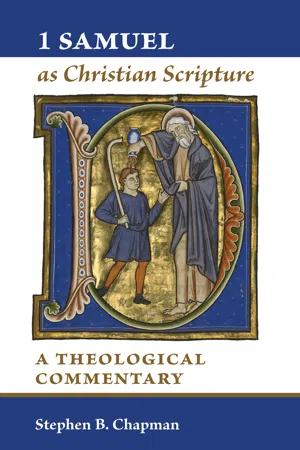
This work by Stephen Chapman offers a robustly theological and explicitly Christian reading of 1 Samuel. Chapman’s commentary reveals the theological drama at the heart of that biblical book as it probes the tension between civil religion and vital religious faith through the characters of Saul and David.
- 357 pages
- English
- ePUB (mobile friendly)
- Available on iOS & Android
eBook - ePub
About this book
Information
Topic
Theology & ReligionSubtopic
Biblical CommentaryPart One
Taking Up the Task
Chapter 1
Reading 1 Samuel as a Book
An oblivion to the text itself seems to me the greatest defect in present-day biblical scholarship.1
Those who talk of the Bible ‘as literature’ sometimes mean, I think, reading it without attending to the main thing it is about.2
The time is out of joint.3
What does it mean to interpret the Bible as scripture? Does it mean to read the Bible “like any other book”?4 If so, then why is its historical and religious particularity thought to be relatively unimportant? And if reading scripture is not like reading any other book, then in what way does one read scripture differently?5
Christian communities presently experience great uncertainty about interpreting the Bible theologically. The confusion stems in large part from an erosion of traditional reading practices within those Christian communities themselves. It is difficult to know how to read scripture well in the absence of models and experiences of doing so. Additional difficulty arises from the challenges these communities face in maintaining their particular manner of life as they are increasingly confronted by a global capitalism deeply antagonistic to social difference and non-commercial value. Yet a third factor consists of ongoing theological disputes about the nature of scripture and the proper method for scriptural interpretation.6
What is the appropriate focus for a theological reading of scripture? Is it the events that scripture reports, the characters it depicts, the themes it illustrates, or the doctrines it upholds? Theological readings continue to center on one or more of these possibilities without necessarily differentiating or adjudicating among them. Further challenges surface when the scriptural book being interpreted comes from the Old Testament. How can the Christian community do justice to the Old Testament’s pre-Christian form but at the same time interpret the Old Testament as a truthful witness to the One it calls Lord? An even more basic problem has to do with the relationship between history and text. Is the proper subject matter of a theological reading of scripture the historical events to which the biblical text refers? Or is it the text itself as a literary work? Put more provocatively, is even the history unreported by the biblical text theologically significant? In what way? Or, conversely, can a text that is unsubstantiated or even apparently contradicted by historical research still ground an authoritative theological point? How and why?
Precisely because the findings of historical-critical research on the Bible have consistently pointed out qualitative distinctions between historical event and textual depiction, modern Christian scholars have perceived themselves as faced with a fundamental choice between the two. At the risk of painting with too broad a brush, evangelicals and liberals have both tended to respond to that sense of a choice by privileging history, resulting in an ironic pairing of otherwise strange bedfellows.7 The now “traditional” disagreement between these two camps exists because evangelicals typically refuse on principle to allow any biblical text to be considered unhistorical,8 while liberals largely insist, also on principle, that some biblical texts must be judged historically inaccurate in order to be interpreted correctly. But in this way historical issues dominate the readings of both camps. Ultimately they each view the religious truth they seek as having been revealed in the history behind the biblical text. For both, reading the Bible theologically means reading it in order to reconstruct and illuminate a religious history to which the Bible, more or less reliably, gestures.
It is important to emphasize, however, that for both groups the position taken on the historicity of the biblical traditions is ultimately theological in nature. For liberals, the ability to root biblical theology in history provides a means of reconciling the Bible with modernity and discriminating within the canon, of subordinating certain texts to others. This hermeneutical move has allowed for the depreciation or dismissal of morally troublesome texts as being of dubious historicity (e.g., Joshua, Jonah, Esther)9 or as representing an earlier stage of “progressive revelation.”10
Once the nineteenth century had given birth to the conception of history as developing, not static, it was no longer necessary to believe that the divine command to Saul to slaughter the women and children of the Amalekites was as adequately revelatory of the character and purpose of God as the love-commandment of the Sermon on the Mount.11
By proceeding along these lines, liberalism’s weak flank has always been viewed by religious conservatives as its inability to sustain a fully robust doctrine of scripture, seen above all in the usually otiose character of the Old Testament within liberal theologies.12
By contrast, conservative evangelicals have sought ever since the intensification of such debates in the nineteenth century to insist upon a high view of scripture, even as they, too, roo...
Table of contents
- Contents
- Acknowledgments
- Introduction
- Part One: Taking Up the Task
- Part Two: Reading 1 Samuel Closely
- Part Three: Reflecting on History and Theology
- Bibliography
- Index of Authors
- Index of Subjects
- Index of Scripture and Other Ancient Sources
Trusted by 375,005 students
Access to over 1.5 million titles for a fair monthly price.
Study more efficiently using our study tools.
Frequently asked questions
Yes, you can cancel anytime from the Subscription tab in your account settings on the Perlego website. Your subscription will stay active until the end of your current billing period. Learn how to cancel your subscription
No, books cannot be downloaded as external files, such as PDFs, for use outside of Perlego. However, you can download books within the Perlego app for offline reading on mobile or tablet. Learn how to download books offline
Perlego offers two plans: Essential and Complete
- Essential is ideal for learners and professionals who enjoy exploring a wide range of subjects. Access the Essential Library with 800,000+ trusted titles and best-sellers across business, personal growth, and the humanities. Includes unlimited reading time and Standard Read Aloud voice.
- Complete: Perfect for advanced learners and researchers needing full, unrestricted access. Unlock 1.5M+ books across hundreds of subjects, including academic and specialized titles. The Complete Plan also includes advanced features like Premium Read Aloud and Research Assistant.
We are an online textbook subscription service, where you can get access to an entire online library for less than the price of a single book per month. With over 1.5 million books across 990+ topics, we’ve got you covered! Learn about our mission
Look out for the read-aloud symbol on your next book to see if you can listen to it. The read-aloud tool reads text aloud for you, highlighting the text as it is being read. You can pause it, speed it up and slow it down. Learn more about Read Aloud
Yes! You can use the Perlego app on both iOS and Android devices to read anytime, anywhere — even offline. Perfect for commutes or when you’re on the go.
Please note we cannot support devices running on iOS 13 and Android 7 or earlier. Learn more about using the app
Please note we cannot support devices running on iOS 13 and Android 7 or earlier. Learn more about using the app
Yes, you can access 1 Samuel as Christian Scripture by Stephen B. Chapman in PDF and/or ePUB format, as well as other popular books in Theology & Religion & Biblical Commentary. We have over 1.5 million books available in our catalogue for you to explore.