Ecclesiastes is one of the most fascinating -- and hauntingly familiar -- books of the Old Testament. The sentiments of the main speaker of the book, a person given the name Qohelet, sound incredibly modern. Expressing the uncertainty and anxieties of our own age, he is driven by the question, "Where can we find meaning in the world?"
But while Qohelet's question resonates with readers today, his answer is shocking. "Meaningless," says Qohelet, "everything is meaningless." How does this pessimistic perspective fit into the rest of biblical revelation? In this commentary Tremper Longman III addresses this question by taking a canonical-Christocentric approach to the meaning of Ecclesiastes.
Longman first provides an extensive introduction to Ecclesiastes, exploring such background matters as authorship, language, genre, structure, literary style, and the book's theological message. He argues that the author of Ecclesiastes is not Solomon, as has been traditionally thought, but a writer who adopts a Solomonic persona. In the verse-by-verse commentary that follows, Longman helps clarify the confusing, sometimes contradictory message of Ecclesiastes by showing that the book should be divided into three sections -- a prologue (1:1-11), Qohelet's autobiographical speech (1:12-12:7), and an epilogue (12:8-14) -- and that the frame narrative provided by prologue and epilogue is the key to understanding the message of the book as a whole.
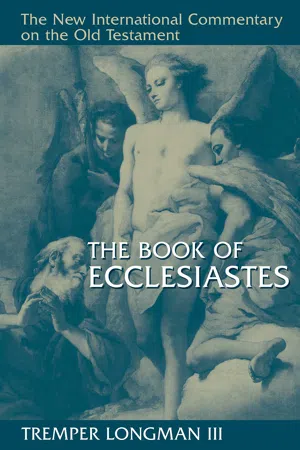
- 322 pages
- English
- ePUB (mobile friendly)
- Available on iOS & Android
eBook - ePub
The Book of Ecclesiastes
About this book
Trusted by 375,005 students
Access to over 1.5 million titles for a fair monthly price.
Study more efficiently using our study tools.
Information
Print ISBN
9780802823663
Text and Commentary
I. Frame Narrative: Prologue (1:1–11)
A. Superscription (1:1)
1The words of Qohelet, son of David, king in Jerusalem.
Ecclesiastes opens with a superscription that introduces the speech of Qohelet in 1:12–12:7. It is the opening line of an eleven-verse section that prepares the reader for what follows by setting the mood of Qohelet’s thought. This introductory section was written by a second, unnamed wisdom teacher, whom I will refer to as the frame narrator1 (see “Authorship” and “Structure” in the introduction).
Superscriptions appear at the beginning of many other biblical books, most consistently with works of prophecy. The superscription is like the title page of a modern book, in that it provides information about the genre, author, and occasionally the subject matter and date of a book (e.g., Isa. 1:1; Jer. 1:1; Nah. 1:1). Superscriptions are found in other wisdom contexts (Prov. 1:1; Song of Songs 1:1), and the one that is closest to the opening of Ecclesiastes is found in Proverbs 1:1: “The proverbs of Solomon, son of David, king of Israel.”2 The similarity may be part of the frame narrator’s strategy of near identity between Qohelet and Solomon (see “Authorship” in the introduction).
In the case of Ecclesiastes, the book’s superscription provides the genre (words) and an authorship designation (Qohelet, son of David, king in Jerusalem). The date and subject matter are left unexpressed.
The most natural reading of the superscription in wisdom and prophetic literature is that it was added by a second, subsequent hand. It is not impossible that the author or speaker wrote the superscription, referring to himself in the third person, but the only reason to argue in this direction is to defend a rather mechanical view of biblical inspiration that insists only one author stands behind a single book. In my view, this superscription is the work of the frame narrator.
The frame narrator uses a general term, words, to describe what is to follow in 1:12–12:7. As any Hebrew dictionary will attest, dābār occurs over fourteen hundred times in the OT and means “word,” “thing,” “affair,” and sometimes “event.” While Qohelet narrates both events and words in the bulk of the book, it is safest to stick with the more general term “words,” since it introduces a speech. Though dābār could have the sense of oral speech, we cannot rule out the possibility that Qohelet’s words were a written composition that was then used as a foil by the second wise teacher as he instructed his son (12:12) in the dangers of speculative thinking. Ecclesiastes 1:12–12:7 does carry the tone of a lecture of a teacher to his students.
For a full discussion of the name Qohelet, consult the introduction under “Title.” See also the discussion under “Authorship.”
While there is no doubt that the word ben in the phrase son of David “denotes close relationships of mind and spirit without implying actual physical kinship,”3 here it is beyond question that the superscription intends to associate Qohelet and Solomon. The purpose for this association is given in the introduction, under “Authorship.”
Both George Barton4 and James Crenshaw5 assert without argumentation that king in Jerusalem refers to Qohelet and not to David. This point is not established by grammar, since the phrase immediately follows the name David. In other words, it is difficult to tell whether the phrase is in apposition to David or to the entire phrase son of David. The issue is hardly crucial, though, since no one doubts that David ruled as king from Jerusalem, and Qohelet asserts his kingship in 1:12.
The expression in Jerusalem is rather strange. The Septuagint noted the problem and added “of Israel,” thus “king of Israel in Jerusalem.” H. L. Ginsberg6 prefers a philological rather than a text-critical solution when he evokes a cognate from the Akkadian of Ugarit to translate “property owner in Jerusalem.” I do not find these and other efforts of comparative philology persuasive. Though the normal formula was “king of Israel,” there is no problem in recognizing variants, including the present king in Jerusalem.
B. Introduction to Qohelet’s Thought (1:2–11)
After the superscription, the frame narrator introduces the words of Qohelet with a brief, ten-verse introduction. Two textual signals make it certain that we are not hearing Qohelet’s voice yet. The first is the appearance of “Qohelet said” in v. 2. This phrase, not typical of Qohelet’s method of self-presentation, is found here, in 7:27 (for the significance of which see the Ec 7:27), and in 12:8.7 Second, and perhaps more importantly, 1:12 bears a likeness to the opening phrase found in the genre of Akkadian autobiography (see “Genre” in the introduction). Only after that verse may we be certain that Qohelet himself is speaking.
The function of the prologue, though, is to set the mood for what is to follow. The author/narrator of Ecclesiastes reflects the somber tone of Qo-hel-et’s ultimate conclusion by both introducing and concluding Qohelet’s speech with the same refrain: “Completely meaningless, completely meaningless! Everything is meaningless!” (1:2 and 12:8).
Other commentators8 divide vv. 2 and 3 from 4–11. Their decision is based on the belief that Qohelet starts talking in v. 4. My genre analysis (see “Genre” in the introduction), however, lends strong support to the understanding that Qohelet starts speaking in v. 12.
There is further disagreement as to whether the prologue is poetry or prose, an issue that runs throughout the book. Indeed, the larger issue of the precise distinction between poetry and prose is a vexed one.9 While there is a little parallelism in the prologue, it is my opinion that the prologue is prose since it lacks the heightened presence of the cluster of traits that defines poetry in Hebrew: parallelism, terseness, and wordplays.10
2“Completely meaningless,”11 Qohelet said, “completely meaningless! Everything is meaningless!”
3What profit is there for people12 in all the toil that13 they do14 under the sun?
4A generation goes, and a generation comes, but the earth remains the same forever.
5The sun rises,15 and the sun sets,16 only to hurry around to rise again.
6It blows to the south, going around to the north.17 The wind goes around and around. The wind keeps blowing in circles.
7All rivers flow to the sea, but the sea is never full. The rivers return18 to the place from which they flow.
8All things are wearisome beyond words. The eye is never satisfied with seeing, nor the ear with hearing.
9Whatever19 is20 will be again. What was done in the past will be done again. There is nothing new under the sun.
10Here is a common expression, “Look, this is new!” But it was already here long ago. It existed before our time.
11There is no remembrance21 of the past, nor will there be any remembrance of what will be in the future. There is no remembrance of them among those who will exist in the future.
2 The book of Ecclesiastes leaves no doubt about Qohelet’s ultimate conclusion—everything is completely meaningless. The second wisdom teacher (see “Authorship” in the introduction) here introduces and later (12:8) concludes Qohelet’s words with this summary statement. In doing so he utilizes a refrain that occurs repeatedly within the body of the book itself (e.g., 2:1, 15, 19; 3:19; 5:9 [English 5:10]; 6:11; 7:6; 8:10, 14; 9:9; 11:8; 12:8). Indeed, the phrase occurs over thirty-five times in the book. In addition, to make sure that the reader gets the point, the refrain is composed of a series of superlatives, making this motto an extremely strong statement.
The phrase completely meaningless literally reads “meaninglessness of meaninglessnesses,” or more traditionally, “vanity of vanities.” The latter translation, made famous by the KJV, is now problematical because the English term “vanity” is primarily used in reference to self-pride.
The superlative is formed by the use of the word twice in a construct relationship (habēl habālîm), first in the singular and the second time in the plural. Grammatical analogies include “Song of Songs,” meaning the very best song (Song of Songs 1:1), and “Holy of Holies,” in reference to the most holy spot on earth (Exod. 29:37)—see other analogies in Deuteronomy 10:14 (“heaven of heavens”) and Genesis 9:25 (“servant of servants”).
The expression is further heightened, first, by the repetition of the superlative, and then, as if it were not already crystal clear, by the fin...
Table of contents
- Cover
- Title Page
- Copyright Page
- Dedication
- Contents
- General Editor’s Preface
- Author’s Preface
- Abbreviations
- Introduction
- Text And Commentary
- Notes
- I. Subjects
- II. Authors
- III. Scripture References
- IV. Foreign Words
Frequently asked questions
Yes, you can cancel anytime from the Subscription tab in your account settings on the Perlego website. Your subscription will stay active until the end of your current billing period. Learn how to cancel your subscription
No, books cannot be downloaded as external files, such as PDFs, for use outside of Perlego. However, you can download books within the Perlego app for offline reading on mobile or tablet. Learn how to download books offline
Perlego offers two plans: Essential and Complete
- Essential is ideal for learners and professionals who enjoy exploring a wide range of subjects. Access the Essential Library with 800,000+ trusted titles and best-sellers across business, personal growth, and the humanities. Includes unlimited reading time and Standard Read Aloud voice.
- Complete: Perfect for advanced learners and researchers needing full, unrestricted access. Unlock 1.5M+ books across hundreds of subjects, including academic and specialized titles. The Complete Plan also includes advanced features like Premium Read Aloud and Research Assistant.
We are an online textbook subscription service, where you can get access to an entire online library for less than the price of a single book per month. With over 1.5 million books across 990+ topics, we’ve got you covered! Learn about our mission
Look out for the read-aloud symbol on your next book to see if you can listen to it. The read-aloud tool reads text aloud for you, highlighting the text as it is being read. You can pause it, speed it up and slow it down. Learn more about Read Aloud
Yes! You can use the Perlego app on both iOS and Android devices to read anytime, anywhere — even offline. Perfect for commutes or when you’re on the go.
Please note we cannot support devices running on iOS 13 and Android 7 or earlier. Learn more about using the app
Please note we cannot support devices running on iOS 13 and Android 7 or earlier. Learn more about using the app
Yes, you can access The Book of Ecclesiastes by Tremper Longman in PDF and/or ePUB format. We have over 1.5 million books available in our catalogue for you to explore.