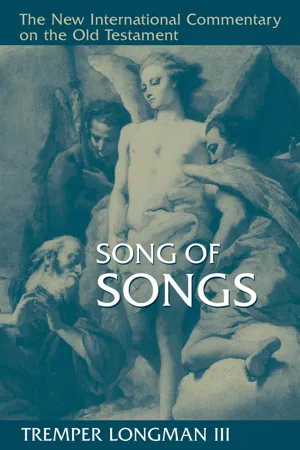
Relationships are a wonderful, mysterious, often elusive, sometimes painful part of the human experience. The most intimate of all human relationships, according to the Bible, is that between a husband and a wife. It is no surprise, therefore, that there is a book of the Bible, the Song of Songs, that focuses on this relationship. What is surprising is how little attention is given to the Song of Songs by scholars, by the church, and by readers of the Bible. With this volume Tremper Longman III unpacks for modern people what this ancient love poem says about the male-female relationship -- and, by analogy, about God's love for his people.
Longman's superb study begins with a thorough introduction to the Song of Songs and its background. Longman discusses the book's title, authorship, date, literary style, language, structure, cultural milieu, and theological content. He also canvasses the long history of interpretation of the Song of Songs, a history too often characterized by repression of the text. In the commentary itself, Longman structures the Song of Songs according to its twenty-three poetic units and explains its message verse by verse. The exposition is made clearer by Longman's adoption of an anthropological approach to the text and by his frequent comparisons of the Song of Songs with other ancient Near Eastern literature.
Learned yet highly accessible, innovative yet fully informed by past scholarship, this commentary shows the beautiful Song of Songs to be a timeless celebration of human love and sexuality.
- 254 pages
- English
- ePUB (mobile friendly)
- Available on iOS & Android
eBook - ePub
Song of Songs
About this book
Information
SONG OF SONGS
CHAPTER ONE
SUPERSCRIPTION (1:1)
1. The song of songs, which1 concerns2 Solomon.
The Song of Songs opens with a superscription.3 The first verse is a detached description of the contents of the book; what follows in the rest of the book is passionate love poetry. Superscriptions appear at the beginning of many other biblical books, most consistently with works of prophecy. The superscription is like the title page of a modern book in that it provides information about the genre, author, and occasionally the subject matter and date of a book (e.g., Isa. 1:1; Jer. 1:1–3; Nah. 1:1). Superscriptions are found in other wisdom contexts as well (Prov. 1:1; Eccles. 1:1), where, interestingly, Solomon is either mentioned or implied.
In the case of the Song, two items appear in the superscription. The first is song of songs, a construct phrase built from the singular and then the plural of the same noun “song” (šîr). This grammatical structure often indicates the superlative. Analogies include “completely meaningless” (habēl hăbālîm; Eccles. 1:2), and “Holy of Holies,” in reference to the most holy spot on earth (Exod. 29:37)—see other analogies in Deuteronomy 10:14 (“heaven of heavens”) and Genesis 9:25 (“servant of servants”). Indeed, M. H. Pope cites Jewish commentary on the book that highlights the Song as the best biblical song and Origen, a third-century Christian theologian, who refers to seven songs in the Bible of which the Song of Songs was the apex.4 In this context, however, the expression may also point to the composite nature of the book. As described in the Introduction, the Song of Songs is a single poem composed of many poems, literally then, a song of songs.5
Song (šîr) is a genre designation, but a broad one. It indicates a literary text with a musical accompaniment. While it can designate a host of different types of songs,6 Pope says it more often than not indicates a “glad song.”7 “Song” leaves the composition ambiguously related to the cult and religious expression.8
More difficult to discern is the function of the phrase which concerns Solomon (ʾăšer lišelōmōh). The problem has to do with the force of the preposition le. The semantic range of the preposition is wide, and it theoretically could be translated “of,” “to,” “by,” or concerning. The choice of translation usually derives from the context of the preposition within a sentence, but the superscription does not provide such a sentence context to guide us. The ancient audience presumably would have been well aware of the force of the preposition in a superscription, but we are distanced and ignorant of that information. The ambiguity is the same as that in the title of the Psalms, but the same answer is not necessary in both cases.
Some scholars9 argue that the superscription was added late as tour de force to provide the book with authority or to link it with the wisdom tradition. Perhaps this is the case. However, it is also conceivable, on analogy with Proverbs,10 that Solomon, though not the author of the book as a whole, was the originator of some of the poems within the collection. Solomon himself is only mentioned twice in the book (3:6–11; 8:10–12), once rather favorably and the second time rather unfavorably. (For more detailed discussion, see the Introduction: Authorship).
POEM ONE:
THE WOMAN’S PURSUIT (1:2–4)
THE WOMAN’S PURSUIT (1:2–4)
The Song proper begins with an explosion of words. Bernard of Clairvaux noted that the woman’s speech presupposes a conversation and relationship that has already begun, and he calls this line a “beginning without a beginning.”11 It sets a dynamic tone that never ends throughout the book. Indeed, the last poem, as we will see, does not impart a distinct sense of closure.
The first of the songs begins with an expression of the woman’s desire for the man. As is frequently the case throughout the Song, the woman takes the initiative. Indeed, A. LaCocque and S. D. Goitein12 point out that the woman speaks 53 percent of the time in the Song, while the man speaks 39 percent of the time. Perhaps the text was subversive in its ancient context;13 it certainly is in the present in Christian contexts where females are expected to keep their proper place in life and romance. The characters of the Song may not be identified with historical figures or any actually existing human beings; neither do the poems carry a narrative. They express universal emotions. As is the case in the Psalms, the voice of the poet is intended to be our voice at the proper time and in the proper place.
This poem was not always taken as a reference to physical lovemaking (cf. Introduction). Perhaps the most notable allegorical interpretation of this poem is that which takes it as a reference to the Exodus. The woman, Israel, beckons her man, God, to take her into his bedroom, Palestine.
The form of these three verses is a poem of yearning (see Introduction: Genre for other examples). The name, of course, derives from the woman’s expressed desire for union with the man.
The Woman
2. Let him kiss me with the kisses of his mouth,
for your14 love15 is better than wine.
3. How wonderful16 is the scent of your oils;
your name is poured out17 oil.18
Therefore, the young women love you.
4. Draw me after you; let’s run!
The king has brought me into his bedroom.19
The Women of Jerusalem
We will rejoice and feel happy for you!
We will praise20 your love more than wine!
The Woman
They rightly21 love you!22
2 The first poem is a passionate exclamation on the part of the woman who desires union with the man. The woman takes the initiative here and in many of the poems of the Song. The aggressiveness of the woman in the Song undermines our stereotypes of ancient gender roles and also instructs those today who look to the Bible for guidance in matters of relationships. This book will not support a dominance of the male over the female. Nonetheless, her initiative does not go so far as to say “I will kiss him,” but rather her exclamation wants to prod him to action (let him kiss me).
The characters of the Song are not specific. That is, the woman is not a particular woman but stands for all women. The same may be said for the man. These characters are developed intentionally in a nonspecific way since they are not reporting about a particular couple. These poems invite later readers to place themselves in the position of the woman and the man. In this way, the Song is similar to the book of Psalms, where the reader is implicitly encouraged to put him or herself in the place of the first-person speaker.23
The motif is the invitation for intimacy expressed in the form of a wish.24 The Song expresses the couple’s yearning for complete union and thus appeals to every sense. The woman begins with the erotic touch of a kiss. The expression let him kiss me with the kisses of his mouth, though it sounds awkward and even ponderous to us, expresses her exuberance. F. Delitzsch certainly stretches the phrase when he makes the preposterous comment that the expression means that she only got a few of Solomon’s rather promiscuous kisses.25 The specification of kisses on the mouth may suggest that there were other intimate gestures, perhaps, for instance, nose kisses,26 but then the specification may also be a function of poetic rhythm.
In what a prosaic person would call a “motive clause,” she likens his love to the taste of wine, a rich and sensuous liquid. The bouquet of the wine as well as its taste creates an enticing metaphor for the physical aspects of love, especially the kiss. Drinking wine intoxicates, and kissing the woman arouses the man, making him lightheaded. Indeed, she insists not only that the man’s love is like wine, but that it is better than wine.27
3 After praising his taste, the woman celebrates his scent. Men apparently wore aromatic oils, what we today would call cologne. All of her senses are aroused by his presence. The man’s physical smell leads to a comment on his reputation as well, signified by his name. His reputation goes before him positively like his scent. He is loved not only by the woman, but also by all the young women. These women are unspecified, but their function here is to confirm the good taste of the female speaker. She is not deluded by love; others love her man as well, thus confirming her choice. Pope points out that this particular word for young woman (ʿălāmôt) indicates “sexual ripeness without presumption one way or the other as to virginity...
Table of contents
- Cover
- Title Page
- Copyright Page
- Dedication
- Contents
- General Editor’s Preface
- Author’s Preface
- Abbreviations
- Introduction
- Text and Commentary
- Notes
- Indexes
Trusted by 375,005 students
Access to over 1.5 million titles for a fair monthly price.
Study more efficiently using our study tools.
Frequently asked questions
Yes, you can cancel anytime from the Subscription tab in your account settings on the Perlego website. Your subscription will stay active until the end of your current billing period. Learn how to cancel your subscription
No, books cannot be downloaded as external files, such as PDFs, for use outside of Perlego. However, you can download books within the Perlego app for offline reading on mobile or tablet. Learn how to download books offline
Perlego offers two plans: Essential and Complete
- Essential is ideal for learners and professionals who enjoy exploring a wide range of subjects. Access the Essential Library with 800,000+ trusted titles and best-sellers across business, personal growth, and the humanities. Includes unlimited reading time and Standard Read Aloud voice.
- Complete: Perfect for advanced learners and researchers needing full, unrestricted access. Unlock 1.5M+ books across hundreds of subjects, including academic and specialized titles. The Complete Plan also includes advanced features like Premium Read Aloud and Research Assistant.
We are an online textbook subscription service, where you can get access to an entire online library for less than the price of a single book per month. With over 1.5 million books across 990+ topics, we’ve got you covered! Learn about our mission
Look out for the read-aloud symbol on your next book to see if you can listen to it. The read-aloud tool reads text aloud for you, highlighting the text as it is being read. You can pause it, speed it up and slow it down. Learn more about Read Aloud
Yes! You can use the Perlego app on both iOS and Android devices to read anytime, anywhere — even offline. Perfect for commutes or when you’re on the go.
Please note we cannot support devices running on iOS 13 and Android 7 or earlier. Learn more about using the app
Please note we cannot support devices running on iOS 13 and Android 7 or earlier. Learn more about using the app
Yes, you can access Song of Songs by Tremper Longman in PDF and/or ePUB format. We have over 1.5 million books available in our catalogue for you to explore.