The most accessible, most broadly pitched full-length commentary on Timothy and Titus, this NICNT volume explores Paul's three letters to Timothy and Titus within their historical, religious, and cultural settings.
In his introduction, Towner sets out the rationale for his historical approach, questions certain assumptions of recent critical scholarship, and establishes the uniqueness and individuality of each letter. Significantly, Towner's work displays unprecedented interaction with four recent major commentaries on these Pauline letters. Centered on an outstanding translation of the Greek text and including thorough footnotes, bibliographical citations, and indexes, Towner's commentary on Timothy and Titus is sure to become a standard reference for busy pastors, students, and scholars.
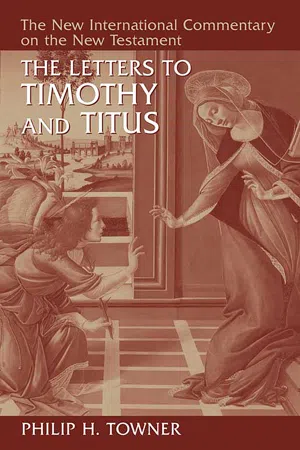
- 934 pages
- English
- ePUB (mobile friendly)
- Available on iOS & Android
eBook - ePub
The Letters to Timothy and Titus
About this book
Information
Print ISBN
9780802825131
Notes
1. See the discussion in D. Guthrie, New Testament Introduction (Downers Grove, IL: IVP, 1970), 584; in reference to P. Anton, Exegetische Abhandlung der Pastoral-briefe Pauli an Timotheus und Titum (ed. J. A. Maier; 1753–1755); cf. R. F. Collins, Letters That Paul Did Not Write: The Epistle to the Hebrews and the Pauline Pseudepigrapha (Good News Studies 28; Wilmington, DE: Michael Glazier, 1988), 88.
2. This is the implication to be derived from Irenaeus, on which see below: A. Reception and Canonicity.
3. Cf. the excellent model in Johnson, 13–99, 135–54, 319–30. Conversely, the three-volume work of Oberlinner, though perfect in format for introducing the letters as discrete writings—with an individual volume allowed for treatment of each letter—nevertheless treats introductory matters as global matters at the front of the first volume.
4. In view of the full discussions in e.g. Johnson, 20–26; Marshall, 2–8, no attempt is made here to reproduce exhaustively the early evidence.
5. Polycarp, Letter to the Philippians, 4.1 (referring to 1 Tim 6:7, 10); cf. 5.2 (=1 Tim 3:8–13), on which see W. R. Schoedel, Polycarp, Martyrdom of Polycarp, Fragments of Papias (The Apostolic Fathers, vol. 5; Camden, NJ: Nelson, 1965), 4–5; D. A. Hagner, DLNTD, 86.
6. See 1 Clement 2.7; 60.4; 61.2 (which texts employ language reminiscent of Titus 3:1; 1 Tim 2:7; 1 Tim 1:17, respectively). For the possibility that Ignatius and the author of the Epistle of Barnabas also knew the letter to Timothy and Titus, see The New Testament in the Apostolic Fathers (by the Oxford Society of Historical Theology; Oxford: Clarendon Press, 1905), 37–40. But cf. Johnson, 20, n. 16.
7. Against Heresies, 1.pref. (citing 1 Tim 1:4); see also 4.16.3 (citing 1:9); 5.17.1 (citing 2:5); 3.1.1 (citing 3:15); 1.23.4 and 2.14.7 (citing 6:20).
8. Stromateis 1.1 (citing 1 Tim 5:21); 1.9 (citing 6:3–5); etc.; 4.7 (citing 2 Tim 1:7–8); 1.10 (citing 2:14); etc.; Exhortation 1 (citing Titus 2:11–13; 3:3–5).
9. See the discussion in F. F. Bruce, The Canon of Scripture (Downers Grove, IL: IVP, 1988), 176.
10. On which, see Bruce, Canon, 158–69; and for a second-century date, see E. Ferguson, “Canon Muratori: Date and Provenance,” in Studia Patristica 17 (ed. E. A. Livingstone; New York: Pergamon, 1982), 677–78.
11. Tertullian, Against Marcion 5.21. See discussion in B. M. Metzger, The Canon of the New Testament: Its Origin, Development and Significance (Oxford: Clarendon Press, 1987), 159; Marshall, 7–8.
12. E.g. Johnson, Paul’s Delegates, 24.
13. E.g. Bruce, Canon, 131, 138.
14. E.g. H. Y. Gamble, The New Testament Canon: Its Making and Meaning (Philadelphia: Fortress, 1985), 42; L. M. McDonald, The Formation of the Christian Biblical Canon (Rev. and Expanded ed.; Peabody, Mass: Hendrickson, 1995), 157, 141. For the view that Polycarp wrote these letters against Marcion (which is extremely unlikely in view of the evidence that Polycarp actually cited 1 Timothy), see Hans von Campenhausen, “Polykarp von Smyrna und die Pastoralbriefe,” in idem., Aus der Frühzeit des Christentums (Tübingen: Mohr [Siebeck], 1964), 197–252; H. Koester, History and Literature of Early Christianity, Volume Two: Introduction to the New Testament (Philadelphia: Fortress, 1982), 297–308.
15. Cf. Clement, Stromateis 2.11.
16. See Johnson, 22–26.
17. Cf. discussion in Johnson, 25. There is much to be learned from the reception and use of these letters in subsequent periods of church history, which until the nineteenth century fairly uniformly regarded them as Pauline and authoritative. Johnson, 26–42, shows how approaches to them developed, with refinements in method (and the expected idiosyncrasies too), as their status as canonical Scripture continued to be affirmed.
18. See J. D. Quinn, “P46—the Pauline Canon?,” CBQ 36 (1974), 379–85; Johnson, 17–18; cf. Jeremias, 4. For the various negative views, see J. Duff, “P46 and the Pastorals: A Misleading Consensus?,” NTS 44 (1998), 578–90.
19. Duff, “P46 and the Pastorals.”
20. See further Marshall, 6–7; Cf. N. A. Dahl, “The Particularity of the Pauline Epistles as a Problem in the Ancient Church,” Neotestamentica et Patristica, NovTSup 7 (Leiden: Brill, 1962), 261–71.
21. See esp. J. K. Elliott, The Greek Text of the Epistles to Timothy and Titus (Studies and Documents XXXVI; Salt Lake City, UT: University of Utah Press, 1968); B. M. Metzger, A Textual Commentary on the Greek New Testament (rev. ed.; New York: UBS, 1975), 639–56; Marshall; Johnson; L. T. Johnson, Letters to Paul’s Delegates: 1 Timothy, 2 Timothy, Titus (Valley Forge, PA: Trinity Press International, 1996); Mounce.
22. For an introduction to the methodology and witnesses to the Greek NT text, see B. M. Metzger, The Text of the New Testament (2nd ed.; New York: Oxford University Press, 1...
Table of contents
- Cover
- Title Page
- Copyright Page
- Dedication
- Contents
- Editor’s Preface
- Author’s Preface
- Abbreviations
- Bibliography
- Introduction
- The First Letter to Timothy
- The Second Letter to Timothy
- The Letter to Titus
- Notes
- Index of Subjects
- Index of Authors
- Index of Scripture References
- Index of Early Extrabiblical Literature
- Index of Key Greek Words
Trusted by 375,005 students
Access to over 1.5 million titles for a fair monthly price.
Study more efficiently using our study tools.
Frequently asked questions
Yes, you can cancel anytime from the Subscription tab in your account settings on the Perlego website. Your subscription will stay active until the end of your current billing period. Learn how to cancel your subscription
No, books cannot be downloaded as external files, such as PDFs, for use outside of Perlego. However, you can download books within the Perlego app for offline reading on mobile or tablet. Learn how to download books offline
Perlego offers two plans: Essential and Complete
- Essential is ideal for learners and professionals who enjoy exploring a wide range of subjects. Access the Essential Library with 800,000+ trusted titles and best-sellers across business, personal growth, and the humanities. Includes unlimited reading time and Standard Read Aloud voice.
- Complete: Perfect for advanced learners and researchers needing full, unrestricted access. Unlock 1.5M+ books across hundreds of subjects, including academic and specialized titles. The Complete Plan also includes advanced features like Premium Read Aloud and Research Assistant.
We are an online textbook subscription service, where you can get access to an entire online library for less than the price of a single book per month. With over 1.5 million books across 990+ topics, we’ve got you covered! Learn about our mission
Look out for the read-aloud symbol on your next book to see if you can listen to it. The read-aloud tool reads text aloud for you, highlighting the text as it is being read. You can pause it, speed it up and slow it down. Learn more about Read Aloud
Yes! You can use the Perlego app on both iOS and Android devices to read anytime, anywhere — even offline. Perfect for commutes or when you’re on the go.
Please note we cannot support devices running on iOS 13 and Android 7 or earlier. Learn more about using the app
Please note we cannot support devices running on iOS 13 and Android 7 or earlier. Learn more about using the app
Yes, you can access The Letters to Timothy and Titus by Philip H. Towner in PDF and/or ePUB format. We have over 1.5 million books available in our catalogue for you to explore.