eBook - ePub
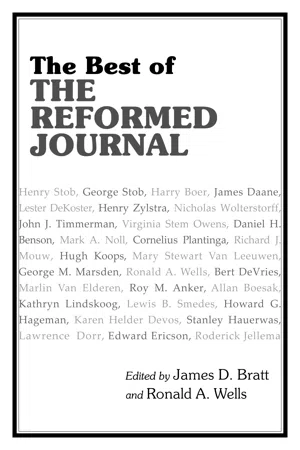
The Best of The Reformed Journal
- 344 pages
- English
- ePUB (mobile friendly)
- Available on iOS & Android
eBook - ePub
The Best of The Reformed Journal
About this book
For four decades, from 1951 to 1990,
The Reformed Journal set the standard for top-notch, venturesome theological reflection on a broad range of issues. With a lively mix of editorial comment, articles, and reviews, it addressed topics as diverse as the civil rights movement, feminism, the Vietnam War, South African apartheid, the plight of Palestinian Christians, and the rise of the Christian Right, all from a Reformed perspective. In this anthology James Bratt and Ronald Wells have assembled select pieces that exemplify the
Journal's position at the cutting edge of thoughtful Christian engagement with culture.
Information
Topic
Theology & ReligionSubtopic
Christian DenominationsPART I 1951-1962
James Daane spoke for the founding editors when he declared that the postwar world required “a Reformed theology bristling with vitality and restless with creative energy.” That tone and agenda are well captured in the opening essay in this section, Harry Boer’s “The Cathedral,” and the two selections that follow start to flesh out what such a project might produce. Lewis Smedes, who would become a Journal editor in 1964, appeared in its pages already in 1952 while a graduate student in theology at the Free University of Amsterdam. His piece issued a prescient call for sacramental renewal which would recur down through the years in the Journal’s columns, just as it would become a leading theme across American Protestantism later in the century.
The Journal’s serious but gentle critique of 1950s American culture is well put in John Timmerman’s “The American Way of Life,” the Journal debut of a longstanding member of the Calvin College English department and an eventual Journal editor. Timmerman’s Christian-Idealist outlook came from Henry Zylstra, whose “Thoughts for Teachers” also demonstrates the literary method that a generation of Calvin students learned from this most influential of teachers. Zylstra’s death in Amsterdam in December 1956 was a profound shock to the magazine and college alike; ironically, his classic Advent meditation, “Hospitality,” ran that same month.
The magazine’s more hopeful, if still measured, engagement with American society is evident in Sidney Rooy’s reflections upon Billy Graham’s 1957 New York City Crusade and Ernest Van Vugt’s remarkably titled Calvin College chapel talk, “Pitch Your Tents Toward Sodom.” Stronger assertions appear in Henry Stob’s defense of academic freedom at a Christian college, written in light of both the recent imposition of “loyalty” oaths at American colleges and universities and recurrent suspicions in the CRC about various sorts of “unorthodoxy” at Calvin College. A frequent target of such, Lester DeKoster, never ducked a fight and invited controversy with his forthright assault on the prevailing assumption that being Reformed meant voting Republican. The truly egregious religio-political system of South African apartheid received the first of many Journal rebukes in the essay Harry Boer published at the dawn of the 1960s from his teaching post in Nigeria.
The inaugural period in the Journal’s history closed, as it opened, on a theological controversy, this one precipitated by Calvin Seminary professor Harold Dekker’s revisiting the middle term of the old Calvinist acronym of TULIP: the doctrine of limited atonement. Dekker’s article drew many critiques, one of the best being that of Peter De Jong, a future Calvin Seminary professor himself. The CRC Synod duly investigated the matter, only to decide in 1967 that, while Dekker had spoken a bit loosely, he was not guilty of doctrinal error. That decision marked the end of the reign of the conservative establishment against which the Journal’s founders had arisen, and arguably the beginning of their own ascendancy.
OPENING BELL
The Cathedral
HARRY R. BOER
July 1953
We who stand in the spiritual tradition of John Calvin think of him as a reformer and a theologian, as a writer of the Institutes and of the Commentaries. Only infrequently do we think of him as a preacher, and hardly at all as one who addressed the world of his day from the pulpit of a massive cathedral. That Calvin during the space of thirty years preached his eloquent sermons in the impressive setting of marble and stone structured in Gothic beauty is worthy of note.
On a hill on which old Geneva was built stands the Cathedral of St. Peter. It overlooks the now much extended city and beautiful Lake Leman sparkling amid the foothills of the Alps. This cathedral I recently visited. It is an experience that does not leave a conscious son of the Reformation untouched to walk on the very stones on which Calvin walked, to worship in the church in which he proclaimed the Gospel, to look down the long nave as down the ages and to stand small under its vaulting arches. Calvin, I discovered, had been given a speaking platform worthy of his message and personality. His timeless witness was spoken in the symbolic setting of enduring stone hewn into the form of a heaven-pointing cross.
* * *
St. Peter’s in Geneva is neither in size nor architecturally one of the great churches of Christendom. It does not have the rich magnificence of St. Peter’s in Rome, nor the massiveness of Notre Dame in Paris, nor the delicacy and unity of that most perfect and superb of all churches, the cathedral in Milan. In fact, St. Peter’s in Geneva is something of a hybrid. Its two towers are of square Romanic style, its sanctuary is Gothic, and the present facade which was added some centuries after the completion of the cathedral proper is Greco-Romanic, much like the pillared front of Calvin College. But for all that, it is an impressive structure and one that lends solidity and respect to the religious tradition which it has helped to perpetuate.
When Calvin preached in St. Peter’s it was already rich with three hundred fifty years of history. He who ascended the pulpit and they who worshipped in the pew were already then conscious of the weight of a tradition and of a cloud of witnesses who had gone on before. And these witnesses expected loyalty to the sacrifice that they had made and to the tradition they had launched. For into the building of an old cathedral went more than a pledge of annual contributions and an eight-hour day by hired workers. Read how a cathedral rose from the ground in twelfth-century Normandy:
Whoever saw or heard tell of such things? Powerful and wealthy men of noble birth and proud and beautiful women, bowing their necks beneath the yoke of the wagons that bore their stones, and wood, and wine, and wheat, and lime, and oil, everything that was needed to build the church and keep the workers. A thousand people were to be seen, men and women, all drawing one cart, so heavy was the burden laid upon them, and among the multitude, struggling forward in deep emotion, deep silence reigned. At the head of the long procession, the mighty minstrels sounded their copper trumpets, and bright hues of holy banners waved in the wind.
Building the cathedral was the work of everyone in the community. It was an act of faith, a religious exercise. The cathedral became a faith symbolized in sculptured stone.
In the building of a modern church a different pattern is followed. Whoever, in the days when cathedrals were built, saw or heard tell of such things? A congregational meeting is held, it is voted by a substantial majority to build a new church. A building committee is appointed. Bids are asked, a contract is let. A bond issue is floated. A union keeps plumbing for the plumbers, masonry for the masons. On a given day the building is “turned over” to the congregation. There is prayer when the corner stone is laid, prayer when the building is dedicated. For the rest, a contractor who sustains no relationship of any kind to the religious community for whom he is building is in charge of constructing God’s house.
It probably cannot be done otherwise. The Church of Jesus Christ is divided into many denominations and most of these are spread over vast areas. Seldom does a large entire community build a church. The economic resources of the divided Christians do not permit the building of vast and spacious cathedrals. The Roman Catholic Church does not suffer from this disadvantage and this is evident in its houses of worship. They are cathedral-like if not cathedrals in fact. And the division of labor in our highly complex economy does not permit men and women, boys and girls, to put common shoulders to the wheel and make a religious exercise out of a great common effort to interpret in stone the faith that lives in the soul.
I am aware that not all the marble of the great cathedrals represents the unmixed steadfastness of their hewers’ devotion to God. Was not the income of Tetzel’s sale of indulgences used to finance the building of Rome’s mighty St. Peter’s?
When in the chest the money rings
The soul from Purgatory springs.
But cathedrals can be built and doubtless have been built without recourse to such abuse. The fact remains that a simple and religiously unified society found within itself the idealism and the resourcefulness to unite brawn and brain and heart in the construction of massive immutable sermons in stone that breathed comfort and repose to harried souls throughout the changing generations. And the fact also remains that we do not so build.
We dig harbors and channels, writes a historian, we build factories; our forebears thought nothing more urgent than to erect upon earth a counterpart of heaven. Strange economists, these, who poured all the resources of their time into works which were to enrich nobody!
Calvin still lived in this tradition. Who shall say how much the dedication of his life, how much the massiveness of his theology owe to the cathedral tradition, to the strengthening buttresses and mighty arches and heavy pillars. Great spirits are helped by great environments.
Dutch American Calvinists have quite left this tradition. We build houses of worship to last some generations and expect that then our great-grandchildren will erect new ones. But we will not be in those new buildings. Our spirits will be absent, lost in the ruins of the old. And because we will not be there, those who lived before us will not be there. Our posterity will stand alone, much as we now so largely stand alone. They will be conscious of a physical relationship to those who gave them birth but somehow strangely distant from their spirit and ideals, just as we now stand strangely distant from the spirit and ideals that lie at the fountainhead of our tradition.
Have we not become quite poor? Theology is the queen of the sciences in the Reformed tradition, but we have not produced a new thought, have not found a new vision in half a century. But there has been endless casuistry about the movies and divorce. Apparently isolated from all that went before or came after stands concern with the large problem of Common Grace in 1924. Why was no more heard about it for twenty-five years and more? Was it really theological and religious concern that lifted the problem to prominence a quarter-century ago?
I think that all this is the way it is because we have not the inner strength to build cathedrals. Like the rest of America, we have the money to build them, but not the inner strength. We have money to build a million-dollar science building. We have more millions for a commons building and dormitories and other such soulless structures. But there is on Calvin’s campus no cathedral, no small effort at one in the form of a solid, spacious, worship-inviting chapel. This the often emptily boastful descendants of the preacher of St. Peter’s in Geneva do not have at the center of their denominational life.
Now I do not mean to say that we cannot build a cathedral-like chapel on our school grounds. Of course we can. We could probably still wedge it in between the present dormitory and the library. Enough propaganda and the thing will stand there ere long. Did not Rockefeller set forth enough millions to build Riverside Church? We can do the same on a smaller scale, for we are a determined people when we get going. But it would not, I fear, be a cathedral.
A cathedral, to me, represents a profound human appreciation for history in its religious significance and development. It says that God is the Lord of History. Therefore it cuts the never-aging rock out of the eternal hills and fashions it into an enduring structure, a testimony to man’s witnessing, consecrated, royal service to the God of time, past and present and future. That is a cathedral. That is a true cathedral. In such a cathedral one never stands alone. One stands in the consciousness of communion with and indebtedness to the past, and of a stewardship to discharge in the present and transmit to the future. It is this sense of history, the sense that builds cathedrals of stone or stately mansions of the soul, that we have lost in the Christian Reformed Communion.
Of thirty-eight American-born members in last year’s graduating class at Calvin Seminary three or four had a passing degree of proficiency in Dutch. The affinity of the others for the great tradition out of which they came was limited to a vague historical appreciation. It was not their fault. Their religious and cultural community had lost it for them. Theologically we have wholly lost the daring that in Holland fifty years ago established new patterns of thought, enriched old ones, and produced works that delighted and strengthened a virile people. Books were sold and read because of their inherent worth. We have lost a great tradition. Lost the spirit of inquiry, and the spirit of discussion and mutual confidence so essential to it. Lost it so much that it is not always safe to be true to the theological tradition that gave us birth. Such a religious and cultural community cannot build a cathedral. Is so utterly unable to build a cathedral that if it built one it would not be one. For a true cathedral is an embodiment of history, the monumentalization of a faith that unites the generations. And it is the historical sense, the indebtedness which it creates and the obligation which it establishes, that we have lost. The very fact that every annual synod is composed nearly one hundred percent of men who were not members of the previous synod shows the want of appreciation for the need of historical continuity. Go to Calvin’s library and see how its shelves are stocked, how unreal the touch with the contemporary theological situation, how inadequate its storing up of the thought of the past, and you will know that we are not, cannot be, a cathedral-building people.
Can we again become one? Assuredly we can. Did not Israel become a temple-building people after the long captivity? So we can again become a cathedral-building community. But first we will have to unlearn and leave our idolatries as Israel had to unlearn and leave its idolatries. The chilling and killing touch of a dead traditionalism, satisfaction with what great men said in living context to their day many years ago, living on them but not extending them, the substitution of legalism for the safeguards of the liberty wherewith Christ has made us free — these, all these, must go, and unfettered men must be free to preach the unfettered Word to a world that needs unfettering from a bondage that on...
Table of contents
- Cover
- Title Page
- Copyright
- Contents
- Publisher’s Note
- Acknowledgments
- Introduction
- Part I: 1951-1962
- Part II: 1963-1977
- Part III: 1978-1990
- Reformed Journal Contributors
Trusted by 375,005 students
Access to over 1.5 million titles for a fair monthly price.
Study more efficiently using our study tools.
Frequently asked questions
Yes, you can cancel anytime from the Subscription tab in your account settings on the Perlego website. Your subscription will stay active until the end of your current billing period. Learn how to cancel your subscription
No, books cannot be downloaded as external files, such as PDFs, for use outside of Perlego. However, you can download books within the Perlego app for offline reading on mobile or tablet. Learn how to download books offline
Perlego offers two plans: Essential and Complete
- Essential is ideal for learners and professionals who enjoy exploring a wide range of subjects. Access the Essential Library with 800,000+ trusted titles and best-sellers across business, personal growth, and the humanities. Includes unlimited reading time and Standard Read Aloud voice.
- Complete: Perfect for advanced learners and researchers needing full, unrestricted access. Unlock 1.5M+ books across hundreds of subjects, including academic and specialized titles. The Complete Plan also includes advanced features like Premium Read Aloud and Research Assistant.
We are an online textbook subscription service, where you can get access to an entire online library for less than the price of a single book per month. With over 1.5 million books across 990+ topics, we’ve got you covered! Learn about our mission
Look out for the read-aloud symbol on your next book to see if you can listen to it. The read-aloud tool reads text aloud for you, highlighting the text as it is being read. You can pause it, speed it up and slow it down. Learn more about Read Aloud
Yes! You can use the Perlego app on both iOS and Android devices to read anytime, anywhere — even offline. Perfect for commutes or when you’re on the go.
Please note we cannot support devices running on iOS 13 and Android 7 or earlier. Learn more about using the app
Please note we cannot support devices running on iOS 13 and Android 7 or earlier. Learn more about using the app
Yes, you can access The Best of The Reformed Journal by James D. Bratt, Ronald Wells, James D. Bratt,Ronald Wells,James Bratt, James Bratt, Ronald Wells in PDF and/or ePUB format, as well as other popular books in Theology & Religion & Christian Denominations. We have over 1.5 million books available in our catalogue for you to explore.