The relatively recent "worship wars" over styles of worship — traditional, contemporary, or blended — have calmed down, and many churches have now reached decisions about which "worship style" defines them. At a more fundamental level, however, change has yet to begin.
In
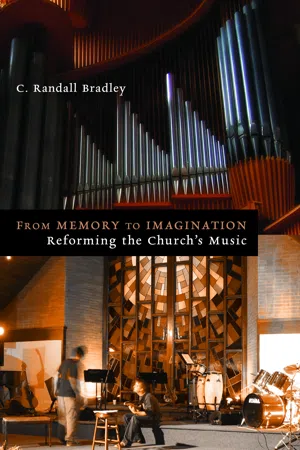
From Memory to Imagination Randall Bradley argues that fallout from the worship wars needs to be cleaned up and that fundamental cultural changes — namely, the effects of postmodernism — call for new approaches to worship. Outlining imaginative ways for the church to move forward, this book is a must-read for church leaders and anyone interested in worship music.
- 251 pages
- English
- ePUB (mobile friendly)
- Available on iOS & Android
eBook - ePub
About this book
Information
Topic
Theology & ReligionSubtopic
Christian Rituals & PracticeCHAPTER 1
From Memory to Imagination: Beginning the Journey
Let us build a house where love can dwell
And all can safely live,
A place where saints and children tell
How hearts learn to forgive.
Built of hopes and dreams and visions,
Rock of faith and vault of grace;
Here the love of Christ shall end divisions . . .
All are welcome, all are welcome,
All are welcome in this place.
Marty Haugen, “All Are Welcome”
Memory is something that you never want to be without. Memory is foundational — it gives life meaning. Memory keeps us grounded, contextualizes our experiences, helps to facilitate emotional responses, provides a conduit for connecting to new experiences, helps us to feel safe, deepens our current experiences by situating them within other times and places, helps leaders provide continuity, lets us share our stories, and allows us to connect to the stories of others. Memory permits us to be part of a metanarrative that connects us to all people and all places. Without memory, we would not be connected to God’s redemptive story throughout history.
However, memory can be a liability when we depend too heavily on it, and aren’t willing to move past our memory to imagine what God may want to do in the present. When we’re not willing to move beyond memories of the past, we risk not experiencing new forms of worship, new ways to view God; and our bank of memories ceases to accrue new experiences to add to our personal and collective story of God’s redemptive love in our lives and in our communities. Too often we get stuck in memory, which eventually degenerates into sentimentality. Memories that were pulsing with relevancy, life, and wonder become stagnant and murky, and their lack of clarity can cause them to take on unhealthy meaning and power. To remain vibrant, our memories need regular rejuvenation. Without new stories to experience and share, we are unable to experience God’s continual work in our lives and our communities. Instead of moving along a grand continuum of God’s design, we are stuck in a particular place and time; and so we fail to experience God as dynamic, forever being revealed, and continually moving. At its best, memory should give us confidence and strength to experience God in new ways; however, when we linger too long on specific memories without replenishing and refurbishing them, our faith experience can become petrified. Once living trees, we eventually turn to stone.
In order to experience the freshness and newness of God, we must be continually moving past memory toward imagination. However, moving beyond memory doesn’t mean that we forget our past. Memory informs and provides context for the present, but it is tempered by our recent and current experiences and by those of our community. We know that we are stuck in memory when our most significant God stories are in the distant past, when we find ourselves clutching the memories of God from another time too tightly, when our view of God has not changed in many years, when we become skeptical about new God stories, and when we are unable to imagine God as dynamic in our present and future.
Being stuck in memory reveals our brokenness, and we are unable to move ourselves into imagination. We must trust God to move us forward. We must recognize our “memory stuck” condition and ask God to give us new vision and the ability to imagine again. We must depend on our community of faith to help us by encouraging and challenging us. Sometimes we can find ourselves in a “memory box” in which all the faith we seem to have depends on memory. During these times, memory can keep us standing until we find our way to God’s next memory-filled place. Being stuck in memory is not a matter of age: whether you’re stuck in the 1990s, at last summer’s youth camp, or in the seventeenth century, you’re still stuck and, because of that, lacking imagination.
God’s best is always in our future, for while we have one foot here, we also have one foot in eternity. For the Christian, life is lived in the state of “already” but “not yet.” God has already done God’s salvific work in our lives by redeeming us through God’s son, Jesus, and we are on the journey toward being with God in eternity. But we are not with God in eternity yet, and we must fully live in the confidence of what God has already done with the hope and assurance that God will fully complete what God has begun. Being stuck in memory allows us to live only in the “already” without experiencing either the present or the “not yet” — the stuff of imagination.
Memory is always a part of our faith, for it is in remembering that we are drawn back to God’s work in history — both cosmic history and individual history. To understand God in our contemporary context, we must consider God’s actions in the past, for it is in doing so that we are often able to see God working contemporarily. As worshipers, we acknowledge God’s eternal being and offer praise for God’s saving work and faithfulness. We give thanks to God because of what God has done and because of God’s being; and we understand God’s being primarily by God’s revelation of God’s self in history.
True faith in God is always connected to the story of God’s redemptive work in history — both the history of the church and our own individual history — for we are continually finding our story in the greater narrative of God’s story. As followers of Christ we are always connected to Christ-followers throughout history through whose faithfulness we are called to be faithful. Through God’s self-revealed act of sending God’s son, we know of God’s love for us; through the life of Jesus, we are challenged to live sacrificially and serve others; and through Christ’s death and resurrection, we are assured of our own resurrection.
Despite memory’s importance in defining us as Christ-followers, informing what we know about God, and contextualizing the present and the future, memory is not enough, for it is grounded in the past. Memory interprets the present and informs the future, but it is neither the present nor the future. The present must be fully lived, and the future must be heartily anticipated. God is always moving us toward the future — life in eternity — and our lives are focused on the hope found in Christ’s resurrection. We are first and foremost people of the Resurrection, and our focus is on the risen Christ, who is alive and forever calling us toward God.
God alone is God. What we bring to worship is always based on our feelings, our impressions, our hunches, our leanings, our experiences, our memories, our community, and more. While we interpret and relate to God based on our own experiences, relationship to those around us, and our memories and recall, our subjective memory does not alter God’s being. While we do our best to keep God’s “Godness” in perspective, we are incapable of worshiping God objectively, and to think we can is idolatrous, since we are incapable of understanding God in ways that transcend our own biases and contexts. Since worship is for and about God, worship has an objective dimension — God. The dialogue of worship always involves communion between God, who is beyond our understanding, and we humans, who are always flawed and broken.
All memory is subjective. While it is based on actual moments in time, it is laced with interpretation and forgetfulness. New experiences are always interpreted within the context of our biases, prejudices, needs, and previous experiences. As time passes between events and our telling of them, we tend to alter stories to make them more as we wish they were or to make them fit the particular context in which we are telling them. Over time, we begin to believe the stories as we have told them rather than returning to the original events which spawned them. As time passes, our pain becomes less hurtful, our transformation more dramatic, our words more profound, and our response more measured. One has only to hear his/her own experience told by someone else to know how memories become distorted once they are shared. Memories are constantly in flux; they ebb and flow, and they do not remain consistent throughout our lives or the lives of others who share them. Furthermore, we can never go back to authenticate a memory fully because the place and circumstance of the memory can never be fully re-created. The passing of time changes everything around us — the people, the places, the circumstances, and the context.
Although memory can never be fully trusted as accurate, it is vital to our faith because it is what we know. As flawed as it may be, it is our personal and communal story, our faith journey. The importance of memory is not primarily in the accuracy of facts but in the connection of story from individual to individual and community to community. As our memories connect in recognizable patterns, our individual and group narratives are authenticated, and the similarity of my story to yours substantiates both of our stories and can allow both of us to trust God more fully.
Memory is more than being sentimental. Memory is an important spiritual exercise because so much of our faith is informed by memory. Memory is reliving our experiences. Memory can be active storytelling, individual reflection, or shared silence surrounding mutual encounters. Memory allows our current state to be contextualized, and it provides a launching place for new experiences. Individual memories combine with the memories of others to form larger narratives which form our human story. Because individual memories are usually flawed and incomplete, they are most important when interwoven with the stories of others within communal settings. Just as family stories are made more complete when several family members work together to remember important events, our personal faith stories need others within our faith community in order to find their fuller meaning.
God’s plan for humankind was to create a memory for us on which we can hang everything. From the beginning, God designed a covenant with his creation through which we were able to remember God’s love and actions on our behalf. This covenant of assurance was designed to launch us on our journey to fulfill God’s plan. Throughout the Old Testament, God continually called his followers to remember, to allow their memory of God to inform all that they did. Though humankind continued to forget, they did so despite constant reminders to remember — through prophets, stories of failure and redemption, songs of faith, signs and wonders, and every other imaginable strategy. Likewise, the New Testament encourages us to remember in the taking of bread and wine that God is good for his promise, and that God will return for us in God’s time. God created and redeemed, and everything else stems from that memory.
Sacrament is an act that connects the power of a past event to a present experience, and this connection is at the heart of our faith and worship. Without memory, we easily fall into re-creating what has already been created (our memory of a moment), believing that it is new. Memory should inform and change our present and future, and it should give us the freedom to create and take risks in order to continue God’s creative work within us and within our faith community. In other words, we already live in the past (the already), but we must take the already (our memory) into the not yet. Far too often, however, our worship is based on our re-creating an experience from another time and place rather than allowing our memory of a past experience to launch us toward what God may want to do in the present. Stated differently, the moment or event that created our memory is not the important component of our memory; the ability for the memory to become a vehicle to create a similar outcome is far more significant. We are often guilty of regularly retracing our steps instead of imagining new paths toward similar outcomes. Musically speaking, a significant spiritual moment may be tied to a particular song; however, instead of continuing to sing the same song for the rest of our lives and expecting to re-create the same experience, we can use the memory of the original experience to serve as a catalyst to create other paths that can lead to new spiritual experiences. When I was a college student, I vividly remember my piano teacher, Violet Ervin, discussing her eccentric husband and his bent toward traveling. She told me, “While some people like to travel the world and see many places, Dr. Ervin loves to see the same place many times.” We are often like Dr. Ervin: instead of allowing our memory to launch us toward imagining and basking in the vastness of God, we let our memory become myopic, and we spend our lives experiencing the same God-place many times.
Imagination is built on experience, on our story, and the connection between memory and imagination is similar to carrying two five-gallon buckets filled with water. When you carry both buckets, the load is balanced, and the buckets are interdependent; but if you drop one bucket, that makes the weight of the other bucket nearly impossible to sustain. The resulting imbalance sends you swerving around, and in the process, you spill water, waste time, and often lose your way — unable to deliver the water to its intended destination. In a parallel way, imagination is dependent on memory, and memory is dependent on imagination. Without both in balance, neither functions as intended.
Because memory is so important to imagination, we cannot take it for granted; it has to be nurtured, developed, and rightly understood. While for some, memory has become distorted and idolized beyond its intention, for others it is absent or lacking; therefore, they continue on, unaware of their loss and its handicapping effect. Memory is vital to our faith and worship, and without a solid repository of experiences, our faith is likely to be anemic. However, faith memory is more than a series of sound bites from the past: it is the accumulation of deeply lived experiences in which we are able to see God through intentional reflection. Often our worship is unimaginative because our leaders are lacking in memory, and our faith is shallow because our faith memory-banks are either depleted or were never filled in the first place. Most often, the corollary of a strong imagination is a deep well of memory.
Likewise, creativity also finds its source in memory, because creativity builds on a rich foundation of memories. Since all new ideas find their inspiration in past experiences, a repository of stories is vital to a strong imagination. When creating music, a thorough knowledge of the story of music enhances creativity. An understanding of music history, theory, performance style, instruments, forms, and more can provide a secure launching pad for creating new music. One will likely never write a popular ballad without hearing many songs that intricately weave story and song, compose a great symphony without experiencing the grandeur of orchestral instruments, write a beloved praise song without participating in the unity of group singing, or compose a masterful oboe concerto without understanding the oboe’s range, timbre, and idiosyncrasies. Imagination builds on significant memory, so filling our individual and collective memories with the important stories from our past initiates the potential for creativity. If we don’t do this, we may write music, sing songs, and preach sermons; but instead of choosing notes, sounds, and words from a broad repository, we will be drawing from our thin experiences, and our creative output will reveal the transparent shallowness of our memory pool. Rather than drawing from the unlimited palette of God’s imagination, our creative efforts will draw only from the limited colors of our bleak experience. An illustration comes from a friend’s story about taking voice lessons from a seasoned professor. When my friend complained about the songs that he was required to sing as a part of his lessons, the teacher simply remarked, “I grew up eating peas and cornbread myself, but along the way I’ve learned to enjoy lots of other foods.” While we all begin life with few experiences, life fully lived and realized provides a rich repository of memories from which imagination can flourish.
Both our worship planning and our worship leadership depend on our ability to absorb the experiences around us that give voice to our thoughts about God, form our understanding of God’s kingdom, and generate our deepest prayers. When I was a young teacher, I regularly planned and led worship for the seminary community. In those early years, I listened carefully to the profound prayers that my seasoned colleagues offered to God as a part of chapel worship experiences, and I longed to express my thoughts to God with similar insight and reflection; I felt inept when I was asked to pray in that public context. But eventually I realized that in order to pray with greater insight, I had to live longer and experience God more fully. As a result, I began a process of writing prayers and regularly reading the ...
Table of contents
- Cover
- Title Page
- Copyright
- Dedication
- Contents
- Acknowledgments
- Introduction: A Personal Word
- 1. From Memory to Imagination: Beginning the Journey
- 2. Why We’re in Crisis Now
- 3. The Mess We’re In
- 4. A Clearer Picture
- 5. Worn-Out Paradigms, Unquestioned Myths, and Threadbare Clichés
- 6. What the Bible Does/n’t Say about Music
- 7. Community and the Church’s Music
- 8. The Call to Be Missional
- 9. Embracing Hospitality
- 10. Becoming Multi-Musical
- 11. From Memory to Imagination: Finding Our Way Forward
Trusted by 375,005 students
Access to over 1.5 million titles for a fair monthly price.
Study more efficiently using our study tools.
Frequently asked questions
Yes, you can cancel anytime from the Subscription tab in your account settings on the Perlego website. Your subscription will stay active until the end of your current billing period. Learn how to cancel your subscription
No, books cannot be downloaded as external files, such as PDFs, for use outside of Perlego. However, you can download books within the Perlego app for offline reading on mobile or tablet. Learn how to download books offline
Perlego offers two plans: Essential and Complete
- Essential is ideal for learners and professionals who enjoy exploring a wide range of subjects. Access the Essential Library with 800,000+ trusted titles and best-sellers across business, personal growth, and the humanities. Includes unlimited reading time and Standard Read Aloud voice.
- Complete: Perfect for advanced learners and researchers needing full, unrestricted access. Unlock 1.5M+ books across hundreds of subjects, including academic and specialized titles. The Complete Plan also includes advanced features like Premium Read Aloud and Research Assistant.
We are an online textbook subscription service, where you can get access to an entire online library for less than the price of a single book per month. With over 1.5 million books across 990+ topics, we’ve got you covered! Learn about our mission
Look out for the read-aloud symbol on your next book to see if you can listen to it. The read-aloud tool reads text aloud for you, highlighting the text as it is being read. You can pause it, speed it up and slow it down. Learn more about Read Aloud
Yes! You can use the Perlego app on both iOS and Android devices to read anytime, anywhere — even offline. Perfect for commutes or when you’re on the go.
Please note we cannot support devices running on iOS 13 and Android 7 or earlier. Learn more about using the app
Please note we cannot support devices running on iOS 13 and Android 7 or earlier. Learn more about using the app
Yes, you can access From Memory to Imagination by C. Randall Bradley in PDF and/or ePUB format, as well as other popular books in Theology & Religion & Christian Rituals & Practice. We have over 1.5 million books available in our catalogue for you to explore.