Following up on their previous volume,
Called to Be Church: The Book of Acts for a New Day, biblical scholar Robert Wall and pastoral leader Anthony Robinson here join forces again.
Featuring both exegetical study and dynamic contemporary exposition, each chapter of
Called to Lead first interprets the text of 1 and 2 Timothy as Scripture and then engages 1 and 2 Timothy for today's church leaders. The book covers many vexing issues faced by church leaders then and now -- such issues as the use of money, leadership succession, pastoral authority, and the role of Scripture. Through it all,
Called to Lead shows how Timothy remains a text of great value for the church today
eBook - ePub
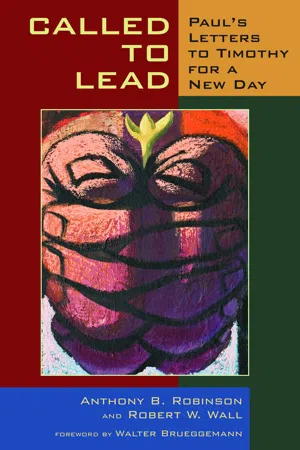
Called to Lead
Paul's Letters to Timothy for a New Day
- 255 pages
- English
- ePUB (mobile friendly)
- Available on iOS & Android
eBook - ePub
About this book
Information
Topic
Theology & ReligionSubtopic
Biblical CommentaryWhat Is the Pastor’s Most Essential Work?
1 Timothy 1:3-17
3 As I requested you to do when leaving for Macedonia: stay longer in Ephesus so that you may instruct certain individuals not to teach divergent doctrine, 4 nor pay attention to myths and unending genealogies. Their teaching only encourages idle speculation rather than faithfulness to God’s way of stewarding the world. 5 The aim of instruction is loving relationships that come from a pure heart, good conscience, and earnest faith. 6 Some have rejected this and have turned to fruitless discussion, 7 wanting to be Torah teachers without understanding either what they are saying or what they are claiming. 8 We know, for example, that the law is good if used lawfully. 9 We understand a law is not for an innocent person but for the lawless and rebellious, godless and sinners, unholy and profane, for those who commit patricide and matricide, for murderers, 10 sexually unfaithful, homosexuals,1 slave dealers, liars, perjurers, and anyone else who acts contrary to healthy teaching, 11 which agrees with the glorious gospel of the blessed God that has been entrusted to me.
12 I thank Christ Jesus our Lord who has strengthened me and considered me faithful, appointing me to a ministry 13 even though I was a former blasphemer and persecutor, a violent man who was shown mercy because I acted in ignorance and unbelief. 14 Our Lord’s grace poured all over me along with the faith and love that are in Christ Jesus. 15 This saying is a core belief worthy of unqualified acceptance: “Christ Jesus came into the world to save sinners” — among whom I am first! 16 But I was shown mercy for this reason, that Christ Jesus might thoroughly demonstrate patience first in me as the role model for those who come to believe in him for eternal life. 17 Now to the King of the ages, to the immortal, invisible, and only God, be honor and glory forever and ever. Amen.

Part 1: Engaging 1 Timothy 1:3-17 as Scripture
Paul’s departure from Ephesus requires that Timothy stay behind to lead the Ephesian Christian congregation in Paul’s absence. Although we are not told why the apostle should give detailed instructions to his young protégé about matters that seem obvious to others, the charge to correct certain rivals seems to make Paul’s absence more threatening to their fledgling congregation. Yet Paul rarely identifies his rivals by name (cf. 1 Tim. 1:19-20; 2 Tim. 2:16-18) and typically substitutes rhetoric for reality when discussing what they teach (cf. 1 Tim. 4:1-4; Titus 1:10-12; 3:9-11).2 What seems clear is that whatever these faceless individuals teach, they do not represent Paul, and they may even exert a negative influence on his congregation in Ephesus. Paul’s entreaty to Timothy to stay put and instruct them makes little sense otherwise.
But the theological crisis that occasions this letter is not the pesky presence of rival teachers; rather, it is Paul’s departure from Ephesus and the threat to his mission in his absence. The difficult tasks of forming a Christian congregation in a pagan place are left to Timothy. While the mention of rivals may sound an alert, this letter’s real aim is to guide his successor in forming a healthy Christian congregation according to the “glorious gospel of God” entrusted to the apostle Paul.
Ephesus was a cultural and religious center of the ancient world: the capital city of Roman Asia, it was among the empire’s most prosperous regions. In due time the city would also become the headquarters of Paul’s missionary organization and perhaps also the place where the first corpus of Paul’s Letters was formed.3 Within its canonical setting, the letter’s Ephesian address cues the story of Paul’s mission in Ephesus (found in Acts 19), which depicts an urban landscape rife with religious conflict provoked by Paul’s identity as a Jewish teacher. Despite a mission that embraced both Jews and Gentiles (Acts 19:10, 17), the congregation’s dismissal from the local synagogue (19:9) and the wider conflict over Paul’s Jewish identity (19:34) form an important subtext that will shape our reading of the letter’s instructions. Moreover, the passing mention of Paul’s “departure for Macedonia” recalls the repeated forays Paul made with Timothy from Ephesus into Macedonia (see Acts 19:21-22; 20:1-6). More importantly, Timothy is among those who heard Paul’s succession speech in Miletus (Acts 20:18-35), the echoes of which frame this Epistle’s theological crisis: How will the congregation that Paul began survive his departure? This correspondence supplies the exhortation and instruction of a departed apostle to form the community left behind. In due time, and under Timothy’s leadership, it will become the custodian of Paul’s apostolic witness for the next generation of believers.
Paul’s “request” (1 Tim. 1:3) sounds a note of irony, since an apostolic request presumes compliance: Paul gives instructions with the air of command. Yet the main clause of his initial request is lacking, and this has the rhetorical effect — perhaps purposeful — of elevating the importance of Paul’s departure. That is, his departure signals a succession of pastoral leadership in Ephesus, but it also means that Timothy is left on his own with only his mentor’s written instruction to school him for the important business at hand.
The purpose clause (hina) declares the first order of this business: “instruct certain individuals” (1:3). The meaning of parangellō (“instruct”) in antiquity is quite elastic, and its use here has been translated in various ways. The preference of most commentators is “command” because of its sense elsewhere in the Pauline corpus when the apostle’s instruction delineates a congregation’s rule of faith and life (e.g., 1 Cor. 11:17; 1 Thess. 4:11; 2 Thess. 3:4-12). But the verb’s repetition in 1:5, where it sets out the “aim of instruction,” does not convey a strong-armed correction of non-Pauline doctrine but rather the catechesis of an entire congregation — a congregation that includes the false teachers. In a sense, Timothy’s instruction not only defines the terms of Paul’s gospel among those who disagree with it, but does so in a priestly fashion that seeks conversion as well as correction.
Paul says that the individuals in need of correction not only teach “divergent doctrines,” but do so in a way that is without spiritual benefit. Paul’s dismissal of a religious curriculum that specializes in “myths and unending family trees” (1:4a) is similar to concerns expressed by two of his contemporaries, Plutarch and Philo, both of whom described myths as “useless fabrications” (Plutarch, Obs. Or. 46) and “mistakes” that follow from inconclusive arguments (Philo, Cong. 53). The added adjective “unending” is a metaphor for the futility of targeting biblical genealogy (cf. Titus 1:14; 3:9) rather than Paul’s gospel (cf. 1 Tim. 4:7; 2 Tim. 4:4; Titus 1:14), which is the source of a congregation’s theological instruction. He later criticizes their ascetic lifestyle, which abstains from certain social conventions (e.g., marriage, certain foods, table fellowship) that make use of the good creatures of a holy God (see 1 Tim. 4:1-5).
In any case, a congregation’s religious instruction is a practical matter, and the effect of instruction in life measures its theological clearness. For this reason, the reader is made alert by Paul’s use of mē . . . mēde to construct a pair of prohibited practices: “Do not teach . . . do not pay attention.” Timothy safeguards the Ephesian mission by combining the core beliefs of Paul’s gospel with a pedagogy that pays attention to a congregation’s spiritual life and ethical choices. It is significant that the summaries of Pauline teaching scattered across the letter are illustrated by personal example and punctuated by pointed exhortation. Christian instruction that sounds a Pauline note is a practical divinity. Yet the believer who follows Paul’s lead is hardly a religious fundamentalist who makes a clean break from those considered heterodox. Paul calls for a redemptive strategy that engages those who disagree with him — “so that they may learn not to blaspheme” (1:20).
While obviously crucial in setting the table for this letter, the precise meaning of oikonomia theou, which we elaborately translate as “God’s way of stewarding the world” (1:4), is notoriously difficult to pin down.4 The meaning of oikonomia doubtless follows from its root, oikos (“house”), and is generally thought to refer to the mundane routines of managing any household, familial or otherwise. Perhaps one hears a resonance of a similar phrase, theou oikonomos, which Paul uses in Titus 1:7 concerning the congregation’s episkopos, or “administrator” (see 1 Tim. 3:1-7), or again in Galatians 4:1-2 concerning the heir’s relationship to his “trustees” (oikonomoi [NASV]) as an analogue of Christian conversion. The Galatians 4:1-7 text, in particular, has been a crux of interpretation for social historians who study the inheritance laws of antiquity. It is arguably the gravitas of the letter’s argument. Various profiles of this transaction have been offered without a consensus emerging.5 But if the one in view is the trustee of a young heir, the legal role of the oikonomos would include his supervision to maturity, at which time he would be able to assume the obligations of his inheritance. The catch phrase used here, oikonomia theou, is probably rooted in this same typological soil that envisions a kind of divine trusteeship by which God manages the outworking of salvation’s history within the ongoing community of faith.6
If readers take it as a type of divine providence, then, they must determine the significance of the genitive (theou) and who or what the appended “faithfulness” targets. The later reference to the church as “God’s household” (oikos theou, 3:15), which recalls theou oikonomos, helps us decide that theou is a subjective genitive: that is, God is the steward of creation, and the act of a believer’s “faithfulness” to God’s stewardship affirms trust in God’s providential care of creation. Timothy now realizes the astounding truth that his continuation of Paul’s mission in downtown Ephesus is of a piece with God’s overall management of the world!
This sense squares with the letter’s wide-ranging instructions, which seek to form a congregation’s life in the world as a public microcosm of oikonomia theou. Ancillary to this role, the “gospel of the blessed God” (1:11) is the curriculum of a Christian congregation’s catechesis into an understanding of God’s stewardship. Almost certainly, Paul means this to be at the leading edge of Timothy’s ministry, and it suggests that Paul’s exploration of the “household” metaphor for church orders is a significant political metaphor for a pattern of public life that is ultimately subversive of Roman rule. The images of suffering and imprisonment in 2 Timothy make clear that Rome and Christianity subscribe to opposite household visions.
The instruction of God’s household trains its members in “loving relationships” (agapē, 1:5a): that is, whether people love each other is a test of their theological orthodoxy (see also 1 John 4:7-8). In Paul’s thought, agapē is not an abstracted rule of life but is the principal characteristic of a congregation’s life together and is formed in the company of the indwelling Spirit (Gal. 5:16-26). As such, neighborly love is a marker of the congregation’s life in Christ (cf. Rom. 5:5; 8:35; 13:9). In the history of those interpreting this feature of Pauline ethics, it is well known that this is an implicit contradiction of the teaching of Jesus, who aimed his disciples at a loving God, which he sharply claimed is “the first and greatest commandment” (Matt. 22:38). Matthew’s Gospel places the commandment in a context that is similar to the one in this letter to Timothy, that is, in an argument between Jesus and Torah teachers (the Pharisees) about the meaning of the law and the prophets (see Matt. 22:34-40; 1 Tim. 1:7). In fact, Aquinas (among others) interpreted agapē more broadly — that is, as humans’ loving relationships with both God and neighbor to reconcile this purported conflict over the love command between Jesus and Paul.7
The triad of religious virtues — “pure heart, good conscience, earnest faith” (1:5b) — are marks of the congregation whose moral competence cultivates loving relationships, not only between its members but toward outsiders as well. This formulation of Christian existence is unique in the New Testament, and its Hellenistic resonance may well reflect the Pauline mission to the nations.8 But its integration of inward affections and outward practices is central to Paul’s definition of the Christian life and follows from the pattern of Jesus’ moral instruction exemplified by Matthew’s Sermon on the Mount (Matt. 5:17-48; 6:1-21). In fact, Paul undoubtedly agrees with other Christian readers of Israel’s Scripture that observing the command of Torah is the moral marker of a covenant-keeping community: not to displace the singular importance of the Christ event in God’s redemptive plan, but as an essential expression of God’s victory over sin.9
The first quality is a “pure heart” (2 Tim. 2:22), which according to Jewish psychology is the epicenter of human existence: our “heart-felt” emotions, affections, and motives determine what we see and how we act. Added to this are the Jewish purity laws, which publicly expressed a community’s covenant fellowship with God. Of course, the question of purity is central to the discussion and decision of the Jerusalem Council in Acts 15, which was prompted by the repentant Pharisee’s question about purity and table fellowship, a question that Peter answered by defining purity as a matter of the heart (Acts 15:5-10).
The pivotal element of this triad is the “good conscience,” which is central to a Hellenistic conception of the moral life. This belief that the Creator builds into every person an internal moral apparatus shaped Diaspora Judaism’s (and thus Paul’s) moral understanding. Even though it is unmentioned in the Old Testament, Philo lists the “good conscience” among his “special laws” (1:203) as the internal spiritual capacity to discern God’s will with the intention of obeying it.
The final element of the triad is a “sincere faith,” which adds a distinctively Christian dimension to the kind of person who has the capacity for loving relationships. Different connotations have been made of Paul’s use of “faith” in the Pastoral Epistles; however, its repetition in this passage (1:2, 4, 5) seems to imply the community’s firm affirmation of God’s way of stewarding the world (1:4b). Whether personified by the faithful actions it takes in life or in the profession of its core beliefs, the force of this virtue is the community’s vigorous and rigorous embracing of the gospel truth disclosed in Christ Jesus.10 Augustine writes that, “if our faith involves no lie, then we do not love that which is not to be loved, and living justly, we hope for that which will in no way deceive our hope” (On Christian Doctrine, 1:40-44).
According to the Pastoral Epistles, what conforms to “the glorious gospel of the blessed God” (1:11) in life and doctrine is considered theologically “healthy” (hygiainō, 1:10), a Greek medical term that provides an apt metaphor for the good effect of Christian instruction (cf. 1 Tim. 6:3; 2 Tim. 1:13; 4:3; Titus 1:9, 13; 2:1-2).11 This word evokes the image of a vital congregation shaped by Paul’s instruction, and it would have struck a responsive chord among its ancient readers, who were familiar with its use in moral discourse: good instruction is the moral foundation of all healthy relationships. Maximus of Tyre, writing a century after Paul, says that “truth and healthy understanding and morality and knowledge of the law and right cannot be acquired in any other way than by actually doing them, just as one can never learn the craft of shoemaking unless one actually works at it” (Discourses 16.3).
Sandwiched between these instructions about a church curriculum is Paul’s curious reflection on the Torah in 1:8-10a. The reader need not be confused by its positive tone. In Romans, Paul admits that since Torah is revealed by God on Mount Sinai, it is inherently “good” (1 Tim. 1:8; cf. Rom. 7:12), and, when rightly used, is an important resource in understanding God’s gospel. Following Jewish literary practice, Paul’s use of moral catalogs like this one o...
Table of contents
- Cover
- Title Page
- Copyright
- Dedication
- Contents
- Foreword, by Walter Brueggemann
- Preface
- Abbreviations
- Itching Ears: Ministry in a Time of Lost and Contested Authority
- What Is the Pastor’s Most Essential Work? (1 Timothy 1:3-17)
- Worship and the Missional Church (1 Timothy 2:1–3:1a)
- Lay Leadership in the Household of God (1 Timothy 3:1b–13)
- Pastoral Leadership in the Household of God (1 Timothy 3:14–4:16)
- Order (and Disorder) in the Household of God (1 Timothy 5:1–6:2)
- The Challenge and Opportunity of Having Money (1 Timothy 6:2b–19)
- A Crisis of Courage (2 Timothy 1:3–14)
- Claiming the Power, Sharing the Suffering: A Pastoral Work Ethic (2 Timothy 2:1–7)
- Remember Resurrection (2 Timothy 2:8–26)
- The Final Charge (2 Timothy 3:10–4:8)
- For Further Reading on 1 and 2 Timothy and Leadership
- Index
Trusted by 375,005 students
Access to over 1.5 million titles for a fair monthly price.
Study more efficiently using our study tools.
Frequently asked questions
Yes, you can cancel anytime from the Subscription tab in your account settings on the Perlego website. Your subscription will stay active until the end of your current billing period. Learn how to cancel your subscription
No, books cannot be downloaded as external files, such as PDFs, for use outside of Perlego. However, you can download books within the Perlego app for offline reading on mobile or tablet. Learn how to download books offline
Perlego offers two plans: Essential and Complete
- Essential is ideal for learners and professionals who enjoy exploring a wide range of subjects. Access the Essential Library with 800,000+ trusted titles and best-sellers across business, personal growth, and the humanities. Includes unlimited reading time and Standard Read Aloud voice.
- Complete: Perfect for advanced learners and researchers needing full, unrestricted access. Unlock 1.5M+ books across hundreds of subjects, including academic and specialized titles. The Complete Plan also includes advanced features like Premium Read Aloud and Research Assistant.
We are an online textbook subscription service, where you can get access to an entire online library for less than the price of a single book per month. With over 1.5 million books across 990+ topics, we’ve got you covered! Learn about our mission
Look out for the read-aloud symbol on your next book to see if you can listen to it. The read-aloud tool reads text aloud for you, highlighting the text as it is being read. You can pause it, speed it up and slow it down. Learn more about Read Aloud
Yes! You can use the Perlego app on both iOS and Android devices to read anytime, anywhere — even offline. Perfect for commutes or when you’re on the go.
Please note we cannot support devices running on iOS 13 and Android 7 or earlier. Learn more about using the app
Please note we cannot support devices running on iOS 13 and Android 7 or earlier. Learn more about using the app
Yes, you can access Called to Lead by Anthony B. Robinson,Robert W. Wall in PDF and/or ePUB format, as well as other popular books in Theology & Religion & Biblical Commentary. We have over 1.5 million books available in our catalogue for you to explore.