The enormously prolific Swiss Roman Catholic theologian Hans Urs von Balthasar (1905-1988) was marginalized during much of his life, but his reputation over time has only continued to grow. He was said to be the favorite theologian of John Paul II and is held in high esteem by Benedict XVI. It is not uncommon to hear him referred to as
the great Catholic theologian of the twentieth century.
In
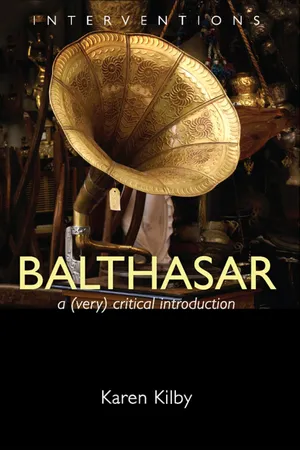
Balthasar: A (Very) Critical Introduction Karen Kilby argues that although the low regard in which Balthasar was held from the 1950s to 1960s was not justified, neither is the current tendency to lionize him. Instead, she advocates a more balanced approach, particularly in light of a fundamental problem in his writing, namely, his characteristic authorial voice -- an over-reaching "God's eye" point of view that contradicts the content of his theology.
- 188 pages
- English
- ePUB (mobile friendly)
- Available on iOS & Android
eBook - ePub
About this book
Information
Topic
Theology & ReligionSubtopic
Christian DenominationsCHAPTER 1
Introduction
A striking feature of twentieth-century Roman Catholic theology is the reversals of fortune which mark the careers of so many of its great figures. Henri de Lubac, S.J., for instance, lived under a cloud for a decade — his own order removed his books from sale, asked him not to teach fellow Jesuits, and even stripped his works from their libraries — but in the early 60s he had a major hand in drafting the documents of the Second Vatican Council, and he finished his life a cardinal. Yves Congar, a Dominican, was forbidden to teach, preach, or write for some time by his superiors, but again emerged as an extraordinarily influential figure in the Second Vatican Council, and he too was made a cardinal before his death. Comparable stories can be told of Marie-Dominique Chenu and to some extent of Karl Rahner.
More spectacular than any of these, however, has been the turnaround in intellectual fortunes of Hans Urs von Balthasar. Like many of the other great theological figures of the century he was ecclesiastically marginalized in the 1950s, but in his case this did not come to an end by 1962; alone among his generation of theologians, he stayed home during the Second Vatican Council. Some time thereafter, however, Balthasar began to be reintegrated, and to gain recognition as a major theological player. As the decades have passed his reputation has only continued to grow. He was said to be the favorite theologian of Pope John Paul II, and is held in high esteem also by Benedict XVI; he is the preferred choice when Anglicans and Protestants look to engage with a Catholic thinker; increasing numbers of Ph.D. dissertations are being written on him; floods of secondary literature have appeared; and one now frequently hears the judgment that he is the great Catholic theologian of the twentieth century.1
It is clear that Balthasar is a creative and important thinker from whom there is a great deal to be learned, and that to ignore, marginalize, or dismiss his thought was, and still is, a mistake. The low regard in which he was held in the 50s and 60s (and in the English-speaking world into the 70s at least) was surely not justified. But it is arguable that the pendulum has now swung too far, and that the current tendency to lionize Balthasar, to look to him as some sort of new Church Father, as the great figure to emerge in the twentieth century, is also not quite right. Balthasar, for a number of reasons, is no easy figure to absorb or assess, and it is possible that the balance has not yet been found.
This volume is intended as a contribution to the search for such a balance. Balthasar is undoubtedly an important and impressive theologian, and much in his work is original, stimulating, and fruitful. But there is also something fundamentally problematic about his thought, something that should make us wary of looking to him as a general theological model, or as the great voice of tradition in our time. To bring out something of the impressive richness of Balthasar’s thought, but also something of what is troubling in it, will be the burden of this volume.
The Difficulty of Finding One’s Way around Balthasar
Balthasar, I have mentioned, is not easy to come to terms with. The difficulty, however, is not on the surface; in one sense he writes more accessibly than most modern theologians. He does not import or create large quantities of technical jargon, or produce particularly difficult prose. Any one sentence or paragraph is not especially impenetrable. But to understand where these sentences and paragraphs are going, how they fit together, to get a sense of how his thought is patterned, and what is at its heart, can be unusually difficult. It is easy to feel lost in the fog when reading Balthasar.
A number of things contribute to this difficulty. One is the sheer size of his canon. Not only did Balthasar write a great many works, as we shall see in the next chapter; he also often wrote at great length. The Glory of the Lord, for instance, is a seven-volume work of which even the first, introductory volume, the volume to which one might turn in hopes of getting a relatively quick sense of what Balthasar is up to, is 691 pages.2
A second source of difficulty is that Balthasar frequently writes in an indirect manner, through collation, exposition, and commentary on the thoughts of others. It is not always easy to keep track of where one is and why one is reading about a particular theologian, philosopher, poet, playwright, or a particular series of theologians, philosophers, poets, and playwrights. Balthasar is frequently described, in the words of Henri de Lubac, as “perhaps the most cultivated [man] of his time,”3 and while the vast range of his learning can surely benefit readers, it can also at times create a fog of impenetrability for those trying to come to grips with his longer works.
Balthasar reports that Adrienne von Speyr, with whom he and his theology were closely connected, would at times rebuke him, and at one point in particular complained about the way in which he wrote:
When I read what you have written . . . , I sometimes feel you are writing for a totally theoretical person, in other words, for someone who lives only in your mind, a person who has all your presuppositions, who always à demi [half] shares your understanding, and this person simply does not exist. So I think it would be good for you to get to know the “normal” man. Somehow you must be brought through him to him. . . . You can’t write just for the sake of the subject matter. You have to do it for the reader.4
Not all of Balthasar’s work fits this description — whether or not in response to the rebuke, Balthasar did in fact write a large number of relatively short pieces that are highly accessible — but von Speyr’s comment certainly captures something about the style of his more substantial works. One frequently has the impression that Balthasar is so absorbed by the question under consideration and by his conversation partner (whether that is Maximus or Luther or Buber or Bernanos) that he forgets to think about the kinds of things — signposts, summaries, the setting of context, the explanation of what is at stake — that might help the reader follow his argument. And because, as we shall see in the next chapter, Balthasar was his own publisher, he was never subjected to any external editorial scrutiny or intervention.
A final source of difficulty is again related to one of Balthasar’s great strengths, his originality. Balthasar did not divide his work up in conventional ways: one cannot place it in familiar categories, nor watch it unfold according to an expected pattern. What is one to anticipate, for instance, from a work entitled Theo-drama? We might know what sort of undertaking to expect if someone offers a work of systematics, or, in a Roman Catholic context, an undertaking in fundamental theology. But what genre of project is a “theo-drama”? The reader will not be able to guess in advance, and will not necessarily be enlightened by skimming.5
One of the aims of this volume, then, will be to help readers negotiate elements of the fog one encounters in reading Balthasar. The aim is not, however, to provide any kind of exhaustive survey: I will not touch on all of the themes of Balthasar’s work, nor all the thinkers with whom he engaged, nor all the books he wrote. The range of Balthasar’s thought is simply too expansive to be helpfully captured in one relatively slim volume. And in any case my goal here is not coverage — not even the limited coverage that might be possible in a slim volume — so much as orientation. Insofar as it affords an introduction, the book will be successful if it can help readers to find their way around in Balthasar’s writings, to acquire a sense for some at least of his central concerns, and to come to terms with some of the characteristic patterns, and the characteristic style, of his thought.
The Difficulty of Criticizing Balthasar
Part of coming to terms with Balthasar, I will argue, is coming to terms with what is problematic, what is troubling about him. But this is no easy matter either. For a number of reasons, Balthasar is in fact exceptionally difficult to criticize.
There is first of all the danger that a critic will seem to be rather behind the times: just as children who have once contracted a disease such as chicken pox subsequently have resistance to it, Balthasar’s theology has something like an acquired immunity to criticism, or to many forms of it, precisely because it was at one stage so marginalized. If until some point in the 1960s he was largely dismissed, seen as an odd, idiosyncratic character, someone to be ignored because he was not really academically rigorous, and since then he has been, as it were, discovered, then anyone who now might want to object to how idiosyncratic some of his views are, or how little rigor one can find in his writings, is in danger of appearing simply passé. Everybody knows Balthasar is not a standard academic theologian, but we have now, so the thinking runs, gone beyond being so narrow-minded as to be troubled by that. The contemporary critic, in other words, is easily wrong-footed by the very fact that at one stage criticism of him was the norm. Balthasar, who is in fact now so very influential, can nevertheless still be represented as an underdog.
Consider, for instance, the way Balthasar has been presented quite recently in Rodney Howsare’s Balthasar: A Guide for the Perplexed.6 This is an excellent introduction to Balthasar — both insightful and readable — and in it Howsare does in fact acknowledge that Balthasar’s star has risen in recent years. And yet at regular intervals we find allusions to Balthasar as in one way or another the outsider — suggestions that “Balthasar’s theology does not fit easily into the modern university setting” and that there are obstacles to “Balthasar’s reception into the academic theological guild” (19); an emphasis on his having been the “theologian non grata of both the so-called ‘conservative’ and ‘liberal’ wings within the Catholic Church” (144); a characterization of Balthasar’s theology as “perplexing to many” because it “does not fit well into either the typically modern approach to theology predominate [sic] in American and European universities, or the typically traditionalist approach which still too often subscribes to neo-scholastic habits of thought” (146). No recent Roman Catholic theologian is more studied, discussed, and generally admired in universities at the moment, and yet he continues to be presented as someone who is usually rejected.
The difficulty in coming to grips critically with Balthasar, however, is not only related to what one might call his reception history. It also has to do with the nature of the work itself. He was, as we have already mentioned, a prolific writer — there are fifteen mostly very substantial volumes in his Trilogy,7 and beyond this more monographs and collections of essays than is easy to keep track of — and in all this vast output, it is not particularly easy to identify an organizing principle — a point so central that criticism here amounts to a fundamental criticism, a criticism of the whole. How can one, then, catch hold of Balthasar well enough to be able to criticize him?
By way of contrast one might think of a figure like Paul Tillich: raise a problem with his method of correlation, or doubts about the value of existentialism, and one has, it would seem, raised doubts about his theology as a whole. Or Karl Rahner: many have presumed that if one rejects his so-called transcendental method, or else discovers flaws in his early and supposedly foundational philosophical monograph, Spirit in the World, then one has found a serious problem with his whole project. Or again Schleiermacher: show why there is something wrong with his notion of the feeling of absolute dependence, and you have perhaps undermined the whole project of his theological maturity. In each case it may be possible to question how fair such approaches to criticism are,8 but it cannot be denied that such thinkers seem at least to give critics a useful target, a relatively easy way to get a handle on their work as a whole. In Balthasar there is no such handle — no central or even apparently central methodological statement, no acknowledged allegiance to a particular philosophical thinker or school, and no one point where it is easy to say: if he is wrong here, something is wrong about the whole business.
A further difficulty arises from the way in which Balthasar argues — or one might say, from the fact that he does not, on the whole, make arguments. Balthasar, as I have already mentioned, very often proceeds through extended exposition and survey; somehow in the process, through commentary ranging over several thousand years of thinkers and texts, he presents the reader with the approach he takes to be correct. In an extended sense one might still call this an argument — an implicit argument that this must be the way things are because the vision laid out is compelling, because things hang together and the tradition makes sense if one reads it this way. But there is often no argument offered in any narrower sense of the word.
This modus operandi makes critical assessment of Balthasar difficult for two reasons. On the one hand, the range of Balthasar’s reading is so vast that it is simply very difficult for a reader or would-be critic to keep up.9 Someone of a more ordinary level of intellectual culture may be in a position to call into question his interpretation of a figure here or there, but Balthasar’s range is so huge that questions raised about his faithfulness to any one figure, or even any particular group of figures, can never effectively undermine the vision itself. That Balthasar is not always a perfectly reliable guide to the thought of others is in fact widely recognized: all but the most hagiographic of commentators will grant that he is at least sometimes idiosyncratic as a reader. In general, though, this does not undermine their confidence in him. Even if one finds a commentator suggesting, as Brian Daley does, that on the whole Balthasar’s treatment of patristic figures affords better insight into his own thought than into theirs,10 this makes hardly a dent, for of course Balthasar ranges over not only patristic thinkers, but Greek philosophers and playwrights, Old and New Testament texts, the medievals, mystical writers, a variety of saints, and all kinds of modern philosophy, theology, poetry and drama.
So, on the one hand, there is a kind of elusiveness to Balthasar deriving from the sheer breadth of his learning. And on the other hand there is the fact that, if he can be said to make arguments, they are for the most part not explicit ones. How does one take issue with the argument, find a weakness in the argument, if a vast intellectual landscape is presented but no overt argument actually offered?
Questions of Influence and Suspicions of Heresy
Before attempting an answer to this last question — before saying something, that is, about how I do intend to develop a criticism of Balth...
Table of contents
- Cover
- Title Page
- Copyright
- Dedication
- Contents
- Acknowledgments
- 1. Introduction
- 2. The Contexts of Balthasar
- 3. Central Images 1: The Picture and the Play
- 4. Central Images 2: Fulfillment and the Circle
- 5. The Trinity
- 6. Gender and “the Nuptial” in Balthasar’s Theology
- 7. Conclusion
- Bibliography
- Index
Trusted by 375,005 students
Access to over 1.5 million titles for a fair monthly price.
Study more efficiently using our study tools.
Frequently asked questions
Yes, you can cancel anytime from the Subscription tab in your account settings on the Perlego website. Your subscription will stay active until the end of your current billing period. Learn how to cancel your subscription
No, books cannot be downloaded as external files, such as PDFs, for use outside of Perlego. However, you can download books within the Perlego app for offline reading on mobile or tablet. Learn how to download books offline
Perlego offers two plans: Essential and Complete
- Essential is ideal for learners and professionals who enjoy exploring a wide range of subjects. Access the Essential Library with 800,000+ trusted titles and best-sellers across business, personal growth, and the humanities. Includes unlimited reading time and Standard Read Aloud voice.
- Complete: Perfect for advanced learners and researchers needing full, unrestricted access. Unlock 1.5M+ books across hundreds of subjects, including academic and specialized titles. The Complete Plan also includes advanced features like Premium Read Aloud and Research Assistant.
We are an online textbook subscription service, where you can get access to an entire online library for less than the price of a single book per month. With over 1.5 million books across 990+ topics, we’ve got you covered! Learn about our mission
Look out for the read-aloud symbol on your next book to see if you can listen to it. The read-aloud tool reads text aloud for you, highlighting the text as it is being read. You can pause it, speed it up and slow it down. Learn more about Read Aloud
Yes! You can use the Perlego app on both iOS and Android devices to read anytime, anywhere — even offline. Perfect for commutes or when you’re on the go.
Please note we cannot support devices running on iOS 13 and Android 7 or earlier. Learn more about using the app
Please note we cannot support devices running on iOS 13 and Android 7 or earlier. Learn more about using the app
Yes, you can access Balthasar by Karen Kilby in PDF and/or ePUB format, as well as other popular books in Theology & Religion & Christian Denominations. We have over 1.5 million books available in our catalogue for you to explore.