- 554 pages
- English
- ePUB (mobile friendly)
- Available on iOS & Android
eBook - ePub
About this book
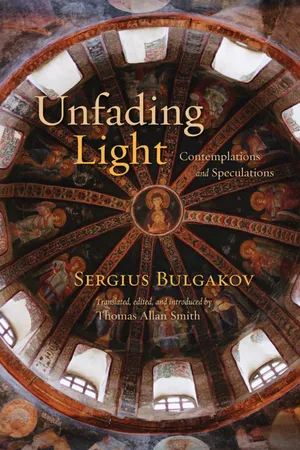
With its scholarly discussions of myth, German idealist philosophy, negative theology, and mysticism, shot through with reflections on personal religious experiences,
Unfading Light documents what a life in Orthodoxy came to mean for Sergius Bulgakov on the tumultuous eve of the 1917 October Revolution. Written in the final decade of the Russian Silver Age, the book is a typical product of that era of experimentation in all fields of culture and life. Bulgakov referred to the book as miscellanies, a patchwork of chapters articulating in symphonic form the ideas and personal experiences that he and his entire generation struggled to comprehend. Readers may be reminded of St. Augustine's
Confessions and
City of God as they follow Bulgakov through the challenges and opportunities presented to Orthodoxy by modernity.
Information
Topic
Theology & ReligionSubtopic
Christian TheologyNotes
Notes to the Translator’s Introduction
1. Bulgakov’s own recollections, which form the basis of the present biographical sketch, are available in Tikhie dumy [Calm thoughts] (Moscow: Respublika, 1996). Additionally, this sketch owes much to the superb study by Catherine Evtuhov, The Cross and the Sickle: Sergei Bulgakov and the Fate of Russian Religious Philosophy, 1890-1920 (Ithaca, NY, and London: Cornell University Press, 1997). Readers will profit from Paul Valliere, Modern Russian Theology: Bukharev, Soloviev, Bulgakov (Grand Rapids: Eerdmans, 2000). Of interest is the introduction by Rowan Williams in his annotated collection Sergii Bulgakov: Towards a Russian Political Theology (Edinburgh: T. & T. Clark, 1999), pp. 1-19.
2. Bulgakov recollects this “atheistic” period in his life in the short text “Moe bezbozhie” [My atheism], in Tikhie dumy (Moscow: Respublika, 1996), pp. 319-24. The text was first published posthumously in Avtobiograficheskie zametki [Autobiographical notes] (Paris, 1946).
3. “Moe rukopolozhenie” [My ordination], Tikhie dumy, p. 346.
4. Evtuhov, The Cross and the Sickle, pp. 30-32.
5. Evtuhov, The Cross and the Sickle, p. 42.
6. Bulgakov, a convinced Marxist at the time, was overcome by the religious beauty of Raphael’s painting, weeping and praying before it on repeated visits. He refers to this event in Unfading Light. But even before traveling west, Bulgakov had a religious experience of natural beauty while traveling by train to the Caucasus in 1894. This too is recounted in Unfading Light.
7. That is, members of the Russian intelligentsia.
8. Evtuhov, The Cross and the Sickle, pp. 43-45.
9. Evtuhov, The Cross and the Sickle, p. 36.
10. Evtuhov, The Cross and the Sickle, pp. 49-50.
11. Bernice Glatzer Rosenthal, “The Nature and Function of Sophia in Sergei Bulgakov’s Prerevolutionary Thought,” in Russian Religious Thought (Madison: University of Wisconsin Press, 1996), pp. 154-75.
12. Valliere, Modern Russian Theology, pp. 231-37 for a discussion of this period in Bulgakov’s life. [Bulgakov’s article is available in Problems of Idealism: Essays in Russian Social Philosophy, trans., ed., and intro. by Randall A. Poole (New Haven and London: Yale University Press, 2003), pp. 85-125. — Trans.]
13. Valliere, Modern Russian Theology, p. 241.
14. Evtuhov, The Cross and the Sickle, p. 54.
15. Evtuhov, The Cross and the Sickle, pp. 77-81.
16. Evtuhov, The Cross and the Sickle, p. 81.
17. Valliere, Modern Russian Theology, p. 241.
18. “Agoniia” [Throes of death], Tikhie dumy, pp. 331-38. The events and Bulgakov’s experiences are vividly described by Evtuhov, The Cross and the Sickle, pp. 120-26.
19. For a brief description of these developments see Dimitry Pospielovsky, The Orthodox Church in the History of Russia (Crestwood, NY: St. Vladimir’s Seminary Press, 1998), pp. 191-98.
20. The best current biography of Florensky is Avril Pyman, Pavel Florensky: A Quiet Genius (New York and London: Continuum, 2010). A reliable discussion of his theology is provided by Robert Slesinski, Pavel Florensky: A Metaphysics of Love (Crestwood, NY: St. Vladimir’s Seminary Press, 1984).
21. See Evtuhov, The Cross and the Sickle, pp. 129-31. The essay was published in Voprosy religii [Questions of religion], vol. 1 (Moscow, 1906), and included in Bulgakov’s collection of essays, Dva grada: Izsledovaniia o prirode obshchestvennykh idealov [Two cities: Investigations in the nature of social ideals], vol. 2 (Moscow, 1911), pp. 303-13.
22. Dva grada, p. 307.
23. 1904: “O sotsial’nom moralizme (T. Karleil)” [On social moralism (T. Carlyle)]; 1905: “Religiia chelovekobozhiia u L. Feierbakha” [The religion of deified humanity in L. Feuerbach]; 1906: “Karl Marks kak religioznyi tip” [Karl Marx as a religious type], “Khristianstvo i sotsial’nyi vopros” [Christianity and the social question], “Tserkov’ i kul’tura” [The church and culture], “Voskresenie Khrista i sovremennoe soznanie” [The resurrection of Christ and contemporary consciousness], “Venets ternovyi (pamiati F. M. Dostoevskago)” [Crown of thorns (in memoriam F. M. Dostoevsky)]; 1907: “Srednevekovyi ideal i noveishaia kul’tura” [The medieval ideal and modern culture]; 1908: “Religiia chelovekobozhiia v russkoi revoliutsii” [The religion of deified humanity in the Russian revolution], “Zagadochnyi myslitel’ (N. F. Fedorov)” [An enigmatic thinker (N. F. Fedorov)]; 1909: “Narodnoe khoziaistvo i religioznaia lichnost’” [National economy and the religious person], “O pervokhristianstve” [On primitive Christianity], “Pervokhristianstvo i noveishii sotsializm” [Primitive Christianity and modern socialism], “Geroizm i podvizhnichestvo” [Heroism and the spiritual struggle], “Filosofiia kn. S. N. Trubetskogo i dukhovnaia bor’ba sovremennosti” [The philosophy of Prince S. N. Trubetskoi and the spiritual struggle of modernity]; 1910: “Apokaliptika i sotsializm” [Apocalyptic and socialism], “Razmyshleniia o natsional’nosti” [Reflections on nationality]. All of these essays and articles are reprinted in Dva grada, vols. 1 and 2 (Moscow, 1911).
24. Williams, Sergii Bulgakov, pp. 59-61.
25. His complicated and shifting attitude towards royal authority is documented in “Agoniia,” Tikhie dumy, pp. 331-38, 343-44.
26. Mikhail Gershenzon, Petr Struve, Nikolai Berdiaev, Semen Frank, Bogdan Kistiakovskii, and Aleksandr Izgoev.
27. Evtuhov, The Cross and the Sickle, pp. 131-33; Williams, Sergii Bulgakov, pp. 61-68.
28. Rowan Williams provides an English translation in his Sergii Bulgakov, pp. 69-112.
29. “Moia rodina” [My native land], Tikhie dumy, p. 315.
30. Especially important is his essay “Sofiologiia smerti” [The sophiology of death] in Tikhie dumy, pp. 273-306.
31. See the excellent discussion of this in Bernice Glatzer Rosenthal, “The Search for a Russian Orthodox Work Ethic,” in Between Tsar and People: Educated Society and the Quest for Public Identity in Late Imperial Russia, ed. Edith W. Clowes, Samuel D. Kassow, and James L. West (Princeton: Princeton University Press, 1991), pp. 57-74; on Bulgakov, see pp. 61-74.
32. English translation: Philosophy of Economy: The World as Household, trans., ed., and intro. Catherine Evtuhov (New Haven: Yale University Press, 2000).
33. Michael A. Meerson, “Put’ against Logos: The Critique of Kant and Neo-Kantianism by Russian Religious Philosophers in the Beginning of the Twentieth Century,” Studies in East European Thought 47, no. 3/4 (December 1995): 226 (225-43).
34. Evtuhov, The Cross and the Sickle, pp. 138-40.
35. The essay was first published in Voprosy filosofii i psikhologii 105 (St. Petersburg, 1910), pp. 661-96, and then in the collection of essays on Soloviev (Moscow: Put’, 1910), pp. 1-31.
36. Rosenthal, “Nature and Function of Sophia,” pp. 158-59.
37. Excellent summaries of the book are provided by Evtuhov, The Cross and the Sickle, pp. 158-70; and Rosenthal, “Nature and Function of Sophia,” pp. 159-63. For the Kantian aspects of Bulgakov’s theory, see Meerson, “Put’ against Logos,” pp. 230-33.
38. Evtuhov, The Cross and the Sickle, p. 146.
39. Evtuhov, The Cross and the Sickle, pp. 146-47, 154-57.
40. Insightful depictions of this moment in Russian Church history may be found in Loren Graham and Jean-Michel Kanto, Naming Infinity: A True Story of Religious Mysticism and Mathematical Creativity (Cambridge, MA: Belknap/Harvard University Press, 2009), pp. 7-17, and Evtuhov, The Cross and the Sickle, pp. 210-18.
41. He began work on this book in 1920, but it appeared in print only in 1953.
42. “Piat’ let” [Five years], Tikhie dumy, p. 340.
43. The events leading up to his ordination are recalled in “Moe rukopolozhenie,” Tikhie dumy, pp. 344-50.
44. Two dialogues, Na piru bogov [At the feast of the gods] and U sten Khersonisa [Beneath the walls of Chersonesus], and a book Tragediia filosofii [The tragedy of philosophy] survive.
45. Both trilogies are now available in English translations published by Eerdmans: The Burning Bush (2009), Jacob’s Ladder (2010), trans. Thomas Allan Smith; The Friend of the Bridegroom (2000), The Lamb of God (2008), The Comforter (2004), The Bride of the Lamb (2002), trans. Boris Jakim.
46. Valliere, Modern Russian Theology, p. 268.
47. Williams, Sergii Bulgakov, p. 131.
48. Evtuhov, The Cross and the Sickle, p. 172.
49. Svet nevechernii, p. 354, n. 1.
50. Avril Pyman, A History of Russian Symbolism (Cambridge: Cambridge University Press, 1994), p. 2.
51. A brief account of artistic life in the Silver Age is found in W. Bruce Lincoln, Between Heaven and Hell: The Story of a Thousand Years of Artistic Life in Russia (New York: Viking, 1998), pp. 267-331. For a full treatment of the Symbolist movement that dominates the period, see Pyman, Symbolism.
52. Constantin Andronikoff, “Note du traducteur,” in Lumière sans déclin (Lausanne, 1990).
53. Williams, Sergii Bulgakov, p. 125.
54. Svet nevechernii, p. 6.
55. Svet nevechernii, p. 14.
56. Svet nevechernii, p. 176.
57. Svet nevechernii, p. 180.
58. Svet nevechernii, pp. 211-13.
59. Svet nevechernii, p. 214.
60. Svet nevechernii, p. 216.
61. Svet nevechernii, p. 410.
Notes to “From the Author”
1. Literally, “collection of variegated chapters,” and undoubtedly an allusion to the second-century writer Clement of Alexandria’s “Stromata” or “patchwork,” which contains a very wide variety of topics pertaining to the Christian life. — Trans.
2. The Khlysty, a sect originating in Russian Orthodoxy in the seventeenth century, are believed to have practiced flagellation as part of their secret religious ritual. — Trans.
Notes to the Introduction
1. Some may object that in Kant’s works there is in fact just such a fourth critique, namely in the treatise Die Religion innerhalb der blossen Vernunft (written in 1793, that is, after all the critiques), which to the greatest exte...
Table of contents
- Cover
- Title Page
- Copyright
- Dedication
- Contents
- A Note from the Translator
- Translator’s Introduction: Bulgakov’s Journey towards the Unfading Light
- From the Author
- Introduction: The Nature of Religious Consciousness
- First Section: Divine Nothing
- Second Section: The World
- Third Section: The Human Being
- Notes
- Index of Names
- Index of Scripture References
- Index of Liturgical Texts
Trusted by 375,005 students
Access to over 1.5 million titles for a fair monthly price.
Study more efficiently using our study tools.
Frequently asked questions
Yes, you can cancel anytime from the Subscription tab in your account settings on the Perlego website. Your subscription will stay active until the end of your current billing period. Learn how to cancel your subscription
No, books cannot be downloaded as external files, such as PDFs, for use outside of Perlego. However, you can download books within the Perlego app for offline reading on mobile or tablet. Learn how to download books offline
Perlego offers two plans: Essential and Complete
- Essential is ideal for learners and professionals who enjoy exploring a wide range of subjects. Access the Essential Library with 800,000+ trusted titles and best-sellers across business, personal growth, and the humanities. Includes unlimited reading time and Standard Read Aloud voice.
- Complete: Perfect for advanced learners and researchers needing full, unrestricted access. Unlock 1.5M+ books across hundreds of subjects, including academic and specialized titles. The Complete Plan also includes advanced features like Premium Read Aloud and Research Assistant.
We are an online textbook subscription service, where you can get access to an entire online library for less than the price of a single book per month. With over 1.5 million books across 990+ topics, we’ve got you covered! Learn about our mission
Look out for the read-aloud symbol on your next book to see if you can listen to it. The read-aloud tool reads text aloud for you, highlighting the text as it is being read. You can pause it, speed it up and slow it down. Learn more about Read Aloud
Yes! You can use the Perlego app on both iOS and Android devices to read anytime, anywhere — even offline. Perfect for commutes or when you’re on the go.
Please note we cannot support devices running on iOS 13 and Android 7 or earlier. Learn more about using the app
Please note we cannot support devices running on iOS 13 and Android 7 or earlier. Learn more about using the app
Yes, you can access Unfading Light by Sergius Bulgakov, Thomas Allan Smith in PDF and/or ePUB format, as well as other popular books in Theology & Religion & Christian Theology. We have over 1.5 million books available in our catalogue for you to explore.