In
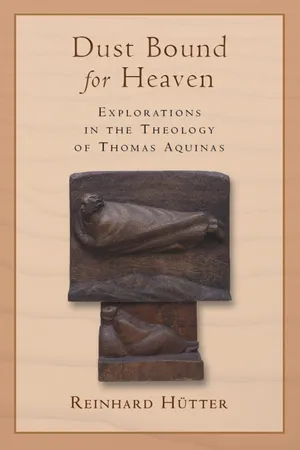
Dust Bound for Heaven Reinhard Hütter shows how Thomas Aquinas's view of the human being as dust bound for heaven weaves together elements of two questions without fusion or reduction. Does humanity still have an insatiable thirst for God that sends each person on an irrepressible religious quest that only the vision of God can quench? Or must the human being, living after the fall, become a "new creation" in order to be readied for heaven?
Hütter also applies Thomas's anthropology to a host of pressing contemporary concerns, including the modern crisis of faith and reason, political theology, the relationship between divine grace and human freedom, and many more. The concluding chapter explores the Christological center of Thomas's theology.
- 521 pages
- English
- ePUB (mobile friendly)
- Available on iOS & Android
eBook - ePub
About this book
Information
Topic
Theology & ReligionSubtopic
Christian TheologyCHAPTER 1
By Way of an Introduction: Thomas Aquinas and Us; or, “Waiting for Thomas”
I. Ressourcement in Thomas Aquinas
This book is an invitation to rediscover the perennial relevance of the theology of Thomas Aquinas, the Common Doctor of the Church. Such an invitation might be met with two objections I want to name up front. There is, first, the objection that after the Enlightenment critique Thomas’s thought is irretrievably passé, philosophically as well as theologically, and that any investigation into his thought belongs exclusively to the discipline of historical studies. There is, second, the objection that it is virtually impossible to recover a sense of Thomas’s culture and wherewithal in order to reclaim him as the Common Doctor.
The first is a modern secular objection. It goes roughly like this: At the beginning of the twenty-first century, what could be more irrelevant, inconsequential, unpromising, and, in short, hopeless than returning to the theology of Thomas Aquinas? Has Thomas’s theology not been put decisively to the side by Protestant theologians since the Reformation and by Catholic theologians since the Second Vatican Council? Has Thomas’s philosophy not died the death of a thousand qualifications since the dawning of modernity — that is, since the days of Bacon, Hume, Kant — and especially since the more recent ascendancy of postmodernity — under the aegis of Nietzsche, Heidegger, Derrida, and Wittgenstein? My answer will clearly be to affirm Thomas’s thought, and this I do at length in the prelude, “Faith and Reason.”
The second objection voices a kind of MacIntyrean reservation, a reservation that is not infrequently held by those who hold Thomas Aquinas in high esteem. I would like to flesh this objection out by giving voice to an author who deserves to be remembered and read again more broadly. In his recently republished The Restoration of Christian Culture,1 John Senior forcefully points out what he regards to be the practical difficulty, indeed, impossibility of a full recovery of Thomas Aquinas as the Common Doctor.
First, he asks where the kind of students who would be the “beginners” whom Thomas intends to teach, especially with his masterwork, the Summa theologiae, are to be found.2 Being attuned since elementary school to multitasking on a laptop while listening to their iPods, contemporary “beginners” in theology are increasingly unaccustomed to and unfit for the practices of silence, prayer, and meditation, the art of reading slowly and attentively, and the training of the memory — skills and practices indispensable for rigorous philosophical and theological contemplation. Also, it does not help that college, seminary, and university curricula that would foster these skills and practices in the context of a coherent, teleologically ordered philosophical and theological education belong largely to the past.
Second, and worse, it seems that the kind of culture that once made possible a Thomas Aquinas, a Fra Angelico, and a Dante Alighieri has irreversibly disappeared. Senior puts it as drastically as precisely:
St. Thomas is still the Common Doctor of the Church but there aren’t many common Catholics. The whole of Christian Culture, the seedbed of scholastic art and science, is depleted. We are in a dustbowl, as the Kansans used to say, and if you plant wheat, though it may sprout up, it will almost instantly wither in the drought. There are many times in history, as in life, when the most difficult virtue of patience must be practiced with a cheerful heart; we must even, as Chaucer says, “counterfeite cheer,” sure as we are in the knowledge that, as Milton put it, in the sonnet on his blindness, “They also serve who only stand and wait.”3
Acknowledging the truth of Senior’s diagnosis, I do submit the following explorations into the theology of the Common Doctor as simply a mode of patiently and actively “waiting for Thomas.” This waiting occurs in the context of Western Civilization in its late modern state, a state in which Christians and especially theologians find themselves not infrequently in the role of Kierkegaard’s clown in the village. In his 1968 Introduction to Christianity, Joseph Ratzinger offers a pithy summary of what Kierkegaard intends to be a parable:
According to this story a travelling circus in Denmark had caught fire. The manager thereupon sent the clown, who was already dressed and made-up for the performance, into the neighbouring village to fetch help, especially as there was a danger that the fire would spread across the fields of dry stubble and engulf the village itself. The clown hurried into the village and requested the inhabitants to come as quickly as possible to the blazing circus to help put the fire out. But the villagers took the clown’s shouts simply for an excellent piece of advertising, meant to attract as many people as possible to the performance; they applauded the clown and laughed till they cried. The clown felt more like weeping than laughing; he tried in vain to get people to be serious, to make it clear to them that it was not a trick but bitter earnest, that there really was a fire. His supplications only increased the laughter; people thought he was playing his part splendidly — until finally the fire did engulf the village, it was too late for help and both circus and village were burned to the ground.4
Joseph Ratzinger — now Pope Benedict XVI — rightly emphasizes that despite this tragic-comic miscommunication, there is a deep, hidden connection between the clown and the villagers as well as between believers and unbelievers. While the modern unbeliever is inevitably looking for something in which to have ultimate faith, the modern believer is always threatened by “the insecurity of his own faith, the oppressive power of unbelief in the midst of his own will to believe.”5 In short, in the middle of tragic-comic misunderstandings, the modern believer and the modern unbeliever often understand each other better than it might at first appear. To put it differently, the very indetermination of the late modern supermarket of ideas opens the opportunity for moments of a fresh receptivity for insights the Common Doctor has to offer to those who are in search of perspectives that are trustworthy and well-framed. The late modern deconstruction of all objective standards of judgment leaves the human mind tangibly unsatisfied. While many simply drift, for a growing number this dissatisfaction turns into the hungry search for the real possibility of a perennial wisdom. This book is written in the confidence that Thomas is still today able to guide this search and lead the seekers of a sapiential perspective up-stream to the source of all wisdom.
My explorations into the theology of Thomas Aquinas are an invitation to catch a glimpse of what makes his theology “original” in the classical sense, that is, what makes his teaching a conduit to the origin, to the source of all wisdom and goodness itself, and what makes him, consequently, the Common Doctor. My hope is that such a “ressourcement” in Thomas’s theology will eventually allow theology to reclaim the dignity of its proper origin, a theology that would again be worthy of its surpassingly excellent and noble subject matter — and hence of its name. Such a ressourcement in Thomas can be nothing but a “waiting for Thomas.” And while we wait as patiently and actively as we can, we do not miss any opportunity for formation that offers itself. And the opportunities for such a formation have greatly increased in the last two decades, because help has come from a direction that neither Joseph Ratzinger was able to foresee in 1968 nor even John Senior in 1983 — the most remarkable revival of academic Aquinas scholarship in the course of the last twenty years.
II. How a Ressourcement in Thomas Differs from a Revival of Aquinas Scholarship
Over the last two decades, there has occurred a most remarkable and unexpected revival of scholarly interest in Thomas’s philosophy and theology. For the most part the historical, interpretive, and reconstructive work done on virtually all aspects of Thomas’s thought has been rigorous scholarship at the highest level of academic standards. At a first glance, this revival of Aquinas scholarship seems to immaterialize the concern that the present spiritual, intellectual, and cultural conditions are fundamentally adverse to any serious reception of Thomas’s teaching. At a second and more considered glance, however, it becomes quickly obvious that a revival of rigorous Aquinas scholarship does not necessarily translate into a genuine, substantive, and normative turning to Thomas’s philosophical and theological vision. There is no causal relationship between a revival of scholarly attention to Aquinas and a ressourcement in the philosophy and theology of the Common Doctor. On the contrary, the way the modern academy tends to function, the revival of Aquinas scholarship might — unwittingly — bury even deeper Thomas’s teaching as that of the doctor communis. It all depends on whether the end of the inquiry is Thomas as an eminent figure of thought, or what eminently preoccupied Thomas’s thought and what is found in his teaching. The latter and only the latter is a true ressourcement.
While I gratefully draw upon the currently burgeoning Aquinas scholarship (see the fourth section of this introduction), I understand this book as an exercise in ressourcement in which I explore Thomas’s theology as a path to the source of perennial wisdom, a path that if traveled again more frequently will lead to an overdue theological renewal after a dire period of pervasive theological fragmentation and disorientation.6 The contemporary theological eye has grown accustomed to the spiritual dusk and even darkness cast by the modern secular culture and hence can hardly stand in the spiritual noon-day light of thirteenth-century Christian intellectual contemplation. A ressourcement in Thomas’s theology should, I would hope, contribute to recovering the vision of a theology strong-eyed, high-spirited, and disciplined enough in the practices of prayer and meditation to gaze again at the dazzling light of divine truth: “In lumine tuo videbimus lumen” (Ps 36:9[10]).
John Senior aptly names the substantive reasons why a ressourcement in Thomas’s theology is categorically different from even the best Aquinas scholarship, why the former claims the theologian qua theologian while the latter lures the theologian qua scholar:
[R]epeatedly affirmed by successive popes over so long a time, with no dissent, as an infallible teaching of the Ordinary Magisterium, the Summa Theologiae is the norm and measure of all Catholic theology before and since. Catholics must believe Thomas Aquinas to be the Common Doctor of the Church with the same degree of certainty that he is a saint. Saints Augustine, Gregory, Bernard, Bonaventure, John of the Cross and others are Doctors also, precious, good, beloved, indispensable and intensely personal to many, but all are measured by the ordinary rule of St. Thomas and read by his light. I don’t say in, because they have lights of their own, but by his light. St. Thomas holds a special place among theologians analogous to that of the Blessed Virgin among saints: he holds the mean between dogma and opinion, what we might call hyper-doxy, as Mary by hyperdulia holds the mean between veneration and worship. Unlike the Mother of God, St. Thomas is theoretically surpassable; and, of course, the Church has never taught that every syllable of the Summa is de fide like the Creed.7
It is the designation “Common Doctor” that makes the small but important difference between Aquinas scholarship and a ressourcement in Thomas. The following explorations are an invitation to rediscover Thomas as the doctor communis. They are written in service of a ressourcement that in turn stands in service of the Faith.
However, I am only too keenly aware of the fact that in order to sustain such a ressourcement over a longer period, some other things are needed — a coherent philosophical and theological curriculum ad mentem S. Thomae, a body of teachers competent and dedicated to implement such a curriculum, gifted students dedicated to the arduous task of being “beginners” under the tutelage of Thomas Aquinas, a way of apostolic life and witness of which study and contemplation are integral components, and last but not least an institution that enables, coordinates, and fosters such an ambitious and complex intellectual endeavor. It is for this very reason that I have dedicated this volume to the Thomistic Institute of the Pontifical Faculty of the Immaculate Conception at the Dominican House of Studies in Washington, D.C. In Dominican life, there is an aspiration toward the unity of proclamation and contemplation, of prayer and study, to which this volume aspires as well.
Let me now turn to the substance of the explorations themselves. The main body of the book is dedicated to the topic announced in the title: “Dust bound for heaven”: Thomas’s philosophical and theological doctrine of the human being — the constitution of the human as a hylemorphic body-soul unity and the ordination of the human being to eternal communion with God — forms a currently most pertinent portal into the depths of Thomas’s theology. However, these primarily anthropological concerns are framed by a prelude in which I attend to what I regard to be the intellectual urgency that makes a “waiting for Thomas” imperative, and a postlude that brings into focus the Christological heart of the matter, the core of Thomas’s theology.
III. The Course the Explorations Take; or, Dust Bound For Heaven
My prelude, “Faith and Reason,” comprises one single chapter, “Is There a Cure for Reason’s Presumption and Despair? — Why Thomas Matters Today.” Here I pursue a twofold purpose: first, I offer a more extensive account of why Thomas matters today, both philosophically and theologically. And while the philosophical and theological reasons for Thomas’s ongoing relevance are clearly distinct, they are still two sides of the same coin. We, that is, Christians in what has come to be called the “West,” are currently experiencing a dramatic crisis of reason and an equally dramatic crisis of faith. That these two crises coincide is far from accidental, and, according to Thomas, the coincidence of such crises is actually to be expected. The modern self-enclosure of reason into the realm of the empirical, the mechanical, the quantifiable, and the instrumental has not only debased reason but de-humanized the human being. At the same time, the equally modern banishment of reason from the center of the faith has made a mockery of God, while rendering his Word as transrational or, even worse, irrational. If the Reformation theologians had the tendency to banish the natural light of reason as much as possible from the enterprise of Christian theology, with the Enlightenment, this tendency was not only reversed. Rather, the type of reason the Enlightenment thinkers brought back was also changed. Called back from its exile, reason took an unprecedented revenge. Significant strands of Protestant (and even Catholic) theology became rationalistic in a way and to a degree absolutely foreign to the medieval scholastics. One defining characteristic of human life under the conditions of post-Enlightenment modernity is that faith and reason are divorced from and at war with each other: here Hegel, there Kierkegaard. The crisis of the one is the crisis of the other, wherefore they can overcome their respective crises only together. And it is precisely for this reason that Thomas matters today. For he arguably remains the surpassing teacher of two lessons late modernity is in urgent need to re-learn: First, the lesson of faith’s centrality for reason’s best exercise. Successful discursive reasoning presupposes the proper interplay of intellect and will. Because the will is profoundly affected by the reality of sin, reason’s best exercise depends on the will’s healing and restoration. Second, the lesson of reason’s importance for faith’s full flourishing. Contemplating the mysteries of the faith in order to seek understanding is greatly aided by the exercise of reason in its inherent openness to transcendence. For it is this metaphysical and contemplative exercise of reason in the service of the faith that protects the faith from suffering two perennial distortions that arise from the legitimate opposition to the sovereignty of Enlightenment rationality — fideism and traditionalism: Fideism conceives faith as an essentially pre-linguistic and pre-rational personal experience that yearns for ever new and ever changing authentic symbolic expression, while traditionalism regards faith as an always already cultural-linguistic “given” that is mediated by a doctrinal-liturgical structure embracing a comprehensive way of life.
In order to operate at its full metaphysical range, reason cannot afford to ignore the mysteries of the faith. For, while they transcend reason, they do not contradict reason, but rather offer reason the most eminent subject-matter to turn to and thereby discover both its full range as well as its limit. Thus, while reason protects the exercise of faith from falling into fideism and traditionalism, faith protects the exercise of reason from submitting to the two perennial excesses to which reason is prone under the condition of modernity — the pride of hyperrationalism and the despair of irrationalism.
The prelude suggests that there is no better place to recover from the twofold crisis of faith and the twofold crisis of reason than by entering the school of the Common Doctor and by reconsidering the full vision of the human nature and destiny that underlies Thomas’s theology: the anthropological call to glory. What has fallen apart notoriously and to our great loss in modern theological and philosophical anthropology is held in a surpassing balance and synthesis in Thomas’s thought. The human being is neither animal nor angel; neither a unique configuration of cosmic dust destined to return just to that, dust; nor a spirit or mind that in its essence, the res cogitans, never really left the community of angelic spirits and is only accidentally and therefore tragically embodied. The human being is indeed made of dust, but divinely informed and configured by a rational soul that ordains this piece of dust for heaven, for the eternal communion with God. How to hold these utter extremes together without losing, repressing, or even ever so slightly neglecting the specificity of each of these co-constitutive principles of human nature is an urgent lesson for which Thomas serves as a most helpful guide and mentor.
The first section of the main part of the book, “Human Nature, Wounded but Not Destroyed,” comprises two chapters that consider the resourcefulness of Thomas’s thought in light of two realities central to human flourishing but in a state of crisis in late modernity: the constructive role of human affectivity in “body politics” and the indispensable role of the natural love of God for a flourishing of the common good in democratic politics.
In chapter 3, “Body Politics beyond Angelism and Animalism,” I consider an aspect of human reality that profoundly shapes human life and is a major cause for its succ...
Table of contents
- Cover
- Title Page
- Copyright
- Dedication
- Contents
- Acknowledgments
- 1. By Way of an Introduction: Thomas Aquinas and Us; or, “Waiting for Thomas”
- Prelude — Faith and Reason
- Dust Bound for Heaven — Contemplating Human Nature and Destiny
- B. Created for Happiness, Bound for Heaven — Nature and the Supernatural
- C. Bound to Be Free, Suffering Divine Things — Grace and the Theological Virtues
- D. Seeking Truth — Wisdom and Contemplation
- Postlude — Mystery and Metaphysics
- Bibliography
- Credits
- Index of Names
- Index of Subjects
Trusted by 375,005 students
Access to over 1.5 million titles for a fair monthly price.
Study more efficiently using our study tools.
Frequently asked questions
Yes, you can cancel anytime from the Subscription tab in your account settings on the Perlego website. Your subscription will stay active until the end of your current billing period. Learn how to cancel your subscription
No, books cannot be downloaded as external files, such as PDFs, for use outside of Perlego. However, you can download books within the Perlego app for offline reading on mobile or tablet. Learn how to download books offline
Perlego offers two plans: Essential and Complete
- Essential is ideal for learners and professionals who enjoy exploring a wide range of subjects. Access the Essential Library with 800,000+ trusted titles and best-sellers across business, personal growth, and the humanities. Includes unlimited reading time and Standard Read Aloud voice.
- Complete: Perfect for advanced learners and researchers needing full, unrestricted access. Unlock 1.5M+ books across hundreds of subjects, including academic and specialized titles. The Complete Plan also includes advanced features like Premium Read Aloud and Research Assistant.
We are an online textbook subscription service, where you can get access to an entire online library for less than the price of a single book per month. With over 1.5 million books across 990+ topics, we’ve got you covered! Learn about our mission
Look out for the read-aloud symbol on your next book to see if you can listen to it. The read-aloud tool reads text aloud for you, highlighting the text as it is being read. You can pause it, speed it up and slow it down. Learn more about Read Aloud
Yes! You can use the Perlego app on both iOS and Android devices to read anytime, anywhere — even offline. Perfect for commutes or when you’re on the go.
Please note we cannot support devices running on iOS 13 and Android 7 or earlier. Learn more about using the app
Please note we cannot support devices running on iOS 13 and Android 7 or earlier. Learn more about using the app
Yes, you can access Dust Bound for Heaven by Reinhard Hütter in PDF and/or ePUB format, as well as other popular books in Theology & Religion & Christian Theology. We have over 1.5 million books available in our catalogue for you to explore.