Debate over whether or not Jesus can be best interpreted within an "apocalyptic scenario" has continued to dominate historical Jesus studies since Schweitzer and Bultmann. In
The Prophet Jesus and the Renewal of Israel Richard Horsley shows that the apocalyptic scenario -- with its supposed expectation of "the end of the world," the fiery "last judgment," and "the parousia of the Son of Man" -- is a modern scholarly construct that obscures the particulars of texts, society, and history.
Drawing on his wide-ranging earlier scholarship, Horsley refocuses and reformulates investigation of the historical Jesus in a thoroughly relational-contextual approach. He recognizes that the sources for the historical Jesus are not separate sayings, but rather the sustained Gospel narratives of Jesus' mission. Horsley's new approach finds Jesus the popular prophet engaged in a movement of renewal, resistance, and judgment against Roman imperialism, Jerusalem rulers, and the Pharisees.
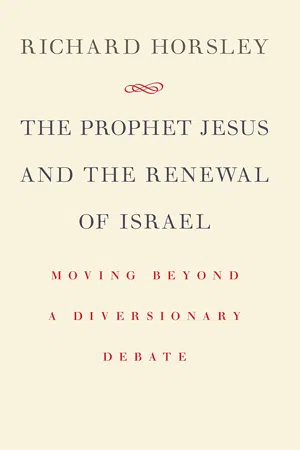
eBook - ePub
The Prophet Jesus and the Renewal of Israel
Moving beyond a Diversionary Debate
- 167 pages
- English
- ePUB (mobile friendly)
- Available on iOS & Android
eBook - ePub
About this book
Information
Topic
Theology & ReligionSubtopic
Biblical StudiesPART I
The Apocalyptic Jesus: A Diversionary Debate

CHAPTER ONE
The Apocalyptic Scenario in Schweitzer and Bultmann
Albert Schweitzer’s and Rudolf Bultmann’s sketch of “the apocalyptic scenario” of Judaism that they believe Jesus shared shaped how Jesus was understood through much of the last century. A summary of their sketch will provide some perspective on what neo-liberals are reacting against in their construction of an alternative, “sapiential” Jesus and a sense of the apocalyptic Jesus that the neo-Schweitzerians are restating. Not all of the features that one or both sides of the debate consider apocalyptic are key events or themes in the scenario. But most of them depend on this end-of-the-world scheme that twentieth-century scholars came to believe was prominent in “Judaism” at the time of Jesus.
In his own construction of the historical Jesus (summarized at the end of Quest of the Historical Jesus,1 to which the following makes reference), Schweitzer insisted that not just the preaching of Jesus but his whole public work had to be understood in terms of the apocalypticism that (he believed) pervaded Jewish expectation at the time (QHJ 350-97). In his distinctively theological formulation, “eschatology is simply ‘dogmatic history’ — history as moulded by theological beliefs — which breaks in upon the natural course of history and abrogates it” (351).
Schweitzer thought that the eschatology of the earliest Christian community was identical with Jewish eschatology. Therefore the eschatology of Jesus could only be interpreted on the basis of the intermittent Jewish apocalyptic literature from the book of Daniel (early second century BCE) to the book of 4 Ezra (early second century CE). Historically, John the Baptist, Jesus, and Paul “are simply the culminating manifestations of Jewish apocalyptic thought” (367). “We are, therefore, justified in first reconstructing the Jewish apocalyptic of the time independently out of [Matthew, Mark, and Paul], . . . in bringing the details of the discourses of Jesus into an eschatological system. . . .” After Schweitzer, it became standard for interpreters to understand Jesus’ sayings according to an eschatological system, an “apocalyptic scenario” that was derived eclectically from Jewish apocalyptic literature. And it is not difficult to discern the influence of passages from Matthew, Mark, and even Paul in the set of “events” or “themes” that comprise “the apocalyptic scenario” that, since Schweitzer, Jesus has been understood to have preached.
For Schweitzer, Jesus’ preaching of the coming of the Kingdom of God signaled the end of history, end of the world. For his Jesus, the Kingdom was symbolically and even temporally connected with the harvest (and harvest imagery has since been read as symbolic of apocalyptic judgment and/or consummation). Jesus’ statement to the disciples that they would not have gone through all the towns of Israel “before the Son of Man comes” in Matthew 10:23 was the key. Assuming that Jesus viewed himself as the coming Son of Man, Schweitzer identified the Son of Man’s coming with the Parousia spoken of by Paul and Matthew 25. Taking Matthew 10:23 literally, Schweitzer claimed that Jesus believed that “the Parousia of the Son of Man, which is logically and temporally identical with the dawn of the Kingdom, will take place before [the disciples sent out to gather in the ‘harvest’] shall have completed a hasty journey through the cities of Israel to announce it” (358-59).
Indeed, Schweitzer took the whole mission discourse in Matthew 10 as a prediction of the events of the “time of the end,” which was immediately at hand. In the predicted course of eschatological events, the Parousia of the Son of Man was “to be preceded by a time of strife and confusion — as it were, the birth-throes of the Messiah” (362). This is the general eschatological time of tribulation to which the closing petition in the Lord’s Prayer refers (the “testing”). Another integral event in the apocalyptic scenario was the resurrection, the eschatological metamorphosis of people into a transformed condition. Schweitzer viewed the resurrection and the Parousia of the Son of Man as simultaneous, as “one and the same act” (366).
Schweitzer insisted that this grand apocalyptic scenario was utterly independent of any “national movement” or current historical events or even a general eschatological movement. John the Baptist and Jesus themselves “set the times in motion.” By their call to “repent, for the Kingdom of Heaven is at hand,” they created a “wave of apocalyptic enthusiasm” (370). And in his own distinctive contribution to the “quest of the historical Jesus,” Schweitzer believed that because the final tribulation, the cataclysm of the coming of the Kingdom, and the Parousia of the Son of Man did not happen as he had predicted in Matthew 10:23, Jesus attempted to force the eschatological events (389-90). Jesus then attempted to compel the coming of the Kingdom by violently cleansing the Temple and provoking the Pharisees and the rulers to kill him.
Bultmann similarly declared that Jesus’ message of the Kingdom of God “stands in the historical context of Jewish expectations about the end of the world and God’s new future.”2 His message is not determined by the national hope of the restoration of the kingdom of David by the royal Messiah or of the gathering of the twelve tribes. It is rather related to the hope of other circles documented by “the apocalyptic literature.” Apocalyptic expectations look not for a change in historical (social-political) circumstances, but a “cosmic catastrophe which will do away with all conditions of the present world as it is.” According to Bultmann’s summary, the apocalyptic scenario includes the same set of events as in Schweitzer’s sketch of Jesus. The new aeon will dawn with “terror and tribulation.” The old aeon will end with God’s “judgment of the world to be held at the determined time by [God] or his representative the Son of Man, who will come on the clouds of heaven.” Thereafter “the dead will arise” and receive their reward which, for the faithful/good deeds will be “the glory of paradise.”
Although Bultmann does not lay out details, he understands Jesus’ message of the Kingdom of God in the context of this apocalyptic scenario.3 Time has run out on the old aeon under the sway of Satan; “the Kingdom of God is at hand” (Mark 1:15). “The Son of Man” is coming as judge and savior (Mark 8:38; Matt. 24:27 par., 37 par., 44 par.; Luke 12:8-9; 17:30). Judgment and resurrection of the dead are coming (Luke 11:31-32 par.; Mark 12:18-27). Details are irrelevant given his certainty that the end is at hand, the Kingdom of God is breaking in (Luke 10:23-24; 6:20-21). While not the calculations typical of apocalyptic (“Lo here or there”), since the Kingdom is already “in your midst” (Luke 17:21-22), there are signs of the time (Luke 12:54-56; Mark 13:28-29), especially in Jesus’ deeds and message (Matt. 11:5 par.). Bultmann’s own particular twist lies in his stress on the imminence of the events of the apocalyptic scenario and hence the urgent need for decision on the part of those who heard Jesus’ message of the impending cosmic catastrophe.
It must be immediately striking to anyone familiar with the Gospel representations of Jesus that the logic of Schweitzer’s and Bultmann’s apocalyptic Jesus makes the rest of his teachings — about common social-economic life, subsistence living, and response to persecution, as well as his healings and exorcisms, his debates with the Pharisees, and his pronouncements about the high priests and Temple — more or less irrelevant. For Schweitzer, since the world was coming to an end imminently, any other teachings of Jesus were merely “interim ethics.” Bultmann’s view was somewhat less logical and more complex. God’s demand to individuals, in the face of the impending cosmic catastrophe, was personal decision — to abandon home and family and literally follow Jesus in his travels. Bultmann insisted, however, that this did not mean asceticism, but “an otherworldliness” of readiness to respond to God’s summons to “abandon all earthly ties,” to turn away from self, and place oneself at the disposal of others.4 Bultmann also viewed Jesus’ focus on God’s call to radical obedience as an attack against legalistic ritualism, against all the cultic and ritual regulations of Judaism.5 Some of my students over the years have commented that, with this conviction that the historical world was coming to a catastrophic End, Schweitzer’s and Bultmann’s apocalyptic Jesus could not possibly have been “the historical Jesus,” but seems like an “anti-historical” Jesus.
Schweitzer’s and Bultmann’s presentations of the apocalyptic Jesus are also significant as key steps in the approach that became standard in the study of the historical Jesus in the twentieth century: the focus on separate individual sayings of Jesus and citation of them as attestations of the scholarly interpreters’ argument and claims. One of Schweitzer’s repeated observations in his review of nineteenth-century books on Jesus was that reading the life of Jesus off the pages of the Gospels was utterly unacceptable as historical method. Critical analysis of the texts of the Gospels was a necessary preliminary step. Scholarly attention had been moving ever more narrowly to text-fragments in the Gospels with the increasing awareness of how particular Gospels had their own distinctive perspective and theology. Post-Enlightenment rationalism and naturalism, moreover, had made historians skittish about using the narratives of Jesus’ infancy and healings and exorcisms, replete with “supernatural” features, as sources for information about Jesus. The only reliable material in the Gospels was the teaching of Jesus, and scholars were accustomed to reading the teaching in individual verses, separate individual sayings.
As can be seen in their presentations of Jesus, both Schweitzer and Bultmann proceed from the Jewish apocalyptic scheme or scenario that they believe was shared by Jesus, along with John the Baptist, Paul, and other early Christians, and then find and cite or refer to individual sayings of Jesus as illustrations or attestations of particular events or features of the scenario. Schweitzer believed that Jesus’ saying in Matthew 10:23b (the disciples he was sending out would “not have gone through all the towns of Israel before the Son of Man comes”) was the key for his whole construction of Jesus’ mission, as noted above. He then took other sayings from the preceding mission discourse, with the image of “the harvest” from 9:37, “sheep in the midst of wolves” from 10:16, and other such “tribulations” from the ensuing verses, as evidence for the overall apocalyptic scenario that Jesus was expecting and acting out. Otherwise, he took sayings from here and there in the different Gospels that (he thinks) fit the portrayal he was constructing.
Bultmann, who had refined form criticism of individual sayings and miracle stories at the outset of his career, was more “disciplined,” with more carefully considered criteria by which sayings qualified as reliable evidence for the views of Jesus. In fact he did much to refine the approach to Jesus’ teaching that focused on individual sayings. It is evident in his presentation, however, that the overall apocalyptic scenario is the model or pattern into which particular Jesus sayings are fitted. The one saying that he cites for the “eschatological judgment” as imminent, Luke (Q) 11:31-32, for example, does not, either by itself or in literary context, suggest imminence. He cites the kingdom sayings in Mark 1:15 and Luke 6:20-22 and his declaration to his followers that they are seeing what the kings and prophets desired to see (fulfillment?; Luke 10:23-24) as evidence of Jesus’ preaching that the End is at hand. But none of those sayings suggest anything about “the End.”
Schweitzer’s and Bultmann’s focus on and appeal to the individual sayings of Jesus taken by themselves out of literary context as attestations of one or another motif, or even of the apocalyptic scenario, thus raise questions about this use of the Gospel sources in relation to the apocalyptic scenario that they believed was pervasive in Judaism at the time of Jesus. As we shall see in the next chapters, however, this approach has become the time-honored standard approach in discussion of the historical Jesus.
CHAPTER TWO
The Non-Apocalyptic Jesus
Once scholars became convinced that Jesus shared the apocalypticism they believed dominant in “late Judaism,” the apocalyptic Jesus became dominant for much of the twentieth century. But Enlightenment liberalism had not gone away. Insofar as the end of the world that he proclaimed did not come, was not the apocalyptic Jesus a deluded fanatic?
Bultmann avoided the implication by “demythologizing” the prescientific universe of Jewish apocalypticism that he believed Jesus shared. He combined this with an existentialist interpretation of Jesus’ call to repent: to choose one’s own authentic existence in the face of the cosmic catastrophe.1 That solution seems to have satisfied nearly a whole generation of liberal Christians at mid-twentieth century.2
Scholarly skeptics, however, began to chip away at key aspects of the apocalyptic scenario and/or at the belief that Jesus supposedly shared it. It was argued that Jesus did not see himself as “the Son of Man” and/or that “the coming Son of Man” sayings were not “authentic.” Closer examination of key passages in key Judean apocalyptic texts suggested that “the son of man” was not a title of an eschatological judge. Other specialists argued that particular “kingdom of God” sayings do not speak of the kingdom as both eschatological and imminent, and some may not be authentic.3
Finally toward the end of the century, liberal leaders of the “Jesus Seminar” expressed serious doubts that Jesus himself had proclaimed the imminent end of the world. In his scholarly-autobiographical presentation of “A Temperate Case for a Non-Eschatological Jesus,” Marcus Borg4 stated two key points that knocked the props out from under the apocalyptic Jesus: First, “the coming Son of Man” sayings were virtually the only basis for the modern scholarly sense that Jesus preached the imminent end of the world. Second, Jesus’ kingdom of God sayings viewed by themselves, apart from the “coming Son of Man sayings,” do not speak of an imminent end of the world, perhaps not of the end of the world at all. Borg and other liberal interpreters, however, still believed that the apocalyptic scenario was prominent in “Judaism” at the time of Jesus, that John the Baptist preached imminent apocalyptic judgment, and that the early Christians shared the apocalyptic perspective, focused on Jesus as the “Lord” or “Son of Man” whose parousia (coming) was imminent. Indeed, it was their continuing belief in “apocalyptic” Judaism and the “apocalyptic” expectations of the early Christians that set the framework for their construction of a non-apocalyptic Jesus. They could explain (away) the “apocalyptic” sayings of Jesus as secondary additions to the “sapiential” sayings that they argued were earlier or “authentic.” As Robert Funk stated it, somewhat programmatically,
We can understand the intrusion of the standard apocalyptic hope back into his [Jesus’] gospel at the hands of his disciples, some of whom had formerly been followers of the Baptist: . . . they reverted to the standard, orthodox scenario once Jesus had departed from the scene.5
More than any other recent interpreters of Jesus, the liberal leaders of the Jesus Seminar start from and focus on individual sayin...
Table of contents
- Cover
- Title Page
- Copyright
- Contents
- Introduction
- Part I: The Apocalyptic Jesus: A Diversionary Debate
- Part II: The Prophet of Renewal: Jesus in Historical Context
- Conclusion
- Index
Trusted by 375,005 students
Access to over 1.5 million titles for a fair monthly price.
Study more efficiently using our study tools.
Frequently asked questions
Yes, you can cancel anytime from the Subscription tab in your account settings on the Perlego website. Your subscription will stay active until the end of your current billing period. Learn how to cancel your subscription
No, books cannot be downloaded as external files, such as PDFs, for use outside of Perlego. However, you can download books within the Perlego app for offline reading on mobile or tablet. Learn how to download books offline
Perlego offers two plans: Essential and Complete
- Essential is ideal for learners and professionals who enjoy exploring a wide range of subjects. Access the Essential Library with 800,000+ trusted titles and best-sellers across business, personal growth, and the humanities. Includes unlimited reading time and Standard Read Aloud voice.
- Complete: Perfect for advanced learners and researchers needing full, unrestricted access. Unlock 1.5M+ books across hundreds of subjects, including academic and specialized titles. The Complete Plan also includes advanced features like Premium Read Aloud and Research Assistant.
We are an online textbook subscription service, where you can get access to an entire online library for less than the price of a single book per month. With over 1.5 million books across 990+ topics, we’ve got you covered! Learn about our mission
Look out for the read-aloud symbol on your next book to see if you can listen to it. The read-aloud tool reads text aloud for you, highlighting the text as it is being read. You can pause it, speed it up and slow it down. Learn more about Read Aloud
Yes! You can use the Perlego app on both iOS and Android devices to read anytime, anywhere — even offline. Perfect for commutes or when you’re on the go.
Please note we cannot support devices running on iOS 13 and Android 7 or earlier. Learn more about using the app
Please note we cannot support devices running on iOS 13 and Android 7 or earlier. Learn more about using the app
Yes, you can access The Prophet Jesus and the Renewal of Israel by Richard Horsley in PDF and/or ePUB format, as well as other popular books in Theology & Religion & Biblical Studies. We have over 1.5 million books available in our catalogue for you to explore.