Acceptable Words offers prayers that correspond with each stage of the writer's work -- from finding inspiration to penning the first words to "offering it to God" at completion. Gary Schmidt and Elizabeth Stickney, experienced writers themselves, introduce each chapter of prayers with pithy pastoral reflections that will encourage writers in their craft.
This welcome spiritual resource for writers includes both ancient and contemporary poems and prayers -- some of which were written especially for this volume. A thoughtful gift for any writer,
Acceptable Words will accompany writers on their spiritual journey, lending words of praise and petition specifically crafted to suit their unique vocation.
Watch the trailer:
eBook - ePub
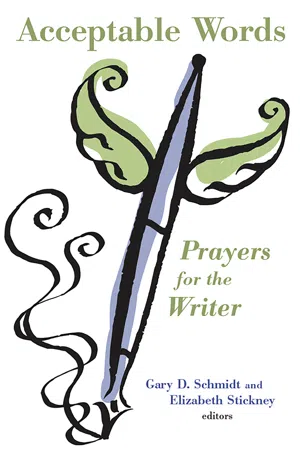
Acceptable Words
Prayers for the Writer
- 216 pages
- English
- ePUB (mobile friendly)
- Available on iOS & Android
eBook - ePub
Acceptable Words
Prayers for the Writer
About this book
Information
Topic
Theology & ReligionSubtopic
Creative Writing

The Writer Encounters the World
The heavens declare the glory of God; and the firmament sheweth his handiwork.
Day unto day uttereth speech, and night unto night sheweth knowledge.
There is no speech nor language, where their voice is not heard.
Their line is gone out through all the earth, and their words to the end of the world.
PSALM 19.1-4

Suppose, wonders Ralph Waldo Emerson in his essay, “Nature,” suppose the stars came out only one night every thousand years. Suppose the night was drawing nigh. Would we not all be filled with a fantastic eagerness to see this strange thing, of which we had heard only the most ancient of stories? Would we not anticipate it, and wait breathlessly? And when we had seen these miraculous stars, would we not wonder and marvel at the display? Would we not write poetry about the sight? Would we not tell the tale to future generations, that we were alive on this once-in-a-millennium night, when all the stars of heaven poured light down upon earth?
But, says Emerson, the stars come out every night. Every night the starry heavens, with all their wonders, unfold to us, as we walk across the village commons. This is the miracle of the universe.
Or, as the Belgic Confession asserts, we know God “by the creation, preservation, and government of the universe, since that universe is before our eyes like a beautiful book in which all creatures, great and small, are as letters to make us ponder the invisible things of God: his eternal power and his divinity.”
Writers, as Flannery O’Connor has said, begin with what is physical and concrete. They begin with their perceptions of the extraordinary, mundane, knowable, confusing, healing, broken, moving, exasperating world that we find around us. Our characters, our themes, our images, our settings, our plots, our metaphors, our language, our tones — all the elements that the writer crafts into a text — come out of that world. What else could a writer do?
It is the writer’s task to stay peculiarly attached to and aware of the physical created world — and to be aware of the awareness. The writer is aware of the miracle of a maple tree bark, even though she may be in a forest of maple trees. The writer is aware of the cracks in this one sidewalk he walks on, even though he is walking in a city of sidewalks. The writer is aware of the smell of salty pretzels, the beat of the sun at the high altitudes, the lonely cry of a train whistle across cornfields, the slight twist in the dying man’s nose, the hosta mostly deer-eaten, the gait of the border collie, the pulled-back hair of the high school volleyball player, the bleary-eyed determination of this one girl with a head cold, trudging to school among all the other students.
The writer knows that the stars come out every night, that they are all around us, and that they are stars.
The Victorian essayist John Ruskin wrote in his 1872 lecture, “The Relation of Wise Art to Wise Science,” that he had one urgent thing he wanted to tell all artists; it was this: “You cannot learn to love art, unless you first love what art mirrors.”
Art — writing — mirrors the world, the world that, the Psalmist says, day after day pours forth speech, and night after night displays knowledge; its words go to the ends of the earth. This is the world the writer knows. This is the world from which the writer draws all matter. This is the world for which the writer feels gratitude and love.

I will thank God for the pleasures given me through my senses, for the glory of the thunder, for the mystery of music, the singing of birds and the laughter of children. I will thank God for the pleasures of seeing, for the delights through colour, for the awe of the sunset, the beauty of flowers, the smile of friendship, and the look of love; for the changing beauty of the clouds, for the wild roses in the hedges, for the form and beauty of birds, for the leaves on the trees in spring and autumn, for the witness of the leafless trees through the winter, teaching us that death is sleep and...
Table of contents
- Cover
- Title Page
- Copyright
- Dedication
- Contents
- General Introduction
- 1. The Writer Encounters the World
- 2. The Writer Studies the World
- 3. The Writer Begins
- 4. The Writer’s Vision Expands
- 5. The Writer Attends to the Word
- 6. The Writer Finds Joy in the Work
- 7. The Writer Petitions
- 8. The Writer Offers the Work to God
- The Writers’ Biographies
- Sources and Acknowledgments
- Index
- “A Reverie”
Trusted by 375,005 students
Access to over 1.5 million titles for a fair monthly price.
Study more efficiently using our study tools.
Frequently asked questions
Yes, you can cancel anytime from the Subscription tab in your account settings on the Perlego website. Your subscription will stay active until the end of your current billing period. Learn how to cancel your subscription
No, books cannot be downloaded as external files, such as PDFs, for use outside of Perlego. However, you can download books within the Perlego app for offline reading on mobile or tablet. Learn how to download books offline
Perlego offers two plans: Essential and Complete
- Essential is ideal for learners and professionals who enjoy exploring a wide range of subjects. Access the Essential Library with 800,000+ trusted titles and best-sellers across business, personal growth, and the humanities. Includes unlimited reading time and Standard Read Aloud voice.
- Complete: Perfect for advanced learners and researchers needing full, unrestricted access. Unlock 1.5M+ books across hundreds of subjects, including academic and specialized titles. The Complete Plan also includes advanced features like Premium Read Aloud and Research Assistant.
We are an online textbook subscription service, where you can get access to an entire online library for less than the price of a single book per month. With over 1.5 million books across 990+ topics, we’ve got you covered! Learn about our mission
Look out for the read-aloud symbol on your next book to see if you can listen to it. The read-aloud tool reads text aloud for you, highlighting the text as it is being read. You can pause it, speed it up and slow it down. Learn more about Read Aloud
Yes! You can use the Perlego app on both iOS and Android devices to read anytime, anywhere — even offline. Perfect for commutes or when you’re on the go.
Please note we cannot support devices running on iOS 13 and Android 7 or earlier. Learn more about using the app
Please note we cannot support devices running on iOS 13 and Android 7 or earlier. Learn more about using the app
Yes, you can access Acceptable Words by Gary D. Schmidt, Elizabeth Stickney, Gary D. Schmidt,Elizabeth Stickney,Gary Schmidt, Gary Schmidt, Elizabeth Stickney in PDF and/or ePUB format, as well as other popular books in Theology & Religion & Creative Writing. We have over 1.5 million books available in our catalogue for you to explore.