Personal, experiential faith is seldom given a seat at the table of academic theology and biblical studies. David Crump, however, with the assistance of Søren Kierkegaard's religious philosophy, claims that "authentic understanding, and thus authentic Christian commitment, can only arise from the personal commitment that is faith."
Examining the various biblical, historical, cultural, theological, and academic hurdles demanding a truly Kierkegaardian leap of faith before one can meet the resurrected Jesus, Crump's
Encountering Jesus, Encountering Scripture provides a very insightful discussion of key New Testament texts and issues revealing how Truth is discovered only through the subjectivity of faith.
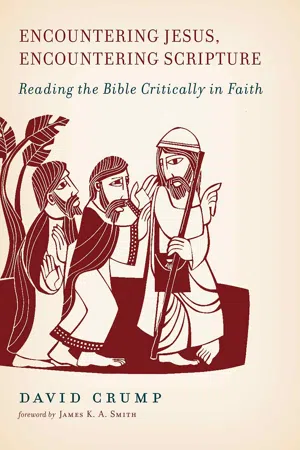
eBook - ePub
Encountering Jesus, Encountering Scripture
Reading the Bible Critically in Faith
- 155 pages
- English
- ePUB (mobile friendly)
- Available on iOS & Android
eBook - ePub
About this book
Information
CHAPTER 1
Introduction
Try as I might, stewing over my questions in the seminary library while reading the Gospel of Luke was not producing any ready answers, which only caused my stewing to become more fervent. In the course of my studies, I had slowly become convinced that my teachers were right — in composing their books the four Evangelists (the Gospel-writers) had shaped and edited their sources. They were not only preservers but also interpreters of the traditions about Jesus.
Though this reads like old news to me these days, it was a new and disconcerting thought at that point in my life. It certainly was very different from what I had been taught to believe (at least implicitly) while growing up in the church — that the four Gospels offered fairly straightforward transcriptions of Jesus’ words and deeds. If I allowed myself to accept this new idea that Matthew, Mark, Luke, and John had painted portraits of Jesus — the first-century man I believed was crucified, resurrected, and ascended into heaven — with no intention of rendering him precisely as he was, then where could I go to meet the real Jesus, as he truly is without a third party’s interpretation getting in the way?
The various historical reconstructions offered by form-critics1 and other scholars, including those who had launched what is sometimes called the second quest for the historical Jesus,2 had not convinced me that they offered any viable alternatives. Albert Schweitzer’s verdict on the first quest seemed as apt for all later critics as it was for the first: each new investigator repeated his predecessors’ mistakes. Projecting his own preconceived ideas back into history, each of these writers constructed a new “historical Jesus” shaped by his own prejudices while boasting “of the skill with which [he found his] own thoughts again in the past!”3
I was already convinced that the critics who thought themselves better equipped than the ancients to recover the Jesus of history were fooling themselves. I was not willing to follow one pied piper after another with their alluring “assured results” of modern critical methods. But now I was left to wonder: were the Gospel authors any different? When I read the Gospel of Mark, how certain could I be that the Jesus depicted there was indeed the man crucified at Calvary? Put another way, how much does the face of Jesus in Mark reflect the face of Mark the Evangelist? If that were not worrisome enough, many critics argued that the Gospel writers tailored their portraits of Jesus to fit the needs of the early church communities. What if the Jesus of Mark was nothing more than a ghost of Jesus meant to serve that rather anonymous and amorphous collective labeled the Markan community? Am I looking at Jesus of Nazareth, or am I seeing Mark wearing a Jesus carnival mask?
This was my dilemma.
I can’t remember how long I actually sat at the table thinking and praying, waiting for some solution to appear. Eventually a light went on, and I will never forget that particular moment of crystalline clarity. It hit me like the proverbial ton of bricks. If my Christian faith had led me to a true relationship with Jesus Christ, then the Christ I now know by faith is the true Jesus of history.
Someone else may have found this solution totally unsatisfactory, but it stopped me dead in my meditative tracks. Whether it sounds provocative and dangerous or strikes one as a superficial tautology, that moment has never left me. I believed then, and still believe today, that either the Jesus I know through my experience of faith is the resurrected Jesus of Nazareth, the Jesus of history, or my Christian faith is an illusion.4 That epiphany left me with the firm belief that there are no other viable alternatives.
If my Christian faith was an illusion, then the real challenge I faced was not in learning to demythologize the New Testament, making it more rationally accessible, but in finding the courage to demythologize my entire lived experience of Christian faith and religion. Though undoubtedly some readers will accuse me of taking the coward’s way out, I had seen and experienced far too much in my Christian faith that impressed me as genuine spiritual encounter. The option to jettison my 20-plus years of Christian life was a non-starter. Accepting the insights of redaction criticism5 might prompt me to readjust particular articulations of my faith, or certain tenets, but it was not nearly convincing enough to deconstruct it altogether. From that moment on I have remained convinced that the centerpiece, the integrating point of my life with Christ, both devotional and intellectual, must be found in this experience of personal encounter forged in faith. Throughout seminary, doctoral studies, pastoral ministry, and college teaching, the conviction that my personal faith commitment leads me to experience the real Jesus has become the meeting ground for theological inquiry as well as for a deeper personal intimacy with the living Christ.
Though I would not come to realize it for another 25 years, this early conviction about the unavoidably experiential foundation of my knowledge about Jesus Christ — and thus the inherent subjectivity of my (indeed, everyone’s) search for theological and spiritual understanding — was the beginning of a journey that would eventually lead me to the doorstep of a Danish thinker, an iconoclast named Søren Kierkegaard. Though he never dismissed the value of historical research altogether, Kierkegaard staunchly defended the same view that I had intuited: the true Jesus is met through faith — not through historical information no matter how precise and accurate. Though he presents this thesis in a multitude of ways throughout his writings, let me begin introducing you to Kierkegaard’s thought using an example from one of his explicitly religious meditations, something he called an “edifying (or upbuilding) discourse.” Kierkegaard insists that:
We sometimes speak of learning to know God from the history of past ages; we take out the chronicles and read and read. Well, that may be all right . . . but how dubious the outcome frequently is. . . . But someone who is conscious that he [or she] is capable of nothing at all has every day and every moment the desired and irrefragable opportunity to experience that God lives.6
In other words, historical research can be useful, but it may obscure as easily as it illuminates since the historian is no less subject to personal bias than were the most conscientious Gospel authors and their attentive readers. The key, therefore, to real encounter with Jesus is not a more precise reconstruction of the past but a very contemporary step of faith realized in a profound awareness of personal need. This honest admission of individual helplessness and utter dependence before God Kierkegaard refers to as “the Moment.” Such is the stuff that propels the initial and ongoing steps of faith. Life is an ongoing series of such “Moments,” in which we confront the decision of faith over and over again: Will I entrust myself entirely to Jesus Christ, acknowledging that I am completely dependent on him for direction in this life as well as my hope in the next?
This pathway of faith is not just one possibility among many. It is not an anti-intellectual evasion of difficult questions or a mystical mantra circumventing reason or analysis. It is not a pietistic ruse for ceding history’s terra firma to the barbarian hordes of critics, skeptics, and sundry university professors of religion. Neither does it have anything to do with the peculiar nature of the Gospels, their methods of composition, or doubts about their historical reliability. It is quite simply the only avenue available for authentic Christian understanding, given the distinctive natures of both the seeker (self-deceived sinners like us) and the Sought (an incarnate, resurrected Savior). Only taking the step of faith can bridge the vast, essential chasm (what Kierkegaard calls the “infinite qualitative difference”) gaping wide between two such disparate characters as the Savior and the saved.
In confessing my personal and academic affinity for Kierkegaard and his understanding of faith, I speak as a biblical studies professor who is regularly confronted with the naïve if heartfelt piety of students in North America. Bewildered by the amount of ancient history I expect them to learn, and often assuming they “know” all they need to know already, they may complain:
Why do I need to know this stuff?
What does that have to do with Bible study?
What does that have to do with Bible study?
I cannot help but admonish such students with wrinkled brows and glassy eyes that they are uniquely privileged to have access to the world of the Bible, that their higher education is a gift and not a curse. Though I insist on the priority of personal faith and religious commitment in knowing Jesus, this is in no way intended to excuse anyone from the hard work and rewards of learning. I do not intend to segregate heart from mind, nor devotion from education. On the contrary, my goal in this book is to secure thorough integration of heart, mind, and soul by keeping first things first. In the realm of Christian understanding, the most fundamental questions do not concern historical evidence, archaeological data, literary genre, or any of the sundry matters usually tied to the rational explanation of empirical evidence. Rather, the basic issues in this arena are epistemological and spiritual: How can a person come to know God?
When it comes to the more basic problem of precisely how a person enters into an authentic understanding of God Almighty, discussion of evidence, arguments, science, and conclusions — no matter how careful — only amount to “sound and fury, signifying nothing.”7 The beginning of that I-Thou encounter with God is the launch into the spiritual universe that surrounds us. If that foundation is askew, we will not be able to achieve balance between mind and heart, evidence and faith, will and emotion. Without this foundation we begin our spiritual journey from the wrong place, and, though it is possible to redirect once we find our bearings, such corrections are difficult and slow. If you will allow me to change metaphors again, the religious life with its theological underpinnings behaves more like an oil tanker than a hovercraft: you can change courses, but it involves time and calculation as it requires a sizeable amount of self-conscious effort. It is far better to begin correctly. Even though the old adage exclaims “All’s well that ends well,” in the realm of the religious life it is even truer to insist that all’s well that begins well. Good beginnings are more important than good endings, since a misbegotten start can leave one lost or collapsed from wasted effort.
Much of the discussion about finding balance between intellect/education and piety/devotion is marred because extremists on both ends of the spectrum will use wedge issues to further the distance from those with opposing views. Those whose faith is more emotion-based sometimes seem to promote a grotesque brand of anti-intellectualism. A pastor once told me that the intellect must be abandoned in order to make room for faith. Most of us have encountered such an extreme point of view from time to time. Meanwhile, professors of theology sometimes behave as if the reified air of objectification and disinterested research should be the standard atmosphere for everyone in the church. Most of us have met professors who can cynically and unself-consciously dismiss the religious enthusiasm of students and others. Those who denigrate their opponents on the other end of this spectrum tar themselves with the same brush. Each extreme in this debate is actually a mirror image, the shadow self, of the other. Each represents a half of the creature homo religiosus, and each in some way needs the other to be complete.
A Personal Journey
It was while I wrestled with these questions during my years in seminary that I wandered into Kierkegaard’s neighborhood. Even so, it took several decades before I arrived at his front door to read his work for myself. Actually, this intellectual journey did not begin with this famous Dane. My initial exposure to this point of view came by way of a famous German New Testament theologian, Rudolf Bultmann — the very one I had once been warned to avoid at all cost.
While I was preparing a paper on the prologue to John’s Gospel, my research led me to Bultmann’s important commentary.8 It was hardly the first commentary I had ever read. My library contained quite a few. Still, I had never before read a commentary quite like this one. Woven in between the footnotes and excursuses on Greek word usage, Jewish theology, and Gnostic redeemer myths9 was a clear exposition of how personal allegiance to Christ was the prerequisite for any accurate understanding of Christ’s identity. Complete commitment, a radical surrender of personal allegiance, like a stomach-churning leap into the great unknown — this and only this would serve as the launching pad for genuine theological understanding of Jesus.
Though the existential fabric of Bultmann’s thought may sound passé to twenty-first-century postmodern ears, it was all resoundingly new to me at the time. Bultmann convinced me not only of the theological-existential point that commitment precedes insight, but he argued persuasively that this was John’s teaching, not his own invention. I found myself closing the book and pausing in order to absorb the weighty existential challenge Bultmann was pounding into me sentence after demanding sentence. Frankly, I had never before read a commentary, certainly not such an academic commentary, that assaulted both my mind and my will with claims that had immediate personal relevance. The analysis consistently forced itself on both my will and my heart. Here was a scholar (a German university professor no less!) telling me not only that Jesus Christ demanded my personal allegiance — a commitment that would completely reorganize my life and all of its priorities — but that I could never hope to grasp either the meaning of Jesus’ historical identity or the significance of the New Testament message unless I first took this step of personal commitment.
I was taken completely by surprise. Unfortunately, I came to understand that what Bultmann intended to say was very different from what I initially took him to mean. Bultmann conceives of the object of faith in ways that I cannot accept.10 But then, as I explored his understanding of the dynamics of faith, I encountered a scholar who refused to drive any wedges between faith and understanding, living and believing. I found in Bultmann a voice that went so far as to insist that authentic understanding, and thus authentic Christian living, can only arise from the personal commitment that is faith. In describing the centrality of the incarnation, “the Word become flesh” in John 1:14, Bultmann explains that Christ
. . . does not bring a teaching which renders his own presence superfluous; rather as the Incarnate he sets each [person] before...
Table of contents
- Cover Page
- Title Page
- Copyright Page
- Contents
- Foreword
- Acknowledgments
- 1. Introduction
- 2. Recognizing the Messiah When You See Him
- 3. Offended By Uncertainty
- 4. The Apostle Paul, from Encounter to Belief
- 5. Believing the Blasphemous Word
- 6. Education, Experience, and Transformation
- Index of Subjects and Names
- Index of Scripture References
Trusted by 375,005 students
Access to over 1.5 million titles for a fair monthly price.
Study more efficiently using our study tools.
Frequently asked questions
Yes, you can cancel anytime from the Subscription tab in your account settings on the Perlego website. Your subscription will stay active until the end of your current billing period. Learn how to cancel your subscription
No, books cannot be downloaded as external files, such as PDFs, for use outside of Perlego. However, you can download books within the Perlego app for offline reading on mobile or tablet. Learn how to download books offline
Perlego offers two plans: Essential and Complete
- Essential is ideal for learners and professionals who enjoy exploring a wide range of subjects. Access the Essential Library with 800,000+ trusted titles and best-sellers across business, personal growth, and the humanities. Includes unlimited reading time and Standard Read Aloud voice.
- Complete: Perfect for advanced learners and researchers needing full, unrestricted access. Unlock 1.5M+ books across hundreds of subjects, including academic and specialized titles. The Complete Plan also includes advanced features like Premium Read Aloud and Research Assistant.
We are an online textbook subscription service, where you can get access to an entire online library for less than the price of a single book per month. With over 1.5 million books across 990+ topics, we’ve got you covered! Learn about our mission
Look out for the read-aloud symbol on your next book to see if you can listen to it. The read-aloud tool reads text aloud for you, highlighting the text as it is being read. You can pause it, speed it up and slow it down. Learn more about Read Aloud
Yes! You can use the Perlego app on both iOS and Android devices to read anytime, anywhere — even offline. Perfect for commutes or when you’re on the go.
Please note we cannot support devices running on iOS 13 and Android 7 or earlier. Learn more about using the app
Please note we cannot support devices running on iOS 13 and Android 7 or earlier. Learn more about using the app
Yes, you can access Encountering Jesus, Encountering Scripture by David Crump in PDF and/or ePUB format, as well as other popular books in Theology & Religion & Biblical Criticism & Interpretation. We have over 1.5 million books available in our catalogue for you to explore.