A common complaint of recent seminary graduates is their lack of preparation in practical theology, especially in the tasks of leadership. New pastors encounter a host of challenges that can seem overwhelming.
Biblically oriented, wise, and reassuring, Dana Fearon presents twenty-one difficult situations that young ministers are likely to face on the job, including prayer in the hospital room, a request to baptize a dead infant, handling conflict and criticism, entering dangerous areas to reconcile hostile groups, and others. As part of his discussion, Fearon presents and reviews his own response to such situations, using his theological education and long experience in church ministry to instruct others.
eBook - ePub
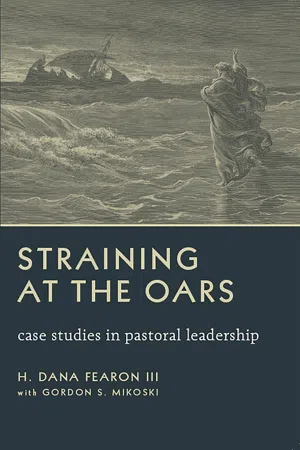
Straining at the Oars
Case Studies in Pastoral Leadership
- 138 pages
- English
- ePUB (mobile friendly)
- Available on iOS & Android
eBook - ePub
About this book
Information
Topic
Theology & ReligionSubtopic
Christian MinistryCHAPTER ONE
Baptizing a Baby Who Has Died

SHOULD A MINISTER baptize an infant who has died at the moment of birth? In seminary, I learned that Reformed theology states that in such an instance it is not appropriate to administer the sacrament of baptism. But what should a minister do when the grieving parents want their baby baptized?
Early in my ministry in Lawrenceville, I had to face this dilemma. Dan, a church member, called from the hospital in the early morning hours to report that his wife, Lucille, had given birth to a baby boy, but that the child was not expected to live. Dan asked me to come to the hospital at once. When I arrived, the nurse told me the baby had died. Entering the room, I saw a small bundle in a crib next to Lucille. Even though the little boy had died, Dan and Lucille said they wanted the baby baptized as Daniel Jr. Reformed theology held that such baptism was not necessary to secure God’s love for the child. I told them that God adopts our babies before they are born and promises to be their God forever.1 I asked why they wanted Dan Jr. baptized, as the child was already with God. They looked at me with shock and anger. From their reaction, it was clear that they believed their little boy would not go to heaven unless the sacrament of baptism was administered. I hesitated because I was afraid that administering the sacrament would reinforce their belief that we had to appease or beseech, or manipulate, God, for the sake of Daniel Jr.’s future. They were confused and angered by my hesitancy.
In that moment, it was clear that my explanation about God’s love for their child was inadequate. They wanted the comfort and assurance they believed baptism would guarantee. I asked a nurse to bring a small container of water. I read a Scripture about Jesus and children, and about his love for us. Then I baptized Daniel Jr. and told them I would visit when Lucille returned home. Largely because of the pathos of the moment, I administered the sacrament. I hoped that administering the sacrament would be an instance of grace for them, helping them to believe in the care of God even in this moment.
John Calvin approached the baptism of infants with the tenderness of a parent. He wrote, “God declares that he adopts our babies as his own before they are born when he promises that he will be our God and the God of our descendents after us.”2 Calvin and his wife had experienced the death of their own newborn son, and his words are even more poignant in the light of that tragedy. His understanding of the destiny of children who have not been baptized before death echoed my conviction about God’s free gift of love. Daniel Jr.’s belonging to God is an act of God’s love and is not dependent on the administration of the sacrament as a mechanism of salvation.
Soon after, I visited Dan and Lucille, and we talked again about that sad morning. I tried to reassure them of God’s love and their baby’s place in the kingdom. Yet, so ingrained was their fear of damnation or at least the loss of salvation without baptism, that their anger and fear were not reduced by my explanation.
On reflection, I think I should have trusted my initial instinct to provide ecclesiastical comfort rather than offer a theological explanation. I failed to realize that the correctness of my theological viewpoint was irrelevant. This couple wanted the reassurance of God’s love for their dead child and were looking for the proper ritual that would speak to their sorrow and reassure them of their child’s safety. They were not in a position to hear the truth about God’s already-given love. When I finally agreed to administer the sacrament, it was because I belatedly realized that the dictum not to baptize dead infants — while a truth that the Reformed tradition has inferred from the gospel — at that moment was secondary to their need for a ritual that stood for God’s love and protection.
Another lesson I learned in this instance is that the pedagogical dimension is wrapped in the pastoral role. Before pastors express “answers,” they need to identify with those who suffer. Acknowledging suffering precedes correct teaching. What I took away from this sad event was an awareness that people would first of all want their pastor to share their sufferings; only later would they welcome a theological truth. This calls for an adjusted view of ourselves from that absorbed in seminary. I was no longer a student who brought correct answers to difficult situations; now I was a pastor and priest who was expected to minister with evidences of God’s love.
A few years later Dan and Lucille indicated that they wanted to transfer their membership to another church because they had friends in that church. That might well have been true, since the Lawrenceville church had an overwhelming number of new members. Some of the grown children of “old-timers” were leaving to join a church that was not experiencing such growth. Yet, I wonder if they were looking for a minister who personified the priestly role, a minister who lifted up their loss and sorrow to God in prayer and beseeched God to have mercy. Were they looking for a ritual that assured them that the sacrifice of God’s Son opened the gates of heaven for their homeless child?
Part of the challenge in leaving the shore of seminary is to understand our new identity. A person of the academy acquires knowledge, challenges traditions, and develops new ideas. A pastor represents God to the people, and the people to God. An important task for new pastors is to learn the language of faith that the congregation speaks and to discover what the symbols of the faith mean to the members.
Discovering the meaning of religious symbols and acts will be increasingly difficult as people join our churches who come from different traditions or whose religious education has come only from watching Hollywood movies. In such critical moments as this, perhaps the best pastoral response is to ponder the tasks of both pastor and teacher, and decide which comes first.
DISCUSSION QUESTIONS
- What is your theological understanding of the status of babies who die prior to baptism?
- Under what circumstances, if any, would you baptize a dead baby?
- How much teaching should there be in the moments of pastoral care? How much pastoral care should there be in teaching?
CHAPTER TWO
Hard Questions about Prayer
WHEN I WAS a new pastor, questions about prayer surfaced as I made hospital visitations. Do we pray only to comfort the suffering person? Does prayer actually avail us of resources that only God can provide? If we increase the number of people praying, does the larger number improve the patient’s chances? In short, what is the power of prayer?
Early in my ministry, I realized that I did not have a theology of prayer. I assumed it was important to pray for someone, but did not know why. I cannot recall a seminary course that dealt with prayer, but in the hospital questions were appropriate and some sort of answer was necessary.
In the first week of my ministry at the Lawrenceville church, I received a call from a member, Miriam, whose husband, Harry, was in the hospital. She told me that during his annual checkup a growth had been discovered and he had been admitted for an operation. Upon arriving at the hospital, I heard the doctor and nurse talking to Harry. I waited in the hall, reviewing what I would do when I saw him. When the medical people left, I went in and talked to Harry and Miriam. She was trying to be hopeful; he was clearly upset. I seconded her expression of hope without assuming certainty, and tried to share his concern. Before I left, I offered a prayer reflecting our need and asking God to help Harry recover.
What did I believe about the prayer I had just offered? I had to dig into the question of prayer. I began a study group in the church both to pray and to talk about prayer. We turned to the Scriptures, figuring there were reasons, based on experience, that the men and women of both Testaments prayed. We studied the way the psalmists prayed. They thanked, glorified, confessed to, and implored God for help, and even insisted that God heed their prayers — calling down the anger of God upon the enemies of the nation. They expressed their doubts, “My God, my God, why have you forsaken me?” (Ps. 22:1). We studied Jesus and prayer, noting that frequently he went off alone to pray (Luke 9:28), and also told his disciples that only prayer and fasting could cure certain illnesses (Matt. 17:21). He prayed for help when he faced his own death (Matt. 26:36). The apostle Paul, too, prayed. He thanked his fellow Christians in Corinth for their prayers when they heard that he was in danger of losing his life (2 Cor. 1:10). We looked at the historic prayers of the church, the testimony of men and women in every century, all inspired by the faith that there is a God who hears and responds.
The conversations of our study group led us to believe that prayer is effective at several levels. On one level, it opens the one who is praying to a relationship with God. Whether we are angry with God, or thankful to God, or casting ourselves upon God, prayer has brought us back to the Father and Mother of us all. A second level involves the person being prayed for. That person is not alone, and is assured there is a community “pulling for” health and salvation. The psalmists seem to pray on the assumption that prayer is even more effective when the community is joined in the effort. Perhaps we did not understand the divine dynamics of prayer, but we believed this was the Scripture’s witness.
Why does it seem that so many prayers are not answered? The study group recounted incidents of friends who recovered, and they wondered if those prayers had been answered, but others in the group remembered prayers that seemed to go unanswered. The group arrived at a provisional explanation. They did not believe there is any way of proving that prayer “works,” but there is a suggestive way of framing prayer as part of an overall confession of faith in God. God calls us into partnership or stewardship of which prayer is a part. This partnership with God involves standing beside Jesus, who prays for us, and joining him in praying for all of God’s creation. Our praying recognizes the solidarity of God with us expressed in Jesus Christ. Faith in prayer is undergirded by faith in God’s act of reconciling us to God’s self.
More recently, I read Theodore W. Jennings Jr.’s Transforming Atonement: A Political Theology of the Cross, in which he describes the cross as that act in which we are reconciled to God: “The suffering and death of the Messiah place him in solidarity with the vulnerability and mortality of creaturely being. The recognition that God is fully present in the suffering and death of this one means that God has taken on the suffering and dying of creaturely existence.”1
We are encouraged to pray, then, in the faith that God has joined in our vulnerability and accompanies us in our dying. With this faith, a pastor can enter a hospital room with the confidence that he/she brings “good news” even in life’s tragic moments.
It was not long before members of the study group formed a smaller group that would regularly offer intercessory prayers for the congregation. Every Sunday they gathered by the communion table following worship to pray for those whose names had been brought forward.
This corporate effort to gain knowledge about prayer shaped my theology of prayer and ministry. I could continue as a pastor with a sense of authenticity because I had something to offer: the news of God being with us, as evidenced by the cross Jesus took upon himself, joining us in our sufferings and lifting us with him to the Father and Mother of us all.
DISCUSSION QUESTIONS
- What is your understanding of the purpose and the effect of prayer? Do you pray to influence God in some way? Or do you pray in order to render yourself and those for whom you are praying more open to the presence and will of God?
- How might the practice of ministry reshape your practice and understanding of prayer?
- In what ways might prayer shape or reshape your theological understanding?
CHAPTER THREE
Teach Us How to Pray
AFRIEND IN SEMINARY returned after spending a summer in a Benedictine monastery. He discovered this was not his calling, but he did tell us about the community’s life at prayer. He told of praying in the early morning, at midday, and in the evening. There were also other hours of prayer. He said it was often a painful discipline, but there were moments when he was humbled and filled by the presence of the unseen God.
If we pastors are to...
Table of contents
- Cover
- Title Page
- Copyright
- Contents
- Preface
- Introduction
- Acknowledgments
- 1. Baptizing a Baby Who Has Died
- 2. Hard Questions about Prayer
- 3. Teach Us How to Pray
- 4. Making Waves
- 5. Moving Power to the Proper Place
- 6. The Congregation Teaches Preaching
- 7. The Pastor’s Day (and Evening)
- 8. Having Friends, Not Cronies
- 9. Needing Help and Accepting It
- 10. Wearing the Collar
- 11. Placing the Flag
- 12. Criticisms and Conflict
- 13. Baptisms and Marriages
- 14. An Unexpected Renewal of Faith
- 15. The Least of These
- 16. Two Guests in the House of the Lord
- 17. Meddling in Community Affairs
- 18. Helping Laity Find Their Gifts
- 19. Developing Spirituality in the Governing Board
- 20. Staff Dynamics
- 21. Setting a New Course
- Epilogue: The Surprising Presence
- Bibliography
Trusted by 375,005 students
Access to over 1.5 million titles for a fair monthly price.
Study more efficiently using our study tools.
Frequently asked questions
Yes, you can cancel anytime from the Subscription tab in your account settings on the Perlego website. Your subscription will stay active until the end of your current billing period. Learn how to cancel your subscription
No, books cannot be downloaded as external files, such as PDFs, for use outside of Perlego. However, you can download books within the Perlego app for offline reading on mobile or tablet. Learn how to download books offline
Perlego offers two plans: Essential and Complete
- Essential is ideal for learners and professionals who enjoy exploring a wide range of subjects. Access the Essential Library with 800,000+ trusted titles and best-sellers across business, personal growth, and the humanities. Includes unlimited reading time and Standard Read Aloud voice.
- Complete: Perfect for advanced learners and researchers needing full, unrestricted access. Unlock 1.5M+ books across hundreds of subjects, including academic and specialized titles. The Complete Plan also includes advanced features like Premium Read Aloud and Research Assistant.
We are an online textbook subscription service, where you can get access to an entire online library for less than the price of a single book per month. With over 1.5 million books across 990+ topics, we’ve got you covered! Learn about our mission
Look out for the read-aloud symbol on your next book to see if you can listen to it. The read-aloud tool reads text aloud for you, highlighting the text as it is being read. You can pause it, speed it up and slow it down. Learn more about Read Aloud
Yes! You can use the Perlego app on both iOS and Android devices to read anytime, anywhere — even offline. Perfect for commutes or when you’re on the go.
Please note we cannot support devices running on iOS 13 and Android 7 or earlier. Learn more about using the app
Please note we cannot support devices running on iOS 13 and Android 7 or earlier. Learn more about using the app
Yes, you can access Straining at the Oars by H. Dana Fearon,Gordon S. Mikoski in PDF and/or ePUB format, as well as other popular books in Theology & Religion & Christian Ministry. We have over 1.5 million books available in our catalogue for you to explore.