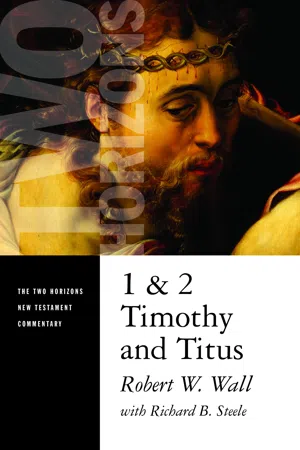
- 432 pages
- English
- ePUB (mobile friendly)
- Available on iOS & Android
eBook - ePub
1 and 2 Timothy and Titus
About this book
This theological commentary on 1 & 2 Timothy and Titus by Robert Wall powerfully demonstrates the ongoing relevance and authority of the Pastoral Epistles for the church today. Wall uniquely employs an apostolic "Rule of Faith" methodology for interpreting these texts as sacred Scripture. Three successive historical case studies by Richard Steele vividly instantiate key themes of the Pastorals. This innovative yet reverent volume will help revive the interest of students, pastors, and other Christian leaders in the Pastoral Epistles.
Information
Topic
Theology & ReligionSubtopic
Biblical Commentary1 Timothy
The theological crisis that occasions 1 Timothy is set out early in the letter (1:3): Paul’s personal absence from Ephesus, and so also the absence of his apostolic charisms, intensifies the threat of heterodox teaching and of the congregation’s accommodation of Greco-Roman culture. After all, these threats would seem much less prominent were the apostle on site distinguishing false teaching from the word of truth or hard at work guiding the formation of Christians whose life is shaped by his instruction (vv. 4–5). Paul’s absence occasions an epistemic crisis when knowledge of the truth, even if mediated by his delegated leaders, is less certain, less clear-cut, and more vulnerable to competing claims and challenges (cf. Phil 1:12–18).
The situation is not unlike that facing the disciples of Jesus when he announces his departure (John 13:33; 14:1–4). The disciples also perceive his departure as an epistemic crisis, poignantly posed by Thomas: “How can we know the way?” (14:5). Jesus’ response to him is instructive: on the one hand, he famously maintains his unique authority as the only way to God (v. 6) while promising his disciples the Spirit, who will continue to mediate his truth to them in his absence. In this letter, Paul’s instructions to Timothy function as a medium of his personal presence: Timothy knows something of how Paul would have handled things were Paul with him.
The introduction of Timothy in Acts 16:1–5 supplies the canonical context of this letter’s address. The reader knows from Acts that Timothy is the child of a mixed marriage in the Diaspora. Evidently his non-Jewish father shaped his religious identification, since he was not yet circumcised. For this reason Paul circumcises him, not only to restore his mother’s Jewish identity but to personify in Timothy the restored Israel that now includes repentant Jews and Gentiles (cf. Acts 15:13–29; 1 Tim 2:7).1
On this basis, we may imagine that the conflict between Jewish and pagan religious backgrounds, which personifies Timothy’s religious upbringing, contextualizes the disputations he might have in Ephesus with those who pretend to be “teachers of the Law.” While Paul vigorously chastises them (1:6–7), it is left to Timothy to correct them as a restored Jew (v. 3).
The Timothy of Acts then accompanies Paul on a European mission that eventually takes him to Ephesus (Acts 18:5; 19:22). He again is mentioned as a member of Paul’s entourage when leaving Ephesus some months later for Macedonia (20:4). Although Acts does not tell us Timothy’s full story, it does provide readers with a few biographical details that locate him on Paul’s missionary team that evangelized Roman Ephesus, when, the reader now assumes, he became familiar with the city’s cultural currents and people. Within this narrative setting, then, Timothy is easily recognized as a good choice to conduct Paul’s business in his absence: he is the ideal tradent and successor to Paul there.
Instructed to continue Paul’s work in his absence, Timothy personifies the faithful recipient of the Pauline legacy. Of course, Paul is irreplaceable: it is to him that the glorious gospel of God has been entrusted (1 Tim 1:10–11; 2 Tim 1:11; Tit 1:3), and he alone is the appointed teacher of truth to the nations (1 Tim 2:7).2 In this sense, the prospect of his departure, whether to another place (1 Tim 1:3; Tit 1:5) or in death (2 Tim 4:6), occasions an epistemic crisis. Timothy is asked to organize a Christian congregation in a pagan place and safeguard the Pauline tradition for the next generation, tasks Paul himself was appointed to complete. The apostle’s perceived ambivalence about Timothy’s readiness to succeed him, most clearly implied by 2 Tim 1:6–7, may well reflect a Thomas-like puzzlement: How can a successor know the way when the one granted spiritual authority to put the nations to rights goes missing? The problems facing the intended readers of 1 Timothy in a post-Pauline setting are best understood when a person of particular spiritual authority goes missing.
The letter’s recipient is made alert to what is at stake by an opening that recalls Rom 1:1–15, itself glossed in canonical setting by the ending of Acts, which depicts a faithful Paul continuing his prophetic ministry in Rome while facing an uncertain future (Acts 28:17–31).3 What seems especially apropos in recalling the opening of Romans is its mention of Paul’s absence (Rom 1:10), which prevents him from personally imparting his gospel and apostolic charism (v. 5) to believers there, which makes them more vulnerable to evil’s corrupting force (v. 11). Paul wrote Romans for the same reason that he now writes 1 Timothy: as an epistolary substitute for his personal presence to provide pastoral encouragement and apostolic instruction to guide believers during his absence from them.4 In fact, Paul’s expansive self-identification in those opening words of Romans raises a haunting question for the reader of 1 Timothy: Given Paul’s apostolic presence and performances, how will the church have a future without him? 1 Timothy offers readers a different response to this crisis than offered by Romans: rather than presenting readers the content of his gospel, Paul gives Timothy instructions in the organization, moral and professional practices, and working relationships that guide those responsible for forming Christian congregations into God’s household (3:15).5
1:1–2Paul Greets Timothy
1From Paul, an apostle of Christ Jesus by the command of God our Savior and Christ Jesus our hope, 2to Timothy, genuine son in faith: Grace, mercy, and peace from God the Father and Christ Jesus our Lord.
1 Timothy begins in a manner typical of other Pauline letters and according to the literary conventions of antiquity: the sender greets the letter’s intended recipient (see also 2 Tim 1:1–2; Tit 1:1–4).6 While expected in a letter, such a salutation has an important rhetorical role: to frame the posture of sender to recipient for one reading the correspondence that follows. In antiquity as today, what one says in greeting another forges first impressions that shape the future of their communication. For example, Paul identifies himself as “an apostle of Christ Jesus by the command of God,” which clearly establishes his spiritual authority over Timothy and assumes that Timothy will comply with what he is instructed to do in this letter. Paul’s address of Timothy as his “genuine son” softens what might otherwise seem like an authoritarian stance, so that Timothy’s adherence to Paul’s written instruction might be prompted by the more intimate relationship they share (cf. 2 Tim 1:2; Tit 1:4).
The precise nature of Paul’s stipulated authority as “an apostle of Christ Jesus” has long been debated among scholars.7 At the very least, we should agree that Paul’s own understanding of apostleship is different from that of Acts, which limits the apostolate to associates of the historical Jesus (Acts 1:21–22). If we define apostleship by the letter’s own terms, especially by its Pauline biography, apostleship is funded by memories of a particular ministry, by the core beliefs of a specific gospel, and by the virtuous life of its exemplar. More critically, it is the risen Christ himself who “placed Paul into service” (1 Tim 1:12) as a “preacher and apostle” (2:7) of “the glorious gospel of the blessed God” (1:11). While this less political definition of apostleship may be attributed to 1 Timothy’s occasion and genre, it does cohere with the résumé of the Paul of Acts, whose importance for the future of the church derives from his conversion to Jesus, his prophetic calling (Acts 9:15–16), and his exemplary career as a prophet like Jesus (20:18–35), rather than from any special status granted him by some ecclesial authority (cf. Gal 1:1, 11–12) based on personal association with the historical Jesus. Indeed, not only is the authorization of the Pauline apostolate predicated on different grounds than that of the Jerusalem Pillars, who were with Jesus from the beginning, but the deep logic of the Pauline gospel is underwritten by the narrative of Paul’s conversion experience and his missionary vocation rather than by his acquaintance with the Incarnate Word (cf. 1 John 1:1–4).
If we are to understand Timothy as the ideal tradent of the Pauline apostolate, the effect on the continuing reception of this letter is to conceive of apostolicity as a body of goods transferable to others. Even though Paul is absent, his gospel and the memory of his ministry are passed on from Timothy to still others (see 6:21; cf. 2 Tim 2:2; Acts 20:17–35). And this idea of apostolicity guides a particular way of reading the canonical collection. If the biblical memory of Paul’s gospel and way of life is not a thing of the past but exemplary of a living tradition with a catholic scope that is passed on from one generation of believers to the next no matter the time zone, then it is appropriate for contemporary readers to identify with Timothy: in some sense “Timothy” and “Titus” are tropes for the faithful tradent who receives and passes on the Pauline apostolate to those who are his “genuine child(ren) in the faith.”8
While exceptional within the Pauline canon (cf. Phil 3:20; Eph 5:3), the repeated reference to God as “our Savior” (1 Tim 1:1; 2:3; 4:10; Tit 1:3; 2:10; 3:4) confesses a central Jewish belief that would have also been readily understood in the Greco-Roman world, where both deities and important leaders (e.g., rulers and military generals) were called “saviors.” They were judged “saviors” not only because they rescued people from calamity but also because they were sources of benefaction that enhanced the lives of their subjects. Significantly, this title used in the letter’s address anticipates the letter’s central theological claim that “God our Savior desires all to be saved” (2:4) and that God’s desired salvation benefits every sinner who is delivered through the messianic work of Jesus from death for eternal life (1:15–16; cf. 2:5–6).
Parallel to this designation of God as Savior, Jesus is personified as “our hope,” a Christological confession without parallel in the Pauline canon (cf. Col 1:27). The grammatical parallel between these opening phrases about God and Jesus implies that the divine command that legitimizes Pauline apostleship is given by both in unison and with mutual support (cf. 1 John 1:3). Moreover, this same parallel combines salvation and hope as logically inclusive expectations of the Pauline tradent: if God’s purpose is creation’s redemption, then the messianic work of Christ Jesus supplies a realistic hope that God’s purpose will be fully realized (so 2:3–6). The letter to Titus elaborates this very point in two powerful theological formulas, arguing that God’s epiphany indicates that God is both the source and object of humanity’s hope (see the comments on Tit 2:11–14; 3:4–8).
Although no clear motive exists why the Pastoral Epistles typically place “Christ” before “Jesus,” the rhetorical effect is to give priority to the church’s claims about Jesus as the messianic broker of God’s promised salvation. The congregation’s hope in the coming triumph of God our Savior is therefore framed by Christ’s personal history, not only during his first coming (1:15; 2:5–6) but at his second coming as well (4:10; 5:5; 6:17). Mention of these critical Christological moments at the beginning and ending of the letter forms a rhetorical inclusio that supplies the motive of a congregation’s ready compliance to the instructions passed on to them by the canonical Paul.
The letter’s intended recipient is Timothy (1:2a; but see 6:21b), who represents the apostolate to others in Paul’s absence (cf. 2 Tim 2:2). The communicative intent of the epithet, “genuine son,” not only expresses Paul’s affection for Timothy but also the expectation that one who is truly a son will imitate his father to help maintain the family’s honor and status within society.9 Aristotle observed that children naturally learn to become adults by imitating their parents (Poetics 1448). According to Jaeger’s now famous study of paideia in early Greek civilization, the role of imitation was central to the general pattern of a person’s learning and cultivated a person’s symbolic universe.10 Framed by this historical perspective, the rhetorical relationship between author and audience may be understood as mimetic: Paul is Timothy’s role model, whose character and sacred practices are learned firsthand. This mentoring relationship is the presumed subtext of the Pastoral Epistles’ extensive use of biography (e.g., 1 Tim 1:12–17) and personal memory (e.g., 2 Tim 3:10–15), and extends also to the practical instructions given to the “son” to imitate so as to preserve the work the “father” has begun (2 Tim 2:2).
This thickened understanding of the letter’s address may guide readers to approach the letter’s paraenesis as curricular; its literary conventions such as biography, exhortation, reminder, and moral instruction purpose to teach the “craft” of apostolic ministry to the “son” as his successor so that he will be able to continue the family’s work of organizing and shaping the faith and witness of Christian congregations with due diligence and skill. Moreover, since the letter is written without a normal “thanksgiving,” which typically introduces the letter’s occasion (but see 1:12–17), Paul’s opening salutation rather than a prayerful thanksgiving hints at this special relationship with Timothy as the letter’s occasion. Indeed, the subsequent text that notes Paul’s departure from Ephesus in effect marks the beginning of a succession of his apostolate (see below on 1:3).
In usual Pauline fashion, the letter’s salutation (1:2b) combines the traditional greeting between Gentiles, “grace,” with that of Jews, “peace.” This interpenetration of two worlds, characteristic of the catholic scope of God’s salvation, is also instantiated in Timothy’s DNA. In this way, the addition of “mercy” to Paul’s greeting probably introduces an important theological theme of his correspondence with Timothy more than it is a response to a particular theological crisis facing Timothy’s congregation.
1:3–11The Aim and Manner of Christian Instruction
3As I requested you to do when leaving for Macedonia: stay longer in Ephesus so that you may instruct certain individuals not to teach divergent doctrine 4or to pay attention to myths and unending genealogies. Their teaching only encourages idle speculation rather than faithfulness to God’s way of ordering the world. 5The aim of instruction is loving relationships that come from a pure heart, a good conscience, and earnest faith. 6Some have rejected this and have turned to fruitless discussion, 7wanting to be Torah teachers without understanding either what they are saying or what they are claiming. 8We know, for example, that the law is good if used lawfully. 9We understand a law is not for an innocent person but for the lawless and rebellious, godless and sinners, unholy and profane, for those who commit patricide and matricide, for murderers, 10sexually unfaithful, homosexuals, slave dealers, liars, perjurers, and anyone else who acts contrary to healthy teaching, 11which agrees with the glorious gospel of the blessed God that has been entrusted to me.
The typical pattern of a Pauline letter would lead the reader to expect a thankful note sounded following the salutation (see below on 1:12–17); instead we find the letter’s o...
Table of contents
- Title Page
- Copyright
- Contents
- Preface
- Abbreviations
- Introduction
- Bibliography
- 1 TIMOTHY
- 2 TIMOTHY
- TITUS
- Index of Authors
- Index of Subjects
- Index of Scripture References
Trusted by 375,005 students
Access to over 1.5 million titles for a fair monthly price.
Study more efficiently using our study tools.
Frequently asked questions
Yes, you can cancel anytime from the Subscription tab in your account settings on the Perlego website. Your subscription will stay active until the end of your current billing period. Learn how to cancel your subscription
No, books cannot be downloaded as external files, such as PDFs, for use outside of Perlego. However, you can download books within the Perlego app for offline reading on mobile or tablet. Learn how to download books offline
Perlego offers two plans: Essential and Complete
- Essential is ideal for learners and professionals who enjoy exploring a wide range of subjects. Access the Essential Library with 800,000+ trusted titles and best-sellers across business, personal growth, and the humanities. Includes unlimited reading time and Standard Read Aloud voice.
- Complete: Perfect for advanced learners and researchers needing full, unrestricted access. Unlock 1.5M+ books across hundreds of subjects, including academic and specialized titles. The Complete Plan also includes advanced features like Premium Read Aloud and Research Assistant.
We are an online textbook subscription service, where you can get access to an entire online library for less than the price of a single book per month. With over 1.5 million books across 990+ topics, we’ve got you covered! Learn about our mission
Look out for the read-aloud symbol on your next book to see if you can listen to it. The read-aloud tool reads text aloud for you, highlighting the text as it is being read. You can pause it, speed it up and slow it down. Learn more about Read Aloud
Yes! You can use the Perlego app on both iOS and Android devices to read anytime, anywhere — even offline. Perfect for commutes or when you’re on the go.
Please note we cannot support devices running on iOS 13 and Android 7 or earlier. Learn more about using the app
Please note we cannot support devices running on iOS 13 and Android 7 or earlier. Learn more about using the app
Yes, you can access 1 and 2 Timothy and Titus by Robert W. Wall,Richard B. Steele in PDF and/or ePUB format, as well as other popular books in Theology & Religion & Biblical Commentary. We have over 1.5 million books available in our catalogue for you to explore.