- 272 pages
- English
- ePUB (mobile friendly)
- Available on iOS & Android
eBook - ePub
About this book
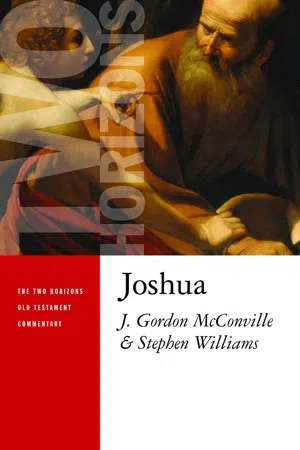
The book of Joshua is often troubling — what should we make of the fact that the violent occupation of land is not simply presented, but celebrated? How can we reconcile that with the key role the book plays in the biblical drama of salvation? What should we make of the God of Joshua? / In this volume Gordon McConville and Stephen Williams interpret Joshua in relation to Christian theology, addressing such questions and placing the book in its proper place in the canonical whole. McConville deals specifically with the commentary and exegesis of the text. Williams then moves in to focus on issues of interpretation. He addresses key theological themes, such as land, covenant, law, miracle, judgment (with the problem of genocide), and idolatry. / The authors posit that the theological topics engaged in Joshua are not limited to the horizons of the author and first readers of the book, but that Joshua is part of a much larger testimony which concerns readers yet today.
Information
Print ISBN
9780802827029
Theology in the Book of Joshua
Stephen Williams
The Question of the Land
Possession and Loss
When we open the book of Joshua, we meet a people poised to go to war in order to take land. It is so positioned not only in God’s name and with God’s permission, but by God’s command. How are we to read and understand this? We view Joshua today against the background of the incessant strife of nations and peoples over land, and particularly the conflict raging in the Middle East between Arabs and Israelis. Christians read the account in the context of the canonical Scriptures of their Old and New Testaments. It is an exercise which takes us to the very heart of those Scriptures. For the question of land dominates the Hebrew Bible, and what is spoken, unspoken, or implied by words and silences in the New Testament on the subject of the land tells us a lot about the relationship between the two Testaments.
Joshua succeeded Moses in leadership, fulfilling his commission to conduct the people of Israel into the land of Canaan. The second half of the book of Joshua chronicles in detail the distribution of territories among the tribes. When God first appears to Moses, it is with an announcement that he will bring the people of Israel into “a good and spacious land . . . flowing with milk and honey” (Exod 3:8). This announcement is preceded by God’s self-description as the “God of Abraham, Isaac, and Jacob.” a family whose story dominates Genesis and whose history is set in motion by God’s declaration to Abraham that he would give the land of Canaan to his descendants and bless the wider nations of humankind through them (Gen 12:1-7). It is given as an everlasting possession (13:15; 17:8). Indeed, Abraham is apparently brought out of Ur specifically in order to receive it (Gen 15:7). Over the course of the Pentateuch, its boundaries are described sometimes in more general, sometimes in more detailed, terms and we cannot extract from the Hexateuch a single territorially precise account.1 Yet they are sufficiently precise for Joshua, as we encounter him, to have a clear and definite mandate, and the book is massively interested in territorial detail. Joshua 21:43-45 forms a kind of climax to a narrative that begins in Gen 12:1.
God’s promise is reiterated all the way through to Deuteronomy; its terms are strong, embracing covenant and oath, and Isaac and Jacob are named along with Abraham. But another feature insinuates itself into the account with increasing prominence. In the intense, strident, concentrated and reiterated terms which characterise Deuteronomy, the people is reminded that God’s covenant has a correlative requirement attached to it, though the exact relation between “covenant” and “requirement” may not be easy to specify and the narrative has introduced us to both an Abrahamic and a Sinaitic covenant. As the people approach the solemn moment when God will speak from Mount Sinai, it is told that “if you obey me fully and keep my covenant, then out of all nations you will be my treasured possession” (Exod 19:5). Accordingly, the people makes a solemn promise to obey what is read in a “book of the covenant” (24:7). Its immediate and drastic failure to deliver on its commitment, in the incident of the golden calf, brings to light a divine radicalism that accompanies divine promise. God threatens to destroy the people and, instead, make Moses into a great nation (32:10). Moses was later to remind the people of God’s offer (Deut 9:14). This does not mean that the covenant was about to be broken from God’s side: Moses was of the house of Levi and therefore a descendant of Jacob and of Abraham. But it looks as though intended beneficiaries could be cut out. Promise and command are linked in the Sinaitic covenant as is indicated by the fact that the Ten Commandments are called the “words of the covenant” (Exod 34:28). Deuteronomy, in particular, hammers home the connection between holding the land of promise and adhering to the law of the God who promised it. But long before we arrive at Exodus and Sinai, Abraham has been told to “keep the covenant” (Gen 17:9); his obedience plays a role in securing the blessing of his descendants (22:18), and Isaac is reminded of the connection between promise and obedience (26:4-5). However they differ, the covenant with Abraham and the covenant at Sinai both draw attention to the importance of obedience.
As we approach the book of Joshua, whose narrative studiously advertises its connection with the immediately preceding book of Deuteronomy, we find promise and precariousness sitting side by side. It is God’s secure word that the land will be possessed; he apparently both intends and instructs the Israelites to live long there, retaining possession. Disobedience, however, will bring disaster, leading the Israelites to a destruction already tasted by other nations (Deut 8:20). God is apparently committed only to the restoration of a remnant from among those driven out into the nations if and when disobedience occurs. Even then, restoration will not be independent of seeking God with heart and soul (Deut 4:26-31). The divine declaration of what would happen should the Israelites call upon God in the future blends into the declaration that certain things will take place. Deuteronomy ends on a predictive note (28:15-68; 30:1-10; 31:21).2
Is the promise of perpetual possession of the land regarded in the book of Joshua as conditional on the obedience of the people? Joshua is well aware that the fate of his fellow Israelites is in the balance and that it is extremely perilous to presume on promise. He was a close associate of Moses in the book of Exodus, and when Moses ascended Sinai to procure the stone tablets, Joshua was on the scene (Exod 24:13). When Moses is alerted by God to the apostasy of the golden calf — the event which led to a threat of destruction and an offer to transfer the privilege of nationhood to Moses’ descendants — Joshua is his companion and observes with him the riotous scene. He knows about the radically fickle ways of the people and what God will accordingly contemplate. Later, when God foretells Israel’s rebellion, he tells Moses to summon Joshua so that he also should hear of it (Deut 31:14). After decades of knowledge and experience, when Joshua delivers his final speech to the people, at the end of his days, he issues a warning on his own account: “If you forsake the Lord and serve foreign gods, he will turn and bring disaster on you and make an end of you, after he has been good to you” (Josh 24:20).
Questions about the terms of the covenant and the tenure of the land, what is irrevocably promised and what is subject to change, are sometimes discussed in terms of the “unconditional” and “conditional” or distinctions between a covenant with “conditions” and one with “requirements.” This may be legitimate, although there is a danger of imposing on the Hebrew Scriptures alien, oversystematized or excessively abstract forms of thought and unwittingly distorting the picture.3 But even when we try to avoid the risk by attending closely to the differing inflections and contents of biblical language spread over the canonical books, the canonical narrative itself suggests that it is the course of future history, rather than semantic analysis, that will show how promise, command, and obedience are related. It is history as interpreted in Scripture that reveals the meaning of promise. The occupation of the land as recorded in the book of Joshua, however incomplete it is, is one of the twin peaks of the story that stretches from the beginning of the book right through to the accounts in Kings and Chronicles (the Davidic establishment being the other). The story itself runs a sad course. The establishment of the Davidic monarchy portends not only short-term security for the land but also the benediction of a glorious and perpetual royal succession. In broad accordance with the pattern that we have noted, David’s speech in the opening chapters of 1 Kings also expresses the conviction that promise is correlated with obedience (1 Kgs 2:4). It is not only the future of the land that is now at stake; it is the Davidic dynasty as well.4 What eventuates is therefore doubly grim — triply, because the fate of temple is also implicated. Israel and Judah separate, but alike share the fate of exile. Towards the end of 2 Kings, we read the chilling words that “in the end he [God] thrust them [Jerusalem and Judah] from his presence” (2 Kgs 24:20).5
Although some exiles return, these are only from among the people deported from the southern kingdom of Judah. Ezra reestablishes the temple in the land and Nehemiah concentrates on the physical security of Jerusalem. The prospect of a newly sanctified land, indwelt by temple and Torah, seems capable of realization. This is what the postexilic leadership wants, and this is entirely consistent, as far as it goes, with the aspirations set forth in Deuteronomy and Joshua. Yet the prophetic writings of the Old Testament close with the portentous suggestion that things are as precarious as ever and that history may repeat itself as far as is possible under changed conditions. The book of Malachi in the Hebrew Bible ends with reference to the land: “See, I will send you the prophet Elijah before that great and dreadful day of the Lord comes. He will turn the hearts of the fathers to their children, and the hearts of the children to their fathers; or else I will come and strike the land with a curse” (Mal 4:5-6). Is it because these words are so ominous that, in the Septuagint, the order of the last three verses is reversed, so that Malachi brings prophecy to its conclusion with an exhortation to remember the laws of Moses and not with the prospect of a great and dreadful day? The Hebrew ends with the ominous word translated above as “curse,” but more strictly “ban” — the very word used in Deuteronomy and Joshua to designate what is devoted to destruction when the Israelites go about the business of war in Canaan. Joshua begins the “Prophetic” division of the Hebrew Bible which ends with Malachi. (In the Hebrew Bible, Malachi is succeeded by the division usually termed “Writings,” but in the Christian Old Testament those writings are all inserted somewhere between Joshua and Malachi.)
Centuries later, the cry of prophecy cleaves through the Judean wilderness when a figure apparelled like Elijah and known to us as John the Baptist summons the people of Israel to repentance. By then, after a history of fluctuating fortunes, the people and the temple were in the land, but the people were not its free possessors, having been integrated into the Roman Empire, set under Roman governorship and paying taxes to their rulers. It has been argued that this was in fact an experience of exile.6 The Torah does not hold political sway in the land. Now the prophetic summons to repentance is focused, in the person of John the Baptist, on the need to prepare the way for the Messiah of Israel. Jesus, believed by Christians to fulfill that role, ministered in the land of promise. He was crucified in Jerusalem, city of David. The temple was destroyed within about a generation of his death, inaugurating a new stage in the history of the Jewish people, with a devastating sequence in the following century, a stage which lasted through protracted centuries until the formation of the state of Israel in 1948 ushered in a new phase in the political history of international Jewry.
The New Testament and the Land
The New Testament is a witness to Jesus Christ and connects him with a new covenant, but there is a conspicuous and eloquent silence on the matter of the land. Ezekiel was the prophet of a renewed covenant, a “covenant of peace” (Ezek 34:25; 37:26), and his prophecy culminated in a specific description of future land allocation more reminiscent of the territorial distributions recorded in the second half of the book of Joshua than any other portion of the Hebrew Bible outside the Pentateuch (Ezek 47:13–48:29). Yet it is Jeremiah’s formulation of a “new” covenant that is quoted twice in the letter to the Hebrews, which is by far the most direct and explicit of the New Testament writings in its focused treatment of covenant (Jer 8:8-12; 10:16-17), although “new covenant” language is vitally present in Luke’s account of the last supper (Luke 22:20).7 The same letter contains one of the two New Testament references to the person of Joshua.8 The story of exodus, wilderness, and entry into the promised land serves Christian believers as in some respects a type of their own story; it prefigures what is to come, and what is to come has now come in Jesus Christ, so a new covenant replaces the old. As interpreted in the book of Hebrews, this new covenant reorients hope by dissociating it from connection with the specific territory of Canaan. Joshua had not given the people rest (Heb 4:8). If he had, there would have been no more promise to be fulfilled. However, there was a promise then, and there is a fulfilment now, yet in such a way that Joshua’s territorial concerns have apparently had their day. The promised land seems to have disappeared from God’s agenda. For what we possess in the new covenant is forgiveness through the sacrificial death and high priestly ministry of Jesus Christ, founder of “a kingdom that cannot be shaken” (Heb 12:28). Hope remains and the wilderness experience serves to describe the ongoing experience of the Christian church, yet the hope is disconnected from association with a particular physical land of promise. The famous exposition in Hebrews 11 and the exhortation to suffer in light of the fact that we have no enduring city (13:14) establish clear metaphorical water between Joshua’s possession of land and the Christian’s possession of the kingdom.
Although the book of Hebrews is distinctive, it is remarkably representative of the New Testament as far as the question of land is concerned. On its surface, the New Testament witness is surprisingly uninterested in the question of the promised land.9 Christology accounts for this. Old Testament prophecies have been, are being, or will be fulfilled through Jesus Christ. What is accomplished in and promised through Christ determines the nature of religious hope and casts new light on the trajectory of history and promise described in the Old Testament. Christ and his kingdom constitute the Christian’s inheritance, hope, and goal, and the kingdom is not particularly identified with the turf that is the land of Israel. Is this what is sometimes termed “supersessionism,” the belief that the promises to Israel have been redirected towards the church and so redefined within it that the significance of the land and the ethnic people of Israel is terminated?10 If so, does it involve reading Joshua against its grain, detaching its meaning and significance from a pentateuchal, historical, or prophetic context that contains far-reaching and immutable promises to Abraham and his descendants?
In pondering the significance of and relationship between the promise to Abraham and the giving of the law, Paul addressed a cognate question. He was a Benjaminite, “Hebrew of Hebrews,” Israelite Pharisee, descendant of Abraham (2 Cor 11:22; Phil 3:5). What is the religious significance of the lineage? In his Letter to the Romans, Paul argued that Abraham is the father of Jew and Gentile alike for he exemplifies that faith which justifies Jew and Gentile alike before God (Rom 4:16). More than exemplification is involved. He is promised that he will be the father of many nations, and the promise is described strikingly: Abraham will be “heir of the world” (4:13).11 Abraham receives the promises on behalf of the world and the world is promised to him. In the Letter to the Galatians, Paul quotes the promise reiterated in Genesis that all nations would be blessed through Abraham. The blessing comes through and with faith. But, more than this, the promise made and inheritance given to Abraham and his seed apply primarily to Jesus Christ (Gal 3:16). There is not a word here about land, and the silence is sign...
Table of contents
- Title Page
- Copyright
- Dedication
- Contents
- Preface
- Abbreviations
- Introduction to Joshua (Gordon McConville)
- Commentary on Joshua (Gordon McConville)
- Theological Horizons of Joshua (Stephen Williams)
- Bibliography
- Author Index
- Scripture Index
Trusted by 375,005 students
Access to over 1.5 million titles for a fair monthly price.
Study more efficiently using our study tools.
Frequently asked questions
Yes, you can cancel anytime from the Subscription tab in your account settings on the Perlego website. Your subscription will stay active until the end of your current billing period. Learn how to cancel your subscription
No, books cannot be downloaded as external files, such as PDFs, for use outside of Perlego. However, you can download books within the Perlego app for offline reading on mobile or tablet. Learn how to download books offline
Perlego offers two plans: Essential and Complete
- Essential is ideal for learners and professionals who enjoy exploring a wide range of subjects. Access the Essential Library with 800,000+ trusted titles and best-sellers across business, personal growth, and the humanities. Includes unlimited reading time and Standard Read Aloud voice.
- Complete: Perfect for advanced learners and researchers needing full, unrestricted access. Unlock 1.5M+ books across hundreds of subjects, including academic and specialized titles. The Complete Plan also includes advanced features like Premium Read Aloud and Research Assistant.
We are an online textbook subscription service, where you can get access to an entire online library for less than the price of a single book per month. With over 1.5 million books across 990+ topics, we’ve got you covered! Learn about our mission
Look out for the read-aloud symbol on your next book to see if you can listen to it. The read-aloud tool reads text aloud for you, highlighting the text as it is being read. You can pause it, speed it up and slow it down. Learn more about Read Aloud
Yes! You can use the Perlego app on both iOS and Android devices to read anytime, anywhere — even offline. Perfect for commutes or when you’re on the go.
Please note we cannot support devices running on iOS 13 and Android 7 or earlier. Learn more about using the app
Please note we cannot support devices running on iOS 13 and Android 7 or earlier. Learn more about using the app
Yes, you can access Joshua by Gordon McConville,Stephen Williams in PDF and/or ePUB format. We have over 1.5 million books available in our catalogue for you to explore.